
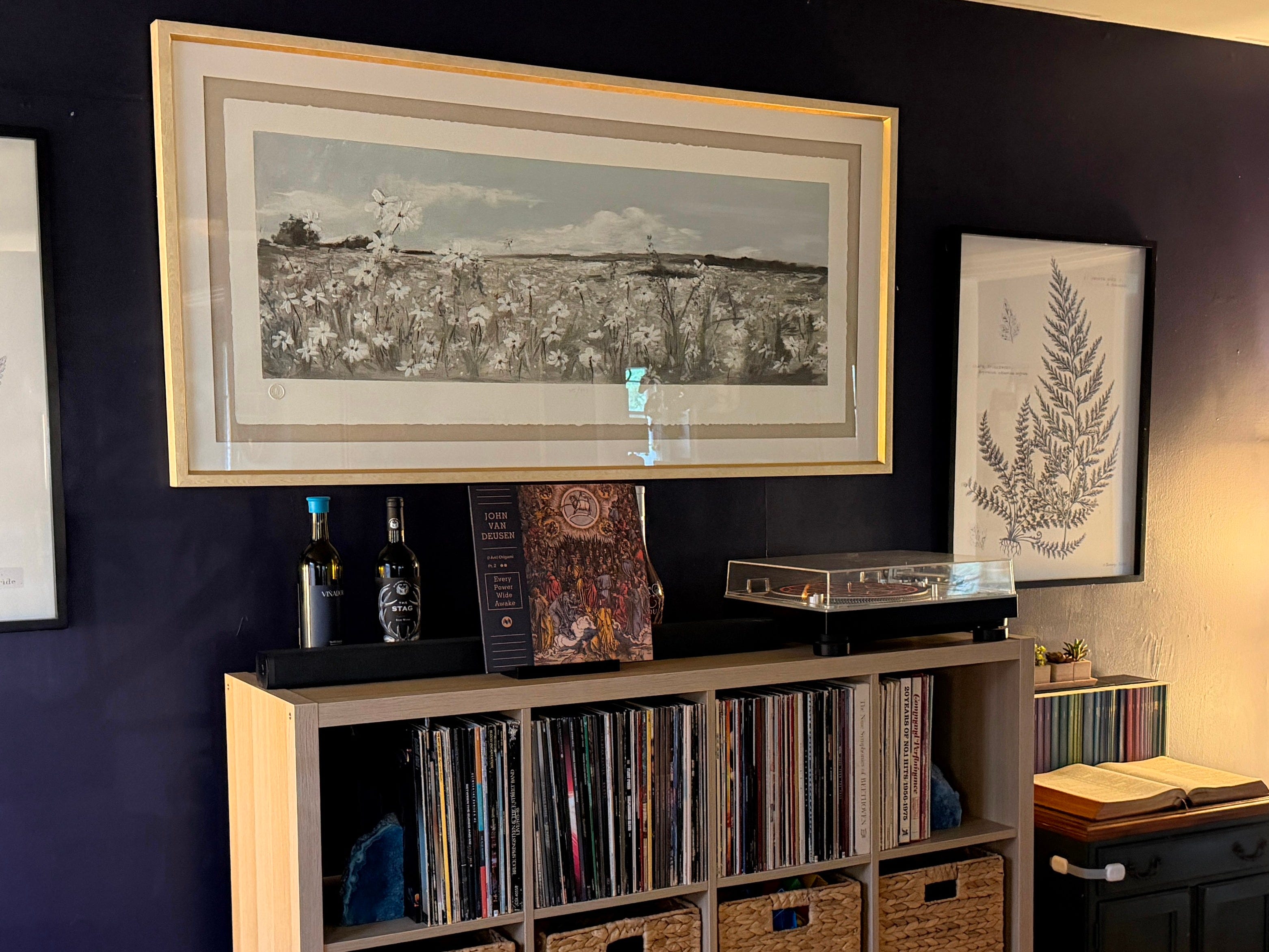
“What if we took the TV out of the living room?”
On a random Saturday in May 2025, Mel (my wife) asked if we could do something I’ve wanted to do for years. It was entirely out of the blue. I don’t remember what prompted her suggestion, and in the moment it didn’t matter. “Let’s do it” was my immediate answer, and a couple hours later the 55in TV that has ruled our living room and dining room since we moved into our house in 2019 was gone.
Both of us were living on screens, and had been for a long time. Both of our laptop-class jobs required it, but even in our marriage, our hobbies were screen-based. YouTube rabbit holes, binging Netflix, video games–when we were done staring at screens for work, we stared at screens to rest. That changed as Moses, our firstborn son, got closer to turning a year old. Because he spent all his time in the places we worked, he spent all his time in the places where the TV was on, and we could see his preference for toys and books collapse in real time. If the TV was on, nothing else was interesting, regardless of what was on the screen.
Neither of us wanted this for our son. We wanted our home to a place of speech, conversation, books, music, creativity, and fun apart from screens, but we couldn’t give our son something we first didn’t have ourselves. If we wanted a speech-centered home for our son, we needed to make a drastic changes in ourselves first.
What follows here is the story of the ups, downs, benefits, and side effects from that one decision. We couldn’t have seen the impact of this decision at the time, but a little more than a year later, we continue to see how that one choice led to a quiet new beginning for our family, our marriage, and us as individuals. And yet, the growth has sometimes been sideways and mixed with setbacks. When people make decisions like this, they’re not always prepared for the difficulties that come along the way. My goal here isn’t necessarily to convince you that you should also do the same thing, just to give you a realistic account of what might happen if you decide to give it a try. Getting to where we are now wasn’t easy, but we aren’t going back.
Right at the onset, I should be clear: we took the TV out of the living room, but we did not get rid of it. We relocated it to our bedroom.
For some of you, that may seem like a red line. It was for us for the longest time as well. In the nearly 8 years we had been married, we only had our phones in our bedroom. But in a 1200 sq ft house, you don’t have many options. My office consisted mostly of bookshelves. We certainly weren’t putting it in the baby’s room. That left our bedroom as the only remaining option. The goal was to get the TV out of the living room, not get rid of it altogether. Moving it to the bedroom crossed a red line, but it was necessary to make a bigger change.
At first, our habits simply followed us to a new location. That night, we laid in bed watching the first three episodes of Andor Season 2, as was our only real hobby as a couple at that point. While I worked in my home office, Mel relocated her work laptop to the bed and continued to watch hours of YouTube or random streaming shows. Moses, almost a year old at the time, was still fixated to the TV whenever it was on. Later that fall, after I changed jobs and Mel became pregnant, he started getting even more screen time in the bedroom. There was change going on underneath the surface, but you wouldn’t have known that at the time. Seeds of a new life were taking root, even as the weeds of our old habits choked the life out of them at first.
Meanwhile, in the living room, we left the soundbar behind. Practically, our bedroom (which isn’t even 6ft away from Moses’ bedroom) didn’t need a medium-end soundbar and subwoofer. My vinyl collection, on the other hand, still depended on it. Leaving the soundbar in the living room let us still listen to records, stream music I don’t own the record for (yet), and listen to podcasts. Shortly after, we added audiobooks to the mix: we spent many a morning and evening working through the audiobooks for the first Mistborn trilogy, which soon carried over into our drive time. This is the single biggest recommendation I can make to anyone who wants to take the TV out of their living room: get a good Bluetooth-enabled soundbar or some other speaker to keep in the room. Most people associate audio with a television, but you can separate the two out. Keep the audio even as you move the video out.
Lastly, we did not banish all screens from the living room or dining room. We continued to use our laptops and iPads on the couches and dining room table, to say nothing of our smartphones. This may seem like it defeats the purpose of making this change. Why take one big screen out of a room if you’re still going to use several smaller screens in the same space? Some of this was out of necessity. Again: both of us had (and still have) jobs that require a laptop, and in a 1,200 sq ft house, you don’t have many options on where you can do that work and keep an eye on the kids. But continuing to work with our computers and phones from the living and dining room actually led to one of the biggest insights I’ve had over the past year: the contrast between permanent and portable screens.
A permanent screen is exactly what it sounds like: it’s a screen that’s physically mounted to a wall, or so deeply embedded in an entertainment center setup, that it just lives there (and you only move it if you absolutely have to). It tells you where to sit and look, and commands your posture and attention. This would include TVs, but also desktop monitors or iPad stations. The size or quality of the screen is important, but it’s main role is that that it stays exactly where it is placed and does what it is supposed to do.
A portable screen is also exactly what it sounds like: it’s a screen that can be set up, taken out, relocated, put away. You tell it where to sit and face, and your posture and attention commands where it’s placed. Smartphones are the obvious example here, but so are tablets, laptops, and a Nintendo Switch. The size or quality of the screen is less important than a permanent screen, although portable screens now rival the quality of permanent screens more than they did ten years ago.
In taking the TV out of the living room, we did not banish all screens from the space. Our phones and computers are still present; I am writing this on my iPad on the dining room table before the kids wake up in the morning. But when I am done, I can put this screen away. I can put my phone away. I couldn’t put the TV away. And that one possibility, of being able to put away some screens while being forced to accept the existence of others, is more important than I realized.
Portable screens are not inherently more virtuous just because they’re, well, portable. The fact that you can take them anywhere is what allows us to keep staring at them everywhere. But portable screens give you agency you can’t have with permanent screens. Permanent screens demand to be used. It’s a giant 55” flat screen TV, who wouldn’t want to get their money and glory’s worth out of the thing? Portable screens also demand to be used, but they lack the embodied command the giant screen on your wall has–which means you have the ability to say no to the phone and say yes to something else.
By itself, taking the TV out of the living room wasn’t the biggest choice in the world. The short term change was minimal and, at some points, probably even regressive. But we wanted to create a speech-centered home for our family, which meant creating the kind of space where that kind of home could arise. This one step did not immediately change our lives, but it created the possibility for our lives to be changed.
Which is exactly what happened.
Without a permanent screen, movable screens now orbit around a screen-free center of gravity. Within that new center of gravity, things that used to have to compete with a permanent screen now have the chance to become interesting, and over time, those things become habits that stick. Books, magazines, MagnaTiles, the Yoto Player, and other toys and activities no longer have to fight against the appeal of a permanent screen, and have now become the core activities we do as a family when Mel and I aren’t working. Our prayer lives are the strongest they’ve ever been, as is our ability and yearning for just sitting in quiet or talking together to one another. Regrettably, our book budget has also exploded, and our need for proper bookshelves becomes increasingly urgent–but that’s a good problem to have, especially when your oldest son wants you to read hundreds of pages a day.
Some meaningful things were lost in this move. Hosting watch parties for sports games or movie nights was something I truly enjoyed doing and is no longer possible. Both of those are good uses of permanent screens. They’re meaningful ways of hospitality that bring people together. But even this has forced us to learn new ways of practicing hospitality. We’ve had to learn new ways of welcoming people in our homes where a screen can’t do the heavy lifting for us. I’ve contemplated a smaller TV that I could set up to watch the Chiefs or take my friends through the criminally underrated four-part Russian War and Peace adaptation, but I’ve not decided yet. Dinner parties, game nights, and vinyl listening sessions are more than enough for now.
Maybe!
Be honest: what is the worst that could happen? The initial shock could be severe, especially with young children. I acknowledge that. But think about the big picture, long-term trajectory and ask yourself: if we did this, what is the worst thing that could happen? To you? To your marriage? To your kids? I can’t answer that question for you and your family specifically, but I would encourage you to just ask the question and consider it. You may be surprised at the answers you find.
New destinations begin with small steps. Paradoxically, those steps are often the hardest. But once you get on the road, it’s easier to keep going. Taking the TV out of the living room did not single-handedly change our lives, but a little over a year later, our lives are almost unrecognizable from before. If you want a change in your family, perhaps consider starting small–just put the family TV in a different room–and see what the Lord can do from there.
Thanks for reading Passing Through Digital Babylon! This post is public so feel free to share it.
Thanks for reading. I have a slate of new articles in the hopper that I am excited to chip away at. There is not a consistent release schedule planned for these, so please subscribe so you don’t miss anything.
One future piece of news: I will be at the THINQ Summit 2026 in Nashville on Oct 1-3 representing What Would Jesus Tech?. I’m excited to join Carmen LaBerge’s entourage and looking forward to good conversations with the others in her group. If you’re planning on being there, I would love to connect. Shoot me a DM and let me know.
Together, we are passing through Digital Babylon.
Austin
No posts
Comments
Nothing yet. Say the first thing.
Sign in to join the conversation.