
Last Friday, my wife Melissa and I welcomed our daughter Miriam Jane Gravley into the world. I wrote a Substack note about how well it went compared to when our firstborn son Moses was born in 2024, and I would commend Bonnie Kristian’s recent piece in Christianity Today about birthing centers, where I was happy to provide a father/husband’s perspective. But, in short: Mel and Miriam are both doing great, and Moses loves his little sister.

I am accepting that newborn sleep-deprived delulu is setting in, which is causing me to punt on the piece I intended to write this week (or perhaps pitch it to a proper publication). Instead, I want to write about coffee and AI. I know those two things don’t normally go together. Maybe they don’t and I shouldn’t write again until after I’ve slept some more. But I think there’s something here. You be the judge.
Miriam was due on April 4. The next day was Easter Sunday. For Lent, I decided to fast from coffee. I recognize that does not make me a very good Presbyterian, and in this instance, I do not care. It was a good and necessary fast, and I am thankful for the Spirit’s work in my life through it. But, since even the holiest of fasts are tainted with sinful motives, there was a pragmatic angle as well: whenever Miriam was born, I wanted coffee to be helpful again. I was drinking too much on a daily basis. I was twitchy and irritable. Instead of a helpful boost, it became a new baseline to get through the day. Coffee addiction gets a wink and nod in evangelical circles when it ought not to, and I was verifiably addicted.
For the past several years, pour overs were the primary way I made coffee at home. But last summer, facing a potential financial downturn, we bought a basic coffee pot and switched to pre-ground bulk coffee from Sams. We started small. We kept it to one cup per person a morning just like we had with a pour over. But then it became two cups. At some point it became three. Mind you: this was just at home. This was not counting coffee at the office or local coffee shop. By the time the day was over, I could’ve had anywhere from three to five cups–far too much caffeine for one day.
Halfway through Lent, I connected a very important dot: the coffee pot did not encourage restraint. Its very design nudged me to one more cup, one more cup, just one more cup. And if I wanted to get my coffee consumption under control, I had to get rid of the coffee pot.
But the coffee pot isn’t an addictive substance, you may be thinking. No, it isn’t. It’s a delivery mechanism, a means to an end. But two sides are necessary to make a coin. Coffee–be it beans or ground–doesn’t become drinkable until you’ve brewed it. To do that, you need something to brew it in, and not all brewing methods are created equal. Some brewing methods trade quality for quantity. Others emphasize quantity to the point quality is optional. A coffee pot maximizes quantity and, by design, finds its greatest joy in making lots and lots of coffee regardless of how good it actually is. No, a coffee pot is not synonymous with caffeine, but it is synonymous with “as much caffeine as you want.”
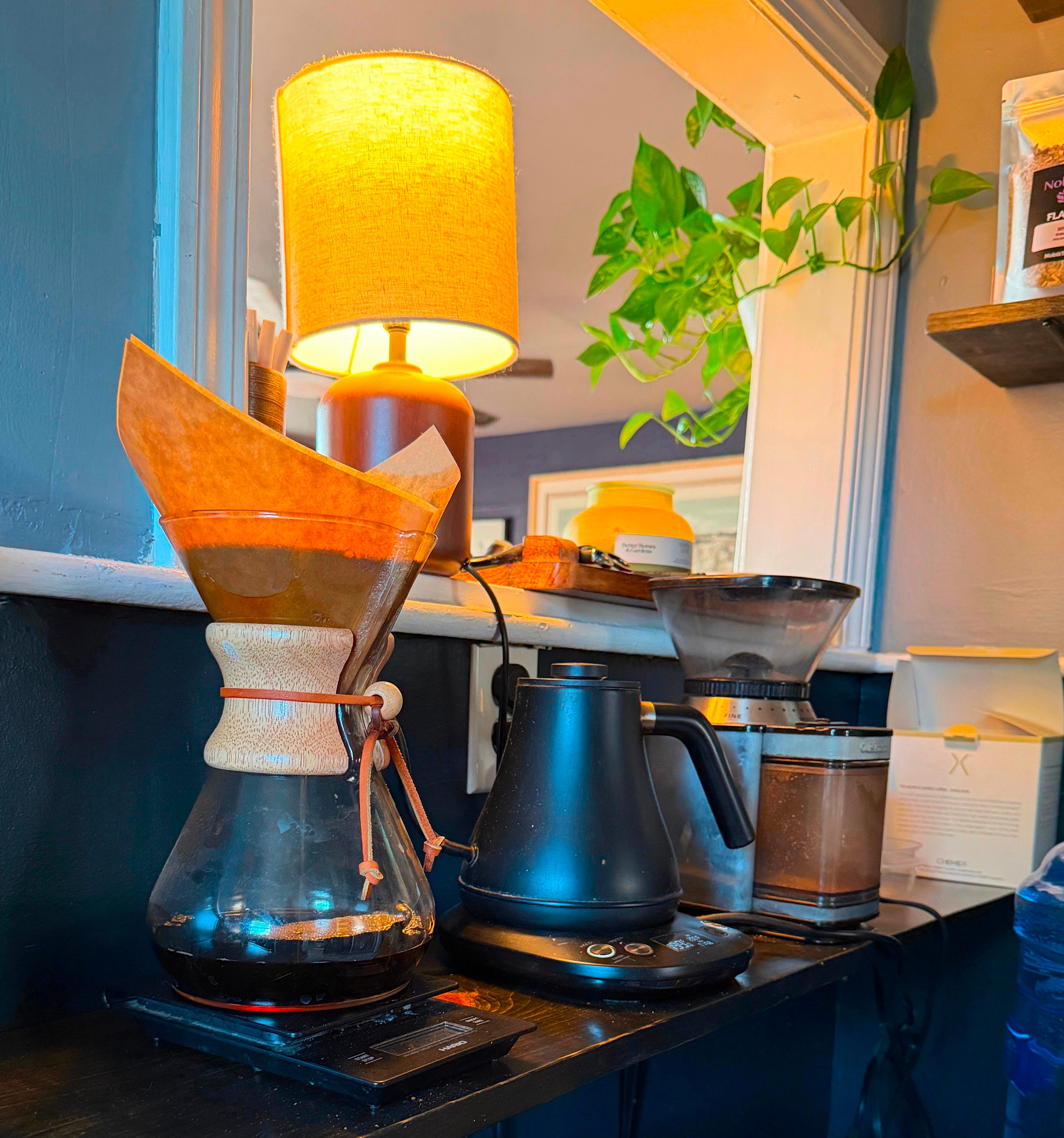
Pour overs are inconvenient. To do one right takes about eight to ten minutes from start to finish. With a one-week-old and a soon-to-be-two-year-old, making a single cup (either for myself with a Kalita or for Mel and I both with a Chemex) feels like an irresponsible waste of time. But the friction is a safeguard. With a coffee pot, I can brew six or more cups in ten minutes. With a pour over, I can only do one or two in ten minutes. If all I have is ten minutes, all I get is one cup. I only need one cup. Pun intended, the grind of making a pour over gives me only what I need and nothing more.
AI is a coffee pot. Whether it’s a chatbot or an agent, it does not encourage restraint. Its very design is to nudge you to one more prompt, one more question, one more hit to your desire to not have to read that thing your friend sent you or crunch some numbers you don’t want to look at or write an email you’re dreading having to send. Before you know it, that one time you helped yourself to AI assistance on your thinking and creating now becomes every time. You used to be able to get by with just one or two requests, and now you risk an AI-withdrawal headache on the first day of going without. Nobody willingly chooses addiction. Nobody willingly chooses to deskill themselves or develop AI psychosis either. The design has an end, and the end is getting you and keeping you hooked.
But AI isn’t an addictive substance, you may be thinking. No, it isn’t. It is a delivery mechanism, a means to an end. But unlike coffee, the ends contain multitudes and they’re not created equal. The only common ground the near-limitless uses of AI share is the promise of getting something that you want or need much quicker than you would if you did it on your own. To do that, you need something to brew what you’re after, and not all brewing methods are created equal. Some brewing methods, or ways we work, trade quality for quantity . Others emphasize quantity to the point quality is optional. AI promises both. Sometimes it delivers both. But if it can’t deliver both, like your favorite coffee pot, AI finds its greatest joy in giving you as much knowledge or grunt work as you can give it regardless of how true that knowledge is or good the work being done. No, AI is not synonymous with an addictive substance, but it is synonymous with “as much of this as you want.”
This analogy is not perfect. Sometimes you do need a coffee pot. For just my wife and I, a twelve-cup pot is overkill. But for a breakfast, book group, or game night with half a dozen people? You bet I’m bringing the coffee pot out of the closet. I’ve been thrilled at how Claude Cowork has taken some ministry admin busywork (the kind most writers writing about AI are unaware of unless they’ve been in vocational ministry) and given me back several hours to pray Evening Office and read Bavinck with consistency. Coffee pots are great when you genuinely need a lot of coffee. AI is great when it truly can save you hours of tedious inhuman machinework that you can reinvest elsewhere. The good and proper use of a thing does not justify its misuse, but the misuse of a thing does not negate the good and proper use of a thing either.
Not all inconveniences are aesthetically pleasing. Even if inconvenience results in better quality, aesthetic inconveniences are certainly not morally superior as to be a conscience-binding law. Efficiency for efficiency’s sake–and inefficiency for inefficiency’s sake–are equal and opposite ditches of poor stewardship. There is a time and place for both, and sometimes you do not get to choose. Countless Americans today are experiencing the equivalent of having their entire vocational futures judged by how much coffe–I’m sorry, how much AI–they can incorporate into their roles. A lot of them hate it. Use does not always indicate approval.
But insofar as you do get to choose, efficiency has its side effects. The path of least resistance shortchanges you in moments where additional time and effort yields deeper rewards. Moses is fascinated watching me make coffee now. He loves getting his little kitchen-stand-stool and bringing it to the coffee bar and watching the coffee drip into carafe. The friction and inconvenience of it all that goes into a pour over creates curiosity and wonder that the coffee pot never did. So it is with all our human endeavors of thinking and creating. It takes longer. It’s messy and imperfect. You may even make mistakes and have to start over. But when the work is good, human work, there are intangible benefits that efficiency cannot replace.
Thanks for reading. If this is nonsense, please just say so. If this is pretentious millennial hipsterism disguising itself as an attempt at meaningful thought, also just say so. You’ll never take my ever-growing vinyl collection from me, but I’ll gladly hand over my bad takes.
Remember: together, we are passing through Digital Babylon.
Austin
No posts
Comments
Nothing yet. Say the first thing.
Sign in to join the conversation.