
Edu Montoya and Lidia Anaut are a couple of musicians with a different take on the traditional record shop. In the Sant Antoni neighbourhood of Barcelona, with its long commercial tradition around the famous market and a growing number of record stores nearby, they’ve built something a little different.
The “Cultura Take Away” concept goes well beyond a shop. In their kiosk and the concept store they opened last year, they sell new and second-hand vinyl, music books, graphic art, clothing and gifts made by Barcelona-based artists. It’s a space where local artists can show their work and the neighbourhood community can enjoy it outside the cold, silent walls of a gallery, right there on the corner, and take it away with them.
We sat down with Edu and Lidia and talked about their story, their musical inspirations, the philosophy behind the shop, and their plans for the future, including their own take on one of the most beloved concert formats.
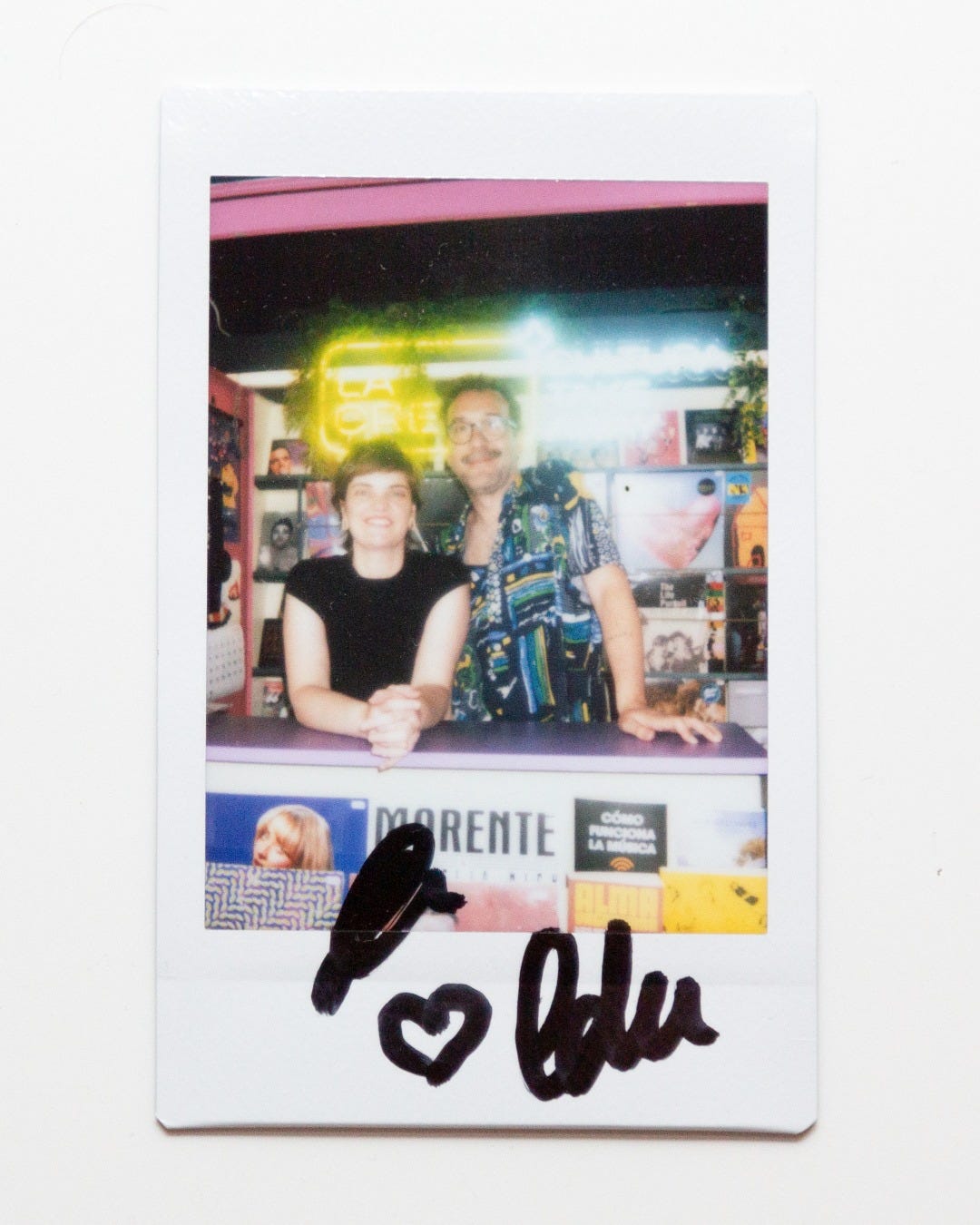
Can you tell us a bit about your backgrounds before the shop? Do you also have your own music project?
Edu: We came from a different world. We were more on the consumer side of what we now sell, not serious collectors, though we had our own small collection of records and graphic art. I studied Art Direction and worked as an art director and designer.
Lidia: I came from marketing. A completely different world.
Edu: Our music project is called Tú no existes. We had other bands before that too. So we knew the ecosystem: distributors, labels, management, music press, but always from the artist’s side, as musicians.
And you’ve also pressed your own vinyl, right? How have those experiences shaped the philosophy of the shop?
Edu: Yes, we have a 7”, the band’s first single, called Carl Sagan, barely any copies left. One is at home and the other day I saw one floating around on Discogs. We also put out the first LP on vinyl, called Tercera República.
Knowing the industry from the other side, you meet more local bands. Ten years of playing venues here in Barcelona, meeting people from other record shops, you end up getting to know the local music scene quite well.
And that shows in what we stock. We really focus on projects we know personally, records we think represent our generation in Barcelona.
You used to try to get your own record into shops. Now do local bands come to you wanting to put theirs in here?
Edu: Yes, and actually one of the first things we tried was reaching out to local labels. We were surprised to find we had to go through distributors to get records from Barcelona labels.
We thought it would be simpler: go directly to the label, we even knew where their office was, and just say we want this record. But in some cases they told us that’s not how they work, it had to go through a distributor. In the end we did manage to work directly with local labels, which is what we wanted.
And do artists come to you directly as well, records under their arm? How does that compare to working with distributors?
Lidia: Yes, it’s happened. It always means a lot to us when someone wants their records here. They come in, leave them with us, and we see how they do. With distributors it’s I guess a bit more corporate.
Edu: There’s a middleman, which is normal. Music is a business at the end of the day, and distributors do their job. Especially the local ones, who usually work with smaller bands, that’s all fine. We’ve never really run into a situation where we wanted to bring in a local band and they were on Sony or something like that. We haven’t gone after those, that’s a different scale entirely.
What bands or records from your teenage years have influenced what you stock?
Lidia: Oasis, without a doubt. I think they left a mark on both of us. There’s always something of theirs here.
Edu: Yes, and our cats are two brothers called Liam and Noel. And then there’s Sidonie, a Barcelona rock band who have been a constant reference for us since we met. They have a song called La Crema, which is one of the reasons the shop is named that.
And something I realised not long ago: the vinyl collection we have in the shop looks more like our CD collection at home than our vinyl collection. Artists like Lauryn Hill, Lenny Kravitz, Lori Meyers, things that weren’t even released on vinyl at the time and that we have here now because we think they mattered to a generation, to a big part of our audience, who are more or less our age. Almost every record we have is one we actually like. We don’t have the volume to afford stocking things we don’t believe in.
Lidia: A big part of the collection we could just as easily have at home. It’s our musical background, our history. And here we keep discovering new things too, talking to customers, getting into musical territory we hadn’t explored before. Those discoveries end up becoming part of the collection as well.
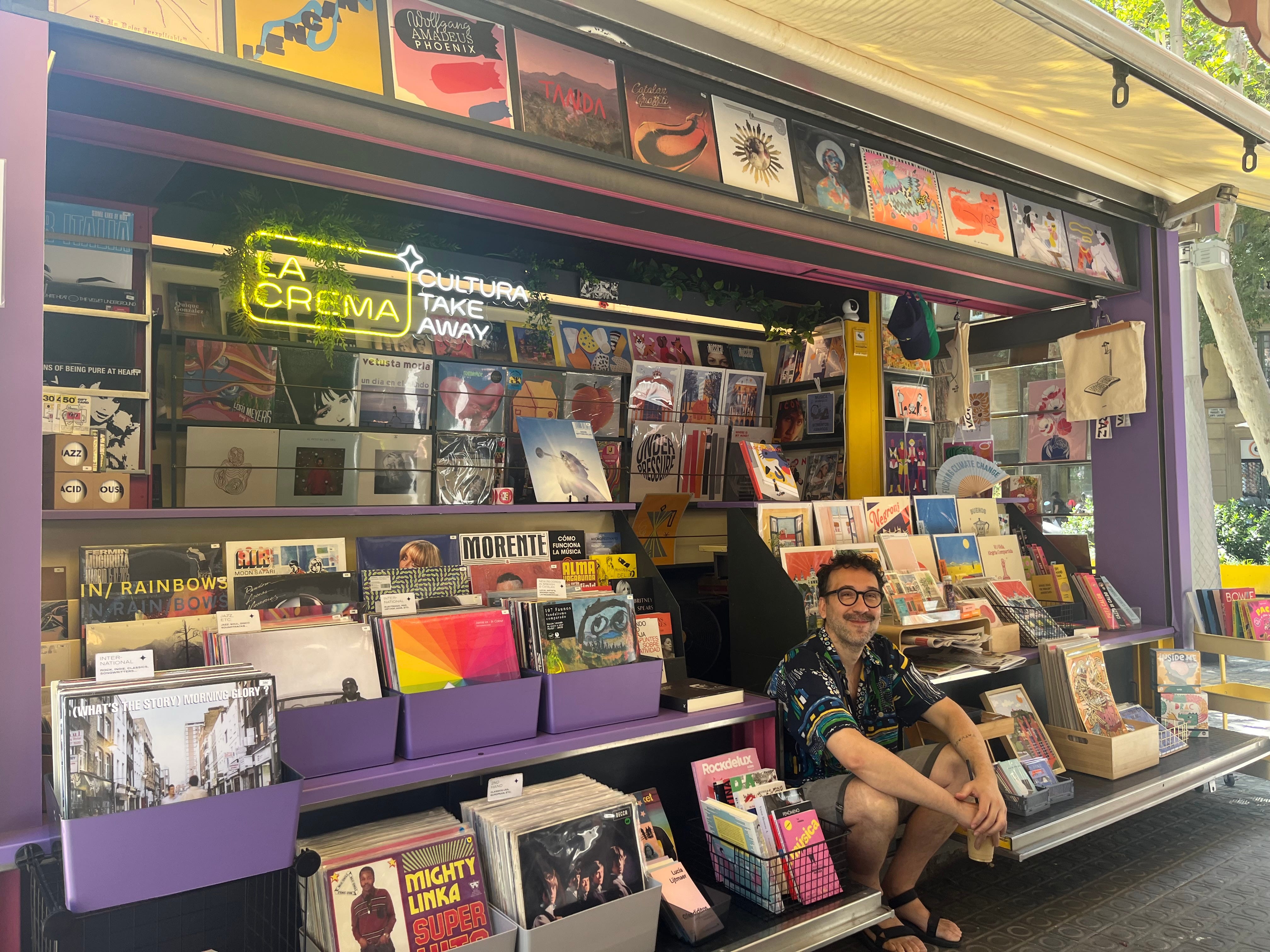
The kiosk was previously occupied by Lost Format. Do you see this as an evolution of what they did or something completely new?
Edu: An evolution, without a doubt. They started selling records here, we took that idea, pushed it further and made it our own. We’re still in touch with them from time to time.
Lidia: And then we added other parts of the business: local art, books, comics, clothing, local brands. We expanded it and diversified it at the same time. The idea of using a kiosk as a retail space was something we’d been thinking about for a while, we’d imagined it before. And the other side of the business was also something we’d had in our heads for a long time. The vinyl part came a bit by chance: it was there, it fit with everything we wanted to do, and it came together very naturally. Ideas we’d already had that suddenly found the perfect home.
When did the idea of expanding with the shop come about?
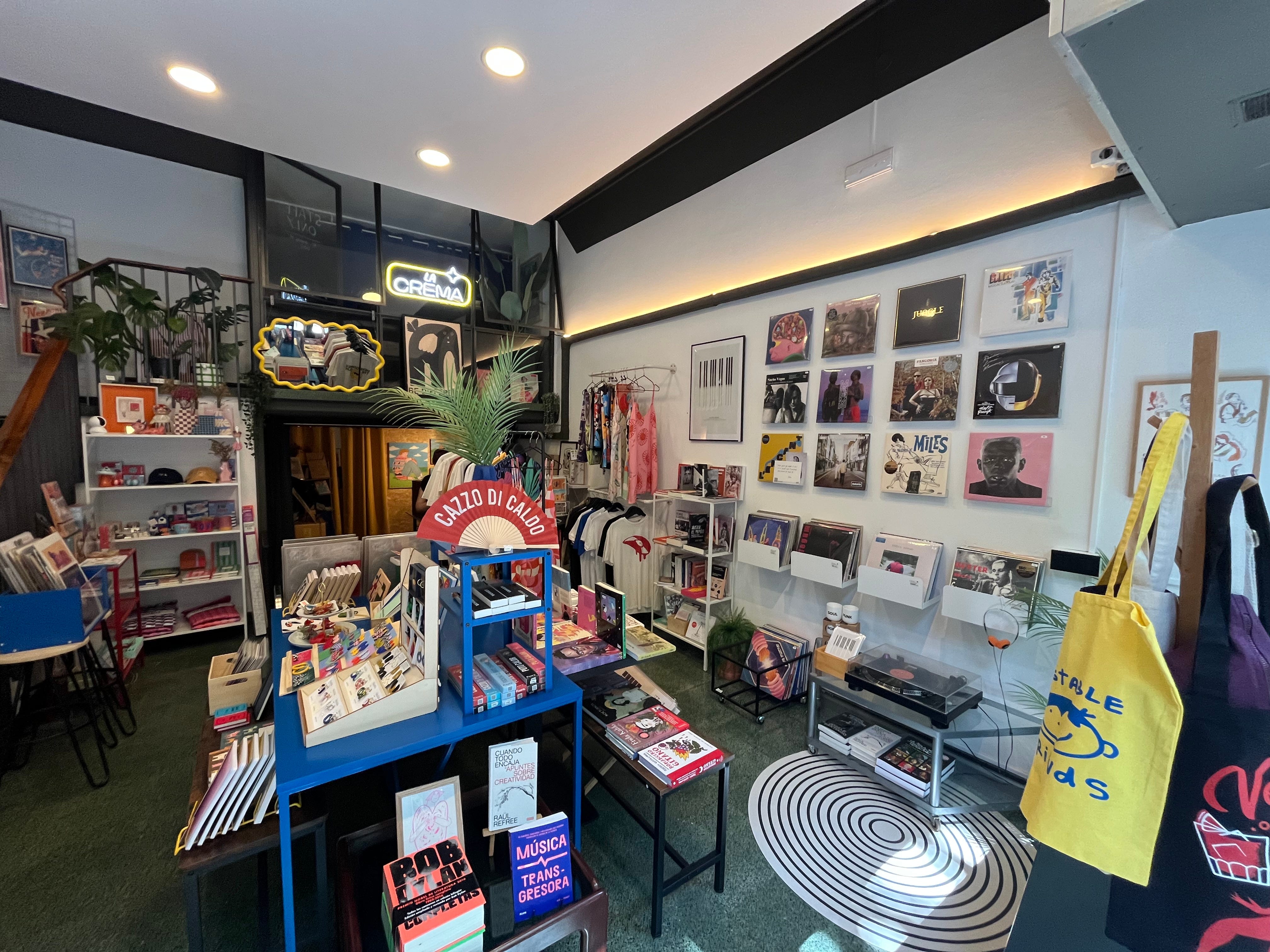
Lidia: The kiosk started in September 2024, and a few months later we were offered the space next door. The idea of having a space with a gallery was already in our heads, but maybe the timing wasn’t quite right yet. Even so, the opportunity was there, everything lined up, and we went for it. The shop has been open a year now and it’s ten steps from the kiosk. The two spaces feed off each other.
Edu: It’s a way of making the two businesses work together. The kiosk acts as a street-level window for what’s in the shop. Sometimes people are surprised and think it’s a pop-up, when actually it came first. The other one came later, and it came quickly. It was an opportunity and we took it, but it also multiplied the workload. Suddenly you go from working in an office to running a kiosk, and in less than a year you’re opening a shop from scratch. It was a lot, very fast.
Lidia: And it was also a question of space. Here in the kiosk, without somewhere to move stock around and store more things, everything gets very limited. The shop gives us that extra room.
Edu: Right, there we can have a turntable to test second-hand records, larger format graphic art, things that are hard to keep out on the street. The kiosk has its advantages, but quite a few drawbacks too.
Is there synergy between the products? Does someone who comes in for vinyl end up buying a print, or the other way around?
Lidia: It’s interesting, it goes both ways really. The goal is for everyone to find something, whether for themselves or as a gift. Some people come in for vinyl and don’t look at anything else, others browse both sides, and sometimes whole families come in where one goes to the records and another to everything else. And it’s not always who you’d expect crossing over.
Edu: Or the other way around, some people don’t even notice the records. The vinyl buyer is a small percentage of the population, which is why building loyalty matters so much. We’ve managed to get regulars who come back to check new arrivals, ask for recommendations. And we put a lot of work into which record to bring in, what idea we’ve had, something the customer maybe already knew but suddenly sees here and thinks: damn, this record. That’s our job really.
Lidia: And those same regulars sometimes come back for other things, a gift or something for the house. The regular customer ends up buying from the other side too.
Edu: And there’s a deeper synergy as well. The visual art world and the music world are very connected: illustrators who do album covers, artists who design posters for bands, people from publishing who are friends with people from labels. It’s a world of shared interest where the people making the art are also the audience for it. For us, coming from the music scene makes that connection feel very natural.
Lidia: For us they’ve always been very connected, and I think for a lot of people too. The whole visual art world is closely tied to music. That’s why it feels so natural to us, because it always has been.
I can see people walking past and saying hello. How’s the connection with the neighbourhood?
Lidia: Funnily enough, Edu and I had already crossed paths in Sant Antoni years ago through work. It’s a neighbourhood that works really well for this kind of business. It’s bohemian, lots of movement, lots of people coming for a drink or to meet someone. But it’s also very much a neighbourhood, and it’s the locals who make our day to day, the ones we get to know as they pass by the kiosk.
Edu: There’s a long commercial tradition here, it’s one of the Barcelona neighbourhoods with the most rooted business community. And you can feel it. The nicest thing has been that the neighbours have watched us grow. When we opened the shop we weren’t new faces, they already knew us as the kiosk people. That helps a lot: for a niche business to get that kind of welcome, from all ages, from people who’ve been in the neighbourhood for years and watched you deliver newspapers for a year and a half.
Lidia: We’ve got to know a lot of people on a personal level just from being here.
Edu: We’ve started watching kids grow up and older people getting older. It has its sad side, but also some very beautiful things.
And does that neighbourhood community become customers too?
Edu: Yes, both, for records and for the shop, maybe a bit more on the design and graphic art side. These are the people who end up trusting you as a shop. And I think there’s a gesture of support in it: I’d want a shop like ours in my neighbourhood, and I’d try to support it.
What about Barcelona as a city? There’s another record shop that opened up last week.
Lidia: It feels like vinyl keeps growing. Maybe it’s a moment and then it drops off, who knows. Hopefully not. The older shops have been holding on for years, that says something.
Edu: It should at least hold steady, which is already a lot. I believe in that, because vinyl has always been there. Even in the worst times, when CDs took over everything, there were people who never sold their collection and kept going to shops. It’s a niche that’s growing right now, but if it stops growing I think it’ll stay stable. It’s something that doesn’t die, that’s our view and that’s why we’re in this. And in the end people are looking for authenticity, they’re looking for the experience of going out, talking to someone.
Lidia: Going out to see what’s new, asking for recommendations, digging through the crates. The experience of coming to buy in person is something the internet doesn’t give you. I think that’s what’s kept a lot of people coming back.
Edu: And being a bit limited also has its value. We’re overstimulated by infinite choice. Sometimes you just need to limit yourself, for your own sanity.
Increasingly so with the world of algorithms. I’ve heard you describe your philosophy as the antithesis of Spotify.
Edu: Yes, there’s no company behind us paying us to recommend a record. Everything is organic. And I think you feel that in the buying experience too. In some shops you can feel judged, like the person serving you is a high-level expert and you’re not meeting their standards. Here we talk about everything naturally, no judgement. If there’s something we don’t carry, like Hard Rock, it’s simply because it’s not a genre we know well. But that naturalness and that human quality is what I think sets us apart from the platforms.
Finally, what’s the vision for the future? Expansions, events?
Lidia: On the events side, we’re doing concerts here at the kiosk. We did one with Carlota Flaneur, there's another this weekend for Día de la Música, and another in July. We want to do our take on Tiny Desk.
Edu: We’re calling it the Kiosk Tapes. In July we have KIW, a jazz trio, and this Sunday Vicente from Sax Lab is coming, a saxophonist. The idea is to make it a recurring event. And in the shop, we launched a podcast, want to start the vinyl listenings, keep going with the graphic art exhibitions, which often come with DJs. Everything feeds into everything else. Up to now we’ve been more in survival mode as a business, putting on events sporadically. The idea now is to turn all of this into a stable cultural circuit.
It's hard to believe a space this small can hold this much culture. Edu and Lidia have turned a street corner into a cultural experience, and by the time I'm finishing this piece they already have another exhibition on. If you're coming to Barcelona, don't miss La Crema Kiosk.
Bonus 📹
Before the interview, I asked Edu and Lidia to pick their 5 favourite records from the shop. Here's their selection:
No posts
Comments
Nothing yet. Say the first thing.
Sign in to join the conversation.