
I’ve been in enough postmortems to know the strategy usually didn’t fail.
The foundation did.
Across companies and roles, I keep meeting three types of people. Only one tends to be recognized. The difference between teams that stall and teams that ship is whether leadership sees and supports all three.
Here is a quick overview so we can dive into tackling the gap.
1. The Strategist (aka the one in the meetings)
Sets direction and owns the roadmap. Runs the offsite and alignment sessions. Their work is celebrated.
Consequence: orgs over index on strategy work and assume execution rises or falls with the strategy. Reasonable and usually wrong, especially given AI’s rapid developments.
2. The Executor (aka the one in the sprint)
Ships. Hits OKRs. Keeps the trains on time. Their output is easy to measure.
Speed is value, but speed needs a well paved path. Someone has to lay the road while the car is moving.
3. The Keeper (aka the one keeping it together)
The person who keeps the system coherent. They carry context, spot second order effects, and design for survivable pivots. They know today’s “bold” API choice will be unwound next quarter and build so the change won’t destroy the roadmap.
They’re praised in hallway conversations, missed in promotion cycles, and invisible to dashboards. Yet they are the actual structural integrity of the organization.
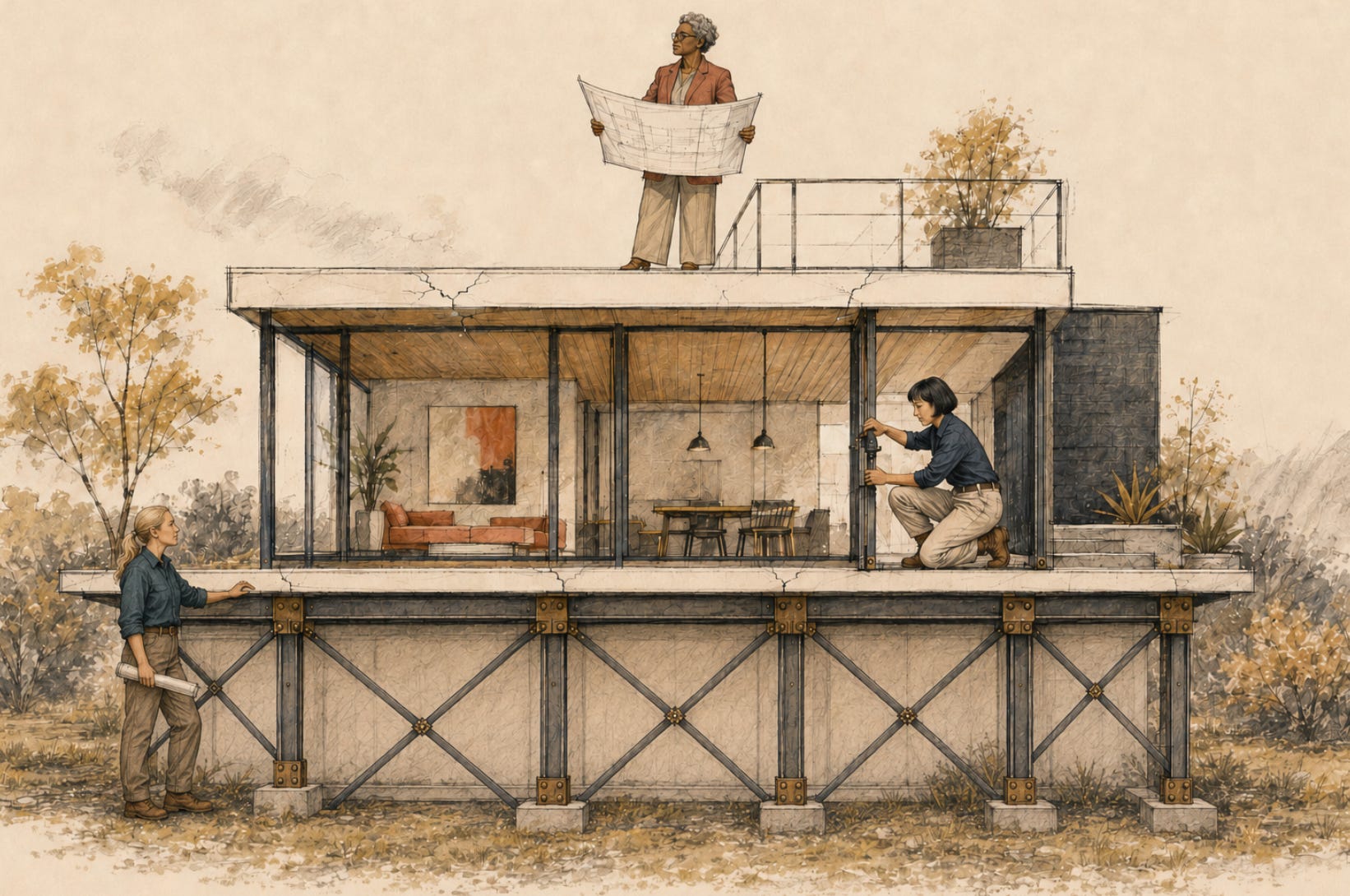
Rob, a client at a large cable provider, heard his CEO say: “If it’s just cracked, we’ll polish it and keep going. That approach doesn’t work. It doesn’t get us to where we need to go.”
Rob translated. The CEO wants to throw out the foundation (again), as he doesn’t believe it can support (another) strategy pivot.
In five years Rob has watched strategies come and go. If you rebuild the foundation for every pivot, nothing ships. So he designed a flexible base (e.g. services abstracted to support multiple LLMs) so a direction change is a switch, not a sledgehammer. A year later, leadership finally caught up. The work held, because Rob designed for reversibility, retained context across pivots, and had already considered constraints vs. cost of change to keep himself honest.
If you’ve seen a “perfect” plan fall apart on contact with reality, you’ve seen a missing Keeper. Strategist + Executor design for ideal conditions (e.g. clear direction, clean handoffs, no baggage). That’s not reality. Conditions shift. Keepers design for the shift.
Look for behaviors, not titles.
They design for reversibility. Two-way doors over one-way bets.
They carry “why” across teams, time, and channels. People ask them “what’s the reality?” and they answer.
They pre-commit to AI guardrails that future teams will thank them for: versioned prompts, evaluation gates, human oversight, and rollback paths.
They name the real tradeoff and put in a plan so you can reverse without drama.
They think about of “cost of change” and plan for pivots before they happen.
Anti-patterns that hide Keepers:
“Glue work” relegated to performance review footnotes.
Senior ICs turned into de facto project managers.
Promotions tied only to launches, not to avoided disasters.
A flexible foundation isn’t loose. It’s a bridge with expansion joints. A solid span that flexes with heat and load without breaking.
Here are practical steps to support all three roles:
Make it a role, not a rumor
Name the work, acknowledge it covers architecture owner, migration lead, and context keeper.
In every team, ensure you have all three: one obvious Strategist, one clear Executor, one trusted Keeper. Rotate to avoid burnout.
Ensure IC/manager parity
Create a dual path for ICs so Keepers don’t have to become managers to be valued.
Publish career ladders with compensation bands where Staff/Principal ICs match Managers at equivalent levels.
Measure what survives
Track “cost of change” (time to revert, time to deprecate, users safely migrated).
Reward avoided incidents and smooth pivots alongside launches.
Wire it into rituals
Add “what breaks if we pivot in 90 days?” to discussions.
Keep a living “why” doc, spot, or channel that outlasts reorgs and OKR cycles.
As you go about your work this week, consider ways you can acknowledge and support Keepers. Here are a few questions to get you started.
Who absorbed the last pivot and did we recognize it?
Where is “cost of change” quietly killing speed?
Where are we taking one‑way door bets without a reversal plan?
If our top Keeper left tomorrow, what would actually fall down?
Strategy can be rewritten. Foundations take years to regrow. If you want plans that survive contact with reality, find your Keepers and respect their value.
Which role do you think Lancaster might fill?

P.S. If you found this helpful, share it with a product friend. If you’re not subscribed, join us! Here are other ways to connect.
Reach out over LinkedIn: Diana Stepner
Curious about coaching? Let’s talk.
Comments
Nothing yet. Say the first thing.
Sign in to join the conversation.