
A New York Times writer observed something about AI search that is stuck in my head.
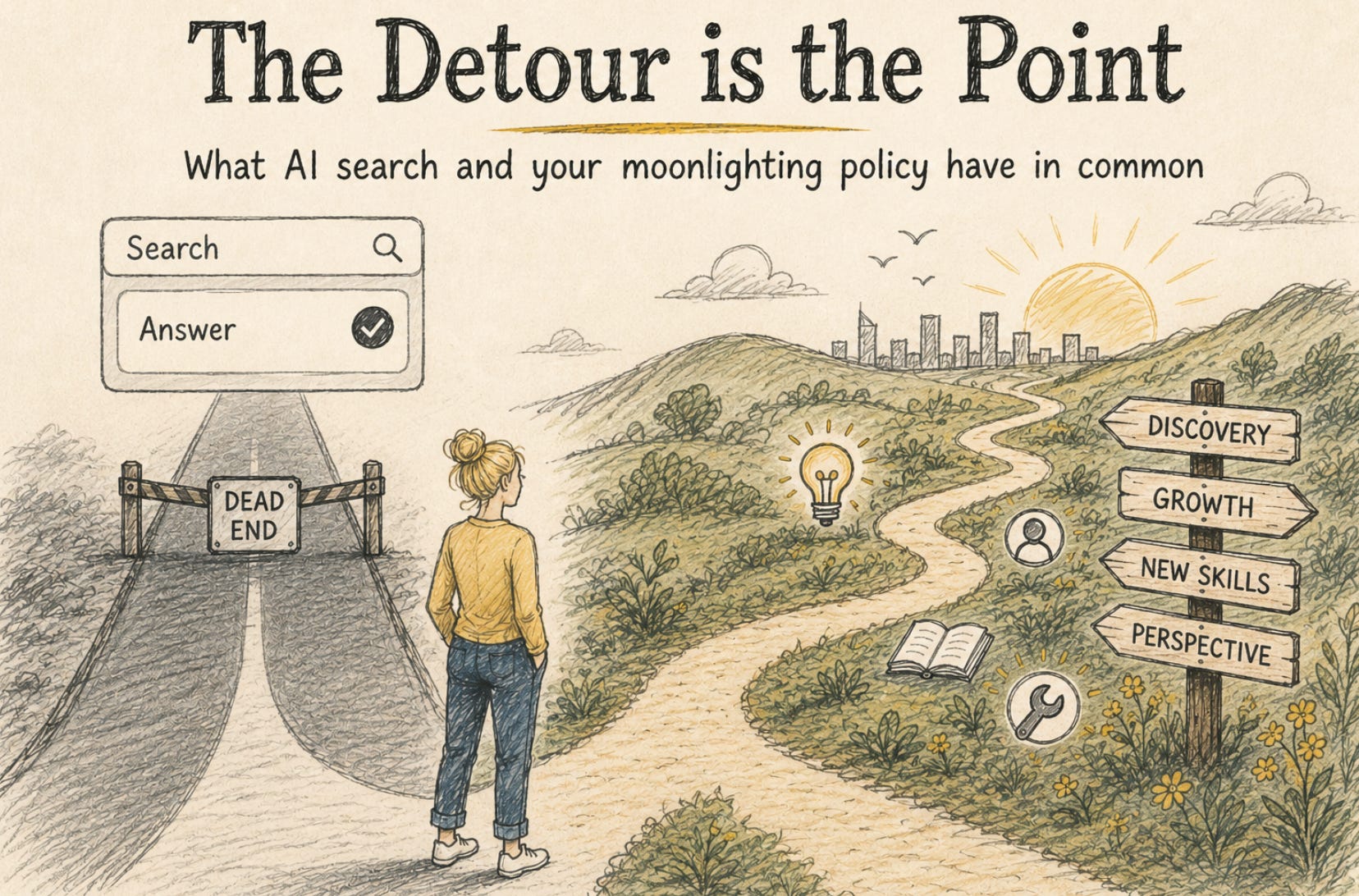
Our tools are treating the space between question and answer as time to eliminate. But that space, the unplanned discovery and things you find only because you weren’t looking, is where most learning happens.
You used to search for one thing and stumble onto five. Now you search and get exactly what you asked for. Nothing more. The learning detour is removed.
I keep thinking about this in the context of banning of side projects, something I see frequently in my coaching practice.
Often when a leader bans outside work, they’re focusing on attention and commitment. Valid concerns to have. I coach ambitious product leaders who believe the people who fully commit are the ones who create something remarkable.
I also coach their teams.
Leaders most anxious about divided attention often already have it. They just don’t realize it. They’re so focused on protecting output, they’ve stopped tracking growth.
That’s the same mistake as the AI search tool. Optimize for the answer. Eliminate the detour. Lose the discovery that makes the learning stick.
A recent Harvard Business Review article cites a Frontiers in Psychology study of 324 employees. Moonlighting predicted higher engagement, not lower, for people motivated by autonomy and mastery.
One note, if someone’s taking a second job out of financial desperation, that’s a signal about the primary role, not the policy. For people chasing challenges outside work, the side project feeds them. They gain energy, sharpened skills, and new perspectives.
The research found that the leaders of the best-performing teams were more likely to support employees’ moonlighting because their people believed the leader supported their growth even without immediate work payoff.
That insight is key. The best leaders invest in people beyond what they can extract.
Anna is one my coaching clients. She deliberately took a step back when starting at a new company. The less intensity gave her more room to breathe after leaving an intense startup and bandwidth to build something of her own.
She learned agentic coding by building, not reading. When her company explored AI features, she could walk her team through her discoveries. Anna learned to find early users and test distribution models, even when it didn’t come naturally. She didn’t just share concepts. She explained the friction and frustrations, especially what works.
None of that was in her job description.
When I asked what the side project had given her professionally, she said: “I showed people at work, look, I built this by myself. That creates credibility and shows they can be builders too.”
She walked through the detour and came back stronger for it.
Conflicts of interest are real. A blanket moonlighting ban sometimes starts with a legitimate incident, and that’s understandable.
I’ve noticed a blanket ban doesn’t address what’s actually happening. A burned-out employee will burn out whether or not they have permission to moonlight. Their stress is already signaling something else is wrong. A poached employee leaves because the primary role didn’t satisfy them. And IP theft? That’s a contract issue, not a moonlighting issue.
What a blanket ban does do is signal something to your team. It says, “I only value you when I can see the output.” It’s the same efficiency mindset as the AI search tool. And, congrats, you’ve just eliminated the ambitious person’s reason to stay.
Companies that have set aside the policy tell a different story. HubSpot encourages employees to build side projects to understand entrepreneurship. Keap gives every employee a free software license to run their venture. A Minneapolis agency called Haberman gives people $1,000 and three paid days off a year for outside interests, as their founder believes it’s bad business to limit an employee’s interests.
Imagine that, believes it’s a bad business decision to limit an employee’s growth!
Here are a few scenarios to consider. If your situation isn’t covered, reach out and we can explore it together.
If you lead a team: Ask whether your people are doing side work due to lack of growth in the role. If yes, the policy isn’t the fix. It’s the environment. If they’re chasing challenge because they’re ambitious and curious, support it. You’re not losing them. You’re keeping them.
If your team’s performance is slipping: Did the side work start because they were bored, or did boredom start afterwards? If the former, the role is the problem. If the latter and they’re neglecting their job, be direct. “Work requires your full attention. We need to pause the side project or reconsider if you’re in the right role.”
If you’re moonlighting: The credibility and skill you’re building on the side is real currency at your day job, even without an obvious connection. Learn to name what it’s teaching you, out loud, to the people who decide your capabilities. Don’t hide it. Reinforce it as professional growth that makes you better at your job.
If your company has a ban: You’re working for someone who thinks your focus is a pie, give a slice to a side work and the company loses. That’s a signal about the leader, not you. You often can’t change the founder’s mindset. You can decide if the place sees your growth as an investment or a threat. Your answer matters more than theirs.
Has a side project ever changed how people saw you at work, or has a manager tried to shut yours down? I’d love to hear how you navigated it. Hit reply.

P.S. If you found this helpful, share it with a product friend. If you’re not subscribed, join us! Here are other ways to connect.
Reach out over LinkedIn: Diana Stepner
Curious about coaching? Let’s talk.
Comments
Nothing yet. Say the first thing.
Sign in to join the conversation.