
Adam looked at his phone for a long moment before he answered me. “I don’t actually know who I’d contact.”
That should have surprised me. Adam is smart, experienced, and well-connected. He’s the type of person others contact for advice. He’s in the middle of a career transition, which is exactly when you’d expect him to reach to his network.
The race to “keep up with AI” is taxing our relationships. The invisible cost is social capital, and the bill comes due when you need help.
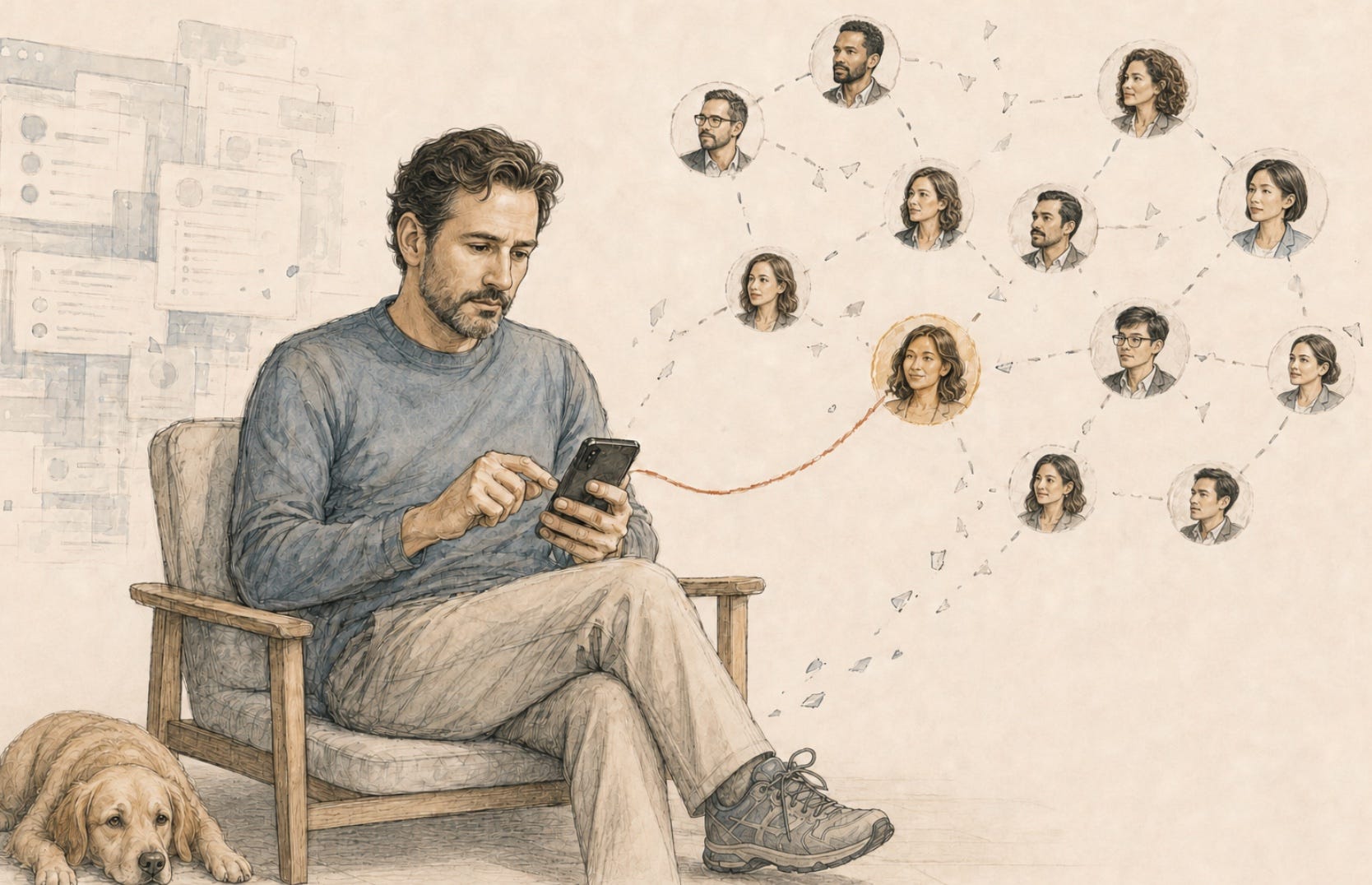
Instead, Adam stared at me during our coaching call. He had his LinkedIn up and was scrolling past names, trying to remember which ones would make time to help him.
Adam didn’t let his relationships go stale on purpose. One skipped catch-up at a time, until reconnecting felt like a to-do he didn’t have the energy to tackle.
It was the rumor of cut number three that was freaking him out. His company was telling their teams to “use AI,” a phrase most execs can’t define any more precisely than the employees hearing it.
They’re betting that fewer humans plus more tooling equals the same output for less money. People have to be let go to cover the cost of going agentic, and someone has to absorb the gap between what leadership promised and what the remaining staff can deliver.
Hours disappear while exploring new AI tools. Then even simple outreach gets put off or handed over to AI, which results in polite but generic messages.
That’s what happened to Adam. He is learning new tools at all hours of the day and night. He has a family and is juggling his own responsibilities plus those of colleagues cut during layoffs one and two. When he has a spot to breathe, messaging a contact feels like a heavy lift, even when AI writes the outreach.
Most of us, are placing too much emphasis on the small, reasonable decisions that let a network fade without noticing it is happening.
A recent piece in The Atlantic argued that one of AI’s lasting cultural effects is that it makes people feel like they’re losing their minds.
For the past decade, popular technology platforms—many of them built or championed by the same cohort who are building today’s AI tools—have favored acceleration over consideration... Over time, these tools flattened our arguments, our politics, our culture, compressing them into the same endless fights, such that people became ensconced in their own bespoke realities.
I’d add that it’s doing the same thing at a much more personal level to our relationships. When your attention is consumed by new tools, increasing workloads, and FOMO, the people outside your immediate Zoom radius quietly stop existing.
You still care about them. But caring, like everything else that isn’t on fire, requires bandwidth you don’t have.
Your network doesn’t wait. It is going through all the same feelings you are. And with so many people looking for their next gig, those actively searching and networking are top of mind. The colleague who previously shared an opportunity with you mentions a new one to someone she had a chat with recently. The mentor who’d have made an introduction thinks you’re settled and doesn’t want to intrude either.
Nobody did anything wrong. That’s just how it works when attention moves on. And, ironically, weak ties often drive opportunity more than strong ones. For example, when my team was let go at a prior role, a person mentioned me to a vendor, who knew of a company that was hiring and introduced me.
So what can you do when you’re running on empty? Here’s the reframe that helped Adam, and why we avoided simply outsourcing the task to AI.
Arthur Brooks, author of The Meaning of Your Life, describes three stages of breaking any hold that’s taken over your life.
First you rebel against the behavior that’s held you back.
Then, with knowledge, willpower, and the help of other people, you break its grip.
Only then do you notice that the task you’d written off as too [fill in the blank] was actually full of purpose the entire time .
Adam and I worked through the three steps together.
He was already stressing about how to network. That feeling of stress, which he felt right behind the eyes, was the trigger to remember one person to contact. It became a sign to take action instead of just being annoyed and mumbling to himself.
Together we drafted a really short note he could reuse on LinkedIn with minor modifications.
With the template and a realization that he was simply redirecting time he’d spent stressed into rebuilding his network, the effort no longer felt overwhelming.
Below is the template we created. Note: Using AI to auto-magically personalize each message didn’t work, since the context was in Adam’s head and not anywhere in Slack, Gmail, Google Drive, or even LinkedIn. Instead, he talks to AI to share the memories and customize the template directly.
Hi [Name]! It’s been way too long — I was just [thinking about / talking to [mutual connection] about / reminiscing about [shared experience, e.g., “our [Company] days”]], which got me wondering how you’ve been. Would love to catch up sometime if you’re up for it. No agenda, just curious what you’re up to these days.
Here is a framework to start rebuilding your network, even when your energy is low.
One message a week: use the template above.
One 5-to-7-minute “reply block” on your calendar to respond.
One walk-around-the-block chat every other week or once a month.
Do it for 12 weeks. That’s 12 weak ties strengthened, which is enough to get back into the habit.
The relentless urgency of always learning a new tool to prove you’re keeping pace isn’t just exhausting. It’s on repeat, the same way any compulsive, well-reinforced habit is. And the way out isn’t a bigger burst of willpower on a Friday afternoon when you’re already depleted.
The way out is think Ant-Man and go sub-atomic. Deliberate acts of rebellion against the urgency itself. One message a week sent not because you need something from the person right now, but because the relationship is worth maintaining in case you (or they) do in the future.
Adam is rebuilding his network now. It takes him two to three minutes to send a message and five minutes to respond. He’s reconnected with six prior colleagues and has an introduction to a hiring manager he didn’t know. When an opportunity for a phone call or in-person meeting pops up, he does it outside to further destress. He normally walks around the block with his dog. Now that time serves multiple purposes.
He compares it to moving to a new city. You don’t find the local’s best coffee shop immediately. It takes time. I love that framing as it’s honest about the effort. Most of the messages Adam sends won’t turn into a new job right away. They matter because Adam put himself out there and can call upon the connection in the future.
That’s the whole of it, really. The people who show up for you later are the ones you didn’t let go of now.
Who’s someone you’ve been meaning to reconnect with? Tag them in the comments or DM for help drafting a message.

P.S. If you found this helpful, share it with a product friend. If you’re not subscribed, join us! Here are other ways to connect.
Reach out over LinkedIn: Diana Stepner
Curious about coaching? Let’s talk.
Comments
Nothing yet. Say the first thing.
Sign in to join the conversation.