
Note: this post is adapted from my sermon titled “Saving What We Love: A Theology of Star Wars” delivered today to the Unitarian Universalist Fellowship of Mankato, Minnesota.
The name of the first Star Wars movie, released in 1977, was A New Hope. That is exactly what this saga gave viewers in my childhood and gives us again now--hope that the resistance can win, that rebellion can become democratic government, that oppressive regimes can be toppled by the people who suffer under them.
In Unitarian Universalism, our theology draws upon wisdom from the world’s faith traditions and from secular sources. The Star Wars saga--movies and books--offers us a theology of hope.
The saga has evolved in the almost five decades since its beginning, and the subtleties introduced in recent movies and streaming series are a powerful response to the world we are living in now.
The last time I preached about Star Wars was not long after the release of the 2017 Star Wars film, The Last Jedi. One of the main characters in The Force Awakens (2015), The Last Jedi, and The Rise of Skywalker (2019) is Finn, a former stormtrooper who joins the Resistance. In The Last Jedi Finn meets Rose, a Resistance mechanic. One of my favorite lines in The Last Jedi (and among my favorites from the entire Star Wars saga) is something Rose said to Finn: “That’s how we’re gonna win. Not fighting what we hate, saving what we love.”
The line from Rose reminded me of a Mother Teresa quote, “I was once asked why I don't participate in anti-war demonstrations. I said that I will never do that, but as soon as you have a pro-peace rally, I'll be there.”
That might sound like semantics. Aren’t an anti-war demonstration and a pro-peace rally the same thing? Clearly Mother Teresa didn’t think so.
The difference, I believe, is the same one that Rose was pointing to in her statement to Finn.
It’s easier sometimes to rally in resistance against something than for something. It’s easier to get worked up in righteous anger against what we hate. But what does it mean for us, spiritually and emotionally, to shift from fighting what we hate to saving what we love? The outward actions may often look the same--protesting at the state capitol or marching in Washington DC. Perhaps, though, we can see the difference when we look at signs you might find at those kinds of protests. I’ve seen both anti-Trump and pro-democracy signs at protests I have attended (in his first term and again this year), and I have often felt uncomfortable about some of the anti-Trump ones because of their mean-spiritedness. Some of them attacked elements of his appearance, and others made fun of him in other ways. I prefer to separate the inherent dignity of a person (a cornerstone of Unitarian Universalist values) from the potentially morally repugnant actions a person may take. Signs that address policy, that seek to create a better world by protecting what we love, are more in keeping with the values I try to embody as a Unitarian Universalist.
This is not just about living out our particular religious values, though--I believe it is about our own spiritual health, no matter what faith tradition, if any, we are part of.
What does it feel like if you are angry all the time, focused on what you hate?
And what does it feel like if you are instead focused on saving what you love?
It’s more than semantics. Framing our resistance to oppression as saving what we love rather than fighting what we hate shifts our own personal emotional energy. It not only keeps us from attacking individuals rather than demanding change in policies. It also shifts us out of a language of battle, of war, of violence.
Of course in Star Wars, there are epic battles and sometimes it does come down to deadly fights between the Empire and the Rebellion, or between the First Order and the Resistance. We might not always be able to avoid conflict or even combat. But when we can choose a different option, shouldn’t we?
Going back to the examples of protest signs, let’s think for a moment about the subtle difference between being against a particular president and being *for* healthy democracy. We can be for the freedom of people of all genders to control our own bodies; for compassionate treatment of immigrants to our nation; for a health care system that cares about all people; and so on. Now, of course that should mean that we also make our choices every time we cast a ballot based on what we are for, based on what we love and what we want to be true about our nation.
Like many of the characters in Star Wars, we may have reached a turning point in the last decade, or in the last three or four months--a point at which we realized that what we love needs saving, and that we are the only ones who can save it. We, the people. Everyday people, exercising our rights in the voting booths and in the streets and in hearings in legislative bodies and in letters and calls to our elected officials. (In Star Wars, before the Rebellion engaged in physical fighting with the Empire, a group of peaceful resisters tried for legislative change. It doesn’t always work, and the movie saga would have been much less exciting if it had, but we too should use the formal tools of our democracy, along with other tactics.)
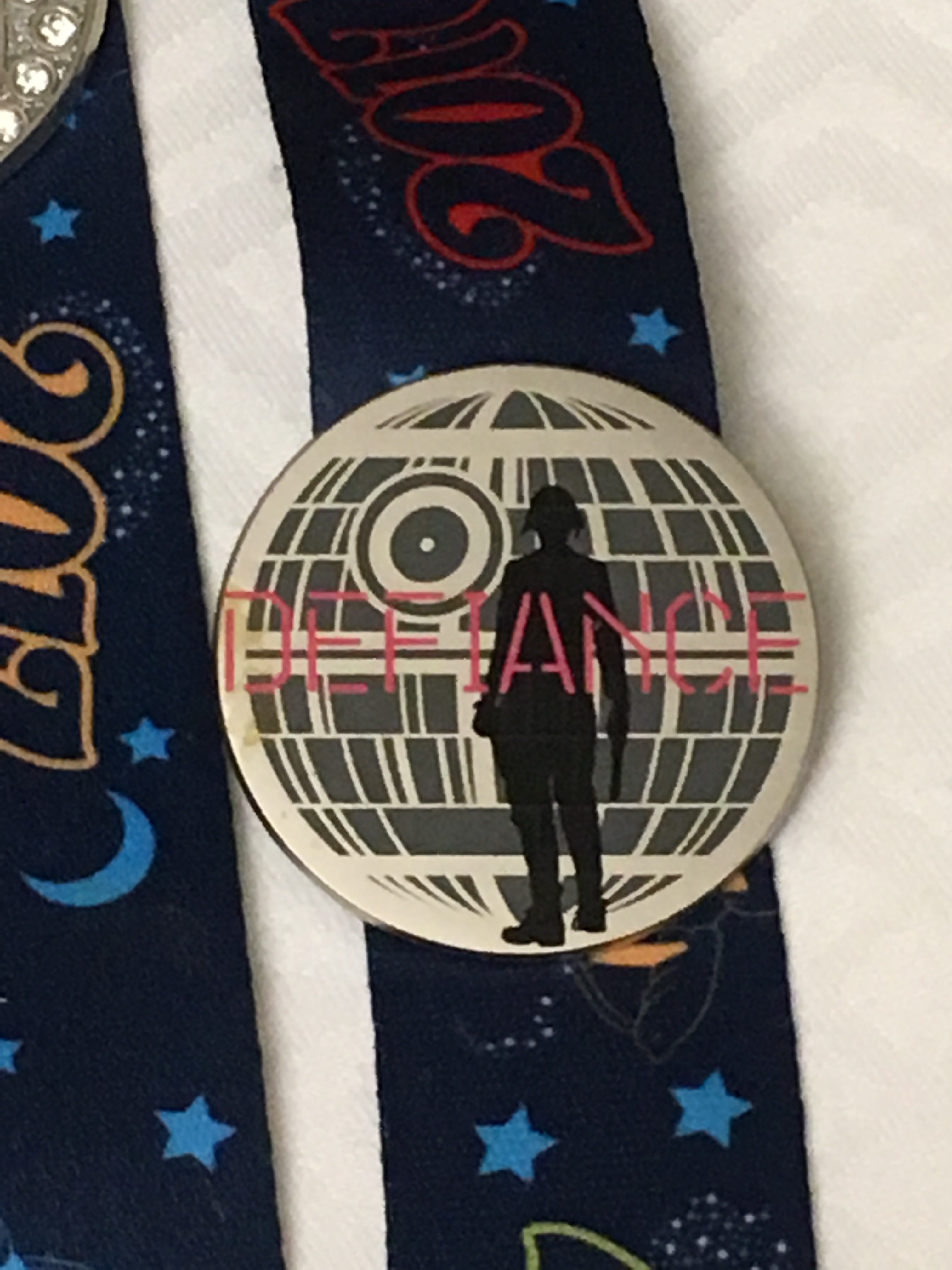
I’ve been a Star Wars fan since the first movie came out in 1977, when I was six years old. Unlike many of my favorite childhood movies, Star Wars has continued to inspire me. In fact, watching Rogue One in December 2016 and The Last Jedi in December 2017, in the context of our national political drama, was particularly powerful.
This spring, the second season of the Disney+ series Andor, which is a prequel to Rogue One and the original Star Wars trilogy, has been similarly spirit-nourishing for me, and for many others.
A character from Andor named Nemik writes a manifesto that includes this passage, now circulating widely on social media:
There will be times when the struggle seems impossible. I know this already. Alone, unsure, dwarfed by the scale of the enemy. Remember this. Freedom is a pure idea. It occurs spontaneously and without instruction. Random acts of insurrection are occurring constantly throughout the galaxy. There are whole armies, battalions that have no idea that they've already enlisted in the cause. Remember that the frontier of the Rebellion is everywhere. And even the smallest act of insurrection pushes our lines forward. And then remember this. The Imperial need for control is so desperate because it is so unnatural. Tyranny requires constant effort. It breaks, it leaks. Authority is brittle. Oppression is the mask of fear. Remember that. And know this, the day will come when all these skirmishes and battles, these moments of defiance will have flooded the banks of the Empire's authority and then there will be one too many. One single thing will break the siege. Remember this. Try.
The stories in these movies and shows have given me hope that we, the ordinary people of this nation, can overcome a corrupt government. Not through intergalactic war, but through the underlying courage of everyday people resisting the powers that be when those powers become corrupt. It isn’t the actions of the movies’ plots that give me hope, it’s the characters and the choices they make. If they can make those courageous choices, often risking their lives, what can we do here in the real world? How can we learn from them what it means to resist?
On January 20, 2017, the day Donald Trump was sworn in as President for his first term, I wrote a blog post titled “In A Time Such As This” in which I said:
In a time such as this, stories of rebellion are stories of hope.
Last month, while my teenager and I were on a mini-vacation not far from home, I took him to see Rogue One: A Star Wars Story. (Don't worry, no spoilers here for those who haven't seen it yet!) This movie is set just before the events of Star Wars: A New Hope, which means it portrays the Rebellion against the Empire. I couldn't help but see parallels to our own national story right now, as people are rising in opposition to a leader who seems determined to change the very nature of our nation.
And then, partway through the movie, I went to the restroom and found that someone had written "Hail Trump" on the wall of one of the stalls.
I went back to the movie, but after it ended, I took my purse (and more importantly, my pen) with me and went back into the same stall to make an edit--crossing out “Hail” and writing “Resist.”
I am 45 years old and have never written anything in a bathroom stall until now. In that moment, though, I couldn't leave that message, "Hail Trump," unchallenged. It rang too many alarm bells for me.
In college, I studied Holocaust literature--but I don't believe I would have needed that background to spot the similarities between "Hail Trump" and "Heil Hitler." In fact, by the time I was in that movie theater, we had already seen post-election news stories...in which self-identified Neo-Nazis and white supremacists chanted "Hail Trump" and other similar phrases while performing the Nazi salute and celebrating the victory of their candidate, who never rejected their support.
So, in a moment of anger and frustration and fear, I changed "hail" to "resist."
I don't know whether the person who wrote the original words will ever see my change. That's not important to me. If someone other than me (perhaps someone who lives in the town we were visiting) found "Hail Trump" frightening, I wanted them to know that someone was resisting rather than celebrating the rise to power of a man who encouraged hate speech and violence against many categories of people, including women, immigrants, Muslims, people with disabilities, LGBTQ+ folks, and people of color. I wanted to do something to counter the fear they might now have, wondering which of their neighbors wrote that in a movie theater restroom, and how many others agree with it.
Today, now that the President-Elect has been sworn in as President, I'm feeling many things, none of them particularly pleasant. The one with the upper hand right now, though, is the same desire that drove me to use my pen in that movie theater: the desire to say, "Not everyone thinks this way. Not all of us are okay with this. Together, we can resist."
We weren't successful in resisting his rise to power, but we can continue to resist hatred and bigotry, and the policies that will come from them. We can do more than write slogans or carry signs, though there's nothing wrong with doing those things. We can and should take bolder actions, including being in close contact with our elected officials to make sure they know our thoughts about legislation that either protects or undermines our democracy, upholds or removes freedoms, affirms or denies the rights of various categories of people. Those of us with privilege can use it not to build up our own security (financial or other) but to amplify the voices of those who too often go unheard, and thus ignored or worse, in our society. We can find ways to serve our society, caring for each other when systems of support for the most vulnerable are cut by the new administration, as they have promised will happen.
We can resist. We must resist.
I will resist.
The day after writing that blog post, I participated in the Women’s March in Concord, New Hampshire. We were among millions who marched, not just all over this nation but in cities around the world, in opposition to what the new administration represented. But we weren’t just marching against the new president. We were marching for women’s rights and a variety of other values that we hold dear that felt threatened that day. The sign I carried at that march had an image of Princess Leia from the original Star Wars trilogy, and the words “A Woman’s Place Is In The Resistance.”
Eight years later, that is still how I feel, and Star Wars is still one of the sources of inspiration and hope for my own acts of resistance.
This year, I attended not a Women’s March but a Hands Off rally at the Minnesota state capitol. I considered carrying that same sign about a woman’s place being in the resistance, but instead carried one that simply said “Hands Off Our Democracy.”
Author Terry Pratchett said, “Fantasy is an exercise bicycle for the mind. It might not take you anywhere, but it tones up the muscles that can.”
Those of us raised on the Star Wars movies--and those who have discovered them in adulthood, or been introduced to them as children in younger generations--have been toning up our resistance and rebellion muscles. Now it’s time to use them.
May we consider what we love, and may we do all we can to save it. May we have the courage to be part of the resistance.
No posts
Comments
Nothing yet. Say the first thing.
Sign in to join the conversation.