
The reading from Matthew is yet another parable! I've not included that today because I’m taking a wee break from the parables.
Don’t get me wrong, I love parables. But Isaiah 44 and Romans 8 grabbed my attention today for reasons that will become obvious below.
Today’s musing is more of a meditation than usual — and has been born of my continuing journey in Ireland where I am surrounded by both rocks and hope.
Read on, especially if you are groaning for hope.
And I am well-aware that it has been a hideous past two weeks in the United States and many are groaning for hope — and have maybe ever lost any hope for hope.
The community we’re forming together includes both free and supporting paid subscribers. One of the benefits of a paid subscription is receiving Sunday Musings on Saturdays. Some sermon writers tell me it helps. 🙂
Please join in.
Click the button below for information and options to sign up.
Thus says the Lord, the King of Israel,
and his Redeemer, the Lord of hosts:
I am the first and I am the last;
besides me there is no god.
Who is like me? Let them proclaim it,
let them declare and set it forth before me.
Who has announced from of old the things to come?
Let them tell us what is yet to be.
Do not fear, or be afraid;
have I not told you from of old and declared it?
You are my witnesses!
Is there any god besides me?
There is no other rock; I know not one.
I consider that the sufferings of this present time are not worth comparing with the glory about to be revealed to us. For the creation waits with eager longing for the revealing of the children of God; for the creation was subjected to futility, not of its own will but by the will of the one who subjected it, in hope that the creation itself will be set free from its bondage to decay and will obtain the freedom of the glory of the children of God.
We know that the whole creation has been groaning in labor pains until now; and not only the creation, but we ourselves, who have the first fruits of the Spirit, groan inwardly while we wait for adoption, the redemption of our bodies. For in hope we were saved.
Now hope that is seen is not hope. For who hopes for what is seen? But if we hope for what we do not see, we wait for it with patience.
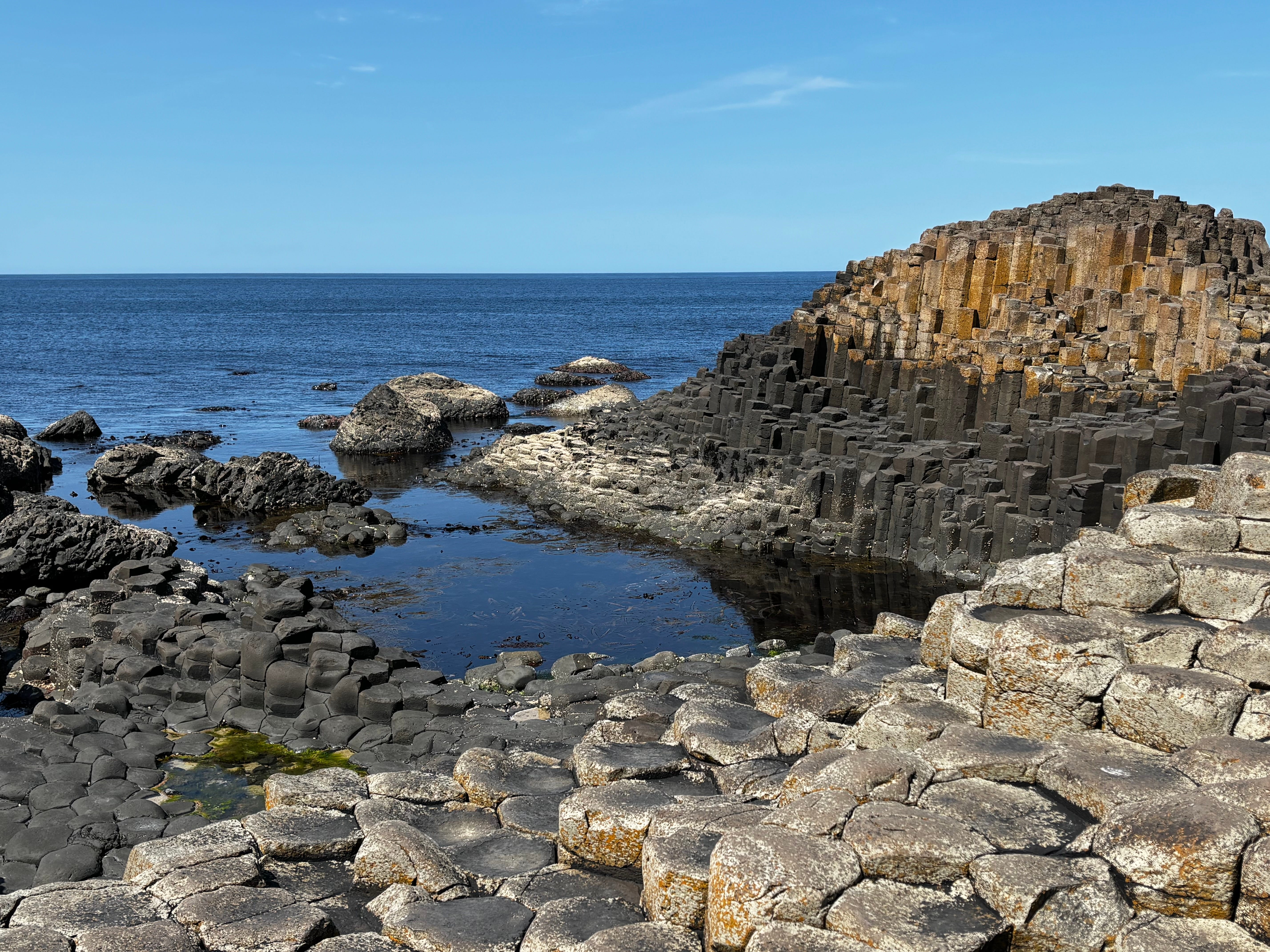
I’ve been in Ireland now for more than two weeks.
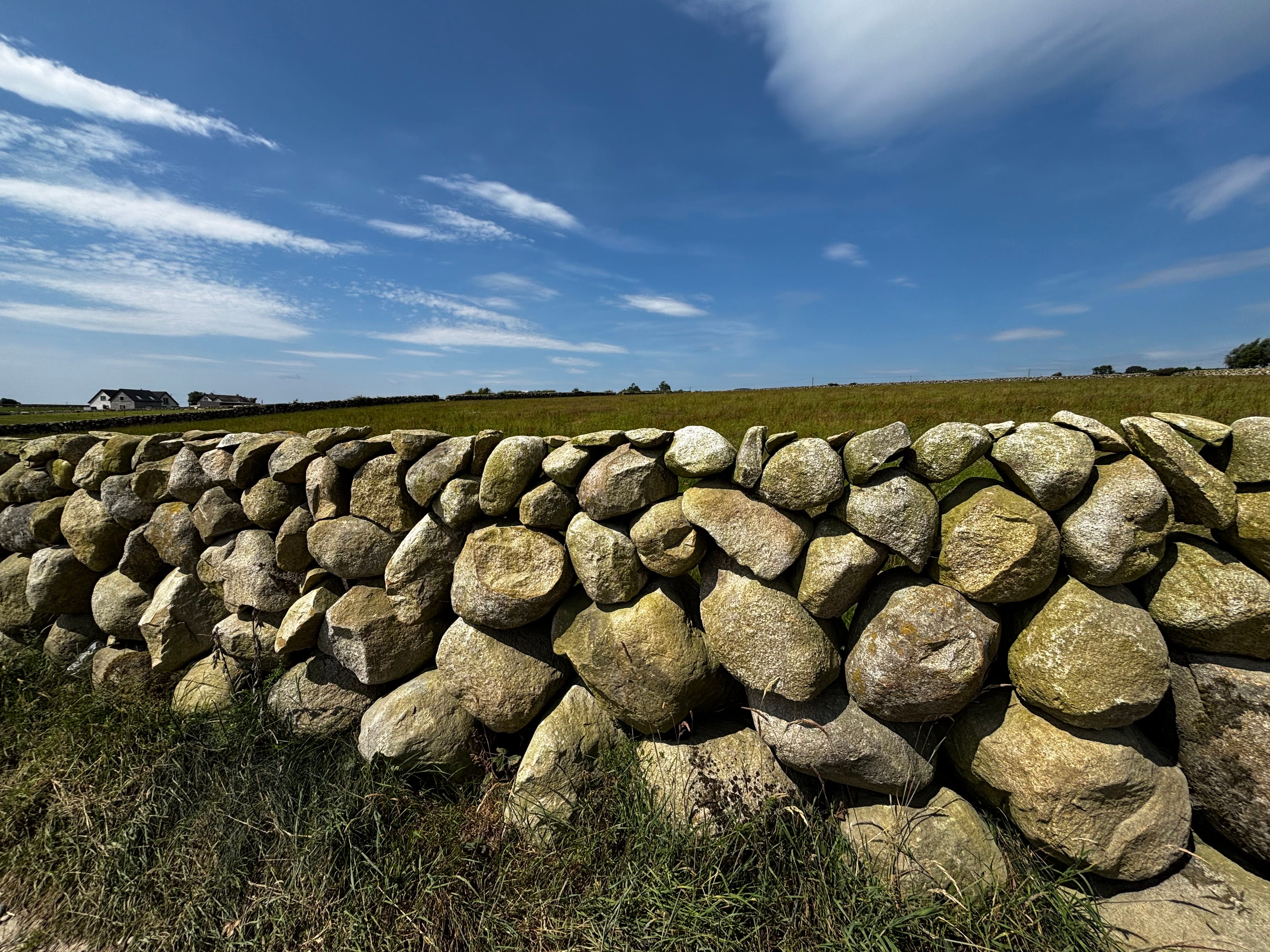
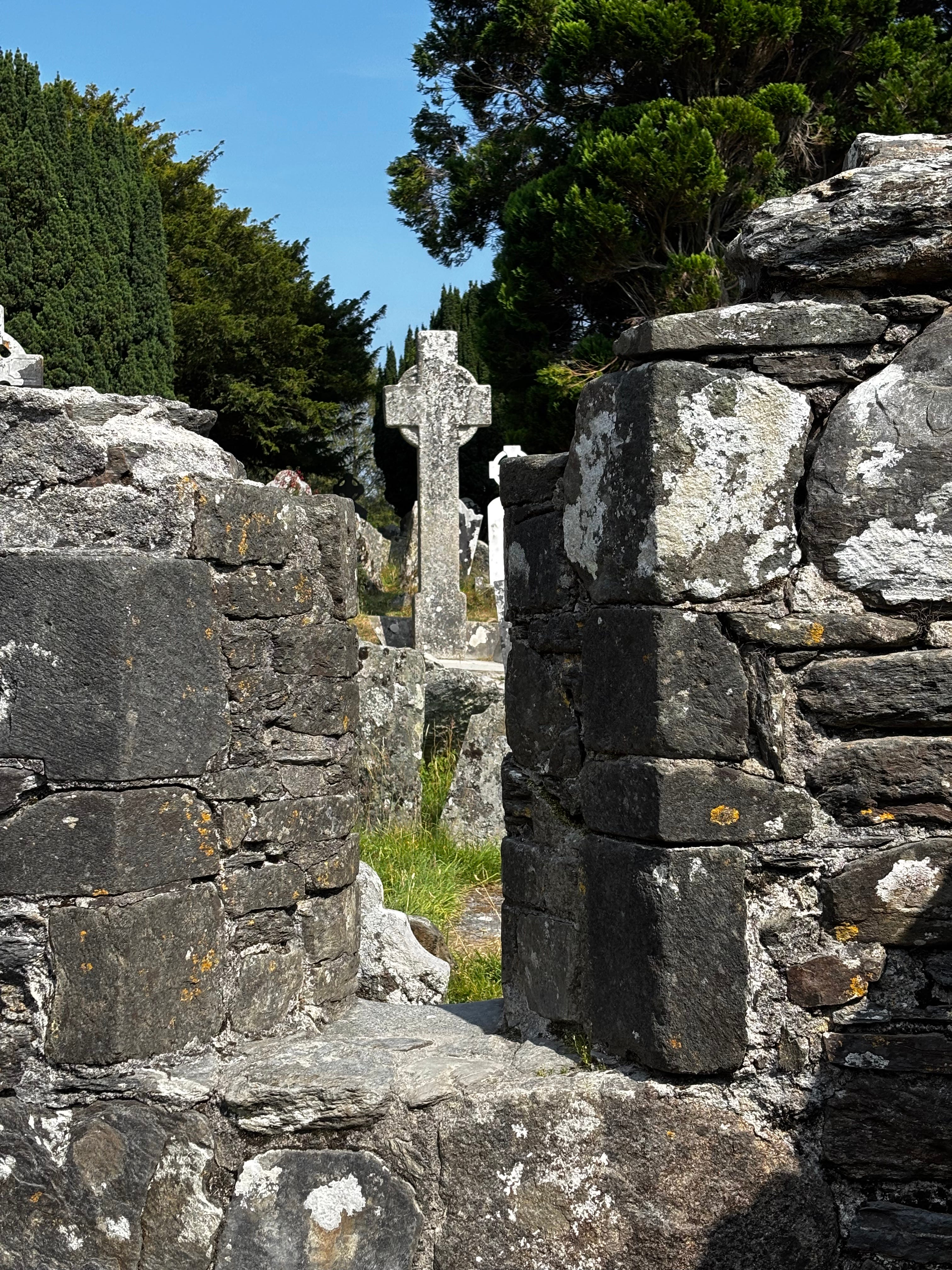
That means I’ve seen lots of rocks — rocky hillsides, stones scattered across fields, boulders of geological wonder, and the wet rocks of waterfalls and meandering rivers. Human-built rock structures abound as well, like ancient burial mounds, rock art carvings, churches dating back more than a thousand years, rough roads, stone walls, and old farmhouses and cottages.
Yes, Ireland is rightly called the Emerald Isle. And the entire earth is rock — we humans live on an enormous rock tracing an orbit in space. But in Ireland, rocks are so, well, obvious. When the landscape isn’t green, it is rocky.
You can’t miss them or pretend that the earth is anything but rocks. To farm, to build, to create — rocks have been moved or transformed or somehow utilized in every endeavor. The boulder-strew fields, the sense of solidity, and their seemingly eternal nature are ever-present reminders of human fragility and mortality. Here, on this glorious island, one lives in a daily conversation with the primeval truths of rocks.
We humans, ere how long we have lived on the land, are but newcomers in an ancient story told by the stones all around.
Thus, my attention turned to today’s reading from Isaiah:
Thus says the Lord, the King of Israel,
and his Redeemer, the Lord of hosts:
I am the first and I am the last;
besides me there is no god.
Who is like me? Let them proclaim it,
let them declare and set it forth before me.
Who has announced from of old the things to come?
Let them tell us what is yet to be.
Do not fear, or be afraid;
have I not told you from of old and declared it?
You are my witnesses!
Is there any god besides me?
There is no other rock; I know not one.
And, of all the rocks, there is but one Rock. God, the God of Abraham and Sarah, the God of Old. The God preached to those of ancient days by Patrick and Brigid and others of the saints. A God known even before Patrick in the wind, rocks, and seas, a God named by other names, but the same sturdy, solid, unyielding presence nonetheless.
Have I not told you from of old and declared it?
Even the rocks witness the eternal Rock.
At the very top of the Hill of Tara, an ancient site where Patrick first told the story of the Anointed Rock to the High King of Ireland, there’s a rock structure. Two (maybe three) millennium or so before Patrick, humans built a massive figure-8 at Tara’s peak. It was the place where High Kings both won their crowns and from whence they reigned.
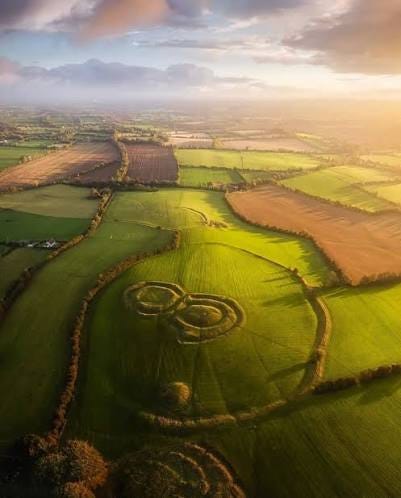
Our guide said “two interconnected circles.” I looked at the arial photo, an infinity symbol, perhaps?
I am the first and I am the last;
besides me there is no god.
There among the rocks, crafted by human hands so long ago, God’s name inscribed on the land — the first and last of Isaiah, the Alpha and Omega of the much-latter mystical Revelation:
“I am the Alpha and the Omega,” says the Lord God,
who is and who was and who is to come, the Almighty.
Those who lived long ago knew this. But western Christians spent centuries moving the rocks, turning them into our own image, building our cities and civilizations on them but rarely recognizing their eternity. But, in more recent years, some theologians have returned to the hills and rocks, searching for more ancient wisdom.
In 1993, Sallie McFague memorably said that the “Earth is the Body of God.” She wrote, “Incarnation [goes] beyond Jesus of Nazareth to include all matter. God is incarnated in the world. . . . [This] suggests that God is closer to us than we are to ourselves, for God is the breath or spirit that gives life to the billions of different bodies that make up God’s body. But God is also the source, power, and goal of everything that is, for the creation depends utterly upon God.”
All bodies includes, of course, all creatures and plants. Like the animals and Adam and Eve. The Tree of Life and all other trees. But she insisted that God was embodied in “all matter.” That includes the rocks. These rocks. All rocks. The most ancient of creation. The body of the Earth itself — Rock. And rock itself is the very image of God.
According to scripture itself, God is a Rock. The Rock.
And yet, Paul wrote,
We know that the whole creation has been groaning in labor pains until now; and not only the creation, but we ourselves, who have the first fruits of the Spirit, groan inwardly while we wait for adoption, the redemption of our bodies. For in hope we were saved.
The whole creation? The Body of God itself? The Ancient Rock?
McFague said yes. That God is “at risk” in and with the world. Now and then, that infinity, the Alpha and Omega, the before and after — groans, waiting for “salvation,” the healing that every living breathing thing awaits. Even the rocks cry out.
I can’t explain it. But I know it. I know it standing on the rocks at the sea as the water breaks on the mysterious stones forming Giant’s Causeway. I know it standing in the foundation of infinity at Tara’s zenith. Breathe in, breathe out. The rocks were alive, whispering, groaning perhaps. Awaiting their fullness of time.
And me. Looking westward from the stony hilltop, toward a homeland in crisis. An America where my government is killing people in the streets and a madman holds weapons of power beyond ancient imaginings.
Hasn’t it always been such?
There, at Tara, I thought of all the political battles on this hill, this sacred mound of rocks carved with the hopes of eternity — where men grasped kingship and goddesses came down, where great armies clashed, and where prophets announced liberation and freedom for all. Here plans were hatched and bodies buried. Here the rocks are soaked in both birth and blood.
None of it was visible, of course, except in historical memory and imagination. But the rocks whispered and groaned their stories beneath my feet. I could feel the Body of God, the body of Earth, the first and the last, quietly pulsing hope.
Hope, like a heartbeat, underfoot. Hope…hope…hope…hope…
The earth, even its rocks, perhaps especially these stones, rhythmically pounding hope. And maybe warning.
Was the beat intensifying? Or was it only my imagination?
Now hope that is seen is not hope. For who hopes for what is seen? But if we hope for what we do not see, we wait for it with patience.
We wait. Like the rocks. With the Rock. We wait.
How long? How very long it has been.
Keep hoping. Like the rocks.
I was surprised to find that my friend, Rosemerry Wahtola Trommer, was feeling the whispers and groanings of rocks on the same day I visited the Hill of Tara. Her poem of the day on July 17, “Eco-Grief,” echoes similar longings to those in my post.
My favorite alpine skinny dipping hole
a dry rock bed, an inverted monument
to drought —
as if I needed one more reminder
of how fragile it is, this world,
how parched our hearts
can become.
On the long hike home
I swim in the seriousness
of what is not here,
remember how it felt to slip
into the snowmelt,
how my whole being shivered in elation,
how the earth itself was so alive.
— Rosemerry Wahtola Trommer, “Eco-Grief,” July 17, 2026
Lay down these words
Before your mind like rocks.
placed solid, by hands
In choice of place, set
Before the body of the mind
in space and time:
Solidity of bark, leaf, or wall
riprap of things:
Cobble of milky way,
straying planets,
These poems, people,
lost ponies with
Dragging saddles —
and rocky sure-foot trails.
The worlds like an endless
four-dimensional
Game of Go.
ants and pebbles
In the thin loam, each rock a word
a creek-washed stone
Granite: ingrained
with torment of fire and weight
Crystal and sediment linked hot
all change, in thoughts,
As well as things.
— Gary Snyder, “Riprap”
I’ve a stone to carry to the top of the hill
I’ve a stone to bring back
At the top of the hill there is a cairn
Being built for long gone loved ones
At home there are many stonewalls
I keep building out of love and place
It isn’t confusing
It’s stone
— Bob Arnold, “Rhythm”
Jesus answered, ‘I tell you, if my disciples were silent, the stones themselves would shout out.’
— Luke 19:40
Comments
Nothing yet. Say the first thing.
Sign in to join the conversation.