
I’m in Belfast, Northern Ireland, this week sharing with a group from Ireland Retreats.
Because of my schedule the last few days, I’m sending a post on this week’s text previously published here at The Cottage in 2023. Oddly enough, that year, the last time Matthew 13 appeared in the lectionary, I was also away from home!
Back then, I asked a friend and sister-writer, Cathleen Falsani, to pinch-hit for me in Sunday Musings. Cathleen is an award-winning journalist and author. She’d shared with us before — and treated us to a memorable piece on light and lighthouses.
Maybe it is a bit of a coincidence — Cathleen, whose family came from Ireland, now lives here. Although I’ve not seen her on this trip, she’s a writer with a deep sensibility of Irish storytelling.
Her post from three years ago is evergreen (probably because everything in Ireland is green!). She takes us into both the puzzle and the wonder of the parable. And her piece is a nice way to move out of the summer parable series into the next few weeks of Sunday parable readings from the Gospel of Matthew.
I hope you’ll appreciate her insights as much as I do.
Jesus went out of the house and sat beside the sea. Such great crowds gathered around him that he got into a boat and sat there, while the whole crowd stood on the beach. And he told them many things in parables, saying: “Listen! A sower went out to sow. And as he sowed, some seeds fell on the path, and the birds came and ate them up. Other seeds fell on rocky ground, where they did not have much soil, and they sprang up quickly, since they had no depth of soil. But when the sun rose, they were scorched; and since they had no root, they withered away. Other seeds fell among thorns, and the thorns grew up and choked them. Other seeds fell on good soil and brought forth grain, some a hundredfold, some sixty, some thirty. Let anyone with ears listen!”
“Hear then the parable of the sower. When anyone hears the word of the kingdom and does not understand it, the evil one comes and snatches away what is sown in the heart; this is what was sown on the path. As for what was sown on rocky ground, this is the one who hears the word and immediately receives it with joy; yet such a person has no root, but endures only for a while, and when trouble or persecution arises on account of the word, that person immediately falls away. As for what was sown among thorns, this is the one who hears the word, but the cares of the world and the lure of wealth choke the word, and it yields nothing. But as for what was sown on good soil, this is the one who hears the word and understands it, who indeed bears fruit and yields, in one case a hundredfold, in another sixty, and in another thirty.”
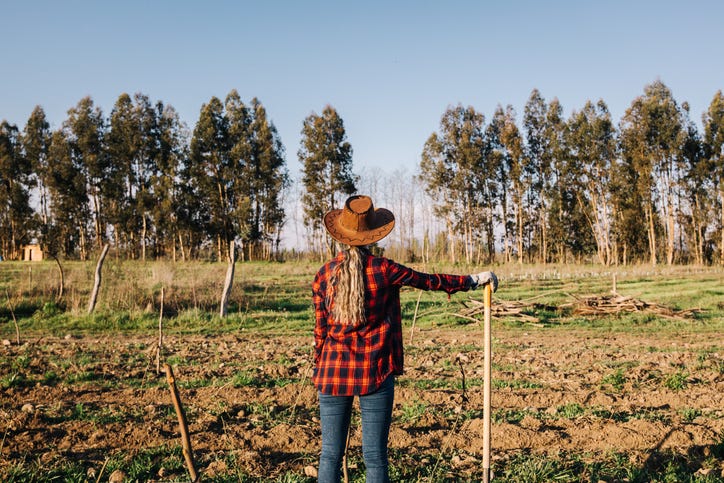
On the Parable of the Sower, by Cathleen Falsani
The “Parable of the Sower,” as the story from today’s Gospel reading is commonly known, always has confounded me.
From the time I first learned the parable about a farmer who sows seeds that meet different fates depending on the kind of soil they reach (or don’t), external conditions, and how the seeds are tended, I wasn’t sure what I was meant to understand.
In the Southern Baptist church of my adolescence, we were taught that the seed was God’s truth (i.e., scripture), that we were the soil, and that whether the planted seed flourished and produced fruit was somehow up to us and an indication of our spiritual health/God’s approval.
But in real life, isn’t the farmer the one responsible for how and where seeds are planted, tended, and harvested? If seeds are planted in rocky soil, choked by weeds, or carried away by birds (or stolen by “the devil”), doesn’t the fault lie with the farmer and not the seeds or the ground?
Throughout much of my life, each time the Parable of the Sower would appear in the ecclesiastical cycle, I’d find myself crankily listening with a furrowed brow. I didn’t understand. The not-knowing made me uncomfortable.
Am I the ground and the seed? Is God the farmer? If not, who is?
Part of the problem might lie in what’s not included in today’s reading — the bits in between Matthew 13:1–9 and verses 18–23 — where the disciples ask Jesus why he chooses to teach in parables.
Hey rabbi, why not just give them a list of clear commands, they seem to imply, or better yet, a manual with step-by-step instructions for how to live?
“You’ve been given insight into God’s kingdom,” Jesus begins his response in The Message para-translation of verse 11 and onward. “You know how it works. Not everybody has this gift, this insight; it hasn’t been given to them. Whenever someone has a ready heart for this, the insights and understandings flow freely. But if there is no readiness, any trace of receptivity soon disappears. That’s why I tell stories: to create readiness, to nudge the people toward a welcome awakening.”
Jesus says he uses stories because he doesn’t want a repeat of what the prophet Isaiah foretold:
Your ears are open, but you don’t hear a thing.
Your eyes are awake, but you don’t see a thing.
Biblical scholars (of which I am certainly not one) debate whether Jesus, in his parables, employed allegory — a literary device where characters and plot points reveal hidden moral or political meanings.
Whether allegorical or not, to my eyes and ears, Jesus’ stories contain wisdom and mysteries that continue to unfold over time and eternity, to and through our interactions with them.
It’s impossible to ensure with total certainty what the results of a literal planted seed will be, no matter how carefully it is tended and cultivated. Likewise, no one can predict the ultimate result of a seed planted in someone’s imagination.
I’m pretty sure Jesus knew this. Perhaps that was his point.
There is mystery, yes. And people have agency. We have the power and ability to choose what to do with what we have received, whether it’s information and talents, peak experiences or traumas.
The boundary-shattering science-fiction novelist Octavia E. Butler grew up Black and Baptist in the racially segregated Pasadena, California, of the 1950s, where the seeds of Bible stories and Jesus’ parables were planted in her young heart. While she eventually walked away from the Christianity of her youth, some of those same seeds grew into her 1993 novel The Parable of the Sower.
Butler’s Sower is set in a dystopian (but not by much) 2024, where the United States is on the brink of annihilation thanks to cataclysmic climate change, rampant social inequality, unfettered corporate greed, and inexorable political corruption.
It also features a political candidate championed by far-right Christians, whose slogan is, “Help us make America great again.”
The heroine of Sower is Lauren Oya Olamina, a Black teenager and daughter of a Baptist minister who has a medical condition called “hyper-empathy” that makes her physically experience the suffering of others. Convinced that humanity will not survive much longer without radical change, Olamina develops her own belief system, where the only enduring truth is “God is Change.” It grows to become a religion of its own called Earthseed.
“[Butler] doesn’t say that religion is good or bad, but she says that we use it to try and articulate our role in life and in the universe,” theologian Tamisha Tyler told journalist Kimberly Winston in a fascinating ReligionUnplugged article about the rise in Butler’s popularity during the COVID era.
Butler’s Parable of the Sower became a bestseller in October 2020—nearly two decades after it was published and 14 years after the author’s untimely death in 2006 at the age of 58. She didn’t live to see the harvest, but when it finally came, it was as abundant as it was unexpected.
Butler’s Parable of the Sower has even been made into an opera that has reached audiences around the world. On March 7, 2020, the opera, which was adapted by mother-daughter musicians Bernice Johnson Reagon (one of the founders of Sweet Honey in the Rock) and Toshi Reagon, was performed at UCLA just days before COVID sent the world into an unprecedented lockdown.
I’ve lost all my fear and exchanged it for a clear vision
As we open our hearts and eyes to see
The whole world’s gone crazy
Except for you and me
Stories find their audiences and audiences find the stories.
May we each have ears to hear the stories we need most, embrace awakening as it comes, and remain open to the unfolding mystery.
Scandalous God, sowing weeds among the crop, raising bread with impure yeast, offering treasure beyond price, casting a net that catches good and bad: throw down our mean idols of purity and possession and let the Son of humanity show us your inclusive, provocative, wide-branching love. — Steven Shakespeare
a sower walks into the great hall
it’s war out there, he says
and you awash in emptiness
you’ve sworn off your duty to sound the alarm
I’ve come in the name of fields
it’s war out there
I walk out from that great hall
all four directions a boundless harvest scene
I start planning for war
rehearsing death
and the crops I burn
send up the wolf-smoke of warning fires
but something haunts me furiously:
he’s sowing seed across marble floors
— Bei Dao, “Sower”
I bless the soil I walk on
I bless the richness of the life
I can neither see
nor understand.
I give thanks for the fruitfulness May we protect and cherish this foundation.
of the earth.
I give thanks for the falling and rising of green things.
I greet the creatures, many legged, single celled,
that do the work of life-from-death.
May we nurture good soil.
May it be sheltered by plants,
free from rocks and thistles.
THANK YOU. Your support really matters.
On a personal level, I request prayers for the soul of my friend, the Rev Laura Cochran, the priest at my little church in Alexandria, Virginia. She was a beautiful human being, smart and thoughtful and curious, open and brave and generous. She was a great conversation partner for me, a loving priest in community, and a prophetic, imaginative preacher.
She was fifty years old and has left behind a husband and child — as well as a grieving community of faith. Laura loved the Cottage and read this newsletter every week.
We all know she is still with us in love.
This is a hard, sad goodbye for a small church with a big heart.
If you’d like, you are more than welcome to send a note of condolence to the people of St. Aidan’s in Alexandria, Virginia.
8531 Riverside Road
Alexandria, Virginia, 22309
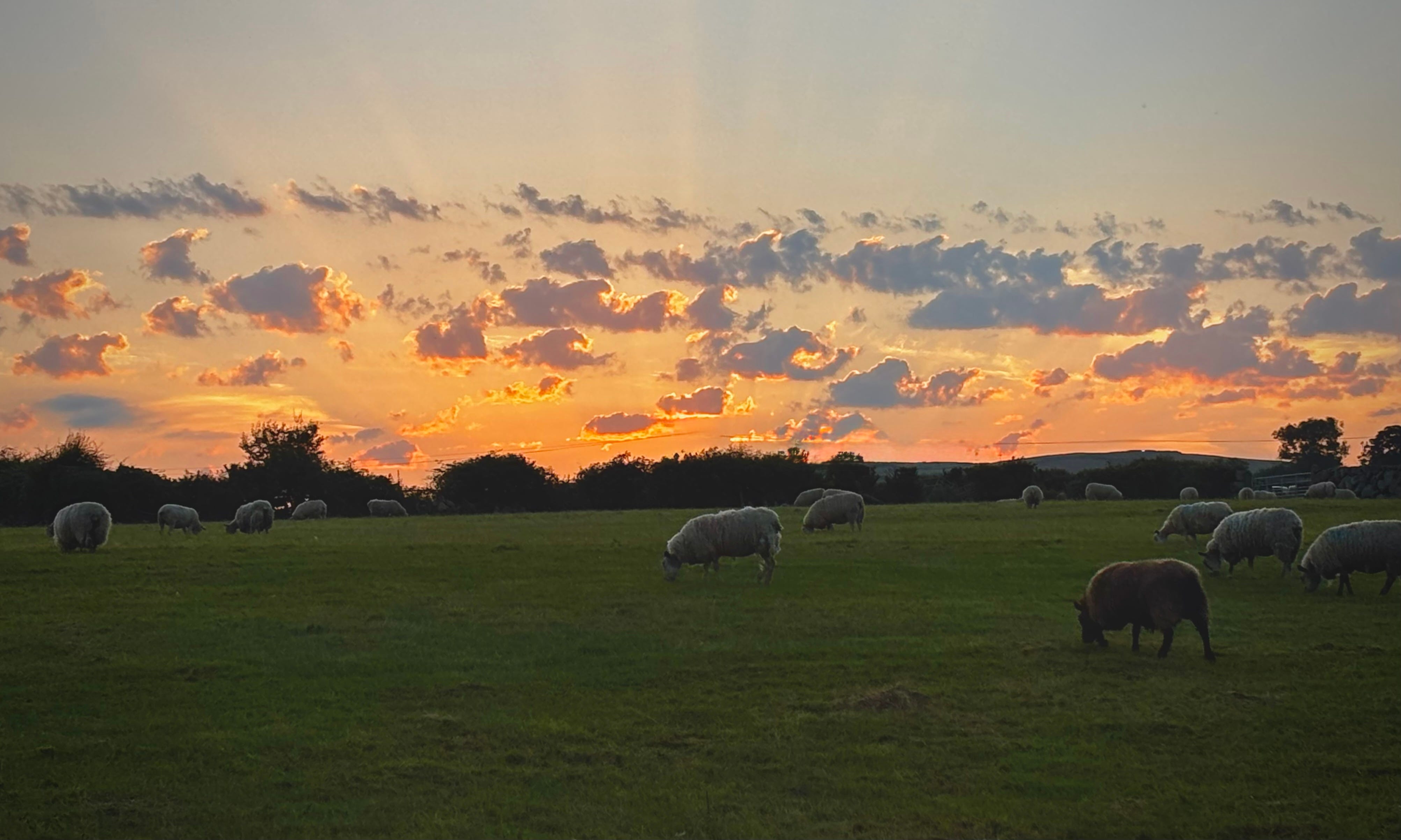
The above view also brought to mind my friend, Laura:
The Lord is my shepherd, I shall not want.
He makes me lie down in green pastures;
he leads me beside still waters;
he restores my soul.
Comments
Nothing yet. Say the first thing.
Sign in to join the conversation.