
I spent most of July in Ireland.
That means, among other things, I spent considerable time learning Irish history — like thinking about the ancient story of St. Patrick and the more modern ones of rebellion and political crises in the north and south.
It also means that I missed the daily news deluge of outrageous behavior and shocking policy moves by the current president here in the United States.
I’ve been home for a few days and trying to catch up on stories I missed. That’s an impossible task, of course, because there is too much to comprehend most days (that’s a purposeful strategy authoritarians use to wear people down). But I try to stay generally informed.
While I follow the “top” news, I also watch for things in my “lane,” those issues closest to my expertise and experience. History is one of my lanes.
While I spent July wading in Irish history abroad, Trump was making a special point of attacking American history — especially as presented at the Smithsonian Institution, America’s museum complex in Washington, D.C.
Yesterday, I read the July 4 report released by the White House attacking the Smithsonian — “SAVING AMERICA’S STORY: How Ideological Capture at the Smithsonian Institution’s National Museum of American History Erases Our Heritage.”
I read it in its entirety — all 160 pages and 522 footnotes of it.
The paper makes a few good points, I’ll admit. But overall, it is a fairly-standard social media-inspired sort of document. The authors (a faceless committee wrote it) chose a few click-bait worthy anecdotes and out-of-context words and actions to illustrate their whole argument — clearly intending to stir the passions of their ‘base’ — and launched a political attack on, well, historians.
Historians are my people. I’m taking it kinda personally.
Although the report cites different examples of “ideological capture,” two issues stand out through the entire document. First, the authors clearly want the director of the American history museum fired (and, if not fired, endlessly doxed and harassed by MAGA social media stormtroopers or worse). And second, they are BIG MAD (that’s a professional term 😉) at how the Smithsonian tells the history of slavery and enslavement by identifying racism and white supremacy as foundational to American history.
(They also have a very strange obsession with the terms, “our past” or “the past.”)
Their seething anger at the Smithsonian for centering slavery and race was palpable on nearly every page.
In many ways, it would have been easy to ignore the report and let it die some bureaucratic death. Except, of course, for the fact that on July 24, Trump announced he would place “warning labels” on the Smithsonian to notify visitors of “inaccurate information presented in the Museum.”
Warning labels on a national museum. To expose those lying historians.
Welcome home, Diana.
*****
In early July, a few days after the Smithsonian report was released, I was at the St. Patrick Centre in Downpatrick, Northern Ireland.
St. Patrick is, famously, one of the three patron saints of Ireland — and perhaps one of the best-known of all Catholic saints. The museum in Downpatrick is the only permanent exhibit in the world dedicated to his story and legacy. As the centre’s website declares, “the history of Ireland starts here in Patrick’s words.”
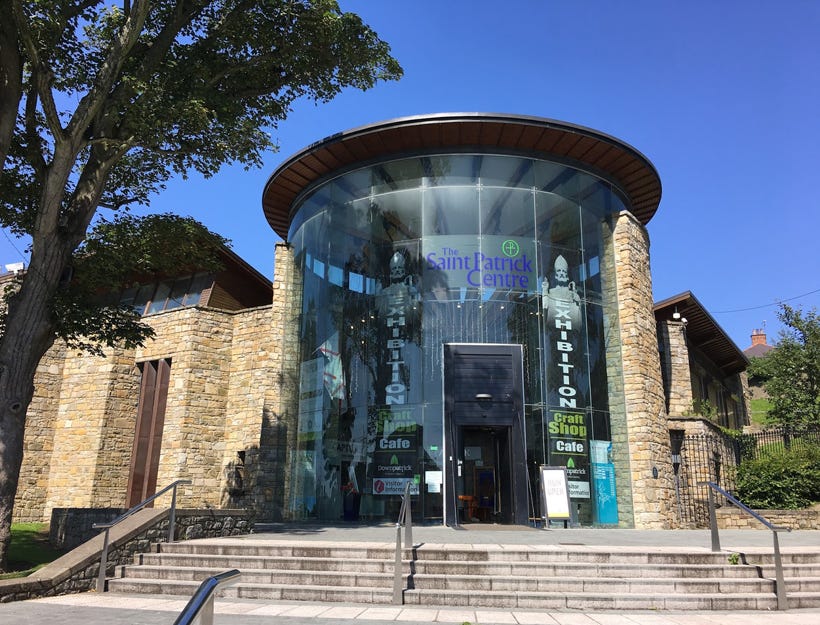
And that history starts with slavery.
The exhibit tells Patrick’s story “from his boyhood in Roman Britain to his captivity by Irish pirates, his slavery on Slemish Mountain and escape.”
Because that’s his story — and a story that becomes central to Irish identity — and it is a story of slavery. Patrick, born and raised in western Britain to Roman-British parents, was kidnapped by Irish raiders, taken from his home, and held for six (or seven) years in slavery. He escaped and returned home only to receive a vision in a dream of the Irish people calling him to return to the place of his enslavement: “We appeal to you, holy servant boy, to come and walk among us.”
Patrick trained as a priest in Gaul and eventually was made a bishop. He then returned to Ireland as a missionary. According to one early historian, when Patrick landed he made his way back to the man who had enslaved him — to buy his freedom and to convert his old master. On this mission, Patrick was given land to build his first church, Sabhall Phádraig, now known as the Saul church.
The former slave returned to the land of enslavement to preach freedom and liberation to those who had held him as property.
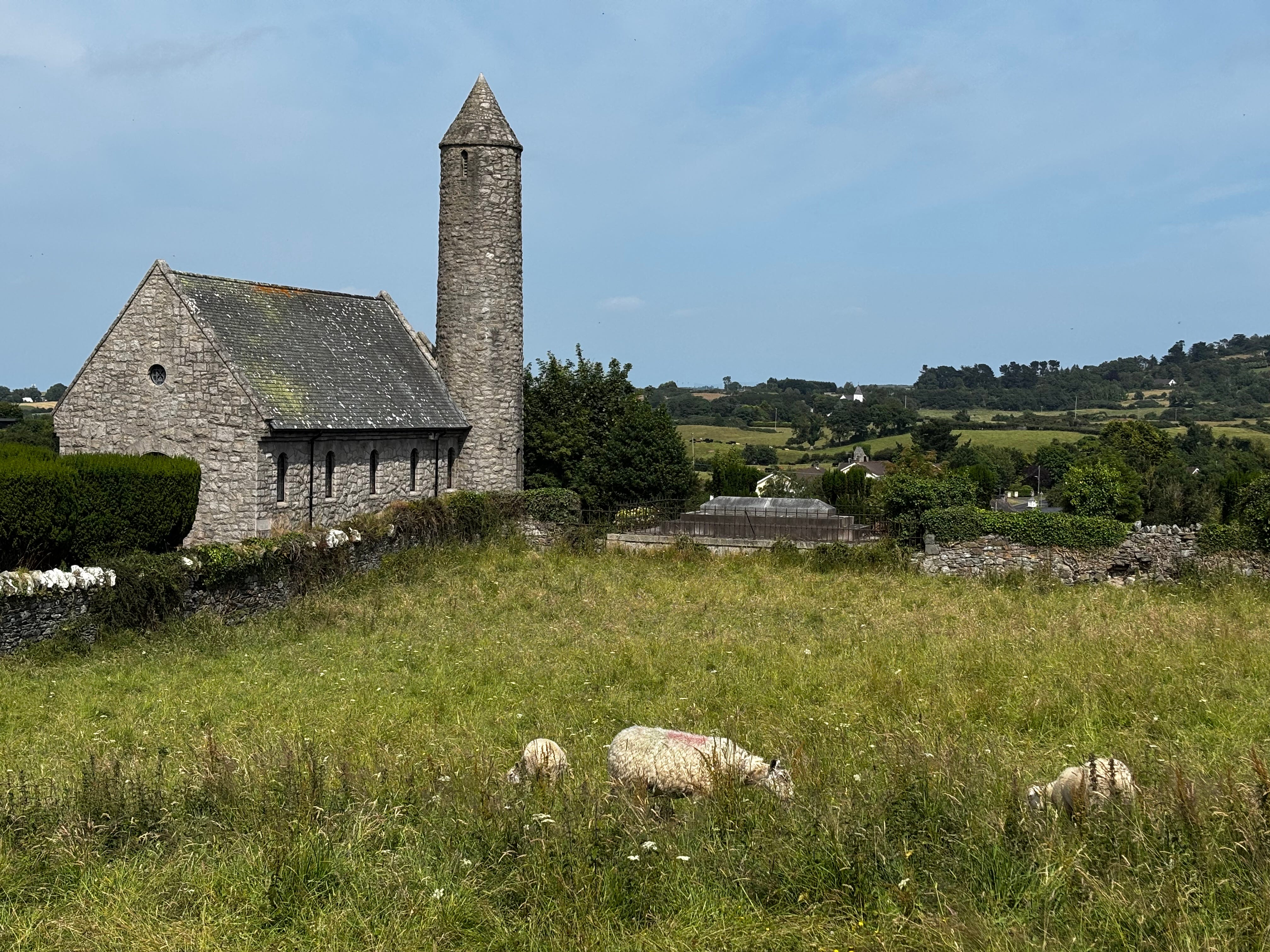
The St. Patrick Centre tells the story of Irish history and identity through this story — a story of slavery. And yes, the Irish were the original bad actors in the story. They were the pirates, the raiders, the enslavers, the “pagan” masters.
And a captured British boy, taken from his parents and homeland, was the hero.
During these July weeks, I’d learn that was often the Irish story — the enslaved became the heroes. The identity of the “master” would change over time. But, the story echoed through centuries: A people held down, enslaved by colonial and imperial powers, their lands and identities stolen who nevertheless preached and sought freedom and liberation for all. They were often exiled, imprisoned, or worse.
But those at the “bottom” of the story fought to tell their own story and to be free in their own land. The “slaves” were the heroes.
As I walked through the museum, questions nagged me: What if we told the story of America and American identity as a story of enslavement and return? What if the formerly enslaved were the heroes and the ‘masters’ in need of conversion? What if we told American history through the history of Harriet Tubman? Or Frederick Douglas? Josephine Baker? James Baldwin?
I quietly laughed at myself. Because that’s exactly what some historians are trying to do right now. It’s the thesis of the 1619 Project. And, apparently, it is why Trump’s “historians” are so very angry at the Smithsonian. You can tell the American story as a history of those “enslaved” (in a multitude of ways) never resting until the full promise of freedom was extended to — or taken by — them. Until they, too, could write the story. Until they claimed their role in history.
The St. Patrick’s Centre, with all of its focus on slavery and liberation, wasn’t a victim of “ideological capture.” Nor was it scary. I daresay that the writers of the Smithsonian report would like it! It tells an ancient story as truthfully as possible (with all the appropriate caveats regarding such old sources, myths and legends) and interprets that story with surprising generosity and inclusiveness. (The only real villains in the museum were the “pagans.” I actually felt bad for Wiccans, Druids, and post-religious folks!)
Maybe some of the current Smithsonian leadership got carried away in certain cases. I don’t know. I haven’t been there in a couple of years. I’m sure I’d have some quibbles, mostly because historians always quibble with one another. But, given the purpose and tenor of the report, I sincerely doubt the museum is being held hostage by those who hate America.
I do know that those writing the Trump report would like to hold us all captive to a narrative supporting their political and social agenda, however. And their history won’t include most of us with anything more than a nod. Sure, there were Black people in the United States. And women, too. But the main story is that of the glorious Founders, Our Fathers of Freedom.
We’re not the United States of the 1950s — or the 1850s — or 1776. Every generation needs to tell the story in its own words, honestly and fully, because we all thrive when we’re included in the tale.
And many more of us have learned our own stories. We’re proud of them, of our ancestors — what those who went before accomplished and passed on to us. We’ll fight for them, for their stories, and for the freedom to tell ours.
It isn’t scary or threatening to center the story of slavery as it was. Or the stories of women’s rights. Or the resilience of the LGBTQ people and communities. These stories open the doors of our minds and hearts a little wider; they invite us into historical empathy (which, of course, is a bad word in Trump world). It isn’t about looking for someone to blame, but to see ourselves — all of us shining — and envision possibilities for freedom we can’t imagine on our own.
We need one another to tell the truth. To share the full story.
And so: go raibh maith agaibh to Ireland! You gave this traveler a nice America250 birthday present. You taught me a thing or two about the struggle for freedom and the power to write your own history — and it helped me to approach my own anew.
I’ll never forget the gift. It wasn’t only a welcome present, but it was a needed one.
The linen map
hung from the wall.
The linen was shiny
and cracked in places.
The cracks were darkened by grime.
It was fastened to the classroom wall with
a wooden batten on
a triangle of knotted cotton.
The colours
were faded out
so the red of Empire —
the stain of absolute possession —
the mark once made from Kashmir
to the coast-barns of the Kent
coast south of us was
underwater coral.
Ireland was far away
and farther away
every year.
I was nearly an English child.
I could list the English kings.
I could name the famous battles.
I was learning to recognize
God’s grace in history.
And the waters
of the Irish sea,
their shallow weave
and cross-grained blue green
had drained away
to the pale gaze
of a doll’s china eyes —
a stare without recognition or memory.
We have no oracles,
no rocks or olive trees,
no sacred path to the temple
and no priestesses.
The teacher’s voice had a London accent.
This was London. 1952.
It was Ancient History Class.
She put the tip
of the wooden
pointer on the map.
She tapped over ridges and dried-
out rivers and cities buried in
the sea and sea-scapes which
had once been land.
And stopped.
Remember this, children.
The Roman Empire was
the greatest Empire
ever known —
until our time of course —
while the Delphic Oracle
was reckoned to be
the exact centre
of the earth.
Suddenly
I wanted
to stand in front of it.
I wanted to trace over
and over the weave of my own country.
To read out names
I was close to forgetting.
Wicklow. Kilruddery. Dublin.
To ask
where exactly
was my old house?
Its brass One and Seven.
Its flight of granite steps.
Its lilac tree whose scent
stayed under your fingernails
for days.
For days —
she was saying — even months,
the ancients travelled
to the Oracle.
They brought sheep and killed them.
They brought questions about tillage and war.
They rarely left with more
than an ambiguous answer.
— Eavan Boland, “In Which the Ancient History I Learn is Not My Own”
Eavan Boland, born in Dublin in 1944, was a leading literary figure in contemporary Ireland, a poet, and internationally-acclaimed professor of humanities and creative writing. She died in 2020. The library at Trinity College Dublin is named in her honor.
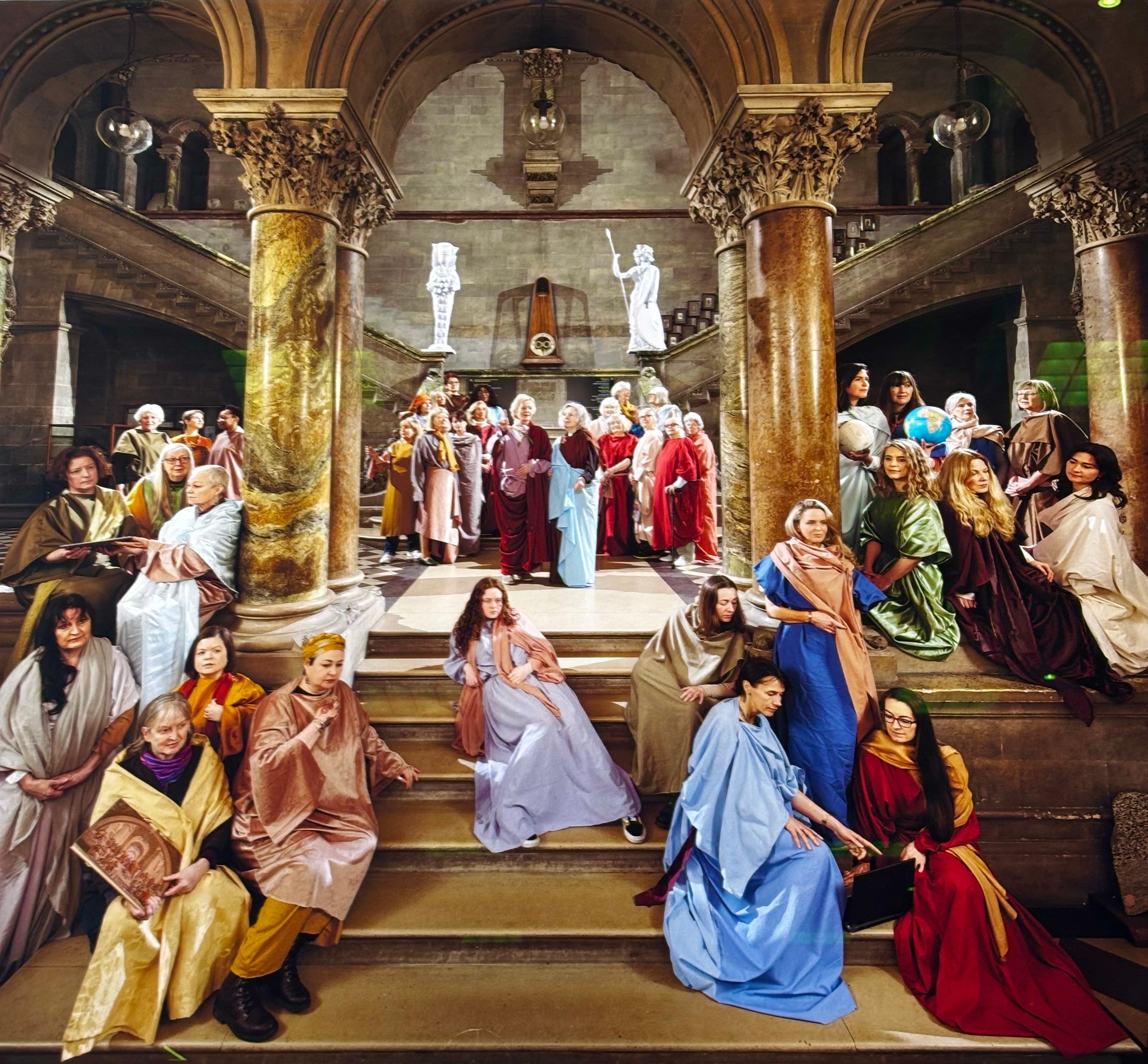
The most effective way to destroy people is to deny and obliterate their own understanding of their history.
― George Orwell
Paid subscribers — this is for you…
Comments
Nothing yet. Say the first thing.
Sign in to join the conversation.