
There’s a lot of conversation online right now about using STE100 to rescue us from WorkSlop and the worst of AI writing.
First, some background. STE100 — actually ASD-STE100, Simplified Technical English — began as a guide for aircraft maintenance documentation. Its focus is reducing ambiguity in technical instructions through things like:
Short, direct sentences
Controlled vocabulary
Consistent terminology
Technical accuracy
Readability for international readers
In a word: clarity.
Which sounds pretty much perfect for removing the fluff from WorkSlop.
I felt this deserved a little more examination.
The thought that drove this: We write for a purpose, to an audience, with content we need to communicate, to achieve an outcome.
In ordinary life, we know that a shopping list is quite different from a recipe or a news article. In my profession, a recommendation to leadership is a different kind of writing from a Pull Request or a Design Document.
So perhaps the question isn’t simply whether STE100 produces clearer writing.
Different writing mechanisms solve different problems.
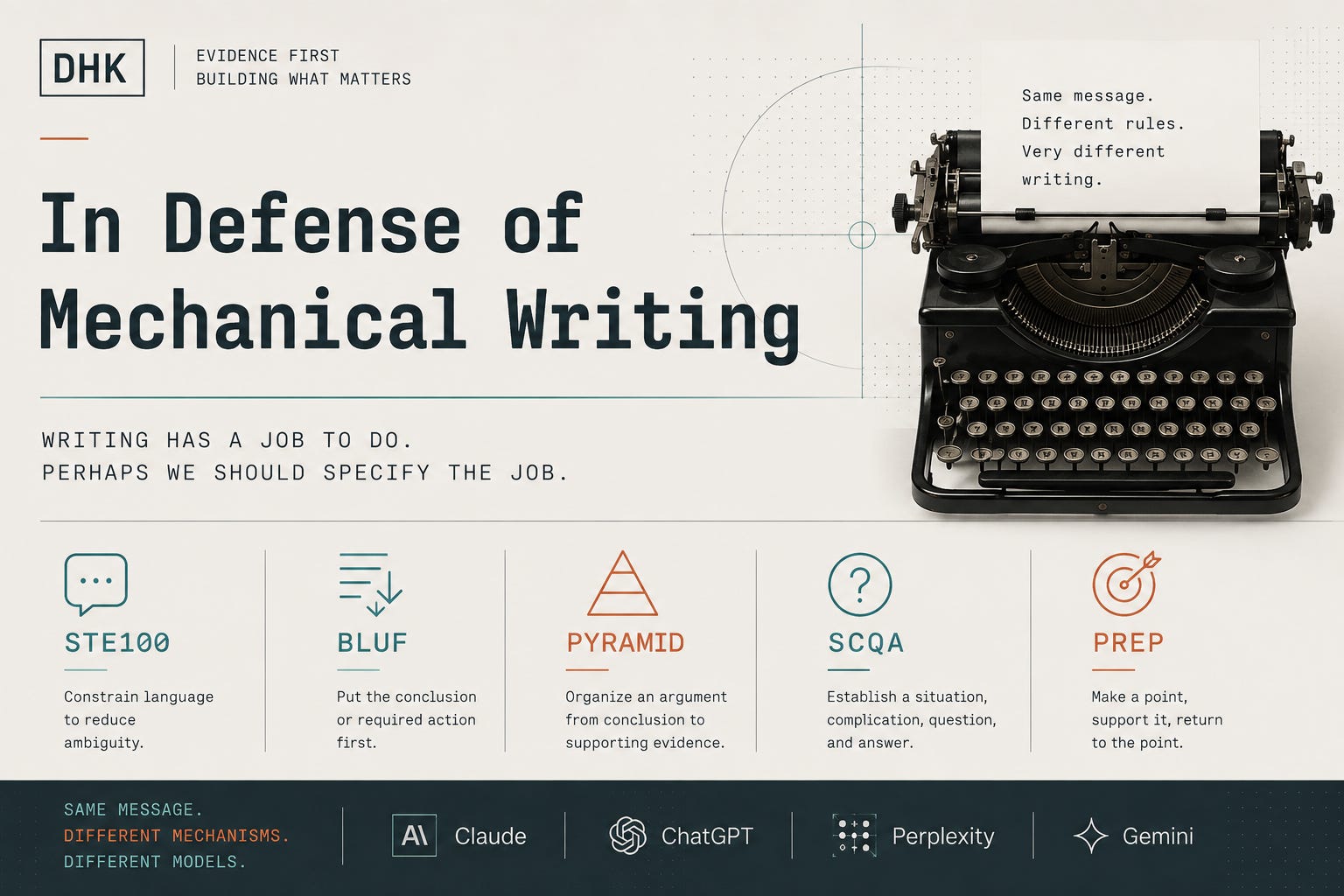
A quick overview of some of the many mechanisms:
STE100 constrains language to reduce ambiguity.
BLUF puts the conclusion or required action first.
Pyramid Principle organizes an argument from conclusion to supporting evidence.
SCQA establishes a situation, complication, question, and answer.
PREP makes a point, supports it, and brings the reader back to the point.
And they aren’t necessarily competitors. You can, for example, write a BLUF in STE100.
Some mechanisms govern the language. Others govern the structure. They solve different parts of the communication problem.
That left me with a few questions:
What does the same piece of writing look like when rendered using each of these mechanisms?
How do they compare when the underlying content, audience, and purpose stay the same?
What happens when different GenAI tools are given the same task?
In other words: same message, different mechanisms, different models.
So, the experiment begins.
Starting with a short piece of workplace writing, I created a single prompt asking each model to render it using the different mechanisms, without changing the underlying facts, recommendation, audience, or required action.
Then I ran the same prompt through Claude, ChatGPT, Perplexity, and Gemini.
I built a small website in Codex in about 15 minutes to put the results side by side.
I’m not here to opine on which is “best”. Instead, look for yourself.
Look at the same message rendered through the different mechanisms. Look at how the different models interpret the same instructions. Some differences are subtle; others are immediately apparent.
Which version communicates the message most effectively?
Which would you actually want to receive?
How would the answer change depending on what the writer is trying to accomplish?
Read a bit. See a bit. Decide for yourself. Let me know what you think.
Comments
Nothing yet. Say the first thing.
Sign in to join the conversation.