
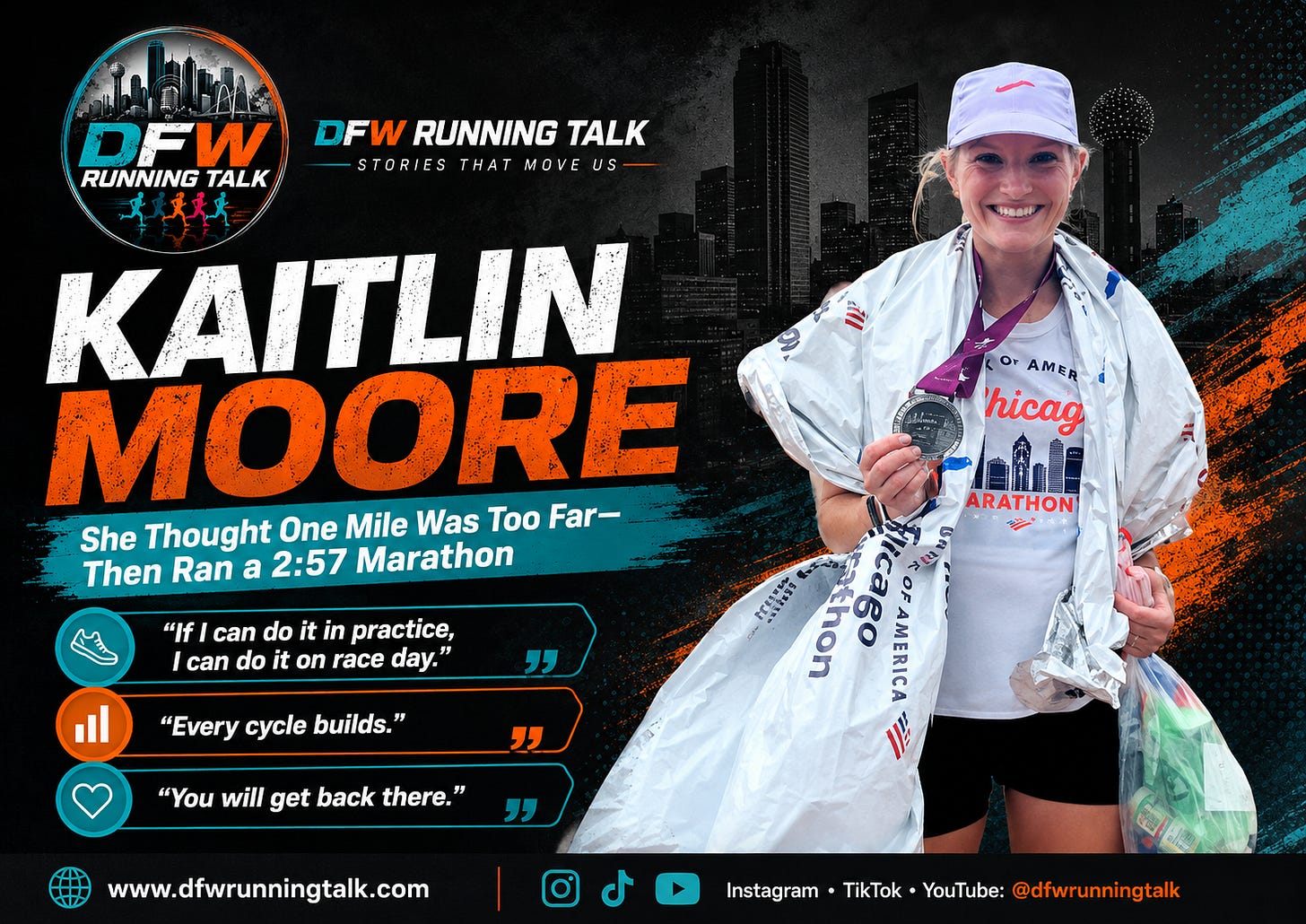
I met Kaitlin Moore in an unusual way: I stopped her during a track workout because she looked fast.
Once we started talking, I knew her story belonged on DFW Running Talk.
Kaitlin grew up playing soccer in Arkansas and later competed at the Division I level for Belmont University. She ran some track in high school, but preferred the 400 and 800. When her coach suggested the mile, she thought it was much too far.
Years later, she would run an entire marathon at roughly 6:45-per-mile pace.
Kaitlin began running more seriously during the pandemic. In 2021, she decided to train for the Dallas Marathon with the ambitious goal of qualifying for Boston.
She did not have a formal plan. She calculated that she needed to run around eight-minute miles—then ran nearly every training run at that pace.
Her longest run reached 23 miles. To make those long runs less lonely, she sometimes ran from one friend’s house to another, piecing together company along the way.
Her reasoning was simple:
“If I can do it in practice, I can do it on race day.”
Kaitlin finished her first marathon in 3:27, earning her Boston qualifying time.
After Dallas, Kaitlin joined Train Pegasus and began learning how to train more effectively. She added track workouts, tempo runs, proper recovery, fueling and different training paces.
The results came quickly:
Dallas Marathon: 3:27
Houston Marathon: 3:08
Chicago Marathon: 3:01
Houston Marathon: 2:57
After running 3:01 in Chicago, Kaitlin knew she could break three hours. She returned to Houston, went out with the sub-three group and finished in 2:57.
She has since run a 1:21 half marathon and a 5:24 mile.
Kaitlin’s improvement has not been linear.
She tore her IT band near the hip after increasing her mileage too quickly. She later tore her hamstring during a track workout and then tore her calf while playing pickleball.
Each injury required time away, physical therapy and a careful return to running.
Today, strength training, mobility work, stretching and rehabilitation exercises are regular parts of her routine. She has also learned that sometimes sleeping in or skipping a workout is better than forcing more miles.
Kaitlin balances training with work, three children and coaching youth soccer. Her husband, Will, helps make the schedule possible, while her running friends provide flexibility, encouragement and friendship.
Some of those relationships now extend far beyond workouts. Their families spend time together, their children play sports together and injured runners still meet the group for coffee.
That community has become one of the most meaningful parts of Kaitlin’s journey.
Her coach, Matt Campbell, describes training as building the area under the curve. Even when one race goes badly or an injury interrupts a season, the work from each training block contributes to what comes next.
Kaitlin summarized it perfectly:
“Every cycle builds.”
Her story is not simply about running 2:57. It is about learning, getting injured, rebuilding and continuing to believe there is more ahead.
🎧 Listen to the full Kaitlin Moore episode on Spotify and Apple Podcasts.
📺 Watch on the DFW Running Talk YouTube channel.
Follow @dfwrunningtalk on Instagram, TikTok and YouTube.
Comments
Nothing yet. Say the first thing.
Sign in to join the conversation.