
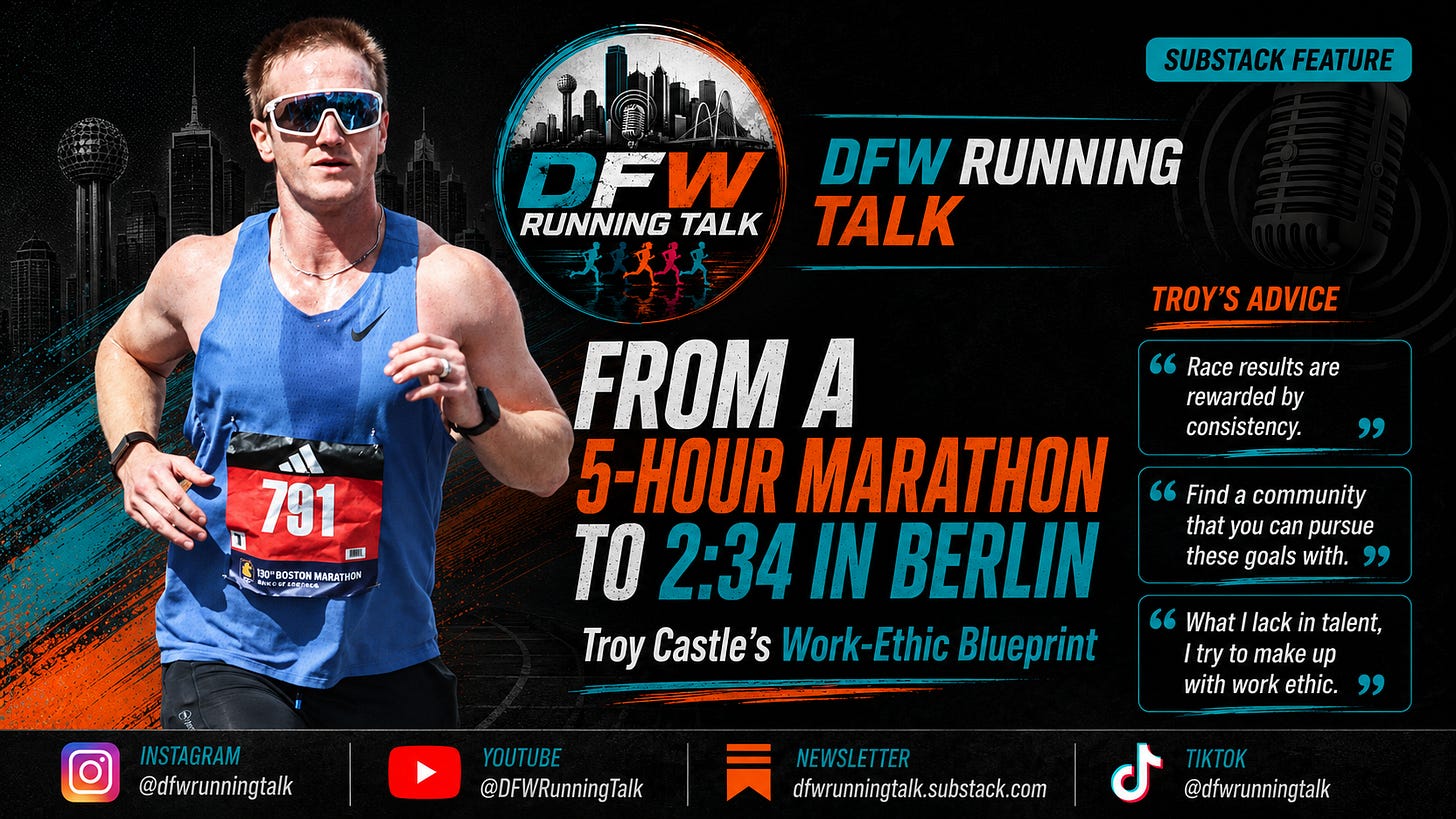
The first time I actually met Troy Castle, I had no idea who he was. He came up to me at the track — “Hey Chris, how’s it going?” — and I turned to a buddy afterward and asked, “Who is that guy?” A week later I was at a WRC run asking around for the hardest worker in the group. Everybody said the same name: Troy Castle.
So here we are.
Troy’s the kind of runner who makes you rethink what’s possible when someone just refuses to stop showing up. He’s a former SMU safety — recruited by June Jones, played in the Birmingham and Hawaii Bowls — a guy built more like a linebacker than a marathoner. And he’s run a 2:34. This is the story of how he got there, and what you can steal from it.
Troy didn’t run distance in high school or college. Football and basketball, with track in the off-season purely to get faster for football. When he graduated from SMU, he missed one thing more than anything else: the training. The weight room, the bleachers, the grind. So he went looking for something new to chase and signed up for the 2016 Dallas Marathon.
No plan. No nutrition strategy. Just “run a lot.” He went out hoping to break four hours, came through the half around 1:45, and then the wheels came off — finishing somewhere around 5 HOURS!
If that sounds familiar, good. That’s most of us. The lesson isn’t “don’t make mistakes.” It’s that everybody’s first marathon is a beautiful disaster, and it still counts as a start.
Troy will be the first to tell you his wife Caroline is the better athlete — an ABCA All-American in volleyball and an all-state swimmer. He found out she made All-American by seeing it on Twitter, screenshotting it, and excitedly texting it to her — only to realize five minutes in that she’d known for a week and was too humble to mention it. Here’s the moment in his own words:
Here’s the part most people skip. Troy didn’t grind marathon miles for years to get fast. He went sideways into triathlon.
His older brother had raced pro triathlon, so Troy dove in — including a very ambitious first race in Cozumel that he’d be the first to say was a steep, “wouldn’t-recommend-it” learning curve. Wife coached the swim (she’s a swimmer, of course). Borrowed bike bag. A ton of Googling. But the real payoff was the bike: by 2020, when the world shut down and racing disappeared, Troy became “best friends with his bike trainer” and put roughly 10,000 miles on the bike that year — more than he put on his truck.
That’s where the diesel engine got built. All that zone-two volume quietly transformed him into an endurance athlete without him ever “running to get better at running.”
The takeaway: cross-training isn’t a compromise. Aerobic volume is aerobic volume, and it compounds.
In December 2019, Troy decided to actually race a marathon for the first time. His logic wasn’t crazy confidence; it was data. He’d been running low-7:00 pace on 20-milers off pure triathlon fitness, and had clocked a mid-3:40s marathon inside an Ironman. He bought a $50 McMillan plan online — his first taste of real, specific run training — and ran a 2:49, qualifying for Boston.
From a 5 hour debut. That’s the power of specificity dropped on top of years of base.
Then, at the 2021 Irving Marathon, he did something he never thought he’d do: he won. Went out hot (his signature move — he’s the “king of positive splits”), grabbed the lead at halfway, and hung on for dear life as the second-place guy — who ran it the right way, evenly split — closed hard down the stretch. Troy took a peek over his shoulder, saw the finish around the corner, and made it by about eight seconds. He’ll tell you he got lucky. I’ll tell you he showed up and won. Watch it:
▶️ How I Won a Race by 8 Seconds
He won it again in 2023. And in Berlin in September 2024 — a flat course, a perfect 52-degree morning after a summer of grinding through Texas heat — everything lined up and he ran 2:34.
Strip away the story and here’s the playbook:
Volume before speed. Years of triathlon and bike miles built the aerobic base everything else sits on. There’s no shortcut around the engine.
Every block starts higher. Even after recovering post-marathon, you don’t start from zero — you start from a higher floor than last time. Fitness compounds across training blocks. That’s the whole game.
Get the half fast. Troy’s now targeting shorter, faster efforts (aiming for a 1:12–1:13 half at the Dallas Marathon) because a quicker half generally translates to a quicker marathon.
Increase mileage, add threshold. His stated marathon “secret” is unglamorous: build mileage smartly, avoid injury, and get in as much threshold work as the weather allows.
Be a sponge. Since joining Completely Slothed, his biggest edge is simply listening to more experienced runners and copying what they do.
Troy trained solo for years and got fast. But what changed everything wasn’t a workout — it was people. A random catch-up at a red light on a solo bike ride turned into a friend named Greg, who eventually pulled him into the Sloths. Now he runs with the group two to three times a week, and he calls it “renewed, revitalized training encouragement.”
He and Caroline make it work with three little kids (four, two-and-a-half, and fifteen months) through one simple house rule: sweat before screens. One takes the 4:45 a.m. shift, the other goes at 6:30. Both get their hour. Both days go better.
His parting advice was the same thing that’s threaded through his entire story:
Find a community to chase your goals with. It makes all of it more fun — and it’s usually the thing that takes you further than you thought you could go.
Next up for Troy: Chicago in October, the Dallas Half in December, and his long-awaited Houston debut in January — where a stacked crew of DFW guys will be chasing that sub-2:30 dream right alongside him.
🎧 Catch the full conversation with Troy Castle on DFW Running Talk. If you’re enjoying these, do me a favor and rate, review, and share — it genuinely helps. See you out there.
Comments
Nothing yet. Say the first thing.
Sign in to join the conversation.