
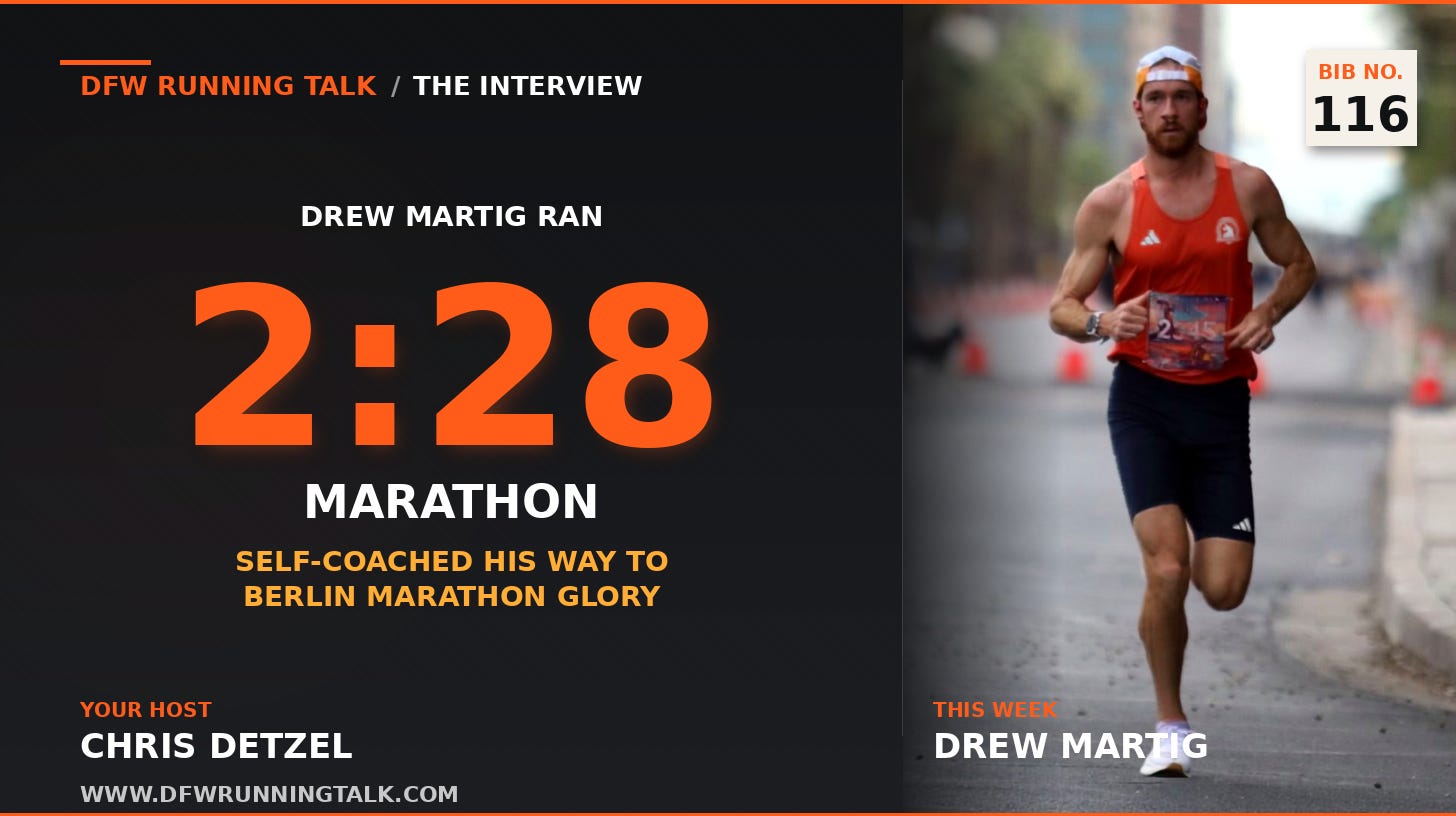
Drew Martig didn’t run a step until he was 27.
Now he’s a 2:28 marathoner.
He didn’t grow up in cross country. He wasn’t a high school standout. His dad was a professional athlete — baseball and football — but as Drew puts it, that gene skipped a generation. He played freshman football, got hurt, and quietly drifted out of team sports.
Then a few years into his corporate career at Checkpoint Software, his CMO walked into the office one day and asked who’d run a 5K with him in a month.
Drew, eager to impress, said yes.
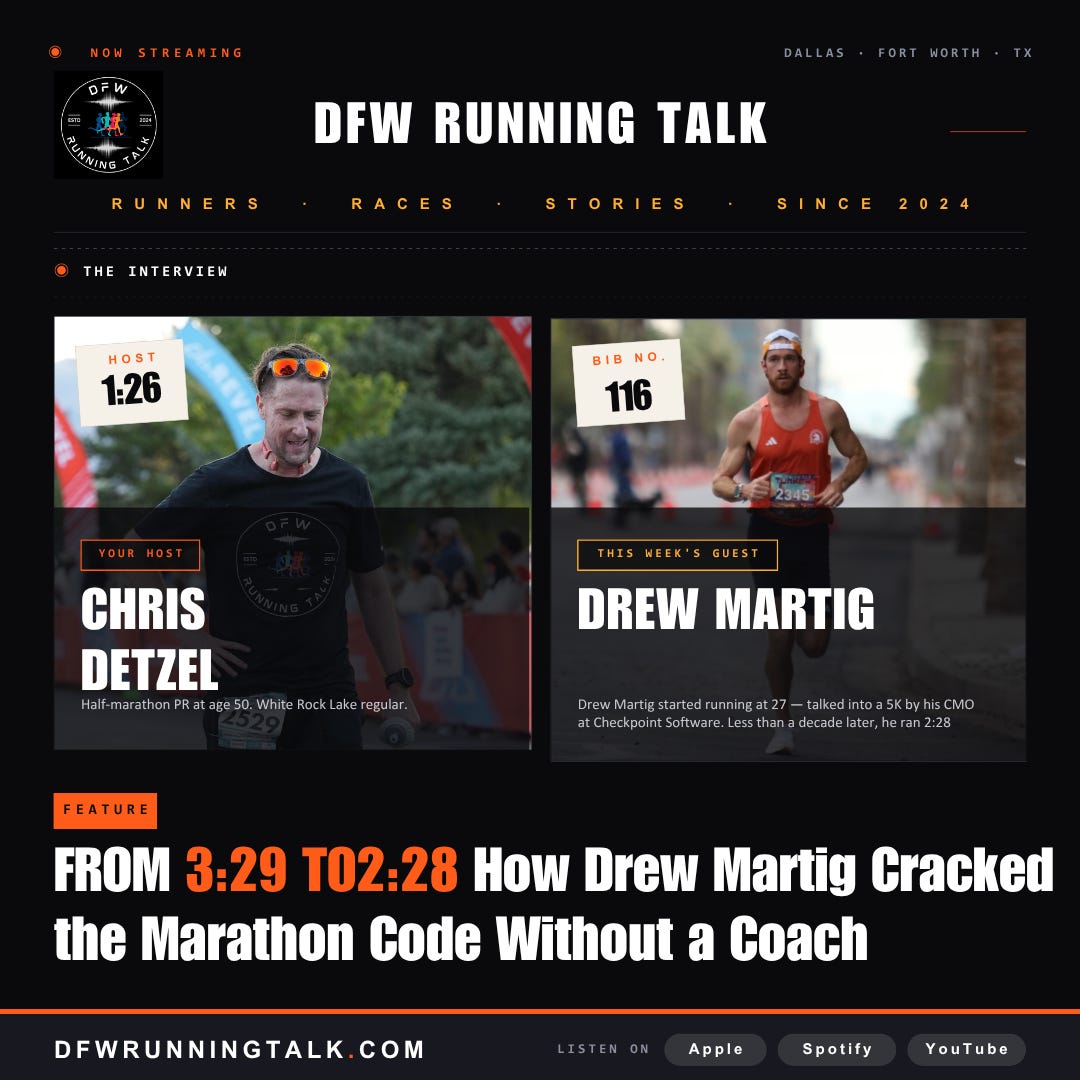
He had no idea what he was doing. His “training” was showing up at a track once a week and running so hard his lungs burned. But something clicked. A 10K followed. Then — somehow — a marathon. CIM, 3:29 off almost no base.
That was about eight years ago.
What happened next is the story I wanted to tell on this week’s episode of DFW Running Talk.
Drew is now a 2:28 marathoner living in Flagstaff at 7,000 feet, self-coached, working a demanding corporate job at Tanium (where, full disclosure, we’re coworkers), raising two kids with a third on the way. He’s done Berlin. He’s targeting Chicago this fall after coming back from a September hernia surgery. He coaches a couple of athletes on the side and runs a growing YouTube channel.
Here’s what stuck with me from our conversation:
Fitness ≠ performance. Drew’s philosophy is that your training builds a level of fitness. Race day is just expressing that fitness. If you’ve done the work, you don’t need to chase arbitrary numbers — you just need to run the race you trained for. That mindset shift took the pressure off and, paradoxically, made him faster.
70 miles is his sweet spot. Not 110. Not 120. He peaked at around 90 during the Berlin build, averaged 80, and feels best at 70. He’s not comparing himself to the Flagstaff pros logging 130-mile weeks. He’s optimizing for his life — kids, work, marriage — and getting more out of fewer miles by being relentlessly consistent.
Altitude is real, but only if you commit. Drew got his blood tested before moving to Flagstaff and a month after. Red blood cell count up. Ferritin up. The full oxygen-transport system measurably improved. But the magic doesn’t happen in a week. The pivot point is three weeks — anything less and you suffer without the gains. For sea-level racing, he picks up 15-20 seconds per mile on his marathon time.
Self-coaching beat structured coaching — for him. Drew worked with John Ranieri, a 2:10-ish pro in Flagstaff, and learned a ton. But the constant pressure to fit a coach’s “ideal plan” into his real life was creating more stress than it solved. When he started designing his own training, he got more consistent, less injured, and saw bigger gains. He admits he might be leaving some performance on the table without external accountability — but the tradeoff has been worth it.
Strength work prevents ~80% of injuries. His made-up number, he admits — but the principle is right. Two days a week, 30 minutes. That’s it. Most runners skip it because “I’m a runner, I need to focus on running.” Drew thinks that’s the biggest mistake at every level, even among elites.
Community beats ChatGPT. We got into AI coaching at the end — apps like Runna, people downloading the first plan that pops up on Google. Drew’s take: AI plans can work if you already have the running skills to make smart day-to-day decisions. But for everyone else, nothing replaces a real person who’s done what you want to do. Even an unpaid mentor. Even just a training partner you call on the phone.
Berlin Marathon, race-day reality. Hip flexor flaring up in taper. Freezing cold start. Pinned in a cattle corral with 50,000 people. First mile at six-minute pace because he couldn’t move. He hopped a fence, got out, and negative-split the rest of the race by a full minute. 2:28. That’s what trusting your fitness looks like.
What’s next for Drew: Pat’s Run in Tempe (Pat Tillman Foundation — great cause), a downtown Flagstaff mile on the 4th of July at 7,000 feet, and Chicago Marathon in the fall.
The full episode is up now on Spotify, Apple Podcasts, and YouTube. If you’ve ever felt like you needed to be a lifelong runner to get fast, or that your mileage isn’t high enough, or that you can’t fit serious training around a real job and a real family — Drew’s story is a useful reset.
Run easy this week.
— Chris
Subscribe on Substack · [Listen on Spotify] · [Watch on YouTube]
🎧 Listen on Apple Podcasts 🎧 Listen on Spotify 📺 Subscribe on YouTube 👥 Join 11,000+ runners on Facebook 📸 Follow on Instagram 🎵 Find us on TikTok 📋 Build a free training plan — 5K, 10K, half or full marathon 🏃 Find a running coach near you 👟 Find a running club near you 🗓 Find a race near you 🎮 Play the Marathon Majors Game
Comments
Nothing yet. Say the first thing.
Sign in to join the conversation.