
“How do we train people who don’t have time for training?”
I hear this question all the time from L&D and HR teams. And it’s a fair one.
Deskless workers spend their shifts serving customers, stocking shelves, caring for patients, building buildings, and responding to unexpected challenges. Every minute away from the job carries a cost that extends beyond labor spend. Plus, they tend to have limited device access, making them even more difficult to reach with information.
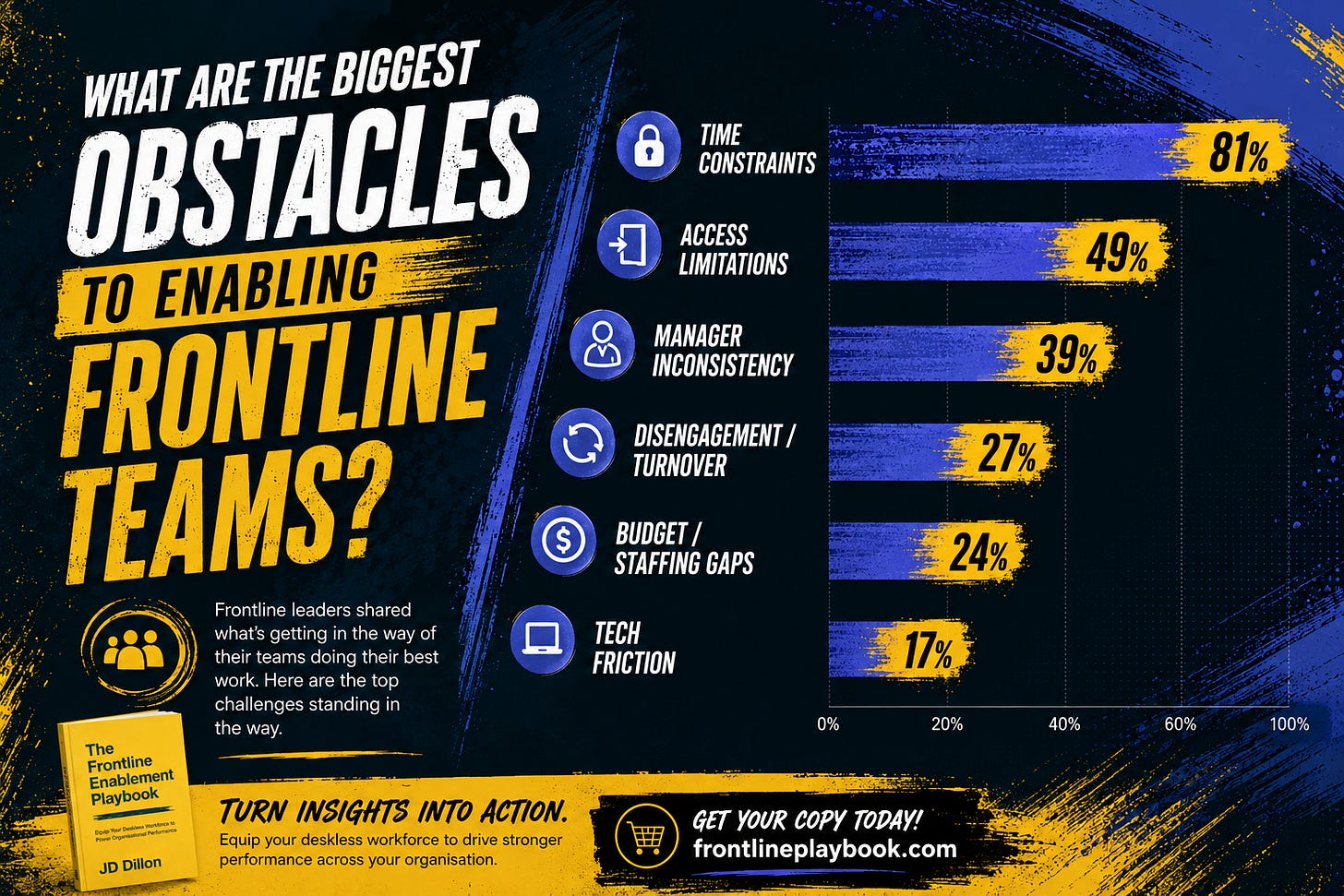
Corporate training was not designed for this reality.
For years, we’ve searched for ways to make training fit the frontline. We shorten content. We make it available on mobile devices. We search for new channels, new technologies, and new ways to reach people in the moments they have available.
But what if time is just a symptom of a much deeper problem?
Too many organizations view frontline enablement as a distraction. Training means lost productivity, coverage challenges, and additional labor costs. As a result, we’re constantly searching for a few minutes between customers, patients, deliveries, and service calls to help people improve.
I understand this mindset … because I used to think this way too.
When I was an operations manager, L&D wasn’t a team I turned to for help. They were the people who scheduled my employees for classes I didn’t know about and pulled them away from an operation that was already short-staffed. L&D made my difficult days even more difficult.

Training didn’t help me hit my goals. It was just another demand competing for my attention.
Organizations make time and spend money on activities that deliver clear value. Nobody questions safety inspections because they understand the risks of injury and fines. Nobody questions maintenance because they understand the cost of equipment failure. Nobody questions inventory audits because they understand the financial consequences of poor execution.
The connection between the activity and the outcome is obvious. L&D rarely comes with the same clarity.
For decades, we’ve conditioned people to think of development as classes, courses, workshops, and programs. We’ve taught them to associate learning with time away from work rather than improved performance at work. So when business pressures increase, development is one of the first things pushed aside.
Employees often carry a similar perspective. Most frontline workers aren’t asking for more training. They’re looking for ways to do their jobs better, solve problems faster, stay safe, reduce frustration, and create opportunities for themselves. If they can clearly see how your solution helps them achieve those goals, they’ll engage. If they can’t, they’ll tune out just like management.
Rebuilding enablement to fit into the flow of work is critical because organizations aren’t going to redesign their operations to accommodate L&D. But making tools, resources, and support more accessible doesn’t automatically create engagement. People still need a reason to offer their time and attention.
I recently had the opportunity to speak with hundreds of frontline enablement professionals at ATD26, the world’s largest talent development conference. I can only cover so much ground during an hour session, so I invited attendees to submit questions digitally. I then answered every question in a virtual Q&A video on my LearnGeek YouTube channel.
Most of the questions were tactical. People asked about device access, time constraints, training engagement, leadership buy-in, and reinforcement methods. But rather than focusing on tools, formats, or delivery methods, I kept coming back to the core challenge: how do we foster a culture where frontline enablement is valued, prioritized, and embedded as part of the job?
Right-fit tactics still matter, but they only work when supported by a culture that values development, reinforces expectations, and holds people accountable for performance.
Here are a few ideas I explore in the Q&A.
Put deposits in the bank. Don’t expect people to give you time. Earn it. Find small but meaningful problems that make work easier, reduce frustration, improve performance, or help managers hit their goals. Solve one problem. Then solve another. Over time, people stop viewing L&D as the group that adds work and start viewing you as a partner that helps them succeed.
Foster accountability on the job. Too often, we measure participation instead of performance. We focus on who completed the training and have no idea if people apply what they learned on the job. One of the most powerful and overlooked forms of reinforcement is peer accountability. Equip trainers and experienced employees to support coworkers, reinforce standards, and correct poor habits. When people hold one another accountable for doing the job right, enablement becomes a shared responsibility rather than an L&D initiative.
Make reinforcement part of the operation. Managers are already burned out. We often make it worse by asking them to support L&D projects. Instead, give them simple ways to reinforce performance on the job. When I managed theme parks, I was required to ask team members one reinforcement question every shift. It took less than a minute, but it helped identify knowledge gaps, spark coaching conversations, and build confidence that employees were ready to handle challenges in the moments that matter.
Elevating frontline enablement doesn’t require new technology, a bigger budget, or the perfect training program. It starts with helping people see the connection between the value we provide and the outcomes they care about most.
It’s easy to get wrapped up in familiar frontline challenges: limited time, low engagement, lack of buy-in, and restricted access. We’ve been having many of the same conversations for years. And it’s frustrating when you invest months building programs that employees don’t complete, managers don’t reinforce, and stakeholders don’t prioritize.
If we want people to see the value of frontline enablement, we need to embrace a new perspective first.
Your frontline team doesn’t need the perfect solution. They need the right solution. They need help solving problems, reducing frustration, building confidence, and making their day a little easier. When you consistently deliver that kind of value, people stop viewing enablement as another request competing for their attention and start seeing it as a resource that helps them succeed.
Over time, you stop being the person who delivers training and become a trusted partner in delivering results. You don't need to ask for a seat at the table because you’re shaping the conversation.
And when that happens, you’ll be surprised how often people start coming to you for help — and how much easier it becomes to find the time.
Comments
Nothing yet. Say the first thing.
Sign in to join the conversation.