
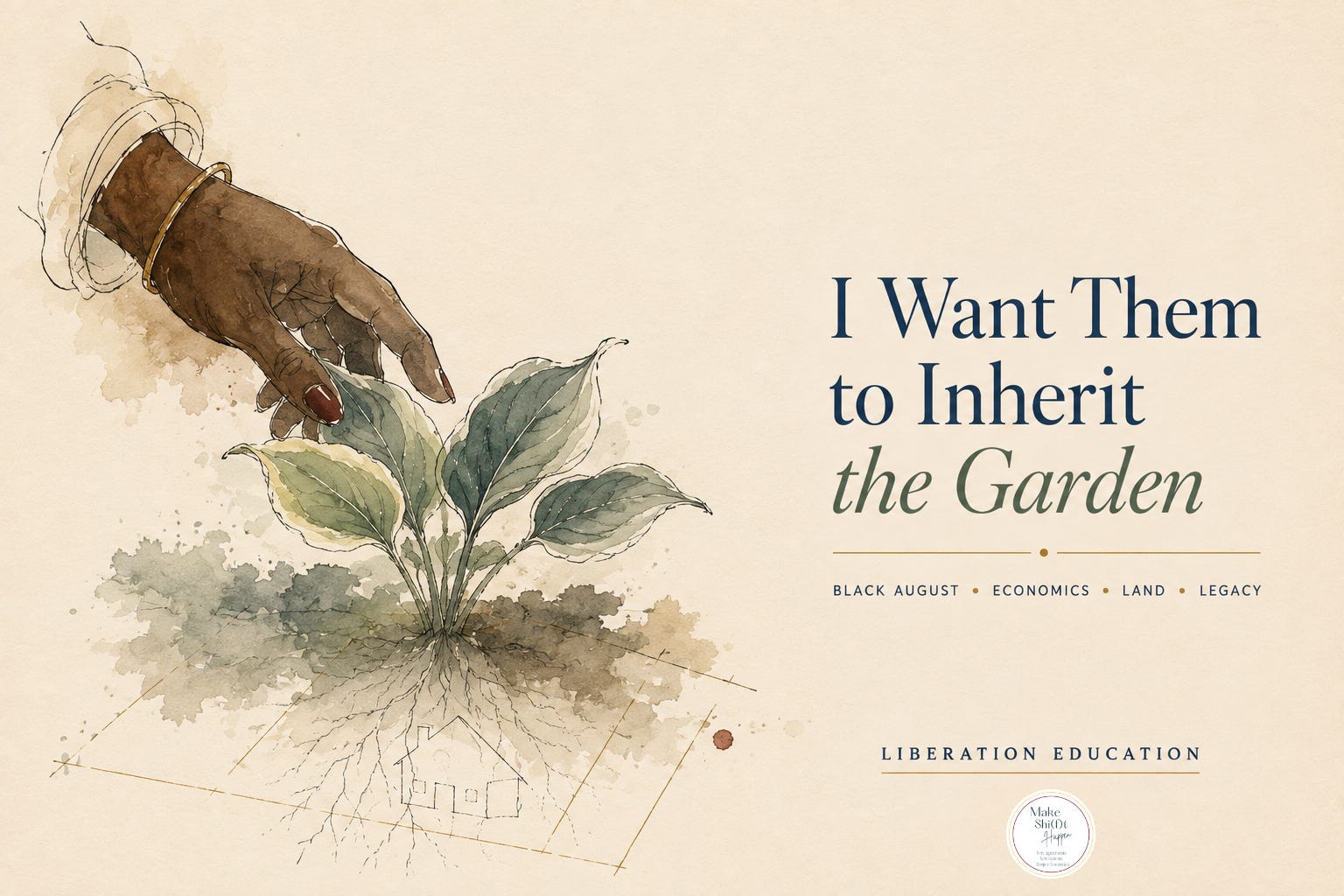
If the people who kept a community alive can no longer afford to remain once everyone else decides it is valuable…who was the “revitalization” actually for?
Yesterday I went into the store to buy some sweet treats and wound up spending a $110…
Listen. 😂
ADHD and impulse spending are a chaotic combination, and because I know this about myself, I have developed a completely scientific economic policy wherein if (more like when) I spend money impulsively, I try to offset it by scoring something for free.
Do not ask an economist about this.
Anywho, I found an electric fireplace for free, and it is going into the cottage where I will be recording my podcast Let’s Have The Conversation, because apparently I will now be having literal fireside chats.
I love that for me.(and you)
But going to pick it up took me through Atlanta’s Westside.
And somewhere between getting my free fireplace and driving through neighborhoods I have known for years, something shifted.
I’ve lived in Atlanta for about twenty years now. Long enough to watch this city change, shift, and morph. Long enough to remember places before somebody discovered they were up-and-coming.
My children’s great-grandmother owned a home not far from there.
Years ago, we took our shared eldest to see it. Nobody was home (it was empty), so we simply sat outside for a while, letting them be in a place that belonged to their history.
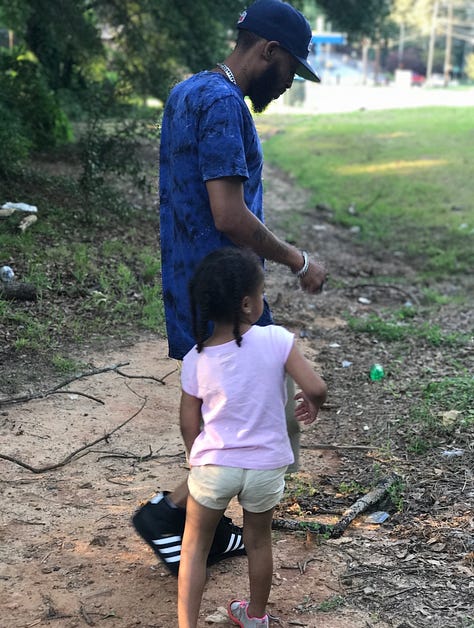
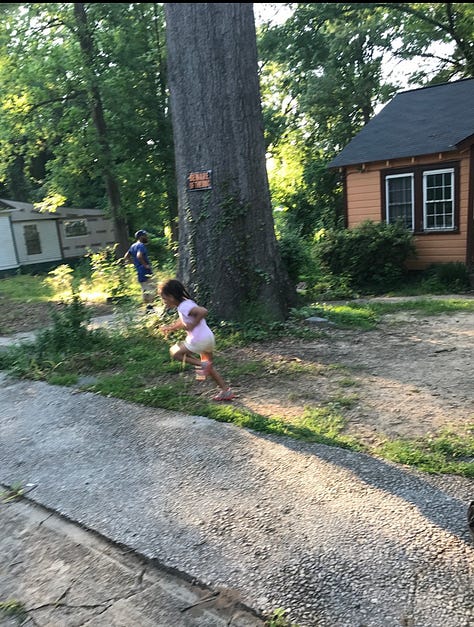

Grandma’s hostas were still there.
That matters to me.
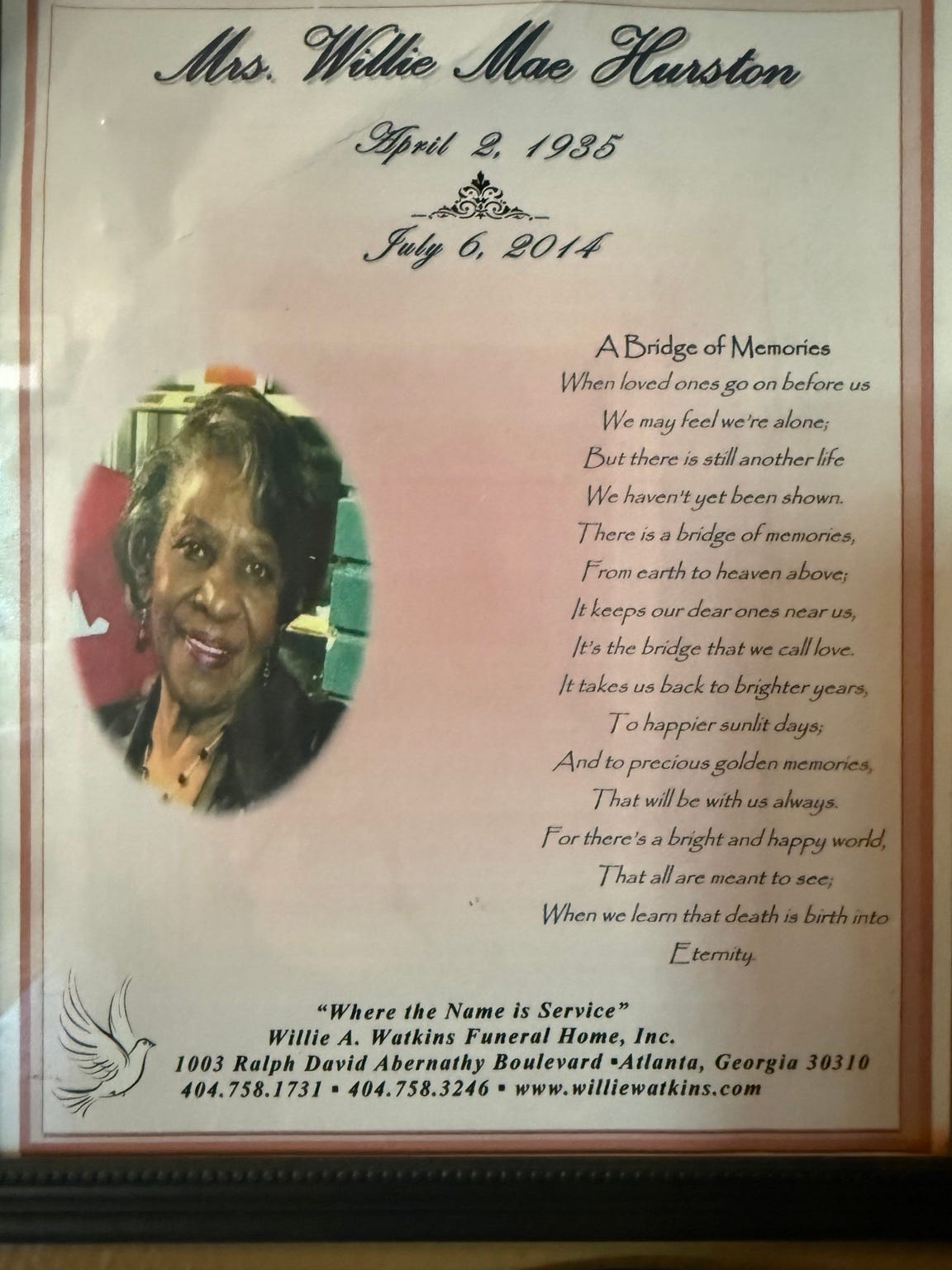
Her name was Mrs. Willie Mae Hurston.
April 2, 1935 — July 6, 2014.
The kids’ great-grandmother.
And before she becomes a metaphor in this story about land and legacy, I want to make sure I name her as a person.
Grandma Willie Mae.
A Black woman who lived here.
Raised family here.
Loved plants here.
Put her hands in this Georgia soil and planted things she expected to grow.
So when I tell you her hostas were still there, I am not talking about landscaping.
I am talking about evidence.
A living little (re)membering that says:
Willie Mae was here.
She loved plants, and somehow, after the house changed hands, after the neighborhood changed, after somebody came through and “revitalized” the property,
her hostas remained.
I’m planning to go back.
Because this is Black August, and we have been talking about economics, and I cannot stop thinking about what it means for pieces of us to remain on land we no longer own.
And before I go any further, there is another truth this land requires me to hold.
Black people were not the first people displaced from this Georgia soil.
Long before Hunter Hills, long before Atlanta, long before Black families fought to put their names on deeds here, Indigenous peoples lived with, tended, and belonged to these lands. The Muscogee (Creek) people were forcibly removed from much of what is now Georgia through settler colonialism, land seizure and state violence.
That history does not diminish the significance of Black land ownership.
It complicates it.
Because liberation requires us to be able to hold more than one truth at the same time.
Black people building Hunter Hills in the face of segregation and racist housing policy was resistance.
And the land upon which that resistance became possible carries an older history of dispossession.
We cannot critique displacement only from the moment it happens to us.
If I am asking what it means for Black people to have the right to remain, then I must also (re)member those who were denied that right before us.
The land (re)members them, too. 🌬️
We use these words as though they mean the same thing.
They don’t.
Revitalization asks: What does this community need to thrive?
Gentrification asks: What would make this community more valuable to people with more money?
Those can produce some of the same things.
Grocery stores.
Parks.
Sidewalks.
Coffee shops.
Public transportation.
Renovated houses.
Investment.
Infrastructure.
None of those things are inherently bad.
Black neighborhoods deserve beautiful parks.
We deserve grocery stores with fresh food.
We deserve safe streets, good schools, functioning infrastructure, thriving businesses and houses that appreciate in value.
The problem isn’t that historically disinvested Black communities finally receive investment.
The question is:
Who gets to benefit from the investment?
Because if I improve your neighborhood until you can no longer afford to live there, I did not improve your neighborhood for you.
I improved the land beneath you for somebody else.
And that distinction matters.
There is another phrase I want us to become familiar with:
legacy residents.
These are the people whose lives, labor, families, and community relationships existed in a neighborhood before everybody suddenly decided the neighborhood was desirable.
They are the grandmother, or in this case, the great-grandmother, whose hostas are still growing.
The family who bought their brick ranch in 1953.
The neighbor who knows who used to live in every house on the block.
The people who remained through the decades when banks would not lend there, businesses would not invest there, and governments allowed infrastructure to deteriorate.
And here is the economic violence we rarely name:
The people who maintained a community through its period of disinvestment are often the people least able to afford its period of reinvestment.
Sit with that.
We praise them for surviving abandonment and then call their displacement the natural consequence of progress.
That is not progress.
That is extraction.
That is what I was thinking about when I found myself driving through Hunter Hills.
Hunter Hills is particularly important because this isn’t simply a neighborhood Black people moved into after white flight.
Black people built it.
Black contractors.
Black families.
Black people intentionally creating access to modern homeownership during an era when American housing systems were explicitly designed to restrict where we could live, borrow and own.
And now this historically Black community sits amid the enormous economic transformation happening across Atlanta’s Westside.
The BeltLine gets closer.
Development follows.
Property values rise.
New construction appears beside old ranch-style homes.
Homes enter price ranges the people who originally built this community could scarcely have imagined.
And we are told the neighborhood is in transition.
Atlanta has always had such pretty language for Black displacement.
And sitting there, I wrote this:
I can hear the souls of Black folks
in the hidden corners
of what’s called Hunter Hills.
Not ghosts.
Souls.
There is a difference.
Ghosts are what we call the dead
when we are afraid they might still be here.
Souls are what remain
when somebody loved a place enough
to leave themselves in it.
And these folks are still here.
In the red Georgia clay.
The old trees.
The brick ranches built low and wide.
Porches made for sitting
and screen doors that let
the whole neighborhood know
somebody was frying fish.
I can hear children being called home
before the streetlights come on.
Dominoes slapping.
Gospel through an open window.
Somebody’s uncle under a hood
telling a child,
hold the damn flashlight still.
Black life.
Ordinary and sacred.
Because Hunter Hills was not
a neighborhood white folks abandoned
and Black folks inherited.
Black folks built this.
Black contractors.
Black families.
Black money saved dollar by dollar
in a country that had already decided
where we could live,
where we could borrow
and what we were permitted to own.
And still—
some Black family stood
on this Georgia dirt
and imagined a house.
A yard.
A key.
A deed with their name on it.
Do you understand
how revolutionary
a front door can be?
They built a neighborhood
because America would not let them inside of hers.
And now America wants theirs.
They call Hunter Hills
a neighborhood in transition.
Atlanta has always had
such pretty language
for Black displacement.
Revitalization.
Development.
Coming Soon.
Luxury.
As though we have not
already been here.
As though a neighborhood becomes valuable
only after somebody else discovers it.
The old brick house
beside the new construction.
The vacant lot
beside the house approaching
three quarters of a million dollars.
The BeltLine gets closer.
Property values rise.
And somehow the descendants
of people who fought
for the right to own here
must fight again
for the right to remain.
This is the particular cruelty of it:
Black people built a place
to escape exclusion
only to watch inclusion arriving
carrying a purchase agreement.
But Hunter Hills
is not an obituary.
Black folks are still there.
Still tending yards.
Still owning homes.
Still organizing.
Still resisting the quiet suggestion
that progress requires our disappearance.
So when I say
I can hear the souls of Black folks
in the hidden corners of Hunter Hills,
I am not only listening backward.
I am listening for instructions.
Because memory is not just
evidence that we existed.
Memory tells us what we must protect.
The land (re)members.
The houses (re)member.
The people (re)member.
And beneath all the construction,
all the development plans,
all that pretty language
about what Atlanta is becoming—
I can still hear them:
Baby, we built this!
And this time,
we intend to remain.
Before we move on, stay here for a moment.
If you feel grief, let yourself feel the grief.
For the homes lost.
The neighborhoods changed.
The people displaced.
The gardens we can no longer return to.
Notice where that loss lands in your body.
A heaviness?
A tightening?
Heat?
Tears?
Anger?
You do not have to fix it.
And if shame comes with it (I should have known. I should have done more. I benefited. I didn’t pay attention) see if you can loosen your grip on that, even just a little.
Shame is not the action. Awareness is.
Take one breath and let yourself grieve what deserves to be grieved.
Then ask:
Now that I know, what is mine to do?
Not everything.
But something.
Carry that with you.
We are going to practice.
This is why I keep returning to economics during Black August.
Liberation cannot only be about our ability to gain access.
It has to include our ability to remain.
To own.
To inherit.
To transfer.
To rest.
To build something our children do not have to rebuild from nothing.
We talk a lot about Black resilience.
But resilience is expensive.
Every generation should not have to demonstrate liberation by surviving another extraction.
Our ancestors fought for the right to own homes and build security within a property system that had excluded them.
Their children fought to keep them.
Their grandchildren should not have to compete with private equity, speculative investors and six-figure cash offers simply to remain connected to what their families built.
And this connects directly to something else I have been thinking about:
We cannot build a politics where Black people are perpetually praised for how much we can sacrifice.
Give more.
Work more.
Organize more.
Survive more.
Lose more.
Start over.
Again.
And again.
And again.
That is not liberation.
If the only way a community can remain accessible is because somebody is constantly subsidizing everyone else with their exhaustion, that isn’t sustainable community care.
And if the only way Black people can remain in the communities we built is by continually outperforming an economic system designed to extract from us, that isn’t economic liberation either.
Liberation cannot only teach us how to build.
It must teach us how to keep.
How to steward.
How to inherit.
How to transfer wealth without transferring trauma.
How to invest in communities without displacing the people who made those communities worth investing in.
How to welcome change without requiring disappearance.
Because perhaps the economic question of Black August is not simply:
How do Black people build wealth?
Perhaps it is also:
How do we create the conditions where Black people get to keep what we build?
My children’s great-grandmother’s hostas are still growing outside a house she no longer owns.
I keep coming back to that.
Something she planted remained.
And I want more for us than that.
I don’t want our descendants only finding traces of us in somebody else’s yard.
I want them to inherit the garden.
Praxis is where we stop agreeing with the analysis and ask:
What am I going to do because I know this now?
Because if we agree that legacy residents should be able to remain in the communities they built, then our politics should reflect that.
And there are things we can actually fight for.
Learn whose land you are standing on.
And I mean further back than the neighborhood’s current name.
Learn the Indigenous history of the land and the people who stewarded it before removal and dispossession, broken treaties and the lies that built this land. Then learn the history of the community that grew there.
If you moved into a historically Black neighborhood because it was affordable, beautiful, convenient or “up-and-coming,” learn its history.
Who built it?
Who remained when investment left?
Who owned the businesses?
What happened to property values before you arrived?
And pay attention to the language you use.
A neighborhood was not discovered because you found a coffee shop there.
It was not revitalized because people with more money arrived.
There was already life there.
If you are a homeowner (especially an elder or legacy homeowner), find out what protections you qualify for before you need them.
Homestead exemptions.
Property-tax relief.
Estate planning.
Heirs’ property assistance.
Home-repair programs.
Anti-displacement funds.
Predatory investor protections.
And then help somebody else do the same.
Sometimes community care looks like sitting at your auntie’s kitchen table with a laptop and helping her fill out the damn paperwork.
That counts.
This is where I want us to get political.
Ask your city councilperson, county commissioner, neighborhood planning unit and candidates seeking your vote:
What is your plan for keeping legacy residents in place when public investment increases surrounding property values?
Not:
Do you support affordable housing?
That’s too easy.
Ask specifically.
Do you support property-tax protections for legacy homeowners?
Will affordable units created with public money remain affordable permanently, or only for a limited affordability period?
Do legacy residents receive priority in publicly subsidized homeownership programs?
What protections exist for legacy renters?
What percentage of development around major public investments is actually affordable to people who already live there?
Are public dollars financing development that contributes to displacement?
Who owns the land after “revitalization”? And what do we mean when we say ownership?
Follow the money.
Because zoning is political.
Property taxes are political.
Transit is political.
Tax incentives are political.
Development subsidies are political.
Who gets to stay is political.
And when legislation involving housing, zoning, tax allocation districts, affordability requirements or development incentives comes before your local government—
show up.
Send the email.
Make the phone call.
Submit the public comment.
Attend the meeting.
Ask the uncomfortable question:
How does this proposal ensure the people who survived this neighborhood’s disinvestment get to benefit from its reinvestment?
Then wait for an actual answer.
And if you live in Atlanta specifically, learn about the anti-displacement programs that already exist and tell somebody who might qualify about them.
Information that never reaches the people who need it is not access.
That can be praxis too.
Not saving anybody.
Not speaking over legacy residents.
Not deciding what a community needs from the outside.
Helping people access the tools, money, policy and power that make remaining possible.
I don’t want to tell you to get involved and then leave you to figure out what the hell that means.
Years ago, Safi Harriott held space in my online community specifically around getting—and staying—active. One of the lessons from that work remains important here:
Do the small thing.
You do not need to become a housing-policy expert today.
Pick a doorway.
Start with Native Land Digital to begin learning about the Indigenous peoples and territories connected to where you live:
Native Land Digital: native-land.ca
And remember: the map is a beginning, not the end of your research. Follow the names you find. Find the Nations themselves. Learn from their own websites, cultural centers, historians and resources.
If you are in Atlanta/Fulton County:
Fulton County Homestead Exemptions
Check whether you (or an elder in your life) are receiving every property-tax exemption for which you qualify.
Invest Atlanta Anti-Displacement Tax Relief Fund
Learn about Atlanta’s program designed to help eligible legacy homeowners with property-tax increases. The program is not accepting a new 2026 application round while previously submitted applications are being reconsidered, but this is a program worth knowing and watching.
Atlanta Heirs Property Prevention & Resolution Initiative
Heirs’ property can make generational land vulnerable when ownership and title become tangled across generations. Invest Atlanta’s initiative connects eligible homeowners with estate-planning and legal services for wills, trusts, clear title and other property issues. Georgia Heirs Property Law Center
And this is where praxis can become beautifully ordinary:
Sit down with an elder (in any and ALL states) and ask:
Do you have your homestead exemption?
Is your name properly recorded on your deed?
Do you have a will?
Do you know what will happen to this house when you die?
Are you getting letters, calls or texts from people trying to buy your house?
Do you want help figuring any of this out?
Then listen.
Do not take over.
Help them access what they want.
If you live in Atlanta, find your Neighborhood Planning Unit (NPU).
Atlanta is comprised of over 240 unique neighborhoods, which are grouped in to 25 Neighborhood Planning Units, or NPUs. Where residents participate in conversations about zoning, land use and development.
You don’t have to walk in knowing parliamentary procedure.
You can literally start by showing up and listening.
Then, when development is proposed in a historically Black community, ask:
How will this development affect the people who already live here?
What percentage of these homes will be affordable to the current residents of this neighborhood?
What anti-displacement protections accompany this investment?
What happens to renters when surrounding property values increase?
What public money or tax incentives are being used for this project?
How are legacy residents participating in this decision?
And my favorite:
How does this proposal ensure that the people who survived this community’s disinvestment get to benefit from its reinvestment?
Make them answer the actual question. If they can’t, learn more about Atlanta’s City Council
You have my full permission to copy, paste, and personalize this:
Subject: Protect Legacy Residents From Displacement
Hello [Councilmember/Commissioner/Representative Name],
I am a resident of [neighborhood/district] writing because I am concerned about displacement accompanying development and public investment in historically Black communities.
I support investment in our neighborhoods. I also believe the people who maintained these communities during decades of disinvestment should be able to benefit from that investment.
I would like to know what policies you currently support to:
protect legacy homeowners from displacement caused by rising property taxes;
protect legacy renters from displacement;
preserve long-term and permanently affordable housing;
prevent heirs’ property and tangled-title issues from contributing to Black land loss;
ensure publicly subsidized development benefits existing residents; and
give legacy residents meaningful decision-making power in development affecting their communities.
Specifically, how are you measuring whether development is allowing existing residents to remain, rather than simply measuring how much investment enters the neighborhood?
Thank you. I would appreciate a substantive response outlining the policies, legislation or funding mechanisms you support.
[Your Name]
[Neighborhood / ZIP Code]
And because sometimes an email feels like too much:
“Hi, my name is ____ and I live in ____. I’m calling because I want to know what Councilmember/Commissioner ____ is doing to prevent displacement of legacy residents as property values and development increase. Specifically, I want to know what they support around property-tax protection, affordable housing, renter protections and keeping legacy residents in their communities. Can someone from the office follow up with me?”
That’s it.
You made the call.
If making political calls is new for you, 5 Calls can also help you find representatives and provides issue-based calling tools and scripts.
If you’re trying to find organizations already doing work rather than inventing your own initiative, Mobilize can help you find volunteer opportunities and events.
And go back to Safi’s guide:
Find you Representative’s contact info here: https://www.house.gov/representa.../find-your-representative
Find your Senators’ contact forms here: https://www.senate.gov/senators/senators-contact.htm
Find your state legislator here: https://openstates.org/find_your_legislator
Because the goal is not to become the person who reads every terrible thing happening in the world.
The goal is to become someone who has developed a practice of participation.
Small.
Consistent.
Sustainable.
In community.
Because praxis isn’t knowing the right words.
Praxis is what you do because now you know.
And because praxis was never meant to be solitary work, we gather on the 19th of every month to Practice Your Praxis.
This is one of the community spaces I host specifically for moving us beyond I read it. I agree. I learned something. and into:
Okay. What does knowing this require of me now?
We take conversations like this one—theory, history, systems, the things happening in our homes and communities—and practice becoming actionable in what we say we believe.
You do not have to arrive as an activist.
You do not have to know all the language.
You do not have to have the “right” answer.
Come with your questions, your capacity and a willingness to practice.
Because liberation is not something we become intellectually proficient in.
It is something we practice.
Mondays are always free at Liberation Education.
I believe there should always be a doorway into this work that does not require money to enter. So every Monday, I publish a free Liberation Education article like this one: something to help us learn, question, (re)member and practice together.
If this work supports you and you have the capacity, become a paid subscriber.
Paid subscriptions don’t simply purchase more writing. They help sustain the research, education, tools and community spaces that make this ecosystem possible, and help me continue keeping a free doorway open for people who cannot pay.
And if cost is the thing standing between you and deeper participation, there is a scholarship option. Scholarships@DesireeBStephens.com
Please use it.
Access should not depend on somebody else’s depletion, but neither should liberation education belong only to the people who can comfortably afford it.
Those of us with greater capacity help make room for those with less.
That, too, is community practice.
I keep coming back to those hostas. (I’ve been wanting to go back for years)
My children’s great-grandmother planted them.
The house changed hands.
The neighborhood changed.
Atlanta changed.
And somehow…
the hostas remained.
There is something beautiful about that.
But there is also something deeply insufficient about it.
Because I do not want Black legacy to become the little pieces of us that somebody discovers after we are gone.
A rosebush.
A pecan tree.
A church cornerstone.
A photograph in an archive.
A mural painted on the side of a luxury apartment building.
Evidence that says:
Black people used to live here.
I want more than remembrance.
I want retention.
I want inheritance.
I want the child whose grandmother planted the hostas to be able to sit on the porch and tell their own children who planted them.
I want development without displacement.
Investment without extraction.
Revitalization without removal.
I want Black communities to receive resources while Black people are still there to enjoy them.
Because Black liberation cannot be measured only by what we manage to build after being denied everything.
And it cannot keep requiring us to become martyrs to preserve what we have already built.
We should not have to exhaust ourselves proving that we deserve to remain.
Our elders should not have to become housing-policy experts to keep the homes they spent forty years paying for.
Our children should not have to become extraordinarily wealthy simply to return to the neighborhoods that raised their parents.
The right to build means very little without the right to remain.
So yes…
I am going back to see whether those hostas are still there.
I want to stand in front of that house again.
I want to remember the Black woman who put her hands into that Georgia dirt and planted something she expected to grow.
But I want more for us than leaving behind proof that we were here.
I don’t want our descendants finding traces of us in somebody else’s yard.
I want them to inherit the garden.
In solidarity and liberation,
Desireé B. Stephens, CPS-P
Somatic Educator | Counselor | Community Builder
Founder, Make Shi(f)t Happen
Writer of Liberation Education
Steward of Selenite & Sage Healing Homestead Co.
Where Reflection Meets Transformation, and Liberation Becomes a Lifestyle.
Comments
Nothing yet. Say the first thing.
Sign in to join the conversation.