
If charity asks, “How can I help you?” mutual aid asks, “What do we have between us, and how do we keep each other alive?”
I posed a question on my Facebook page before sitting down to write this:
Goooood morning ☀️
During this Black August I’ve been sitting with an underlying premise:
Mutual aid is not charity.
So I want to ask… What does mutual aid mean to YOU?
There are no wrong answers.
How do YOU define mutual aid?
Where did you learn what mutual aid looks like, and was it even called “mutual aid” when you learned it?
How do you differentiate mutual aid from charity, generosity, rescue, solidarity, redistribution, or simply helping someone?
👀 I wanna see something.
I deeply appreciated how candid the answers were, especially when people weren’t entirely sure.
I’ve never really thought about it.
I don’t know if we called it mutual aid.
I guess I think of it as…
And those answers created even more questions.
Because we were not all defining the same thing.
There was conversation about what mutual aid is, what it should be, what makes the mutual part mutual, whether reciprocity is required, and whether some of us have been practicing it our entire lives without ever having language for it.
Later, I’m going to bring some of those responses back into this conversation, because I think the places where we agreed (and especially the places where we didn’t) tell us something important.
But first, we need to figure out what we mean when we say mutual aid. So, buckle up, buttercup…
Somebody shares a GoFundMe: mutual aid.
A family needs groceries: mutual aid.
We give away clothes: mutual aid.
An organization distributes school supplies: mutual aid.
Somebody posts their Cash App because rent is due: mutual aid.
And some of those things may absolutely happen inside mutual-aid networks.
But giving something to somebody who needs it does not automatically make what happened mutual aid.
Sometimes that is generosity.
Sometimes it is charity.
Sometimes it is emergency relief.
Sometimes it is care.
Sometimes—and we need to talk about this one—it is rescue.
And none of those things are automatically bad.
If somebody needs $40 and you have $40, SEND THE $40.
We do not need a political-theory dissertation before help is disbursed.
We are not only asking whether something feels good or helps somebody in the immediate moment.
We are studying power.
And once power enters the conversation, the question changes.
Not simply:
Did a resource move?
But:
Who had the resource?
Who needed it?
Who decided whether the need was legitimate?
Who controlled how much moved?
What did the receiver have to give, prove, disclose, or perform to access it?
And after the resource moved… who still held the power?
That is where charity and mutual aid begin to separate.
Let us interrupt this in real time…
We learn new language for an old practice; the language becomes associated with progressive spaces, somebody calls it “woke,” and suddenly we are arguing about the WORD… whilst becoming completely disconnected from the people, conditions, and histories that produced the practice(s).
Mutual aid is not some new ideology invented by people on the internet.
Human beings have been keeping each other alive for a very long time.
Long before there were nonprofits, foundations, government assistance programs, GoFundMe pages, or 501(c)(3)s, communities developed ways to distribute resources, share labor, care for children, feed one another, pool money, exchange knowledge, tend land, survive crisis, and make sure somebody else’s misfortune did not automatically mean their abandonment.
Indigenous peoples across the world have long practiced forms of communal stewardship, kinship responsibility, reciprocity, collective resource sharing, and relationship to land.
And when I say Indigenous, I mean something broader than the racial categories created by colonial states.
Human beings existed in relationship with communities, ecosystems, land, kinship networks, and reciprocal systems long before colonialism reorganized much of the world around enclosure, ownership, extraction, racial hierarchy, and capital.
Colonialism did not invent communal life.
It disrupted it.
Displaced it.
Criminalized it.
Racialized it.
Commodified it.
And often attempted to replace it.
So sometimes what contemporary political discourse dismisses as “woke ideology” is old community knowledge wearing language that is newly visible to the dominant culture… aka white-bodied people.
Mutual aid is not new.
Collective care is not new.
Interdependence is not new.
Resource sharing is not new.
The idea that:
My survival is connected to yours… is certainly not new.
What may be new is the language you encountered it through.
And that matters.
Because once we sever the language from its lineage, whole political technologies become vibes.
Mutual aid becomes:
Send somebody $20.
Cooperative economics becomes:
Support small businesses.
Collective care becomes:
Be nice to people.
And we lose the architecture underneath the practice.
When I went back through my own work whilst writing this article, I realized:
I had already left myself breadcrumbs. (Thanks past me)
In November 2025, I wrote Mutual Aid as Revolutionary Practice.
I described mutual aid as an ecosystem built through connection, reciprocity, trust, and collective nourishment.
I also made a distinction I want to carry forward here:
It is not:
I gave you $50, so now you owe me $50.
That is accounting. That is a transaction.
That is not the kind of reciprocity I am talking about.
I asked then:
Is this exchange nourishing or depleting?
Nine months later, in Black August, I want to deepen the question.
Now I am asking:
Where is the power?
Where is the choice?
Where is the relationship?
Who bears the cost?
Who gets to receive?
Who is expected to give?
Where does the resource go?
And what are we actually building together?
That is praxis.
We should not return to an idea exactly where we left it.
Our consciousness should deepen.
I have also written about the Free African Society, founded in Philadelphia in 1787 by Richard Allen and Absalom Jones.
The FAS matters enormously in the history of Black mutual aid in the United States.
But even that history does not begin in Philadelphia.
Africans did not arrive in the Americas empty-handed.
We brought knowledge.
Spirituality.
Kinship systems.
Agricultural knowledge.
Political traditions.
Economic practices.
Ways of sharing resources.
Ways of organizing labor.
Ways of understanding ourselves as connected to one another.
Across West Africa and the African diaspora, traditions such as rotating savings groups, communal labor, cooperative economics, and collective obligation existed long before the language of mutual aid became politically fashionable.
Systems such as susu and related rotating savings practices allowed communities to pool financial resources and circulate access to capital.
Communal labor practices brought people together around farming, building, food production, care, and shared survival.
And philosophies of collective personhood remind us that hyper-individualism is not the only way human beings have understood what it means to be a person.
Then came enslavement.
And Black people adapted those communal technologies to a system explicitly designed to extract from us.
We created benevolent associations and infastructure for survival such as:
Burial societies. Churches. Cooperatives. Schools.Defense funds. Care networks.
Housing support. Collective childcare. Businesses. Transportation networks.
Political organizations. Food programs. Health clinics. Legal support.
You cannot have access.
And Black people answered:
Then we will move resources another way.
That is lineage.
And once you understand mutual aid as a community response to exclusion, you start seeing another pattern.
Communities pushed outside dominant institutions often develop their own survival infrastructure.
Jewish communities, for example, developed extensive traditions of communal assistance, charity, mutual support, burial societies, lending networks, and community institutions across centuries of expulsion, discrimination, occupational restriction, displacement, and antisemitic persecution.
And here is something worth studying:
Sometimes the practices marginalized people develop to survive exclusion later become part of the stereotype used against them.
Communal resource pooling becomes:
clannishness.
Economic cooperation becomes:
greed.
Community networks become:
secret control. (enter the cabal)
Pay attention to that.
Because stereotypes can become more legible when we ask different questions.
Not only:
Why does this stereotype exist?
But:
What systemic condition was this community responding to?
What survival practice developed in response?
Who benefited from portraying that survival practice as suspicious, dangerous, immoral, or inferior?
And:
What did the community build anyway?
THAT is one of the reasons mutual aid is such a useful political lens.
It teaches us about the harm.
AND the response.
The stereotype.
AND the survival technology.
The exclusion.
AND the infrastructure people built around it.
The system that said:
You are on your own.
And communities answering:
No the f#@k we are not.
Now let me be clear before somebody decides I said charity is evil.
I didn’t.
Charity can feed somebody tonight.
Charity can pay the light bill.
Charity can put school supplies in a backpack.
Charity can keep somebody housed.
Charity can keep somebody alive.
Immediate need matters.
I am deeply uninterested in becoming so politically sophisticated that somebody stays hungry while we debate whether feeding them is sufficiently revolutionary.
In 1966, the media saw berets and leather jackets, but the community saw doctors and breakfast. The Black Panther Party for Self-Defense didn't just patrol the police; they created the blueprint for modern social safety nets. This is the unfiltered history of the Free Breakfast for Children Program, the People’s Free Medical Clinics, and the 10-Point Program that the FBI called the "greatest threat to internal security." We are exploring why the government was more afraid of a Black man with a law book and a cereal bowl than a Black man with a gun.
Survival Pending Revolution: The Real Black Panther Party
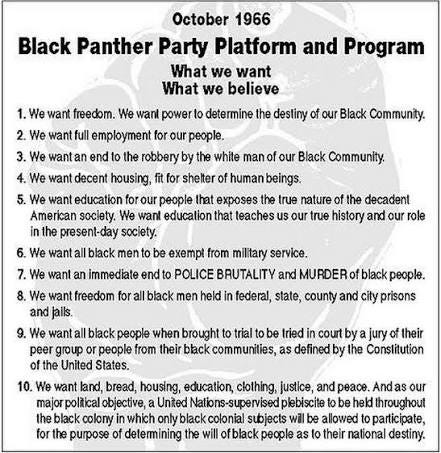
The question then becomes, what happens after we feed people.
Because charity often operates through a particular relationship:
I have. → You need. → I decide what I am willing to give.
And often:
I decide whether you deserve it.
That last part is where things get interesting.
Fill out this application.
Provide your income.
Explain your hardship.
Tell us how many children you have.
Show us your eviction notice.
Prove your disability.
Document your suffering.
Tell us the worst thing happening in your life so someone with institutional authority can determine whether your pain meets the threshold for care.
We have normalized this so thoroughly that we sometimes forget how strange it is.
Imagine needing help and having to audition for it.
And the more convincingly you can perform suffering, the more legitimate your need becomes.
That is not merely resource distribution.
That is a relationship to power.
It is also why my scholarship policy says:
No proof required.
No trauma story owed.
Just ask.
When I began the Selenite and Sage Healing Homestead Feed The Family program, the goal was simple: meet the immediate need.
We did not require people to prove they received EBT.
We did not require income verification.
We did not require a hardship narrative.
You simply had to say:
I need help feeding my family.
That was enough.
People questioned that approach because:
“What if people lie?”
And my response is that I would rather risk a few people receiving something they may not technically qualify for than build a system that humiliates the people who genuinely need care.
Because asking is already hard.
There is already so much shame attached to needing help. (and it is designed that way)
And then we create programs that require people to prove, explain, document, and perform their suffering before we agree to meet a basic need.
That does not reduce shame.
It institutionalizes it.
My operating belief is that most people are honest about their needs.
And even if a few people take advantage, there are far more people who quietly go without because the process of asking has been made too invasive, too suspicious, or too dehumanizing.
I am more interested in preventing exclusion than policing scarcity.
That, too, is a relationship to power.
And it is one of the places where mutual aid asks us to build differently.
Because the resource can be free while access to the resource still has a cost.
Sometimes that cost is money.
Sometimes paperwork.
Sometimes surveillance.
Sometimes respectability.
Sometimes gratitude.
Sometimes obedience.
Sometimes allowing strangers to inspect the most vulnerable parts of your life.
Mutual aid asks us to examine those costs too.
To learn more about the Selenite and Sage Healing Homestead, go here.
Up to this point, we have been examining what mutual aid is, where it comes from, and how power changes the meaning of care.
Now I want to move from political education into praxis.
Because understanding the difference between charity and mutual aid is one thing.
Building relationships where resources can actually circulate without shame, rescue, exploitation, or somebody becoming everybody else’s infrastructure is another.
Below the paywall, we move deeper into:
reciprocity without repayment
receiving without shame
collective care without collective consumption
redistribution, solidarity, and power
Practice Your Praxis across Self, Home, Work & Community
and the question underneath all of it:
And because I do not want to leave you with theory alone, paid Liberation Education subscribers also receive the Mutual Aid Starter Kit as part of this lesson.
The Starter Kit is designed to help you move from:
“We should take care of each other.”
to:
“Okay… how do we actually build the thing?”
It gives you a practical starting place for thinking about shared needs, community assets, reciprocity, consent, resource circulation, communication, sustainability, and the difference between mutual aid and rescue.
The Mutual Aid Starter Kit is included for you. Keep reading and grab your copy below.
You have two doorways.
Become a paid Liberation Education subscriber and receive the Starter Kit as part of your subscription, along with the deeper Liberation Lessons and subscriber resources.
Or purchase the Mutual Aid Starter Kit separately in the shop for $27.
Because reciprocity does not require everybody to enter through the same door.
Some people sustain the ongoing writing.
Some purchase the resource they need.
Some contribute elsewhere in the community.
The point is that the resource moves, the labor is acknowledged, and access has more than one pathway.
That is part of the practice too.
Continue reading with a paid subscription. If you need a scholarship email: Scholarships@DesireeBStephens.com
Comments
Nothing yet. Say the first thing.
Sign in to join the conversation.