

The conversation has quietly shifted. The field has been asking whether AI can use your design system. The more interesting question, the one the community is beginning to sit with, is what happens when AI is also the one writing it.
That is not a hypothetical. When an agent is connected to your component metadata, it is not just retrieving information. It is making decisions about what to reach for and when. When AI operates upstream in the design process, before artefacts exist, before code is written, it is shaping the intent that used to live only in a practitioner’s head. The system is no longer just something you build and maintain. It is something being written alongside you, whether you planned for that or not.
The infrastructure question changes accordingly. Making your system discoverable to agentic tooling is not about documentation coverage. It is about intent legibility at the point where decisions get made. Tokens need to carry purpose, not just values. Components need metadata that explains what they are for, not just how they look. If the agent is operating upstream, the system has to be present upstream in a form it can reason with.
AI has lowered the floor on execution. The ceiling on judgment is still yours. The question is whether your system is clear enough to enforce the difference.
📚 Featured Articles
📰 Published in the Last Week
🎙️ From the Conference Floor
🎗️Support us
📝 Closing Thoughts
Must-read articles at www.designsystemscollective.com.
💡 Have an article to share? Submit it here!
How to connect your Design System to Claude Code and Cursor via MCP by Nadiia Abrosymova
Why We Like It: A clear, practitioner-first walkthrough for making your design system discoverable to agentic tooling — essential reading if you want AI to actually use your components instead of inventing its own.
Pro Tip: This article explains why an MCP server is the infrastructure change design teams must prioritise to make AI-driven coding tools reliable. It gives concrete patterns for structuring component metadata, the JSON vs Markdown split you should adopt, and realistic caveats about what MCP can and cannot fix.
Server-Driven Design Tokens: Eliminating Runtime CSS Generation in B2B Dashboards by Matheus Lacerda
Why We Like It: A data-led, technical case for moving token evaluation off the client in long-lived, high-throughput B2B apps. It connects perf, memory and architectural trade-offs to design system decisions.
Pro Tip: The benchmark-backed argument shows where CSS-in-JS costs accumulate under sustained live updates and how server-driven tokens materially reduce heap growth and long-session jank. If you run dashboards or any long-lived UI, this piece gives measurable reasoning for changing your token strategy.
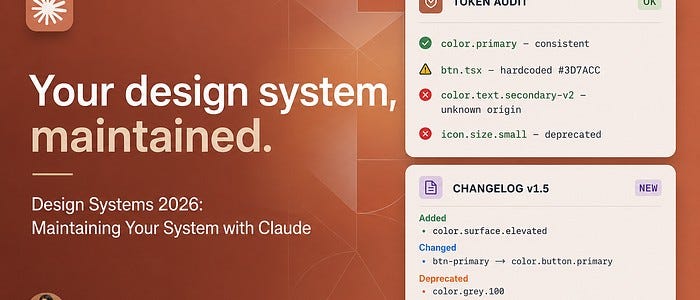
Design Systems in 2026: How to Maintain Your System with Claude by Garima Agarwal
Why We Like It: Practical, prompt-driven maintenance workflows that bridge tokens, changelogs, deprecations and your Claude Skill — maintenance work you will thank yourself for later.
Pro Tip: This is a maintenance playbook: cadence, token audits, deprecation notices, Skill sync checks and ready-to-use Claude prompts. It is especially valuable for teams who have finished a launch but struggle to keep the system usable as it evolves.
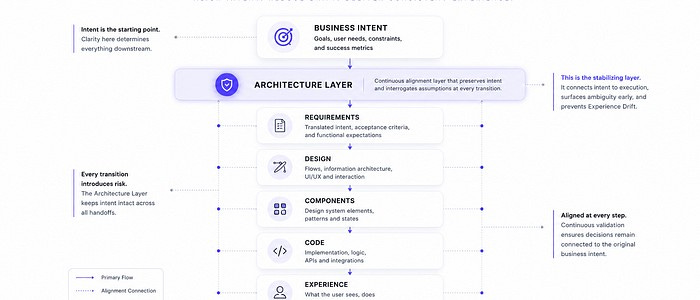
How I Use Claude as a UX Architect by Surendar Selvaraj
Why We Like It: A compelling framing of AI as an “Architecture Layer” that preserves intent and catches experience drift before artefacts are created. It reframes where high-value design work happens.
Don’t Miss: Surendar lays out a concise workflow for using Claude to interrogate requirements, surface hidden assumptions, and maintain alignment across requirements, designs and code. It is strategic and immediately applicable for enterprise-scale teams battling interpretation drift.
To stay updated on the latest articles, we share every new article on our LinkedIn page.
👉 What AI Inherits by Gantushig Javkhlan
👉 Your design system’s newest author is an agent by Murphy Trueman
👉 Design Systems in 2026: How to Maintain Your System with Claude by Garima Agarwal
👉 Critical Thinking Is the Last Thing AI Can’t Do for You by Abhi Chatterjee
👉 How I Use Claude as a UX Architect by Surendar Selvaraj
👉 How to connect your Design System to Claude Code and Cursor via MCP by Nadiia Abrosymova
👉 Figma Config 2026: AI Lowered the Floor. Now Figma Wants You to Raise the Ceiling. by Abhi Chatterjee
👉 Design Intent Is Not Just a Philosophy. It Is Infrastructure. by Eddie Lou
👉 Beyond the UI Kit: The Strategic Foundation of True Design Systems by Jens Merkel
👉 The Hidden Cost of Over-Consistency in Enterprise UX by Shadi Abd
👉 How We Used Modular Content Architecture to Scale a Pharma 360° Campaign by rakesh patel
👉 What makes a component actually reusable? A mental model for designing better abstractions by Sophie
👉 Typography as a System: Beyond Font Choices and Scale by Madhesh P
👉 The JavaScript Tax: What Your Design System Is Costing Your B2B Users by Matheus Lacerda
👉 Server-Driven Design Tokens: Killing Runtime CSS Generation in B2B Dashboards by Matheus Lacerda
👉 Why Every Great User Experience Feels Familiar: The Hidden Power of Design Systems by rakesh patel
👉 What a design system actually is (and why you’ve been doing it wrong) by Dhananjay
👉 Stop Calling It a Design System — You Just Want a Prettier Style Guide by Matilda Anashie
👉 Skeuomorphism Never Left: It Just Got Invisible by Giulia Fanasca
👉 Stop Interviewing Your Users. Go Watch Them Work. by Abhi Chatterjee
👉 What a Career in Design Systems Actually Looks Like in 2026 by Madhesh P
👉 70 Design Systems Every Designer Should Know by Hyeonjun Kim

Learn how designers at WhatsApp, Atlassian, Figma and others use AI in their daily workflows.
Yesenia Perez-Cruz’s talk at the Into Design Systems AI Conference was the one I couldn’t stop thinking about. Here’s what I took from it.
As a Design Systems Collective reader, you get 10% off. Use code DSCOLLECTIVE at checkout. Get the recordings here
If you find our content helpful, here’s how you can support us:
Forward this email to a friend and invite them to subscribe
Support our writers by visiting the Design Systems Collective website
If the agent is also an author now, ambiguity is no longer something a practitioner can correct in review. It is something the agent will fill with its best approximation, across every instance it touches, before anyone notices. The system cannot afford to only know what you built. It needs to know what you meant.
Founding Editor, Design Systems Collective
Comments
Nothing yet. Say the first thing.
Sign in to join the conversation.