
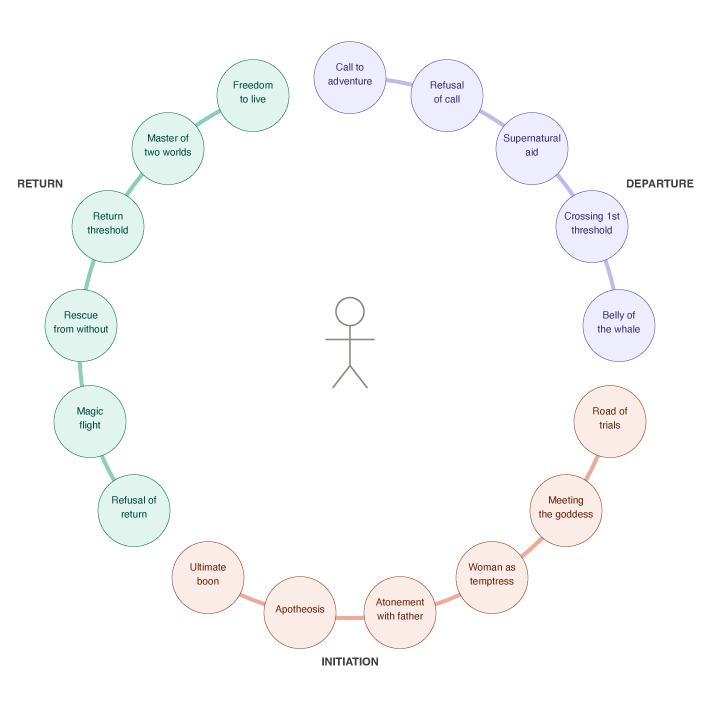
Inspired by Joseph Campbell’s The Hero with a Thousand Faces and the documentary Finding Joe (dir. Patrick Takaya Solomon, 2011).
There is a story from Thailand I want to start with.
Centuries ago, a monastery kept a large statue of the Buddha, solid gold, magnificent. When word came that an invading army was approaching, the monks did something ingenious. They covered the statue in clay and concrete, making it look ordinary, unremarkable, not worth plundering. The army passed through. They saw nothing but a grey stone Buddha and moved on.
Years went by. The occupation continued. And slowly, one by one, the monks who had known the secret died, until there was a time when no one in the village remembered that the Buddha was golden.
Until one day, a young monk sat meditating on the statue’s knee, and as he stood up, a small piece of concrete cracked away. He saw something shiny beneath. He called the others. They came with picks and hammers and chipped away, layer by layer, until the full statue was revealed. Pure gold. Enormous. Unchanged.
The gold had been there the whole time.
Here is what Joseph Campbell would say about that story: it is not a story about a statue. It is a story about you.
Each of us is born golden. We arrive knowing, connected to something real, something alive, something that is entirely and specifically ours. And then life happens. School happens. Family expectations happen. Other people’s definitions of success, safety, and what a sensible person does with their one life; all of that happens. Layer by layer, we coat the gold in clay. We learn to dress a certain way, want certain things, perform certain roles. And by the time we are five or six or seven years old, many of us have already started to believe we are the stone Buddha. Not the golden one.
Campbell spent his life studying the myths of every culture on earth — Native American traditions, Greek mythology, Arthurian legend, Hindu philosophy, Aboriginal stories, the Upanishads — and he found, underneath all of them, one story. The same pattern, told a thousand different ways, across every civilisation that has ever existed. He called it the monomyth. Most people know it as the hero’s journey.
It is not a fairy tale structure. It is a map of the human psyche. It is what actually happens when a person wakes up to themselves.
The hero’s journey has three phases: Separation, Initiation, and Return.
In Separation, the hero is living in their ordinary world when something breaks through. A call arrives. Not always loudly. Campbell said that if you are paying attention, the call comes as a tickle of a feather. If you are not paying attention, it arrives as a sledgehammer. Either way, it comes. The universe is literally dialling you up. You can hang up the phone. You can keep hanging up. But it will keep calling.
Then comes the crossing of the threshold, stepping from one world into another. Sometimes you step. Sometimes you are shoved. And then the belly of the whale: that terrifying, disorienting place where the old world is gone and the new one has not yet arrived. This is not failure. This is the structure of transformation.
In Initiation, the hero is tested. The road of trials. The inner cave. The ordeal that breaks something open. Campbell described the dragon as a beast covered in scales, and on every scale it says either thou shalt or thou shalt not. Every rule, every social obligation, every cultural expectation that has told you who you are supposed to be, that is the dragon. Slaying it does not mean destroying it with force. It means coming to terms with the part of yourself that has been obeying it. Because the dragon is not outside you. When Luke Skywalker cuts off Darth Vader’s head in the cave, the helmet opens, and he sees his own face.
The treasure is not a thing. It is a quality. A hidden strength. A truth about yourself that could only have been uncovered by going through the dark.
And then Return. This is where people are often surprised. Campbell insists that the hero must come back. The boon, whatever was gained in the extraordinary world, must be brought back to the community. The story of the journey is itself the gift. That is why it is a circle. That is why it never ends. You go, you return, you share what you found, and in the sharing you invite others to make the same journey.
Why does anyone resist this? Why do most people not follow their bliss?
One word, according to everyone who has studied this honestly: fear. Fear of what other people will think. Fear of looking foolish. Fear of climbing the ladder, reaching the top, and discovering it is leaning against the wrong wall.
But there is something else too. Campbell talked about a kind of mass hypnosis, a trance of comfort that culture actively maintains. A trance that keeps us consuming, performing, achieving by other people’s metrics, and calling it a life. The should culture. You should want this. You should be at this level by now. You should not want that, it is not practical.
The result, as Campbell saw it, is that we become bundles of conditioned reflexes. Not creative. Not alive. Just predictable. Following paths that someone else laid down, triggered into predictable responses, never quite asking whose story we are actually living.
He was very clear on this: if you enter the forest where there is already a trail, you are not on your path. That is someone else’s path. You have to find your own entry into the dark forest. That is what initiation means.
Follow your bliss. It is the most famous thing Campbell ever said, and also the most misunderstood. It does not mean hedonism. It does not mean pleasure. It does not mean quitting everything on a whim. The word bliss comes from the Sanskrit ananda, a serenity, a deep coherence, a state of being in which you are fully and specifically yourself. It is the thing you cannot not do. Hours feel like minutes. You are entirely present. You are not performing for anyone.
That is bliss. And Campbell’s message was: trust it. Follow it. When you truly step forth and trust your bliss, the universe opens doors where there were only walls.
I have lived this three times that I can name clearly.
The first was 2008. I was working in product design. The work was good, the environment was fine, and something inside me was quietly, persistently saying: this is not it. I did not know what it was. I just knew this was not it. So I stopped. Moved to London to retrain in service design. No map. Just the pull.
The second came from a tension that had been building for years, a need to understand organisations more deeply, to contribute at a level the practice alone was not allowing me to reach. That tension resolved, eventually, into a PhD at Copenhagen Business School. It did not make obvious sense to anyone looking from the outside. It made complete sense from the inside.
The third was leaving my Managing Director role at Livework. That job had shaped me profoundly. I was good at it. I had built things I was proud of. And one day I simply knew it was over. Not because it had gone wrong, because it had run its course. Walking away from that identity, that title, that certainty, was one of the hardest and most liberating things I have ever done. It led, through a long and winding road, here. To Design Mavericks. To this work. To you.
Every single time, the moment I made the choice, I felt something release. Like a story that was no longer mine, finally set down.
And each of those transitions involved a kind of death. Campbell quotes Nietzsche, the snake that cannot shed its skin must perish. The product designer in me had to die for the service designer to emerge. The academic had to die for the practitioner. The Managing Director had to die for the founder. These were real losses. And they were also, each time, the only honest move.
No death, no transformation. No death, no new life.
Here is what I want to say to many of you reading this.
The call to adventure does not always arrive as a thunderclap. For most of the people I work with — design leaders, senior professionals, people who have been excellent at their craft for a decade or more — it arrives much more quietly. A restlessness that has no precise name. A sense that the work is fine but not theirs. A question that surfaces in the early morning and gets pushed back down before breakfast. A feeling of performing a role rather than inhabiting one.
That is still the call. And it deserves to be taken seriously.
Over years of coaching I have sat with many people at exactly this threshold. Some are senior enough that the role looks like arrival from the outside, from the inside it feels like a cage. Some have already made the leap and find themselves in the belly of the whale, disoriented, wondering if they were wrong to jump. Some are still in the refusal stage, rationalising, managing, trying to be satisfied. Waiting for the sledgehammer, when the feather has been there for months.
What coaching does, in my experience, is not to give you the answers. It does something more useful.
It creates clarity, not by pointing to a destination, but by helping you see what you actually value versus what you have inherited from other people’s expectations. It separates the gold from the clay. Most of us are walking around carrying a considerable amount of clay.
It pipelines options. The threshold always feels binary: stay or go, this or that, safe or reckless. Coaching opens the space between those poles. It maps the terrain. It makes the unknown slightly less opaque, so the step across feels less like free fall and more like a considered choice.
And it helps you recognise whether you are on the right journey. Not every restlessness is a signal to act. Not every call is the right one. Part of what good coaching does is help you distinguish between the two, between the pull toward something real and the flight from something uncomfortable. This is not a small distinction. It is, often, the whole question.
Campbell said that a good life involves not one hero’s journey but many. Every transition, every threshold, every moment of choosing the unknown over the familiar is the structure of a life lived with intention. The circle does not close. It spirals. You return, transformed, and the next call is already waiting.
There is a line that stayed with me from the conversation that inspired this piece.
What fills our heart with regret at the end of our lives is not all the risks we took. It is all the risks we did not take. All the opportunities we did not seize. Not what we tried and lost, what we never tried at all.
The gold was always there. The journey is what removes the clay.
You do not need to know where you are going. You do not need to have it figured out before you begin. You just need to be willing to look at the crack.
If something in this piece has stirred something in you, however quiet, however inconvenient, I would like to talk.
I offer one-to-one leadership coaching for design leaders and senior professionals navigating transition. We work at the intersection of identity, authority, and what comes next. Not to prescribe a path, but to help you find your own entry into the forest.
Book a discovery conversation, a single session to explore whether this is the right moment, and whether we are the right fit.
Not ready for coaching yet? That is a completely valid place to be. Sometimes what you need first is not a guide but a companion, someone else in the forest who understands the terrain because they are walking it too.
That is what Design Mavericks is for. By becoming a paying subscriber, you join a community of professionals who are actively exchanging thoughts about where they are, what they are learning, and what comes next. Not a content feed. Not a networking platform. A real conversation between people who take their growth seriously and refuse to pretend they have it all figured out.
Because sometimes the most important thing is simply knowing you are not the only one hearing the call.
The journey is already underway. The question is only whether you are going consciously.
Marzia
Marzia Aricò is a leadership coach, organisational advisor, and founder of the Organisational Intelligence Institute and Design Mavericks. She works with leaders navigating complexity, transition, and the gap between who they are and how they are perceived.
Comments
Nothing yet. Say the first thing.
Sign in to join the conversation.