
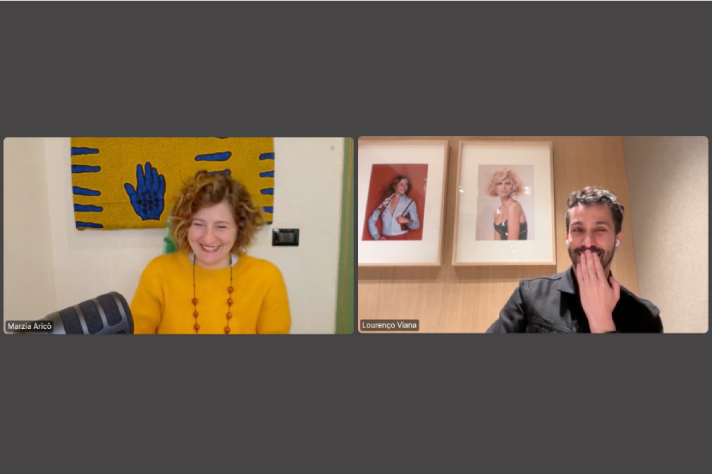
This year, I started a series of ten interviews with Design Mavericks community members, leaders and practitioners who are doing the work, inside real organisations, with all the friction that entails. Each conversation focuses on a theme that matters to design leaders right now. This first episode is with Lourenço Viana, and the theme running through everything he said is one I keep coming back to: how do you build and sustain momentum for design practice inside a large organisation? Not in theory. In practice.
Lourenço Viana, twelve years into building a research and brand experience function at Mango from essentially nothing, is describing how he demonstrates the value of his team’s work to leadership. Not through frameworks. Not through decks explaining what service design is or why it matters. Not by positioning himself as “the bridge between strategy and execution.” Even though that’s precisely what he does.
He does it with examples. Specific, concrete, business-legible examples.
“I never go with the theory. Never, ever, ever.”
That sentence landed with me. Because most of us who work in design research, service design, or insights are trained to build the argument from the ground up. To explain the discipline. To make the case for the practice before we make the case for the outcome. And what Lou is describing, with twelve years of organisational scar tissue behind it, is that the theory is yours. It’s the abstraction you use to make sense of the work internally. But the people across the table from you at the board of directors meeting? They want to know if investing in that fitting room redesign is going to move revenue. They want to see green numbers.
“I don’t say that what we did was bringing the bridge between this and that. This is my abstraction, me, Lou, as a PhD freak who thinks about these things like this. My CEO does not care a single bit about this.”
This is not cynicism. It’s something more interesting than cynicism. It’s a particular form of organisational intelligence that takes years to develop, the ability to hold the full depth of what you know about your practice while communicating only what your audience can actually use.
One of the most clarifying threads running through this conversation is the gap between visibility and value. They are not the same thing, but in practice, one often has to stand in for the other.
Lou described sending monthly NPS reports to leadership. Before the reports, there were constant questions, challenges, requests for justification, and general anxiety about what the team was doing. After the reports started arriving, the questions stopped. Maybe they weren't deeply read every time. But that regular communication did something important: it assured leadership that the job was being taken care of. The signal was transmitting. The anxiety went quiet.
“It’s just the soothing,” he said. “They’re sending the email, so it’s being tracked.”
What this reveals is something most of us know but rarely say out loud: a significant part of demonstrating value in large organisations is not about proving impact but about creating a felt sense of presence. You exist in the organisational consciousness. You are doing things. You are accountable. And as long as that signal is transmitting, you buy the space to actually do the work.
This isn’t manipulation. It’s organisational literacy. And Lou is clear that it can only work long-term if the substance is there underneath it. “When they start questioning, if they do, and they will at some point, you must have the answers.”
The soothing email buys time. The solid knowledge earns trust.
Another moment from the conversation that I think every design leader should sit with.
When Lou talked about blockers in the organisation, people who actively or passively resist the work, he described a realisation he came to through his PhD research. When people don’t yet trust you, value for them is value for them as individuals. Not for the organisation. Not for the customer. For them.
Their bonus. Their process. Their goals this quarter.
He framed it as “the house in the south of France” a shorthand we’ve developed together over years: if you want to understand what will make someone say yes to something, you have to understand what they’re personally trying to protect or achieve. The CEO’s version of that house looks different from the general manager’s. Both are real. Neither one is the organisation’s stated mission.
This is where a lot of design leaders lose traction. They make the case for the work in terms of customer value, business impact, organisational alignment. All legitimate. All true. But if the person across the table is quietly calculating whether this project will complicate their own roadmap, threaten their team’s headcount, or shine a light on something they’d rather keep in shadow, none of that argument will land.
You have to find the individual’s house first.
Rosanne from the community asked Lou how he balances progress and patience. How do you keep going when change is so slow, when reorganisations disrupt everything you’ve built, when the organisation seems to keep forgetting what you’ve already proven?
He didn’t talk about resilience frameworks or prioritisation strategies. He talked about self-knowledge.
“You need to understand where you belong as an individual.”
Lou is, by his own description, a starter. Someone oriented toward the new, toward the next horizon, toward what hasn’t been built yet. That orientation is what makes twelve years at the same company sustainable for him, not despite the slow pace of organisational change, but because of it. There’s always another territory to open up. There’s always a team that hasn’t yet been reached, a practice that hasn’t yet been embedded.
But he was equally clear that this profile is not universal. Some people are optimisers. They are brilliant at taking what exists and making it better. They thrive in stability. They would be bored where Lou thrives, and Lou would be bored where they thrive. Neither is wrong.
What’s problematic is when you don’t know which one you are and spend years fighting the wrong battle, wondering why you feel misaligned in work that looks, on paper, like exactly what you should be doing.
And then there’s the other piece: the default assumption that career progression means moving up. That the next step is always more scope, more authority, a title with “chief” in it.
Lou made a deliberate choice, a couple of years ago, to stop using that as his reference point. Not because he’s unambitious. Because he did the introspective work to understand what he actually wanted from his professional life, and it wasn’t the version of success most organisational systems are designed to reward.
“That took a lot of weight from what I’m doing.”
The fact that he brought up therapy and coaching in this context wasn’t incidental. He said it directly: that process of understanding where you want to be, and how to respond to the situations you find yourself in, is work. It requires help. And for a lot of design leaders operating at the edge of organisational tolerance for their practice, doing that inner work is not a nice-to-have. It’s what makes sustained effectiveness possible.
Lou’s answer to the question about allies was unexpectedly revealing.
The teams that most reliably become partners for research and brand experience work at Mango? Not product designers, who can feel their craft is being questioned. Not operations teams, who are so deep in the day-to-day that introducing new perspectives feels like adding friction. The biggest allies tend to be buyers. Commercial people. The ones who are professionally trained to look for opportunity and move when they find it.
There’s something worth holding there. The people most open to being informed by research are often the people whose success already depends on sensing and responding to change. They don’t need to be convinced that the customer matters. They live and die by it. They just need the insight to arrive in a form that speaks to what they’re already trying to figure out.
Which brings you back, again, to the house in the south of France.
Lou was describing what happens when you bring all the right people into the room at the same time, when the fitting room pilot brings together visual merchandising, interior design, training, technology, assortment in a single coordinated test rather than isolated experiments.
The whole is greater than the sum of its parts.
The people who do this work most effectively are often not the ones who can explain it most fluently in the abstract. They’re the ones who have built enough trust, proven enough value in concrete terms, created enough visibility that the organisation eventually lets them try the thing that can’t quite be described.
The pilot store. The fitting room. The pair of jeans that became a bestseller.
That’s what twelve years of patience, presence, and individual-level understanding gets you.
Lourenço Viana was the first guest in the Design Mavericks Interview Series, which brings senior practitioners from across the design leadership world into conversation with our community. The full interview series is available exclusively to Design Mavericks members on our platform. If you're not yet a member, or if you've been on the free tier and have been thinking about upgrading, this is a good moment. You'll get access to the recordings, the community space where these conversations continue, and everything else we're building together.
Next up: on April 30th I'll be speaking with Kathy Toney, former Design Manager at Mercedes-Benz, who made the deliberate choice to leave the corporate world behind. We'll be talking about the shift, what it actually takes to redesign your own career, and what you find on the other side.
Comments
Nothing yet. Say the first thing.
Sign in to join the conversation.