
Last November, I attended the conference Urban Metabolism and the Archeology of Cities in Eurasia in Bonn (Germany). I talked about it in my December story. The center of the story was Bonn, and what had happened to all the government buildings in the former West German capital.
Since then, I have had an itch to learn more about archaeology in Eurasia. At the conference, I asked for book recommendations, and several people recommended The Horde: How the Mongols Changed the World .
The author, Marie Favereau, also attended the conference. We exchanged a little and promised to read each other’s books.
Archeologists fascinate me. They must be detectives and planners and sociologists and scientists and engineers and so much more all at once. After a busy end of the year, I was finally able to read the book in January.
In her book, Favereau recounts the evolution of the Mongol Empire in an engaging style, from its creation under Genghis Khan in the late twelfth century to its demise at the turn of the sixteenth century.
I was stunned by the amount of information Favereau gathered. Writing this book clearly must have taken a lot of effort. I am grateful to authors who invest a lot of time (and therefore sacrifice a lot) to make knowledge more accessible. They make a real difference.
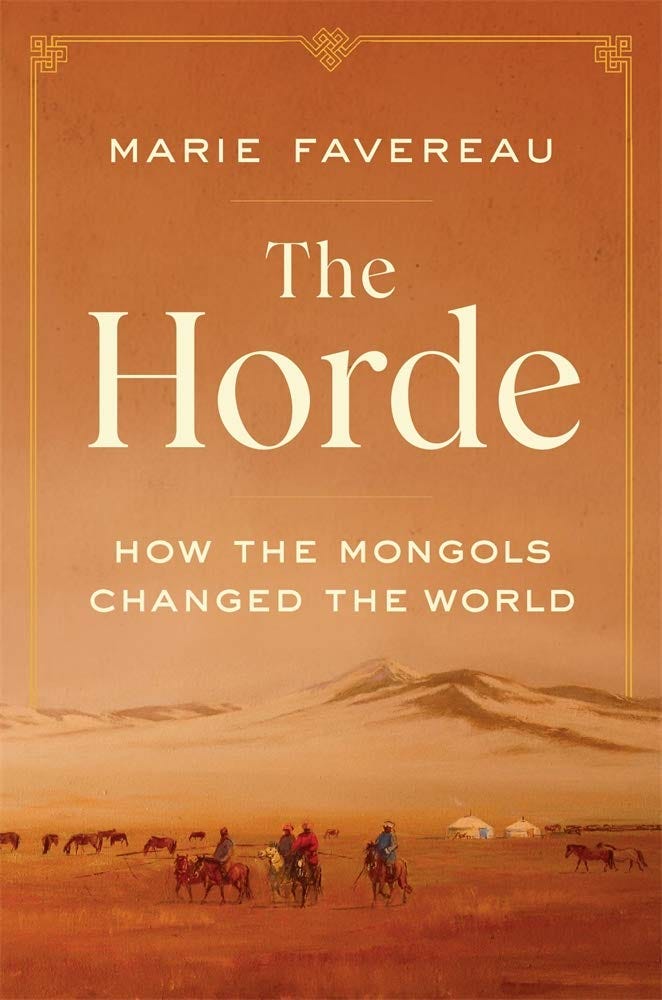
The book focuses on the Jochids’ lineage that ruled the western part of the Mongol Empire. Favereau reveals the intricate politics of the time, which required careful negotiations, strategic plans, and gruesome killings (and which would make for a great TV series).
As an urban engineer, my brain yearned to learn more about Mongol infrastructure. But the Mongols aren’t known for their infrastructure. They were nomads. They did not build cities. As they used to say: “He who is afraid, let him build towers.”1
At first, I thought my thirst for knowledge on infrastructure would not be quenched, but then, I got to page 127 and learned about the yam system.
The infrastructure established for the yam system is essential to the functioning of any empire. It’s not an exaggeration to say that, without it, the empire would have crumbled sooner. Correction: the Mongol Empire would not have existed.
After all, the Mongol Empire is the largest contiguous land empire in history (see map below). It covered 23 million square kilometers (9 million square miles). That’s 1.35 times larger than today’s Russia, 2.25 times larger than Europe, or 2.35 times larger than the continental United States. Managing such a large area demanded a complex system of rules and infrastructure.
What’s the one critical element needed to manage a large empire? Think about it. Every empire has its own version.
It’s a trick question because you must think about hard, physical infrastructure like roads or water conduits, but that’s not the answer.
This critical infrastructure is not physical, at least in the general sense. Even today, it’s arguably become the most important infrastructure, the root cause of globalization, with its merits and its faults.
This answer is: telecommunication.
Isn’t it obvious? The glue that makes an empire stick is information. By definition, an empire must have some form of centralization. While information travels easily in the era of fiber optics, it didn’t in an era when the dominant power was the horse.
And the Mongols are known to be excellent horsemen. They mounted, bred, ate, and milked horses. In the mighty steppe, traveling by horse was ideal, and that applies to information as well.
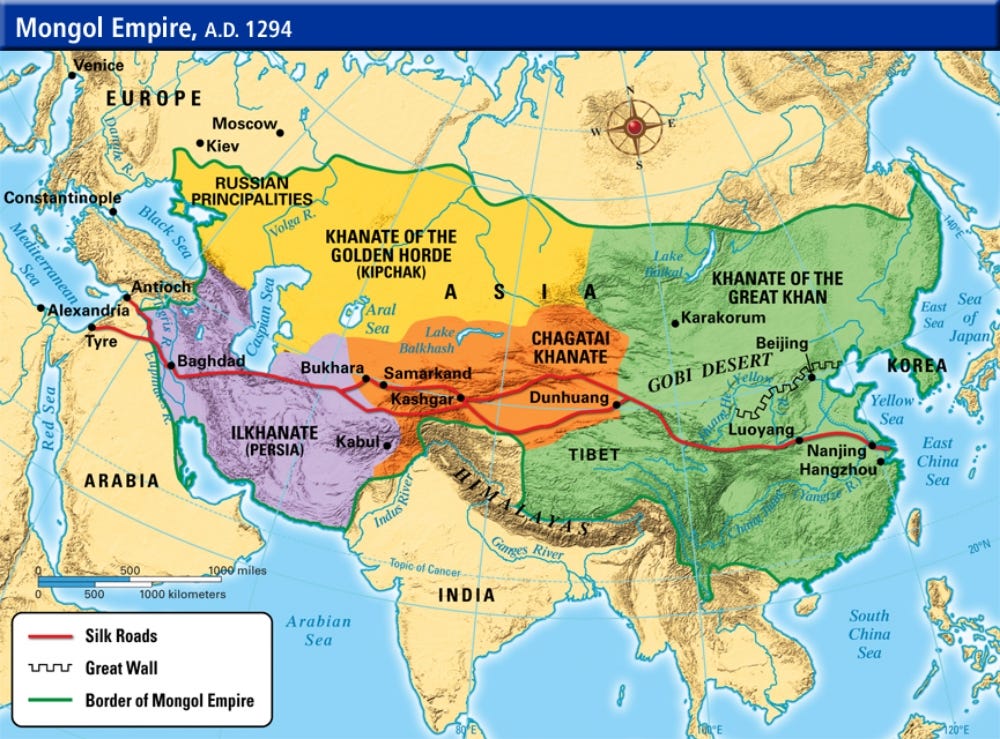
The yam system consisted of a gigantic network of relays in the form of hundreds of yam stations. There were yam posts every 30 to 60 kilometers (20-40 miles), representing roughly a half-day’s distance.2
These stations offered spare horses, food, shelter, and other necessities. An arriving messenger would pass their information to another messenger and then rest, ensuring information kept moving.
Yam stations were very safe. Marco Polo was amazed by the system and used it many times while serving Kublai Khan in the late thirteenth century.3
In The Book of the Marvels of the World, Marco Polo wrote: “… And the messengers of the Emperor in travelling from Cambaluc, be the road whichsoever they will, find at every twenty-five miles of the journey a station which they call Yamb,4 or, as we should say, the “Horse-Post-House.” And at each of those stations used by the messengers, there is a large and handsome building for them to put up at, in which they find all the rooms furnished with fine beds and all other necessary articles in rich silk, and where they are provided with everything they can want. If even a king were to arrive at one of these, he would find himself well lodged.”5
To ensure secure communication, the Mongol bureaucracy had several safeguards, including special seals and paper formats, registered translators, and emissaries. Most surprisingly (to me at least), they issued passports.
This type of system, using horses, existed before, but not at this scale and with such efficiency.
Yam stations were run by Mongols and locals, but used by all, including officials and foreign emissaries.
The size of a yam post varied – those closer to settlements were larger – but they were always staffed by yamchi, “post station staff.”6
The yam system enabled the Mongols “to spy on enemies, carry goods and messages between far-flung locations, and supply military camps, cities, and hordes.”7
It was intricate and strategically designed. One of the most impressive features of the yam system is how it fit the nomadic lifestyle of the Mongols.
As nomads, the Mongol hordes kept moving. Each horde mostly traveled north or south. That makes sense. When it got cold in winter, they would travel south, and when it got hot in summer, they would move back north.
The hordes leveraged the topography of the land. The Mongols are steppe people. Steppes are large, flat areas, with some rolling hills, dominated by grasses and low shrubs (see picture below).
With the semi-arid weather (not much rain), important temperature swings, and strong winds, trees can’t grow easily, hence the large open spaces, which made it easy to travel with a large group of people without requiring roads.8
In such an environment, how do you think the yam system was designed?
It followed east-west axes to form a fine mesh with the hordes. As a result, information could travel fast even though people traveled slowly. This also means that yam stations were mobile, just as people were.
Along with an incessant series of victories and defeats, the yam system was elastic. It would grow and shrink like a breathing machine. This was possible because the Mongols were nomads. They did not build many permanent fixtures.
Favereau reports that thanks to this system, it would take only eight weeks to travel from the Volga River to the Irtysh River.9 That’s eight weeks to travel over 2,600 kilometers (1,600 miles). That’s like crossing 60% of the continental US in 8 weeks in the 1200s.
In reality, the yam system was not one but three systems, designed to meet the different needs of the people and the state.
First, the Morin yam system serviced the regular postal routes. It covered the entire empire and was limited to horseback riders.
Second, the Tergen yam system transported heavier loads pulled by oxen, camels, and strong horses. The geographical coverage was smaller.
Third, the Narin yam system served as a secret communication channel. Speed was of the essence. Travelers could cross between 200 and 300 kilometers (120-190 miles) in a day.10
Favereau devotes three full pages to the yam. She knows the importance of the yam for the functioning of the empire. She has this quote that sums it up beautifully: “The yam made the steppe smaller.”11
As I write these lines, I have just finished reading a series of essays and Wind, Sand, and Stars by Antoine de Saint-Exupéry. It occurred to me that Saint-Exupéry was a yamchi. As a pilot for the Aéropostale in the 1920s, he transported mail across the globe.12
Have you ever read some of his work besides The Little Prince? No one can describe tales of traveling like him. From crossing the Pyrenees to flying in the Andes, Saint-Exupéry’s prose is something else.

Did the Mongols have a Saint-Exupéry to tell tales of their travels? If you know of one, please share it with me.
In his essay “I Went to See My Plane Tonight,” Saint-Exupéry devotes an entire paragraph to traveling and to how tourists cannot appreciate their trip when they treat it as a source of distraction, as if they were attending a show.
Here’s how I would synthesize the thought: A trip is not a show, but a renewal, because one must also travel within.13
I would argue the same thing happens when one reads a good book. For me, reading and getting engulfed in a story is the only thing that stops time, that makes me escape.
By learning about the yam and the Mongol Empire, I renewed myself thanks to Favereau’s book.
Now I want to renew myself with another great book. Please send me your recommendations, especially about books on archaeology.
Thank you for taking the time to read this story.
Please share your comments and thoughts with me through Substack or by email.
For more content about infrastructure, read The Infrastructure Book. Get it for yourself or ask your public/university library, or your company, to buy a copy so many can enjoy it.
Thanks to everyone who has read it already and left a positive review online.
Different spelling, but this is yam.
No posts
Comments
Nothing yet. Say the first thing.
Sign in to join the conversation.