
The state of the world in the first months of 2026 has been gloomy. The situation in the Middle East, particularly in Iran, has been grim.
In news outlets around the world, stories about the conflict are often paired with stories about the price of gasoline.
In Chicago, a gallon of gasoline passed the $5 mark. In Vietnam, prices increased by over 50% overnight to more than $1 a liter (about $4 a gallon).
In France, gas prices now exceed 2€ a liter (over $7.5 a gallon). The price of gas was on everyone’s mind during the March 2026 municipal elections.1
It’s not only transport that is being affected. In Singapore, electricity prices have been rising because most electricity is produced from liquefied natural gas.
The main protagonist responsible for these price hikes is the Strait of Hormuz. Now virtually everyone’s heard of the Strait of Hormuz, but just a few weeks ago, nobody even knew it existed or could point it out on a map.
The story is devoted to the Strait of Hormuz.
Unlike my usual stories, this one will be less cheerful and entertaining, but the message remains important because, as we will see, the Strait of Hormuz will keep making the headlines for a long time.
My goal here is threefold. It is to explain why the Strait of Hormuz is such a strategic location, why disrupting it affects the entire world, and discuss some long-term solutions.
The Strait of Hormuz is a narrow waterway that connects the Persian Gulf to the Gulf of Oman.
It’s on the eastern side of the Arabian Peninsula (see map below). At its narrowest point, the strait is 33 kilometers wide.
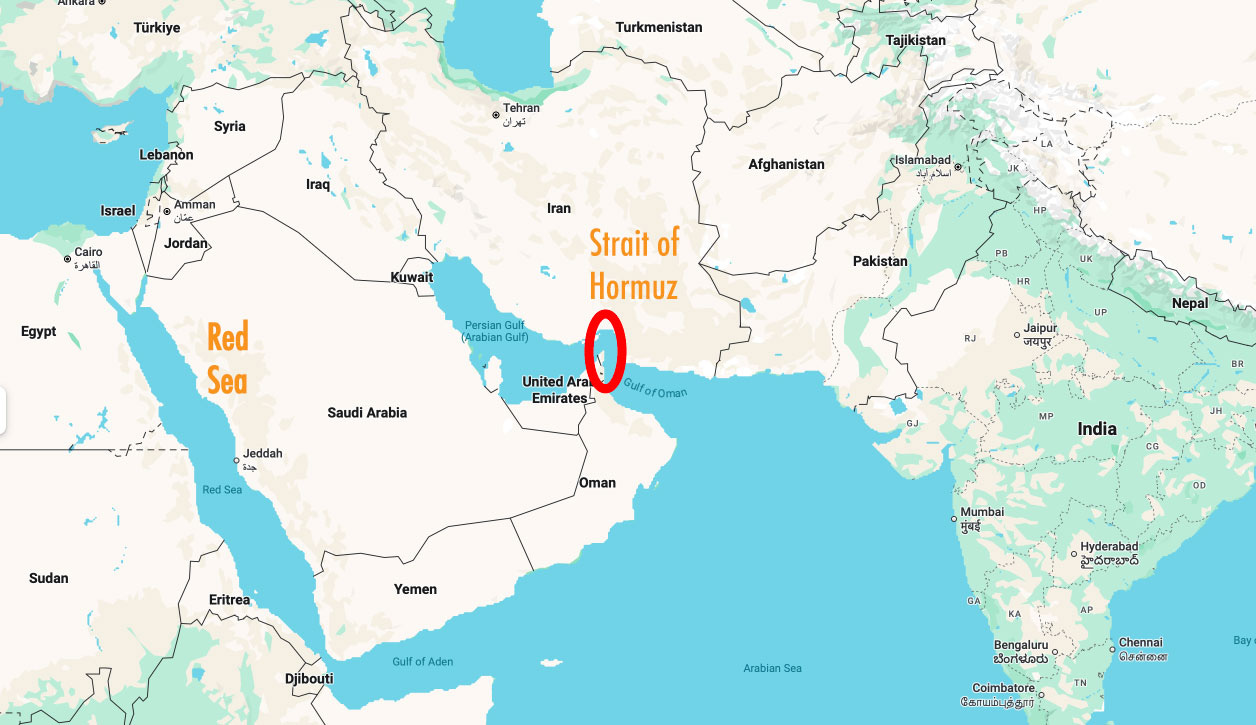
The strait itself offers nothing special. It does not contain oil or gas. It is not a major population center. It’s a desolate place. I am not surprised that few people knew about it.
People usually know its big brother, the Red Sea,2 located on the western side of the peninsula. The Red Sea is better known because of the Suez Canal, located at its northern end.
The Suez Canal provides a direct route between the Mediterranean Sea and the Indian Ocean. It’s a major trade route. Many will remember that it was blocked by the Ever Given for six days in 2021.
Like the Suez Canal, the Strait of Hormuz is a physical link. It connects two places (I should write two markets). But there is one major difference between the two.
The Suez Canal is a transit route. Ships travel through the canal, but nothing is produced in or around the Canal. When the canal is blocked, ships can circumvent Africa to reach their destination.
The Strait of Hormuz tells a different story. It is the only outlet of the Persian Gulf.
The Persian Gulf is a little enclave for some of the world’s largest oil producers—Saudi Arabia, Iraq, Kuwait, the United Arab Emirates, Qatar, Bahrain, and Iran.
When the Strait of Hormuz is blocked, nothing can pass through. There’s no way around.
Normally, about 20 million barrels of oil pass through the Strait of Hormuz on a given day. That’s roughly 20 percent of the global oil consumption. About 20 percent of global liquefied natural gas exports also pass through the strait.
The Strait of Hormuz has long been a strategic location. For thousands of years, it has been an important link between the Middle East and India.
The strait was part of the Maritime Silk Road. From silk, spices, pearls, and Arabian horses, many commodities traveled through the Strait of Hormuz.
The Portuguese quickly saw the potential when they traveled along the African coast toward India in the early 1500s. They built a fortress on the small island of Hormuz and collected tolls from ships coming through.
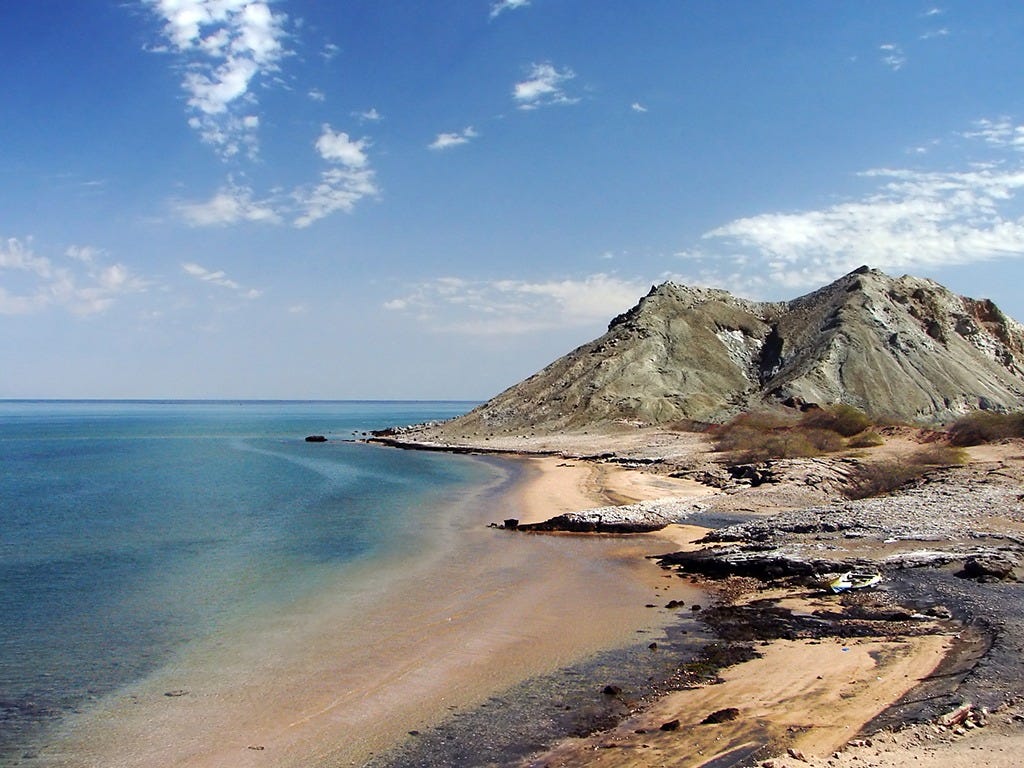
The Portuguese were ousted a century later by the Shah of Persia, Abbas I, who had formed an alliance with the English East India Company. For three centuries, the English provided military power to Iran in return for important trading contracts.
By the early 1900s, oil was found in Iran. The Anglo-Persian Oil Company was soon formed to exploit oil wells and export crude oil. You will better know the company by its current name: BP.
In 1951, the Iranian Prime Minister, Mossadegh, decided to nationalize all oil operations, cutting off the British from a cash cow. The Brits responded with a naval blockade and eventually lost. The Americans came soon after, organized a coup to overthrow Mossadegh, restored the shah, and cashed in, until 1979 when the Islamic regime took over power in Iran.
Since the 1950s, the region has been in turmoil. It’s not surprising. Who controls oil partly controls the world… and is bound to make a lot of money.
Although it is bordered by Iran and Oman, legally, the strait is an international waterway. It does not belong to anyone. Yet, the region is heavily militarized.
While 20 percent of the world’s fossil fuel production happens in the Persian Gulf, that’s not where it is consumed. It’s consumed worldwide. After extraction and processing, crude oil is loaded onto tankers and sent to refineries around the globe.
The major markets for Persian Gulf oil are Asian countries, particularly China, India, Japan, and South Korea. If you are in North America or Europe and feel lucky, remember that most of your products come from Asia. You’re therefore affected just as much, since rising oil prices in Asia inevitably affect you directly.
A closure of the Strait of Hormuz for days or weeks leads to a massive shock. The world needs its oil like a cokehead needs his cocaine.
The picture below shows a screenshot from marinetraffic.com taken on March 23. The red triangles are tankers—many are blocked on the eastern side, waiting to enter the Gulf. The light blue triangles are tugboats and special crafts, waiting for the tankers to arrive. Finally, the green triangles are cargo vessels.
They are all stuck. As of this writing, about 95 percent of the Hormuz traffic was blocked. You can check the situation live on marinetraffic.com or get more data from https://hormuzstraitmonitor.com/.
Ship tracking is possible thanks to the Automatic Identification System (AIS), which uses GPS technology. (Side comment: watching marine traffic maps is both relaxing and mesmerizing. I recommend it.)
When I wrote this, three ships were transiting, whereas it should be closer to 50. Another 400 ships were waiting. The website reported global trade impacts of $2.8 billion per day. China was in a particularly critical situation, followed by India, Japan, and South Korea.
The reality is that the Strait of Hormuz is not only a geographical artifact, but global critical infrastructure.
When critical infrastructure breaks down, everything we rely on is affected.
Resilient infrastructure may be on everyone’s mind, but in the end, supply must meet demand, or the global market goes haywire.
The first law of resilience could be: never depend on a single resource.
The thing with fossil fuels is that we don’t control where the reserves are, and they tend to be concentrated.
Not only that, but in the Persian Gulf, the export of fossil fuels relies on a single, narrow waterway. Here, we are violating the first law of resilience twice: first in production and second in transport.
And here’s the kicker: during the crisis, oil production in the region has slowed down because extracted crude oil must be stored somewhere, and storage tanks are full. Once the Strait of Hormuz opens, it will take time for the machinery to come back online. The effects of the crisis will be felt for weeks after it is over.
One problem is that crude oils differ. We can’t simply substitute Saudi oil with Norwegian or Venezuelan oil. Increasing production in other parts of the world is not a solution.
For many, the solution is for the US military to ensure the safe passage of tankers or to provide better insurance protection, at a cost of billions of dollars to the American taxpayer. Not only can’t this be a long-term solution, but ship owners won’t risk having their ships blown up—they'd rather suffer weeks of losses than years of nothing.
Others have been arguing for a bypass route via a long pipeline to the Red Sea. It’d be the opposite of what the Greeks did when they built ships because the Ottoman Empire cut off access to the Silk Road. This could be better—it would offer one alternative (so some redundancy)—but pipelines can be tampered with, too.
Overall, these are efficient solutions to an inefficient problem.
The only real solution is to become less dependent on fossil fuels. I know I am stating the obvious, but until we sever our dependence on oil, the Strait of Hormuz will continue to make headlines.
While I am generally an optimist, I am also a realist… so we should all build resilience to fluctuating gas prices. Something tells me it’s not over. Save this story. It will come in handy in the future.
…
Phew, we’re done! What a heavy subject. I already know the topic of next month’s story. I promise it’ll be less heavy and more entertaining.
Thank you for taking the time to read this story.
Please share your comments and thoughts with me through Substack or by email.
For more content about infrastructure, read The Infrastructure Book. Get it for yourself or ask your public/university library, or your company, to buy a copy so many can enjoy it.
Thanks to everyone who has read it already and left a positive review online.
To attract listeners, the French radio station RTL offered one free tank of gas every hour on a day in March.
Technically, the strait at the southern end of the Red Sea is Bab-el-Mandeb
No posts
Comments
Nothing yet. Say the first thing.
Sign in to join the conversation.