
By Derrek Falor, M.Ed., CMPC - Thrive Mental Performance Coach
Noah Goldman, Senior Intern - Seattle Academy of Arts and Sciences
I work with high school and college athletes as a mental performance coach. I spent ten years coaching high school soccer. And I’m a parent.
I say all three of those things because this article is written from all three places. What I’m sharing here isn’t theoretical. It’s what I’ve seen from the sideline, from the session room, and from the passenger seat on the way home from a game when my own kid had a hard session or game.
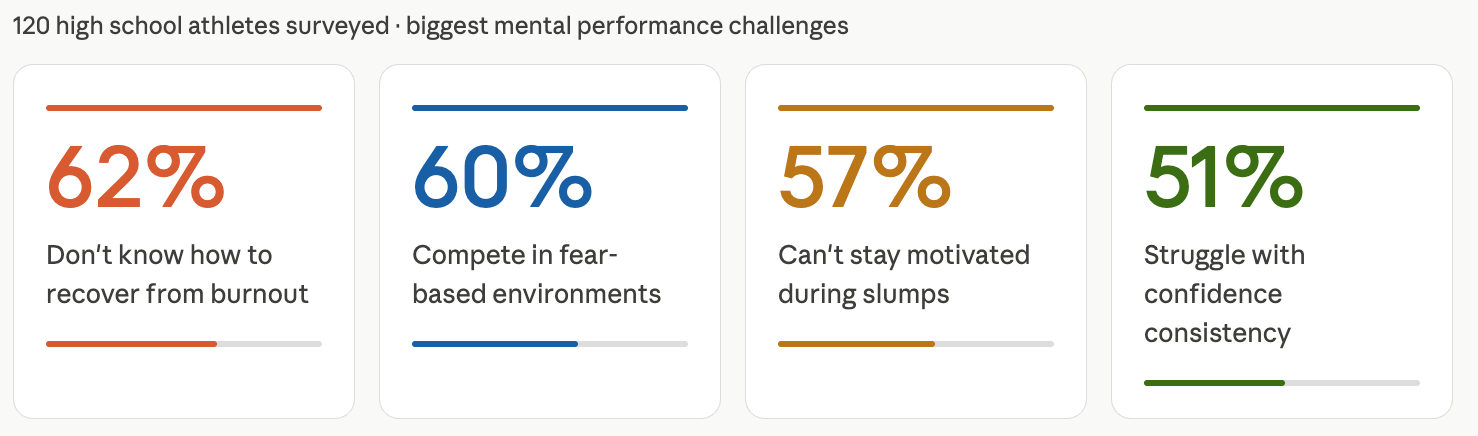
We surveyed 120 high school athletes about the mental side of competing. More than half showed signs of competing primarily from a fear state. Not because they weren’t talented or committed. Because the environments they were developing in, at practice and at home, had quietly taught them that getting it wrong was worse than not trying.
This article is about how coaches and parents can recognize that pattern, understand their role in it, and do something about it.
• 60% of athletes in our survey showed signs of competing from fear rather than bravery, and most coaches and parents are seeing the symptoms without understanding the cause
• Recognition starts with relationship. You cannot see the shift in an athlete you don’t actually know
• For an athlete to play bravely, they are going to make mistakes. Bravery and mistakes go together. The goal isn’t a mistake-free athlete. It’s an athlete who knows how to respond when things don’t go as planned
• The response coaches and parents have to mistakes, more than almost anything else, determines whether athletes learn to play brave or learn to play scared
I’ve sat across from hundreds of athletes in mental performance sessions; High school kids, college players, athletes at every level of ability and experience. One of the things I notice most consistently in our conversations is the moment they stop trying to be their most effective self as an athlete and start trying to avoid getting stuff wrong.
That shift is visible if you know what to look for. The hesitation before a decision that used to come automatically. The retreat from the difficult play, or even the hesitancy to discuss those difficult moments. The way a mistake stays on their face for longer than it should. The athlete who used to demand the ball in big moments now quietly making sure they’re not in position to be a key to their team’s performance.
These aren’t effort problems. They’re fear problems, in one way or another. These moments are almost always a response to an environment, not a reflection of the athlete’s character.
In March and April of this year (2026) we surveyed 120 high school athletes and found that 60% were competing primarily to avoid mistakes rather than to pursue success. A 2023 national survey backed that up, finding 91% of high school athletes reporting sport-related stress with 58% calling it moderate to extreme. NCAA data from more than 23,000 student-athletes found that athletes feel less confident sharing mental health struggles with their coaches than in previous years.
The gap between what athletes are carrying and what the adults around them know about it is a relationship gap and closing that gap is where this work starts.
I tell coaches this all the time: you cannot recognize fear-based play in an athlete you don’t actually know. The signals only make sense against a baseline, and you only have a baseline if you’ve done the relationship work first.
As a coach, that means individual conversations that aren’t about performance. It means paying attention to how each athlete carries themselves when they’re competing well, how they respond to mistakes when confidence is high, what their body language looks like when they’re in a good place. That picture is your reference point. When something deviates from it, you’ll see it.
As a parent, you already have more of that baseline than any coach does. You know your kid. You know what they look like when something is weighing on them before they’ve said a word. You know the difference between a quiet drive home that means they’re processing and a quiet drive home that means something broke.
The question for both coaches and parents isn’t whether they love their athlete. It’s whether the relationship is open enough that the athlete would actually tell them when something is off. Research consistently shows that athletes don’t share mental health struggles with adults they don’t trust. And trust is built in the low-stakes moments, long before it’s needed in the high-stakes ones.
For coaches: when did you last have a one-on-one conversation with each of your athletes that had nothing to do with their performance? If that’s hard to answer, that’s the place to start.
For parents: does your athlete talk to you about what competition actually feels like for them, not just what happened, but what it was like to be in it? If that conversation isn’t happening, it’s worth asking why.
Fear-based play doesn’t always look like nervousness. In experienced athletes especially, it tends to look like something more subtle: safe decisions where aggressive ones used to be natural, a slight withdrawal from the moments that require the one’s ‘all in’, a recovery time after mistakes that’s longer than it used to be.
Here’s what I watch for as a coach and mental performance practitioner.
Decision-making under pressure. The athlete who normally drives at defenders starts looking to play square or safe passes early. The one who used to shoot starts looking for the pass. The defender who welcomed one vs one duels now drops into cover positions. These aren’t tactical adjustments. They’re protective ones. The athlete is managing risk rather than pursuing opportunity.
Recovery time after mistakes. Every athlete makes mistakes. The question is how long they carry them. A fear-based athlete will hold a mistake for several minutes, and you’ll see it in everything they do in the moments that follow. When you know the athlete well, the deviation from their normal recovery pattern is obvious.
Body language between plays. Head down, shoulders forward, physical withdrawal from teammates and coaches. This often looks like disengagement from the outside. From the inside, it’s usually an athlete who is working very hard and losing the battle of fear vs bravery.
The athlete who disappears. Some fear-based athletes don’t play tight or hesitant. They just make themselves smaller. They stop being in positions where the game can ask something of them. From a distance it looks like a quiet game. Up close it’s an athlete who has decided that not being exposed is safer than competing.
Fear-based play doesn’t look the same on every athlete. On one it looks like hesitation. On another it looks like aggression, forcing plays, becoming reckless rather than withdrawn. On another it shows up as emotional volatility that doesn’t resolve quickly. The common thread isn’t the behavior. It’s the orientation underneath it: competing to avoid a bad outcome rather than to produce a effective choice that moves their team forward in some way.
What to watch for: bravery isn’t about confidence before the moment. It shows up in how an athlete handles the current moment, and then immediately shifts to the next action when things don’t go as planned.
After a mistake — what you actually see on the field
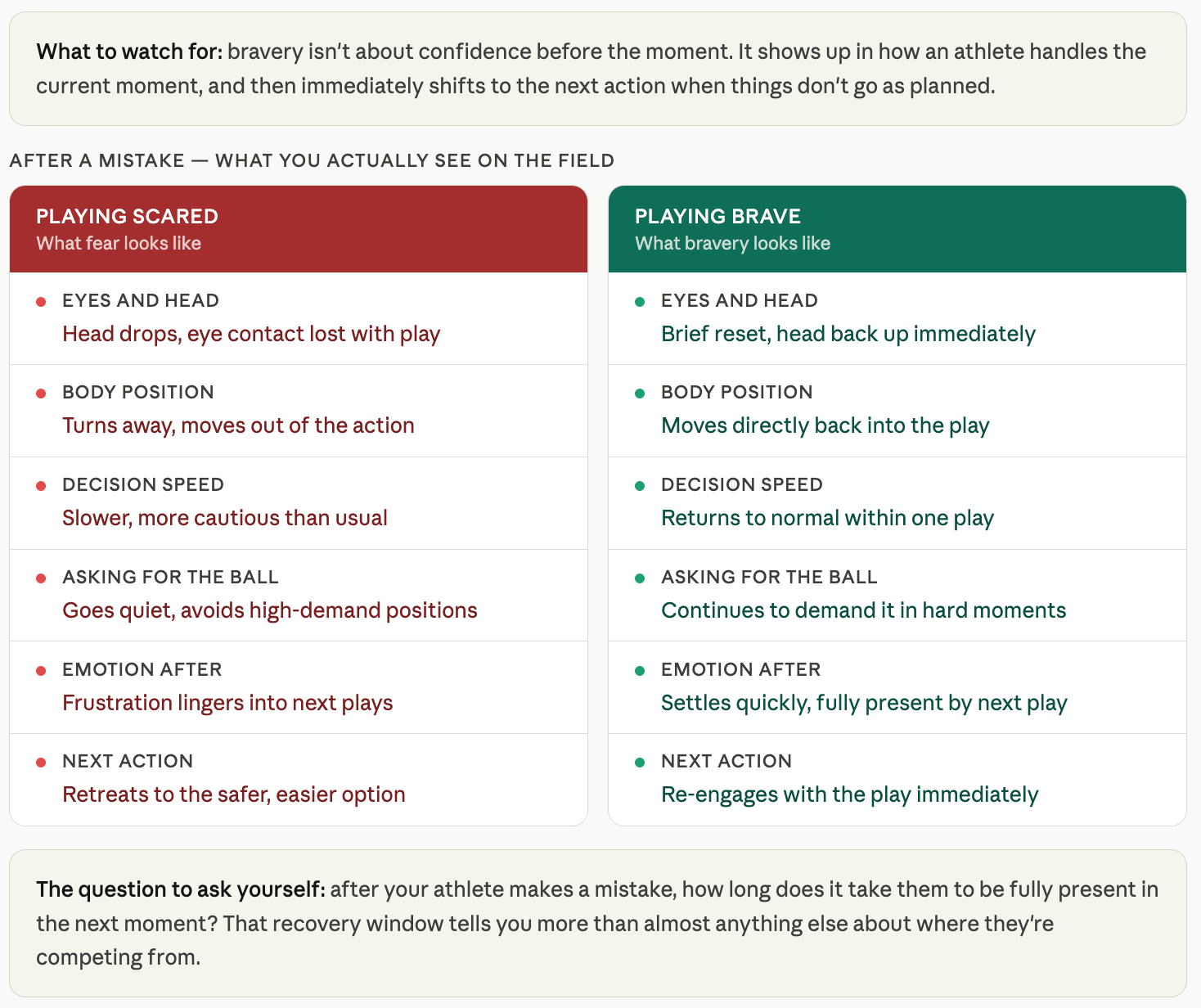
The question to ask yourself: after your athlete makes a mistake, how long does it take them to be fully present in the next moment? That recovery window tells you more than almost anything else about where they’re competing from.
For coaches: Think of one athlete on your roster right now who you suspect might be competing from fear. What specifically are you seeing? And how well do you actually know that athlete as a person beyond their performance?
For parents: Think about how your athlete talks about competition. Are they more focused on what they want to do, or more focused on what they don’t want to happen?
Here’s the thing I most want coaches and parents to understand, because it changes everything about how you respond to what you’re watching.
For an athlete to play bravely, they are going to make mistakes.
That’s not a side effect of bravery. It’s part of what bravery is. An athlete who is genuinely competing with courage, who is attempting the difficult pass, making the aggressive decision, taking the risk they’ve been working toward in training, is going to get it wrong sometimes. That’s what attempting hard things looks like.
The goal is not a mistake-free athlete. It’s an athlete who knows how to respond when things don’t go as planned. An athlete who has already decided what their reset looks like, who has practiced it enough that it’s automatic, who steps back into the play with their focus on the next moment rather than the last one.
When coaches or parents respond to a mistake as if the mistake itself was the problem, they teach the athlete something they didn’t intend to teach: that the way to avoid this response is to not take the risk in the first place. Over time, athletes learn to play not to lose rather than to play to win. They become experts at doing just enough to stay safe. In the end the brave, expressive version of themselves slowly disappears, which is such a huge bummer!
The shift I watched in my own program over ten years of high school coaching was this: when we stopped treating mistakes as problems and started treating them as the natural byproduct of competing with intention, athletes took more risks. They recovered faster. They stayed in difficult moments rather than retreating from them. Confidence that used to depend on results started coming from something more durable/controllable. Eventually our players would cheer on their teammates who took a risk in a challenging moment of the game.
That’s the environment bravery grows in. And both coaches and parents are building it or eroding it every single day, in ways they’re often not aware of.
Name brave attempts explicitly. When an athlete tries something difficult and it doesn’t come off, name the attempt out loud. “That was a great decision. It didn’t work out yet, but that’s the choice we want to see.” Athletes need to hear that the attempt has value independent of the outcome. Over time, this shifts what a good performance means from results to the quality of decision-making and effort.
Design training that requires risk. If every rep in practice is evaluated on whether it worked, you’re training athletes to manage risk rather than take it. Build scenarios where the aggressive decision is the right one, where playing safe is the wrong answer, where athletes have to make difficult choices under pressure repeatedly. Brave play in competition is a habit. It gets built in training.
Build the mistake response into your culture. Every athlete in your program should have a practiced reset for after a mistake. A breath, a cue, a physical gesture that brings them back to the present. Make it part of what your team does explicitly. Teams that practice mistake recovery are more resilient than teams that don’t. It doesn’t happen by accident.
Be consistent in how you respond to errors. Athletes are extraordinarily good at reading coaches. They notice the look after a mistake, the substitution that follows a turnover, the tone of voice in a correction. When your response to risk-taking that doesn’t come off is frustration, you are teaching athletes that safety is the priority regardless of what you say in team meetings. Consistency in how you respond to mistakes is one of the most powerful tools you have.
For coaches: In your last five training sessions, how many times did you explicitly name and affirm a brave attempt that didn’t come off? If the answer is low, that’s the place to start.
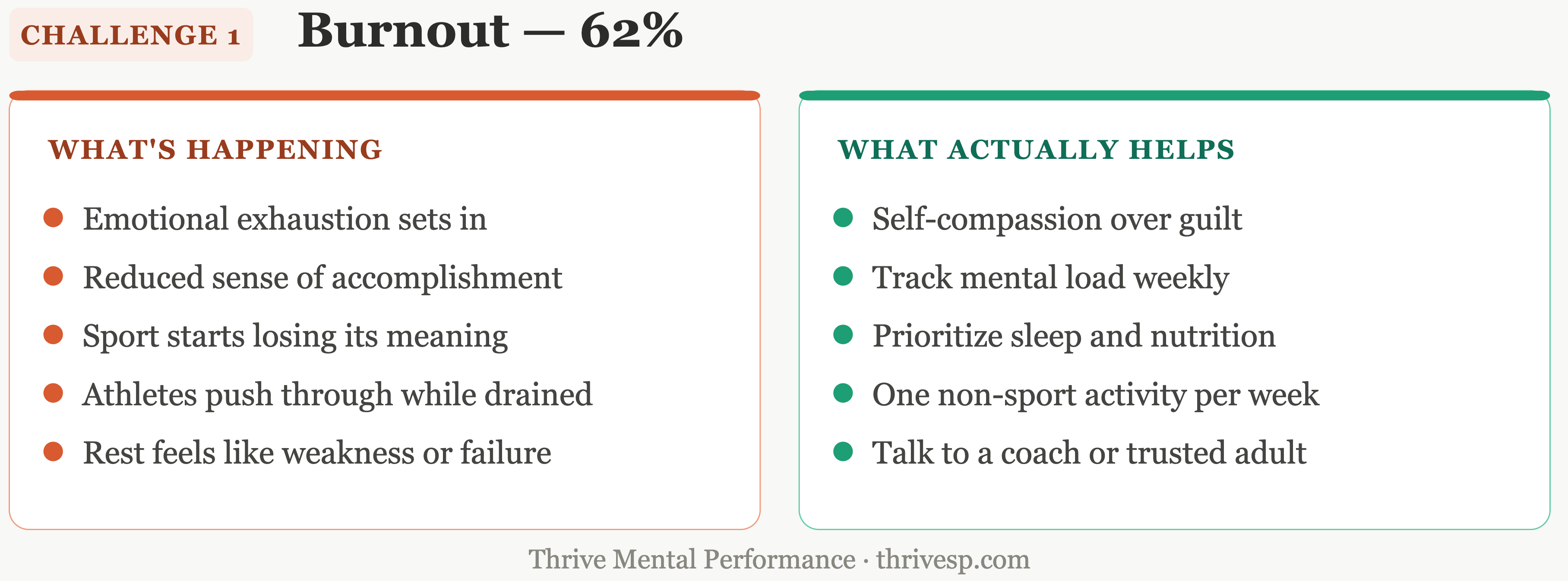
This is the part I want to speak to most directly, because I’ve lived it as a parent and I’ve seen it from the other side as a mental performance practitioner, at times even as a coach of a player who playing in front of a parent who doesn’t get it.
The response you have to your athlete’s mistakes is shaping whether they play brave or scared. Not your intentions. Your actual response. The look on your face when they come off the field. What you say first on the drive home. Whether you bring it up again at dinner. Whether your silence after a hard game communicates disappointment or just quiet.
Most parents don’t know they’re doing this. They’re responding out of love, out of investment, out of wanting their kid to succeed. But the athlete is reading every signal, and what they’re learning from those signals is what’s safe and what isn’t.
Here’s what I ask parents to consider. After your athlete has a hard game, a mistake-heavy performance, a game where things didn’t go their way: what does your response communicate about the mistake? Does it communicate that the mistake is information, something to learn from and move on? Or does it communicate that the mistake is a problem, something that needs to be explained, corrected, or reassured away?
The parent whose first words after a hard game are “you’ll get it next time” means well. But the athlete hears that the performance was bad enough to require reassurance. The parent who says “I loved watching you compete today” and leaves it there is communicating something completely different about what matters.
Bravery requires a safe landing zone. An athlete who knows that their relationship with their parent isn’t conditional on how well they played last Saturday is an athlete who can afford to take risks. An athlete who is quietly managing their parent’s expectations is an athlete who is already playing scared before they get to the field.
The most important thing you can do as a parent isn’t to know more about the mental performance tools in this article. It’s to make sure your athlete knows, without any doubt, that who they are to you has nothing to do with how they performed last weekend.
That’s the ground brave play gets built on.
For parents: What do you say first after a hard game? Not what you mean to communicate. What you actually say. And what does your athlete hear in it?
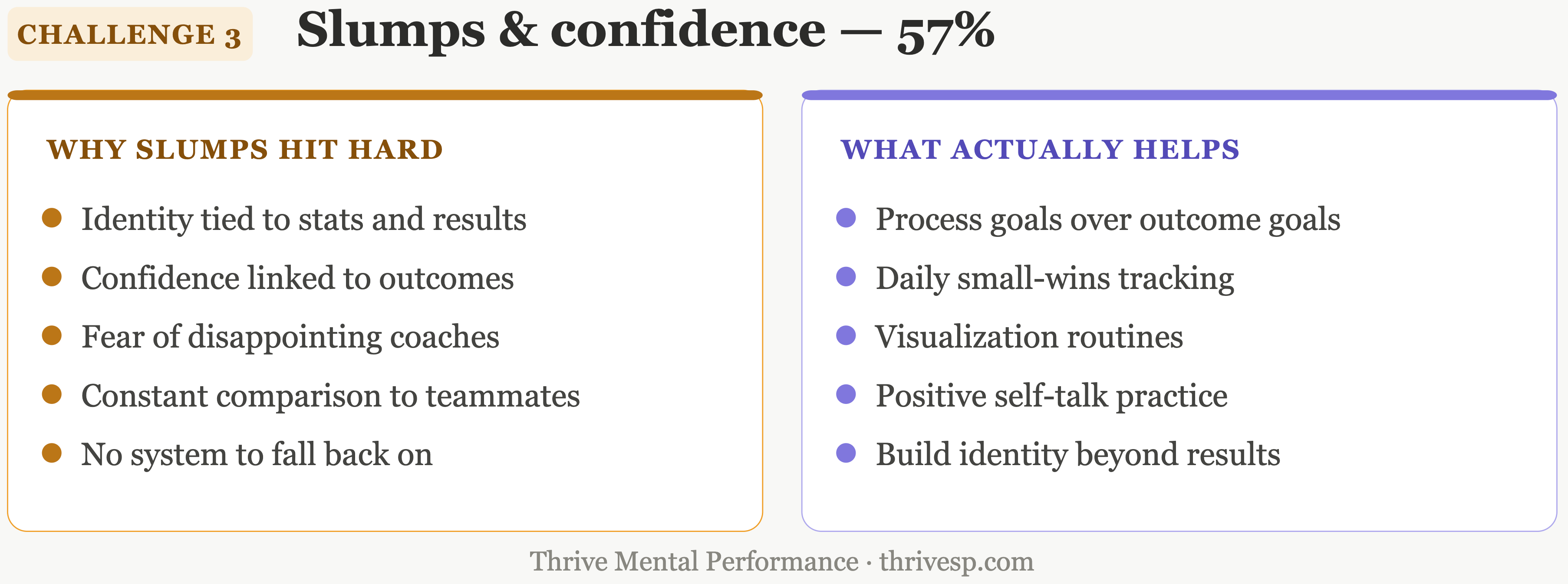
When I identify an athlete who appears to be competing from fear, the conversation I have with them starts with observation, not evaluation.
“I’ve noticed you seem to be playing a little differently than you normally do” opens a door. “You haven’t been playing well” closes one and confirms exactly what the athlete was already afraid of.
I ask questions that give them permission to be honest. “What’s it feeling like for you right now when you play?” “When you’re out there, what’s going through your mind after mistakes?” These don’t presuppose an answer. They don’t apply pressure. The athlete decides how much to share.
I listen more than I talk. The instinct when an athlete is struggling is to offer solutions. Resist that in the first conversation. What the athlete needs first is to feel seen. Solutions land much better once that’s happened.
I’m honest about what I’m seeing without attaching judgment to it. “What I hear you telling me sounds like an athlete who is working really hard not to make mistakes. You’re not alone. All players have been there before. I know how tiring it is.” This names the pattern without labeling the athlete as weak or broken. It normalizes the experience and opens the door to something different.
For parents, the same principles apply. The conversation that starts with “I noticed you seemed really hard on yourself out there” lands differently than one that starts with “what happened in the second half.” One is about the athlete’s inner experience. The other is about the performance. Lead with the person, not the result.
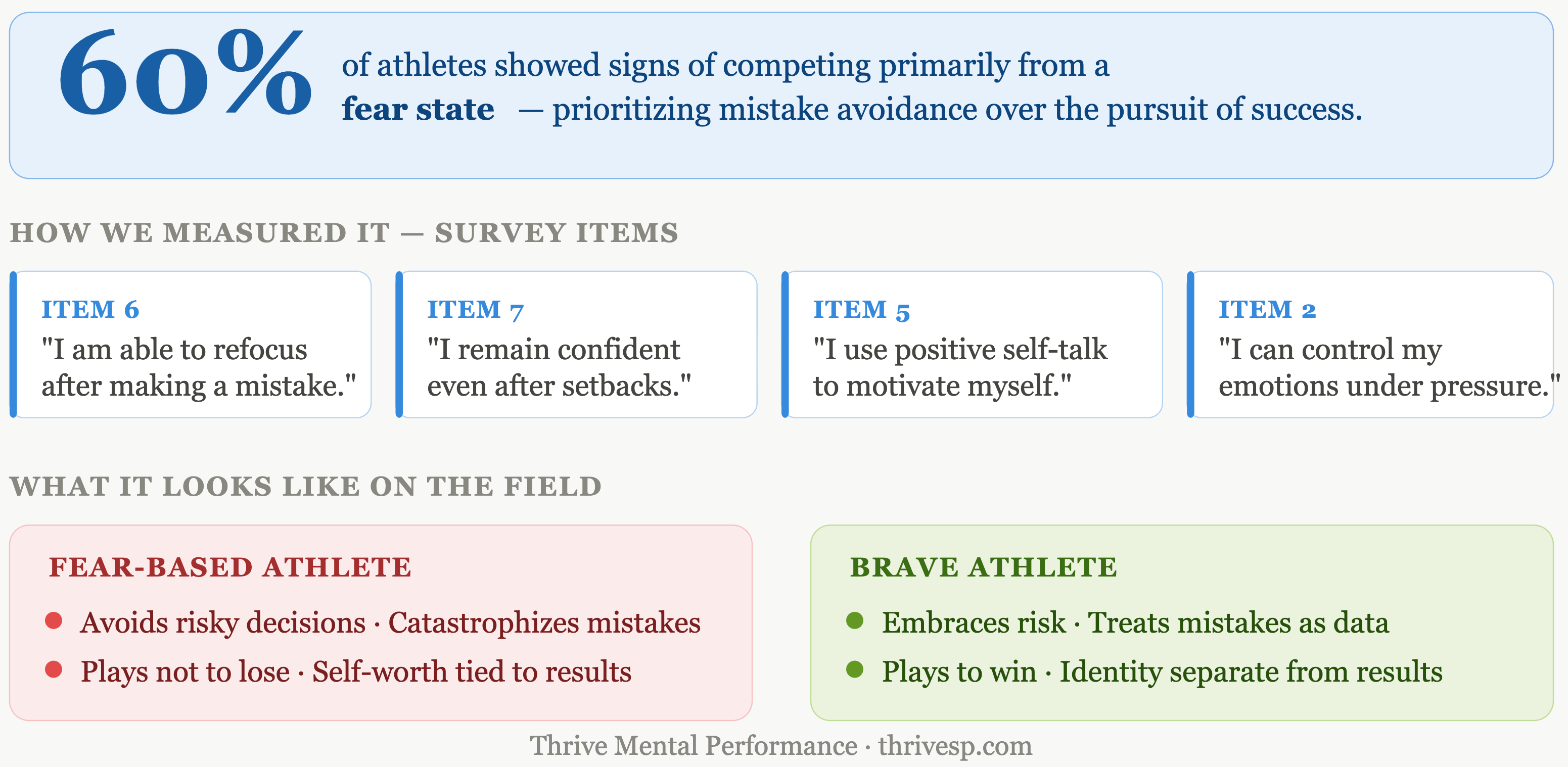
The athletes showing up in our data aren’t struggling because they lack heart or talent. Most of them love their sport deeply. What they’re missing is an environment that makes bravery feel safe, and adults in their lives who understand what bravery actually requires.
It requires making mistakes. It requires a response to those mistakes that keeps the athlete in the game emotionally, not just physically. And it requires coaches and parents who have done enough of their own reflection to know when their response to a mistake is teaching something they didn’t mean to teach.
I’ve coached athletes who transformed completely when the environment around them changed. Not because they got physically better, but because they stopped spending their energy protecting themselves and started spending it competing. The difference was visible from the first session it showed up.
That transformation is available to the athletes in your program and in your home. It starts with recognizing what you’re looking at, understanding what bravery actually brings, and building the conditions where an athlete knows that attempting the hard thing, and not always getting it right, is exactly what you came to see.
This is one of the core areas Thrive works in with high school and college programs. If this resonates with what you’re seeing in your athletes, there’s more coming - on building pre-competition routines, developing team mental performance culture, and the practical tools that move athletes from fear to bravery.
By Derrek Falor, M.Ed., CMPC - Thrive Mental Performance Coach
Noah Goldman, Senior Intern - Seattle Academy of Arts and Sciences
No posts
Comments
Nothing yet. Say the first thing.
Sign in to join the conversation.