
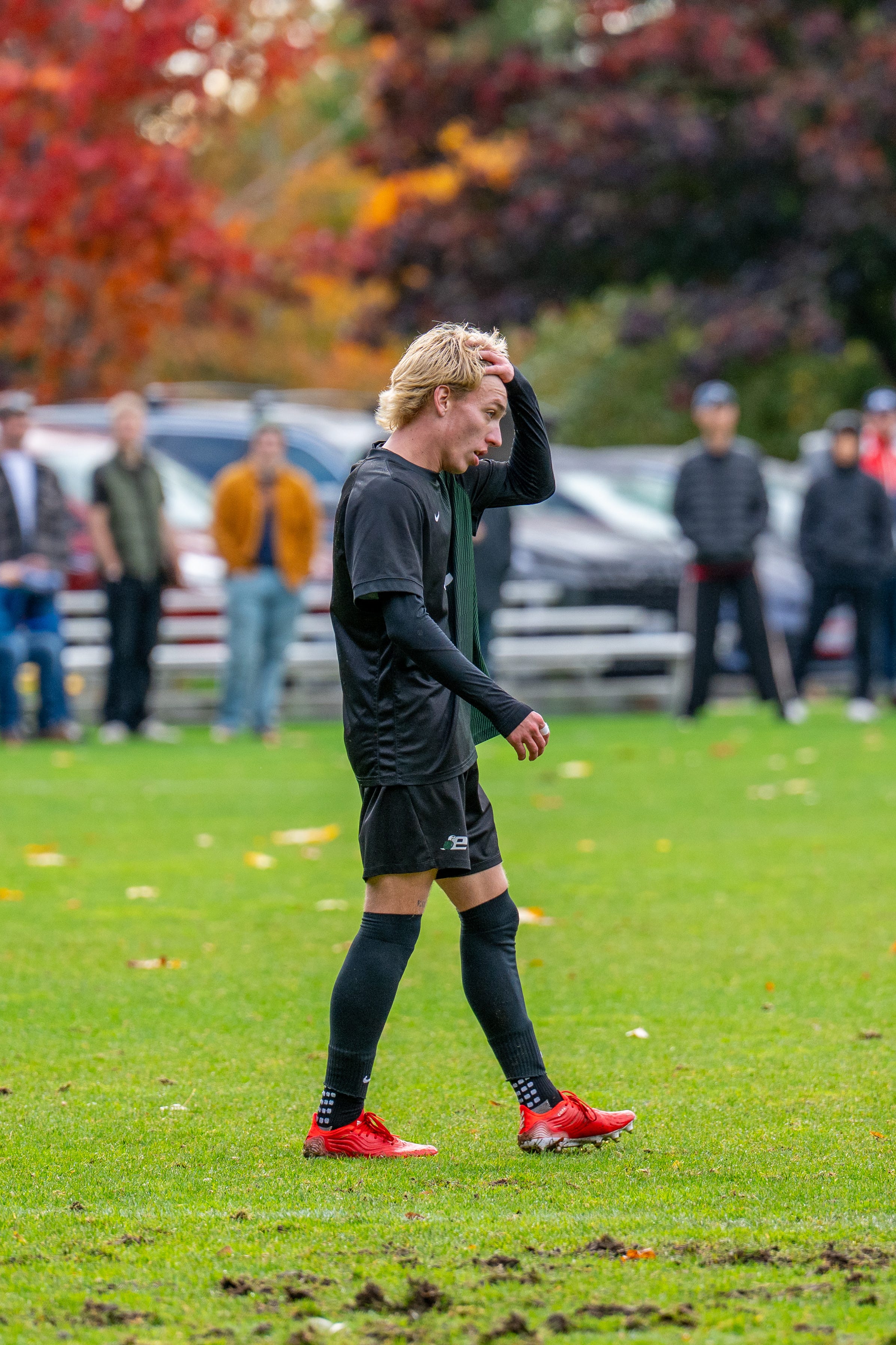
Picture the scene. Twenty minutes in, your player wins a 50/50, plays a sharp ball through the line, and makes a strong, explosive run into space. Everything is flowing. They look bright, confident, connected, physically loose. You can see how they are impacting the game from the sideline.
Then it happens. A misplayed ball. A cheap turnover in a dangerous spot. The other team intercepts and rockets off in transition, scores off the chance. You watch your player’s posture change in real time. Shoulders in. Head down. The next touch is heavy. The run they would normally make, they hesitate on. A pass they would normally play in one touch, they now play as a hesitant ball not directly to their teammate but rather just vaguely into a hopeful spot a teammate might get to. In fact, they have taken so much pace and accuracy off the pass, they have played their teammate into pressure. And for the next stretch of the game, the player you were just watching has been replaced by a version of themselves that is physically present but somewhere else entirely.
You have seen this. Every coach reading this has seen this. Every parent has watched it from the bleachers and felt helpless.
If you are watching this negative spiral from the outside and feeling concern, imagine for a moment how the player in the middle of it is feeling.
Here is what the data tells us and what the research confirms about exactly what is happening in that moment, and why telling a player to “just settle down” is about as effective as telling someone with a broken leg to walk it off.
Anxiety Management is the lowest-scoring of all nine mental skills across our entire dataset. Mean score across 1,176 players: 5.00 out of 10. It has sat at or below that threshold every single year since 2016.
That last part matters. This is not a generational problem that is slowly improving as sport psychology becomes more visible in the culture. The scores from 2016 and the scores from 2025 are essentially identical. Whatever natural development, life experience, and increased awareness of mental health in sport has occurred over the past decade, none of it has meaningfully moved this number.
Only deliberate, structured training moves this number. And right now, for the majority of players, that training is not happening.
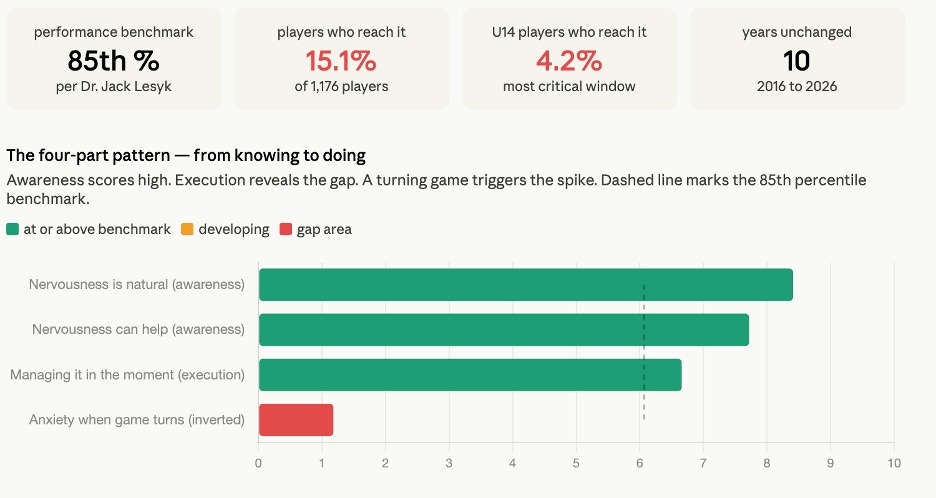
Fifty-four percent of all players in this dataset score below 5.0 on Anxiety Management. More than half. This is not a niche problem affecting a small percentage of high-anxiety athletes. It is the norm. It is the baseline. And it is costing players, teams, and coaches real results every single week.
When we look closely at what players tell us about their relationship with anxiety in competition, a pattern emerges across four distinct areas and it tells the whole story in sequence.
Players demonstrate strong awareness that nervousness is a natural, expected part of competition. Nearly universally, they understand this. They also understand, at a fairly high level, that some degree of nervousness can actually help them perform. That is genuinely encouraging. The intellectual grasp of anxiety in sport is solid across this population.
Then the data shifts.
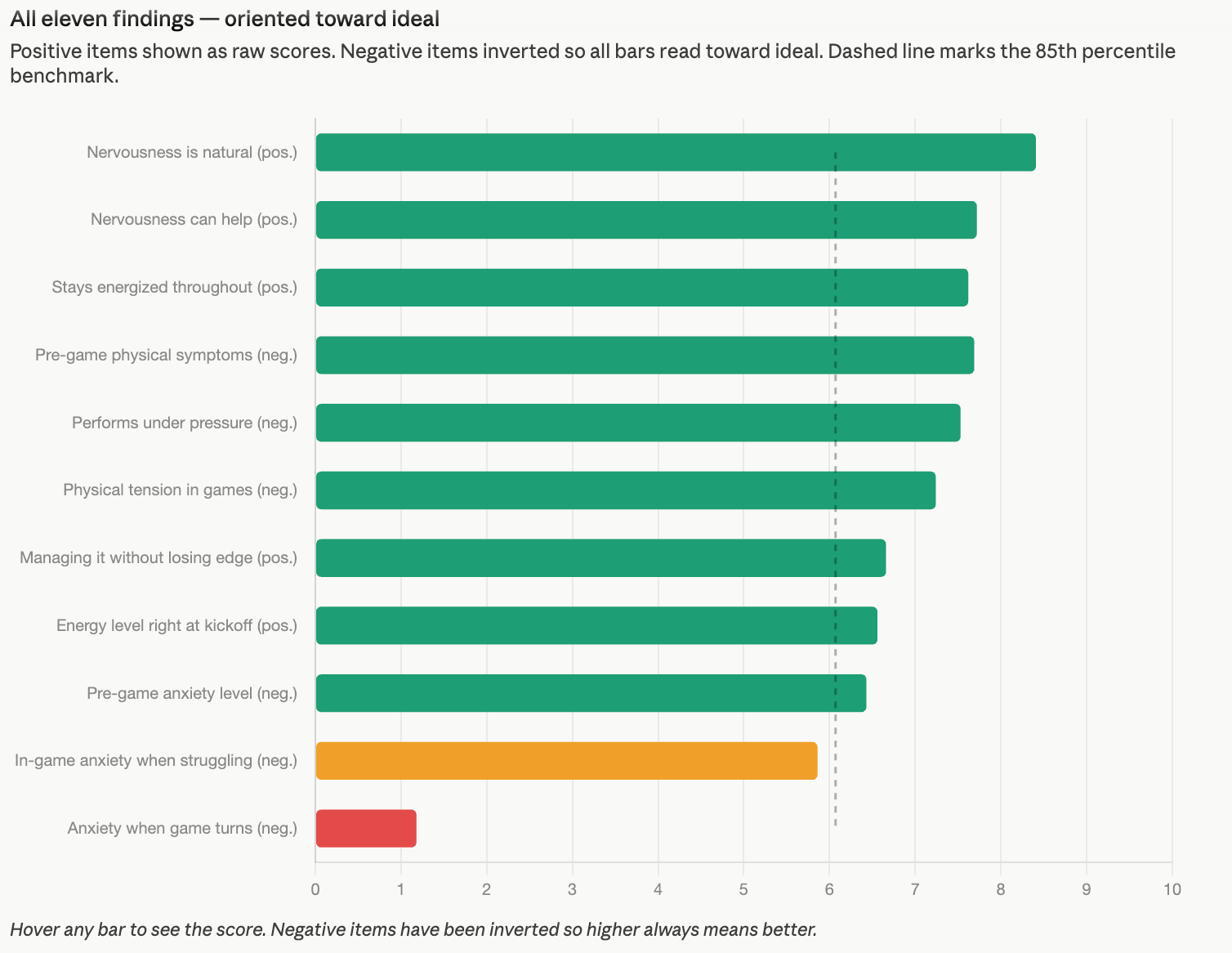
When players are asked whether they have reliable tools to manage anxiety in the moment to bring it back down to a useful level without losing their competitive edge, fewer than seven in ten say yes with confidence. That gap between knowing anxiety is coming and knowing what to do when it crosses the threshold sits at nearly three points. It is not a knowledge problem. It is a training problem.
And then the fourth piece of the pattern lands hardest of all: when asked about getting anxious specifically when things are not going well during a game, the response is nearly universal. Almost every player in this dataset across all ages, all levels, all positions reports that a turning game triggers a significant anxiety response.
Read those four findings in sequence. Players know anxiety is coming. They know it can be useful. They do not reliably know how to manage it when it gets too strong. And the moment it is most likely to spike is precisely when the game most needs them present.
That is the gap. And it shows up, with remarkable consistency, in every year of data we have collected since 2016.
Coaches and parents, this is where it is important to understand that what you are watching from the sideline is not just a mental event. It is a full physiological cascade and it changes everything about how a player sees the game, thinks within it, and moves through it.
When anxiety rises past the useful threshold, the stress response activates. Cortisol and adrenaline enter the bloodstream. Research published across multiple sport science journals confirms that elevated cortisol during competition directly affects cognitive processing and attentional control, and is associated with increased technical error and risk-taking behavior the player would not otherwise demonstrate.
The visual field narrows literally. A player who routinely scans the full width of the field begins to see a smaller picture. Peripheral awareness contracts. Teammates who were visible and accessible five minutes ago are no longer in the player’s perceptual range. They are not ignoring options. The options have physically disappeared from their field of view.
Muscle tension follows. The technical movement patterns that have been trained thousands of times the first touch, the weight of a pass, the body shape before receiving begin to break down because the muscles executing them are no longer operating in their trained state. The player is not suddenly less skilled. They are skilled in a body that is working against them.
And then the attentional system, already narrowed, begins pulling inward. Rather than reading the game, the player is now monitoring themselves. Am I playing well? Did that touch look bad? What does the coach think? The game continues at full speed. The player is no longer fully in it.
This is the cascade. Anxiety rises, cortisol spikes, the visual field narrows, muscle tension builds, and attention collapses inward. What you are watching from the sideline when a player “disappears” after a mistake is not a character flaw or a lack of toughness. It is a trained system, or rather an untrained one, responding exactly as untrained systems respond under load.
A 2024 study published in the journal Sports examining 328 youth football players aged 14 to 18 found that competitive anxiety showed consistent negative relationships with psychological profile and flow state across both age groups studied. The players most affected were not the least talented. They were the ones without trained coping strategies.
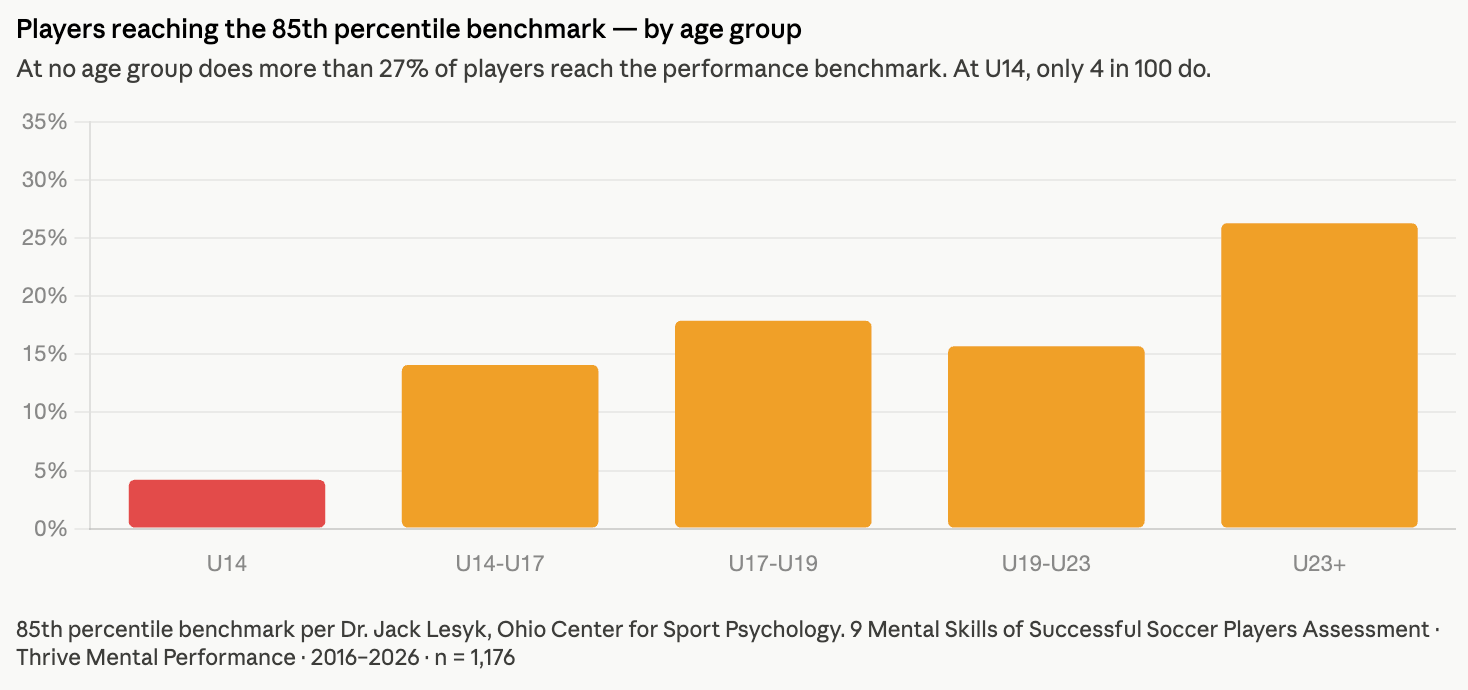
Our data shows the lowest Anxiety Management scores at the U14 level, the lowest point across all age groups, and the lowest of the three undertrained skills at that age. Scores drift upward slightly through the U17-U19 range before plateauing. By college age, the improvement from the early adolescent baseline amounts to less than one point.
Less than one point of meaningful growth across the entire developmental arc from early adolescence through college age. And critically, the scores do not rise in a meaningful linear progression. They drift. A player who does not receive deliberate anxiety management training at 14 does not naturally develop it by 19. They arrive at the next level carrying the same unmanaged system, just in a higher-stakes environment.
For coaches working with U14 to U17 players, this is the finding that should matter most. These are the years when competitive demands escalate sharply. Selection pressure increases. The gap between players who can perform under pressure and those who cannot begins to define rosters and opportunities. And the players who are falling short are very often not doing so because of technical limitations. They are doing so because nobody has ever given them the tools to manage what happens in their body and mind when the game gets hard.
“The best athletes don’t perform well because they don’t feel pressure. They feel it, just like everyone else. The difference is that they’ve done the work to navigate it. — Christian McCaffrey, Super Bowl LVIII, 2024”
That work does not happen by accident. It does not happen through more games, more training sessions, or more encouragement from the sideline. It happens through deliberate instruction, consistent practice, and an environment where the mental side of the game is treated with the same seriousness as the technical and tactical sides.
For parents of U14 to U17 players: if your player is telling you they feel sick before games, that their legs feel heavy in the opening minutes, that they “just don’t feel right” on game day, that is not a phase. That is a skill gap. And it is one of the most trainable gaps in sport psychology.
For college-aged players: if you are still experiencing the same anxiety response at 20 that you had at 15, you are not alone. The data shows most players are. But at the college level, the margins between players are increasingly mental, not physical or technical. This is the window where trained anxiety management creates the largest competitive return and where the absence of it costs the most.
One more finding deserves attention before we close.
Think back to the scene that opened this article. The turnover. The transition goal. The posture change.
Now picture two different players in that same moment.
The first player has no tools. The cortisol spike hits, the visual field narrows, the internal voice gets loud and critical. They feel it happening and have nothing to reach for. The spiral deepens. Their next five minutes belong to the anxiety, not the game.
The second player has gone through mental performance training to navigate these moments. They feel the same spike, the same tightening, the same pull inward. But they have a practiced response. A breath. A reset cue. A short, specific phrase they have used in training hundreds of times that redirects their attention outward and forward. Their body starts to regulate. The visual field opens back up. Within short seconds they are back in the game, not perfectly, but functionally. The next action is theirs again.
Same moment. Same pressure. Completely different outcomes and the difference has nothing to do with talent, fitness, or desire. It has everything to do with whether someone taught them what to do.
Anxiety Management scores across our dataset have shown virtually no meaningful change from 2016 to 2026. The range of annual means sits between 4.67 and 5.23 across all eleven years. The percentage of players reaching the 85th percentile benchmark in any given year has fluctuated between 5% and 26%, with no consistent upward trend. No sign that broader cultural awareness of mental health in sport, increased visibility of professional athletes speaking openly about anxiety, or the general growth of sport psychology as a field has translated into meaningful improvement in how youth and young adult soccer players actually manage anxiety in competition.
Awareness alone does not train a skill. Reading about anxiety management does not train it. Watching a documentary about an elite athlete’s mental health journey does not train it. Applied, evidence-based mental performance work, grounded in assessment data, structured around the individual player’s profile, and practiced consistently in the training environment, is what trains it.
That is the standard. And that is what the next generation of players deserves to have access to.
Part Three of this series will examine Concentration, the skill players think they have, and what the data actually shows.
Derrek Falor, M.Ed., CMPC, is a Certified Mental Performance Consultant for the Association for Applied Sport Psychology, holds a USSF A License, coached college soccer for 20 years, and is the founder of Thrive Mental Performance. He currently serves as Technical Director and EA Coach at Emerald City FC, where he works daily with youth players competing at the club’s highest level. He has worked with players from youth academy through MLS and with programs including the Seattle Sounders U23s and the University of Washington. The 9 Mental Skills of Successful Soccer Players Assessment used in this research is a soccer-specific adaptation of Dr. Jack Lesyk’s 9 Mental Skills of Successful Athletes Assessment, used with his permission.
To learn more about Thrive or to inquire about mental performance consulting, visit thrivesp.com.
No posts
Comments
Nothing yet. Say the first thing.
Sign in to join the conversation.