
Officiating rarely breaks down because
of a lack of Law knowledge.
It breaks down when pressure rises, emotions spill over, and recovery between decisions slows. There are no timeouts when stuff is starting to go sideways. No substitutions. And no chance to step out of performance mode to reset.
That truth has become clear to me across every role I’ve held in the game.
As a long-time coach at the club, high school, and college levels, I’ve seen how an officiating crew’s internal state can shape the flow, tone, and emotional temperature of a match. As a player, I’ve experienced how odd or inconsistent decisions—especially in emotionally charged moments—can swing momentum and belief. And as a referee myself, I’ve felt firsthand how quickly clarity can disappear when regulation slips.
When I returned to refereeing five years ago, my biggest challenge wasn’t fitness or Law knowledge. It was learning how to stay clear, neutral, and decisive in fast, public, emotionally loaded environments. The most effective tool I had wasn’t something new—it was applying my background in mental performance, using the same skills I teach my clients, to the specific demands of officiating.
What became obvious very quickly was this:
For both myself and all others I watched officiate, the officials who perform best aren’t the ones who avoid pressure. They’re the ones who regulate themselves fastest inside pressure moments.
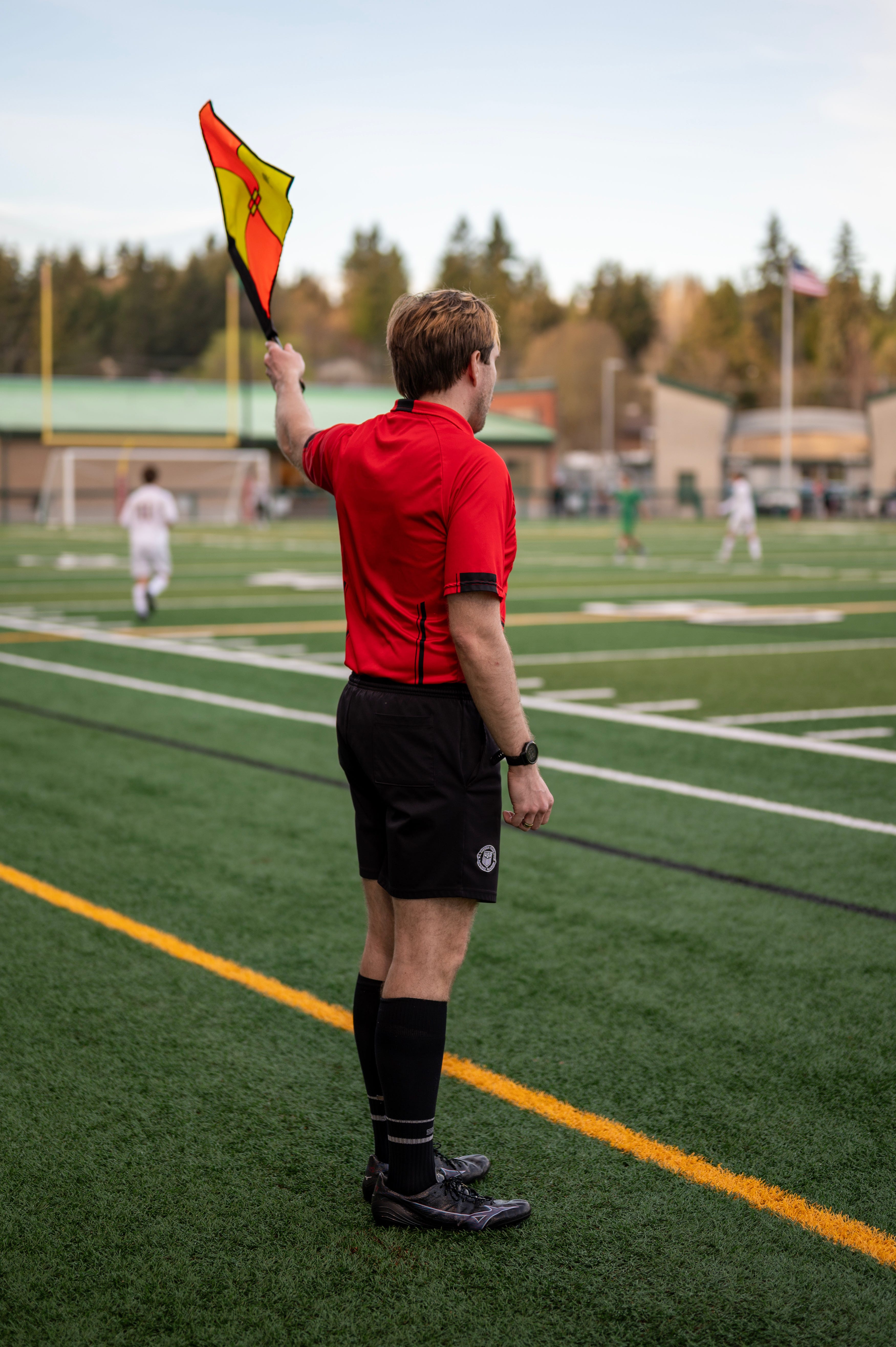
And this isn’t just a center referee skill. Assistant referees often feel the need for self-regulation just as strongly—long stretches of quiet focus, sudden high-stakes offside decisions, bench-side pressure, isolation on the diagonal, and moments where clarity matters even more because you’re furthest from the referee.
That’s why the most important mental skill for referees and ARs isn’t confidence, toughness, or even decision-making.
It’s self-regulation.
Across sport psychology and officiating research, one pattern shows up consistently:
Performance doesn’t decline because officials make mistakes—it declines when officials fail to recover quickly after stress.
Missed calls.
Dissent.
Crowd reaction.
Internal doubt.
Elite officials experience all of it. What separates them is how quickly they regulate and re-engage the task.
Self-regulation is the ability to:
Manage physiological arousal
Control attention under pressure
Interrupt negative thought spirals
Stay behaviorally connected to the next action
It’s a meta-skill—the one that allows all other skills to function when the game gets chaotic.
Self-regulation isn’t one technique. It’s a system.
For officials, it shows up through four interconnected tools:
Breathing – physiological regulation
Visualization – anticipatory regulation
Self-talk – behavioral regulation
Thought awareness (ANT labeling) – cognitive regulation
Each tool has a role. Each shows up at different moments in the match—for the referee and the AR.
Breathing isn’t about calming down—it’s about stabilizing decision-making.
Intentional breathing influences the autonomic nervous system, helping regulate the balance between fight-or-flight activation and the clarity needed for sound judgment. A key pathway here is the vagus nerve, which supports emotional regulation, attentional width, and impulse control.
For officials, breathing must work in two contexts.
During stoppages, longer exhales help downshift arousal, clear emotional residue, and prevent frustration from carrying into the restart. This applies whether you’re the referee after a heated exchange or an AR dealing with bench-side pressure.
During live play, regulation looks different. The goal isn’t deep breathing—it’s avoiding shallow, erratic breaths that narrow vision and rush decisions. Light, rhythmic breathing matched to movement keeps attention wide while you’re still running and scanning.
Breathing doesn’t slow officials down. It keeps us stable.
Visualization isn’t a special technique reserved for elite performers—you already do it every day.
The advantage comes from using it intentionally.
Before the match, mental rehearsal sets the tone. When officials visualize how they will handle dissent, tight decisions, or emotionally charged moments, they reduce surprise. When those moments arrive, they aren’t reacting from scratch—they’re executing a response they’ve already practiced.
For ARs, this might include rehearsing:
a close offside decision with patience and confidence,
a goal-line decision under pressure,
bench-side interactions that remain neutral and composed,
or a communication moment where the crew stays connected.
During the match, visualization becomes a micro-reset tool. A two- or three-second image during a stoppage—strong body language, decisive movement, locked-in focus—can redirect attention away from the last play and toward the next phase.
Visualization prepares the nervous system to behave the way you want it to when pressure shows up.
For officials, self-talk isn’t motivational—it’s directional.
The best referees and ARs use short, technical cues that guide body mechanics and positioning automatically, especially during fast transitions and high-risk moments.
During transitions:
“Open hips, stride—go.”
“Avoid the drop zone.”
On corner kicks:
“Depth, then width.”
“Angle to see through.”
On long distributions:
“Next contest.”
“Second ball.”
In corner pockets away from your AR:
“Get an angle.”
“Close the space.”
After a mistake:
Not “That wasn’t right.”
But “Move early. Find next angle.”
AR-specific cues:
“Sprint with the 2LD.”
“Patient eyes—then decide.”
“Neutral face.”
“Reset the line.”
Same standards. Better recovery.
Automatic Negative Thoughts (ANTs) are fast, convincing, and dangerous during matches.
“I blew that.”
“I’m losing control.”
“Those coaches are on me.”
Unchecked, these thoughts don’t just affect confidence. They hijack attention, slow positioning, and interfere with the next decision.
The skill isn’t eliminating thoughts—it’s labeling them.
Recognizing “That’s an ANT” creates space between thought and action. That space allows officials to redirect immediately to something controllable: movement, angle, next phase of play.
Often, the most important call of the match is the one that comes after the hard moment.
Self-regulation isn’t theoretical—it’s situational.
Pre-game: breathing and visualization set the baseline
Live play: breathing and self-talk regulate movement and focus
Stoppages: breathing and micro-visualization reset intention
Post-mistake: ANT labeling and action cues protect the next decision
Each tool supports the others. Together, they create consistency under pressure—across the entire officiating team.
Great officials are not the ones who never get rattled.
They are the ones who regulate fastest, re-engage the task, and stay present when the game demands it.
Self-regulation isn’t an add-on to officiating—it’s part of the craft.
Train it the same way you train fitness and positioning:
Brief
Intentional
Consistent
Small reps. Big payoff.
This framework is not about making referees calmer or softer. It’s about helping officials stay clear, connected, and decisive when the match demands it most.
Even highly experienced, long-time referees and ARs have challenging game sequences. Level of play, off-field distractions, fatigue, minor injuries, or the cumulative stress of decision-making all affect regulation in real time. This is not a failure of expertise—it’s part of officiating.
From grassroots officials to those receiving assignments from PRO, self-regulation skills enhance more than just performance. They improve accuracy, enjoyment, and engagement with your crew. They strengthen communication, trust, and collective decision-making when it matters most.
One simple way to begin building this skill—especially at the crew level—is through shared pregame language.
(Referee leads. ARs acknowledge briefly.)
“Alright, quick one before we head out.
Today’s game will have moments—fast transitions, emotion, noise. That’s normal.Our priority is regulation first, decisions second.
If something gets heated or weird, we reset fast and stay in the task.Breathing:
Use stoppages to clear the last moment. Long exhale. Fresh start.Movement & Angles:
If in doubt, move early and get an angle.
ARs—stay patient on the line. Sprint first, decide second.Communication:
Simple and clear. Eye contact when we can.
If you need help, take it. If you’re sure, sell it calmly.After mistakes:
We don’t dwell. Label it, reset, and protect the next decision.We’ve got each other.
Do your job, trust the crew, and stay connected to the next play.”“Let’s go work.”
Self-regulation isn’t an extra skill—it’s part of the craft. And like positioning, movement, and communication, it improves with awareness and repetition.
Train it deliberately.
The game will test it.
No posts
Comments
Nothing yet. Say the first thing.
Sign in to join the conversation.