
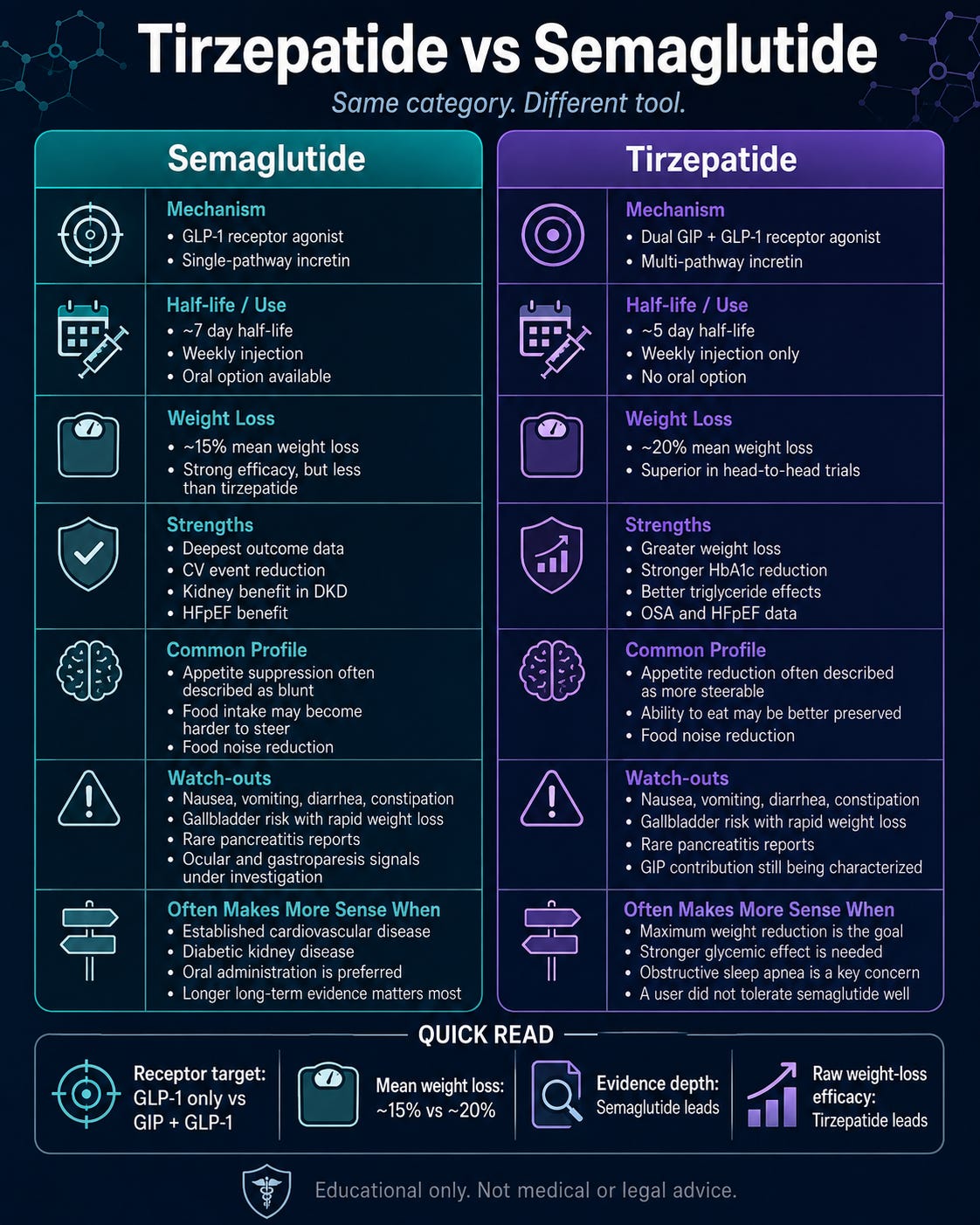
A TLDR was requested for anyone who cannot get through the whole thing in one sitting. It is at the very bottom, just above the disclaimer, so skip down if that is what you need.
These two get compared more than any other pair in metabolic medicine right now, and unlike most comparisons the reason is legitimate. Both are weekly injectable incretin agonists, both are approved for type 2 diabetes and for weight management, both produce weight loss well past anything the older generation of drugs managed, and both come from the same conceptual lineage. They are also the two compounds a person is realistically choosing between if they are going down this road at all. Where the comparison usually goes wrong is treating tirzepatide as simply a stronger version of semaglutide. It is not a dose escalation of the same drug. It is a different molecule hitting a receptor semaglutide does not touch, and that changes the profile in ways that are not captured by the weight loss number alone.
----------------------------------------
Mechanism Of Action
Semaglutide is a single-receptor GLP-1 agonist. It binds the GLP-1 receptor and drives glucose-dependent insulin secretion, suppression of glucagon, delayed gastric emptying, and central appetite suppression through hypothalamic and brainstem signaling. The structural work behind it is an acylated fatty acid side chain that binds albumin and gives it the long half-life, plus amino acid substitutions that resist DPP-4 degradation.
Tirzepatide is a dual GIP and GLP-1 receptor agonist built on a GIP peptide backbone. It carries the same albumin-binding acylation strategy but adds full agonism at the GIP receptor. GIP is the other major incretin hormone, and in type 2 diabetes it was long considered functionally useless because the response to it is blunted in that population. The finding that restoring GIP signaling alongside GLP-1 produces additive effects was not obvious in advance and remains partly unexplained.
What GIP agonism actually contributes is still being worked out. The leading explanations are increased insulin sensitivity in adipose tissue with improved lipid handling and storage capacity, central GIP receptor activity in appetite regulation that appears complementary rather than redundant to GLP-1, and a reduction in nausea signaling that allows higher effective GLP-1 activity to be tolerated. The complication worth being honest about is that GIP receptor antagonism has also shown metabolic benefit in some work, which means the mechanism is not fully settled even though the clinical outcome is.
----------------------------------------
Pharmacokinetics
Semaglutide has a half-life around seven days, reaching steady state in roughly four to five weeks. Tirzepatide sits around five days with a similar time to steady state. Both are weekly, and the difference is not clinically meaningful in practice. What it does affect is washout, since semaglutide takes noticeably longer to clear if side effects need to be resolved or the compound needs to come out before a procedure.
Semaglutide has one structural advantage worth noting, which is an oral formulation using an absorption enhancer. Bioavailability is poor and dosing requirements are high, but the option exists and no oral tirzepatide is available.
----------------------------------------
Evidence Quality
This is the strongest part of the comparison because both have real head-to-head data, which is rare.
According to PubMed, the SURMOUNT-5 trial ran tirzepatide against semaglutide directly in adults with obesity and without type 2 diabetes over 72 weeks, and tirzepatide produced substantially greater reductions in body weight, BMI, and waist circumference, with separation appearing as early as week 4. A post hoc analysis of that trial found 44 percent of tirzepatide participants qualified as rapid responders by week 24 compared with 21 percent on semaglutide, with safety trends similar between the two. Earlier, SURPASS-2 compared the two in type 2 diabetes and also favored tirzepatide on both HbA1c and weight.
Semaglutide carries the deeper outcomes portfolio. It has demonstrated cardiovascular event reduction in people with established cardiovascular disease and obesity without diabetes, kidney outcome benefit in diabetic kidney disease, and benefit in heart failure with preserved ejection fraction. Tirzepatide has outcome data in obstructive sleep apnea and heart failure with preserved ejection fraction, and its cardiovascular outcomes trial established safety rather than a clear superiority claim over an existing GLP-1.
The practical read is that tirzepatide has the better efficacy evidence on weight and glycemia, while semaglutide has the longer and broader record of proving that treatment translates into hard clinical endpoints.
----------------------------------------
Biomarkers And Measurable Effects
Both improve HbA1c, fasting glucose, blood pressure, inflammatory markers including CRP, and liver fat, with tirzepatide generally producing the larger movement on glycemic markers.
Lipids are where the divergence is most visible. Tirzepatide tends to produce larger reductions in triglycerides and larger increases in HDL, which is consistent with GIP receptor activity in adipose tissue and is not fully explained by the greater weight loss alone. Both reduce liver fat substantially and both show benefit in metabolic dysfunction-associated steatotic liver disease.
Lean mass loss is the biomarker most people ignore and the one that matters most in a physique context. Both drive meaningful loss of fat-free mass as a proportion of total weight lost, commonly cited in the range of a quarter to 40 percent depending on the population and the measurement method. Neither compound is protective of lean tissue, and the larger weight loss with tirzepatide means the absolute lean mass at risk is larger.
----------------------------------------
Side Effects And Risk Differences
The side effect categories are nearly identical. Nausea, vomiting, diarrhea, and constipation dominate, are dose dependent, and cluster around titration steps. Both carry gallbladder risk driven largely by rapid weight loss, both carry rare pancreatitis reports, and both carry the rodent thyroid C-cell tumor warning that contraindicates use with a personal or family history of medullary thyroid carcinoma or MEN2.
Two differences are worth flagging. Semaglutide has accumulated a signal for non-arteritic anterior ischemic optic neuropathy in observational work, which is not established as causal but is under active investigation and has no equivalent signal for tirzepatide. Severe gastroparesis reports also skew toward semaglutide, though the reporting environment makes that difficult to interpret cleanly.
Tirzepatide's GI profile is not worse than semaglutide's despite producing more weight loss, and in head-to-head data it is broadly comparable. That is a genuinely notable finding, because more appetite suppression would ordinarily mean more nausea.
----------------------------------------
What Users Consistently Report
These are anecdotal and should be treated that way, but they are consistent enough across large user populations to be worth stating.
Appetite suppression on semaglutide is frequently described as blunt, with food becoming unappealing and total intake dropping in a way that is hard to steer. Tirzepatide is more often described as reducing drive to eat while leaving the ability to eat intact, which matters enormously to anyone trying to hit a protein target in a deficit. That distinction lines up plausibly with GIP-mediated tolerability but has not been isolated in controlled work.
Sulfur burps and prolonged fullness are reported more often on semaglutide. Both produce the reduction in intrusive food thoughts that people call food noise, and both produce reduced alcohol interest often enough that it is being formally studied.
In bodybuilding contexts the microdosing pattern is near universal, typically running doses far below the labeled weight management range specifically to blunt appetite without gutting training performance or protein intake. Tirzepatide dominates that use case anecdotally for the reason above. Nobody should mistake widespread use for validation, since none of this has been studied in trained lean populations at those doses.
----------------------------------------
Same Category, Different Tool
Both are weekly incretin agonists, which makes them look like the same tool at different strengths. The more accurate framing is that semaglutide is a single-pathway intervention with a deep evidence base behind its downstream consequences, while tirzepatide is a multi-pathway intervention with better performance on the primary endpoints and a shorter track record on what those endpoints buy long term.
Semaglutide is the known quantity. Longer market exposure, more outcome trials, more populations studied, an oral option, and a fuller picture of what happens to people who stay on it. Tirzepatide is the more effective tool with a mechanism that is still being characterized, particularly on the GIP side.
Choosing between them on weight loss percentage alone treats the endpoint as the goal. In most real situations the goal sits behind the endpoint, and the two compounds serve those different goals unevenly.
----------------------------------------
Which Makes More Sense When
Maximum weight reduction as the primary objective favors tirzepatide clearly, with head-to-head data supporting it and faster early separation.
Established cardiovascular disease as the driving concern favors semaglutide, which has directly demonstrated event reduction rather than inferring it from weight change.
Diabetic kidney disease favors semaglutide on the strength of dedicated renal outcome data.
Obstructive sleep apnea favors tirzepatide, which has purpose-built trial evidence in that population.
Someone who could not tolerate one on GI grounds should not assume the other will behave the same way, since the profiles overlap but the tolerability reports differ enough that switching is reasonable.
Preference for oral administration leaves only semaglutide as an option.
Neither is appropriate for someone at low body fat chasing cosmetic leanness, where the lean mass cost is disproportionate to the benefit. Neither belongs in a plan without resistance training and a protein floor in place first. Neither is a short-term tool, since weight regain after discontinuation is the consistent finding for both. And neither addresses the behavioral and dietary pattern underneath, which is what determines whether anything holds after the compound comes out.
----------------------------------------
Side By Side
Semaglutide: single GLP-1 receptor agonist, seven day half-life, weekly injection with an oral option available, roughly 15 percent mean weight reduction in pivotal obesity trials, deepest outcome evidence across cardiovascular, renal, and heart failure endpoints, blunt appetite suppression commonly reported, ocular and gastroparesis signals under investigation.
Tirzepatide: dual GIP and GLP-1 receptor agonist, five day half-life, weekly injection only, roughly 20 percent mean weight reduction and superior in direct head-to-head comparison, stronger glycemic and triglyceride effects, GI tolerability comparable despite greater efficacy, appetite reduction more often described as steerable, GIP contribution still incompletely understood.
----------------------------------------
TLDR
Tirzepatide hits two receptors, semaglutide hits one, and that is the whole reason the profiles differ. In direct head-to-head trial data tirzepatide produced more weight loss, better glycemic movement, and larger triglyceride improvement, and it did all of that without a worse gastrointestinal burden. Semaglutide is the one with the deeper record on hard outcomes, having demonstrated cardiovascular event reduction, renal benefit, and heart failure benefit across dedicated trials, and it is the only one of the two available orally.
Pick tirzepatide when the goal is maximum weight and glycemic change or when sleep apnea is in the picture. Pick semaglutide when cardiovascular or kidney disease is the actual concern being managed, or when an oral route matters. Both cost lean mass on the way down, neither holds after discontinuation without something else in place, and neither is a good fit for someone already lean chasing a cosmetic result.
Disclaimer: As always nothing in my breakdowns is meant to be medical or legal advice and is purely educational
No posts
Comments
Nothing yet. Say the first thing.
Sign in to join the conversation.