
A lot of people know where we are today. Almost nobody knows how we got here.
Ask around and you will get sharp, accurate answers. Sema versus tirz. Where reta’s numbers landed. What CagriSema is combining and why it disappointed. That knowledge is real and it is current.
Now ask why semaglutide uses a C18 diacid instead of a C16 fatty acid. Or why tirzepatide is built on a GIP backbone instead of a GLP-1 one. Or why this entire class exists at all.
Room goes quiet.
That is not a knock on anybody. Most people walked into this space around 2023. That is three years of context on a story that runs closer to sixty.
But here is why it is worth your time to fix that. Every design choice in the compounds you are researching right now was somebody’s answer to a specific problem. Once you can see the problems, the molecules stop looking like a random alphabet soup of names and start looking like a chain of solutions, each one only possible because of the last.
And there is a payoff at the end. By the time you finish this, you will understand why Eli Lilly is sitting in federal court right now arguing with the FDA about whether retatrutide has 39 amino acids or 41, and why the answer to that one question may be worth more to them than every clinical result in the entire TRIUMPH program combined.
Grab a coffee. This is the whole arc.
Start with a puzzle nobody could solve for sixty years.
In 1902, Bayliss and Starling described secretin and essentially invented the concept of a hormone. A chemical messenger released by one tissue, acting on a distant one. Thirty years later a Belgian physiologist named Jean La Barre coined the word “incretin” for a hypothetical gut factor that told the pancreas to release insulin.
Hypothetical. Nobody had found it.
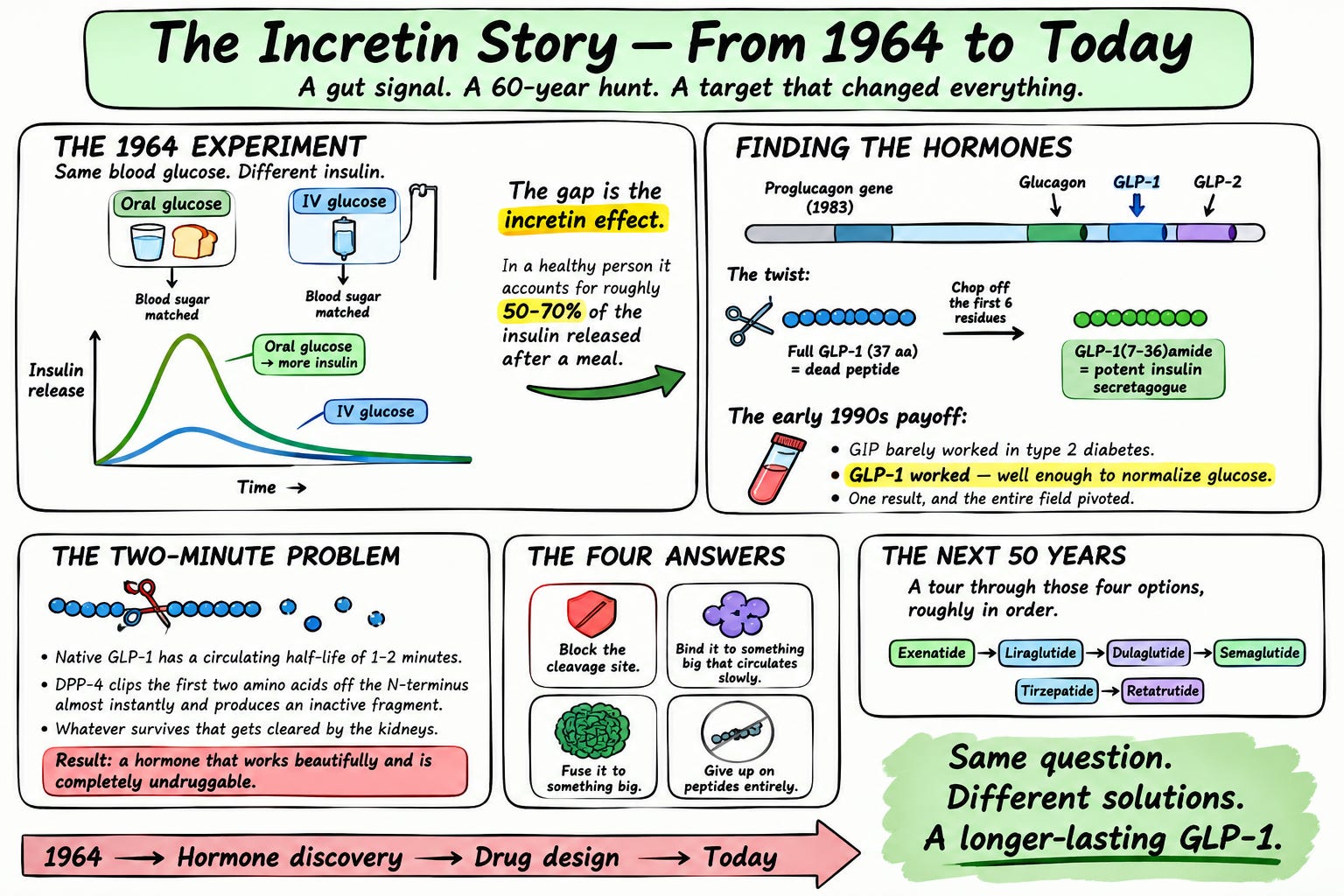
Then in 1964, two groups working independently (Elrick in the US, McIntyre in the UK) ran an experiment so simple it is almost annoying.
They gave people glucose by mouth. Then they gave people glucose intravenously. And they matched the blood sugar levels between the two conditions.
If insulin release were purely a response to blood glucose, the two insulin curves should have been identical.
They were not close. Oral glucose produced dramatically more insulin.
That gap has a name now. The incretin effect. In a healthy person it accounts for roughly 50 to 70 percent of the insulin released after a meal.
Read that again. More than half the insulin response to a meal was coming from somewhere nobody could identify.
The first suspect showed up in the early 1970s. John Brown isolated gastric inhibitory polypeptide, later renamed glucose-dependent insulinotropic polypeptide once people figured out what it actually did.
GIP was real. It was insulinotropic. It was glucose-dependent. Case closed.
Except it was not. Block GIP and the incretin effect does not disappear. There had to be a second hormone hiding somewhere.
It did not turn up in a tissue extract. It turned up in a gene.
In 1983, Graeme Bell’s group cloned the proglucagon gene and found something nobody expected. The gene did not just encode glucagon. Sitting downstream were two additional glucagon-like sequences. They got named GLP-1 and GLP-2.
Then came the subtlety that turned out to be the entire ballgame.
The predicted GLP-1 peptide, the full 37-amino-acid version, did essentially nothing in assays. Dead on arrival. It took work from Svetlana Mojsov and Joel Habener at Mass General, Daniel Drucker, and Jens Juul Holst in Copenhagen to establish that the active molecule is a truncated form: GLP-1(7-36)amide and GLP-1(7-37).
Chop off the first six residues and a dead peptide becomes a potent insulin secretagogue.
The clinical payoff landed in the early 1990s, and it decided everything that followed. Michael Nauck and colleagues infused both incretins into people with type 2 diabetes.
GIP, the frontrunner for twenty years, barely worked. Its insulinotropic action is badly blunted in T2D.
GLP-1 worked. Well enough to normalize glucose.
One result, and the entire field pivoted. GLP-1 was the target.
Then everybody hit a wall.
This is the single most important section in this post, so I am going to be blunt about it.
Native GLP-1 has a circulating half-life of one to two minutes.
DPP-4 clips the first two amino acids off the N-terminus almost instantly and produces an inactive fragment. Whatever survives that gets cleared by the kidneys.
So you have a hormone that works beautifully and is completely undruggable. You would need a continuous IV drip to use it.
Every compound in this post exists to solve that. Exenatide, liraglutide, dulaglutide, semaglutide, tirzepatide, retatrutide. All of them. Different decades, different companies, same question:
How do you make this molecule last?
There are only four real answers. Block the cleavage site. Bind it to something big that circulates slowly. Fuse it to something big. Or give up on peptides entirely.
The next fifty years are a tour through those four options, roughly in order.
Option one showed up in a reptile.
The first solution to the two-minute problem did not come from a lab bench. It came from a Gila monster.
John Eng was a VA endocrinologist in the Bronx in the early 1990s, screening venom peptides. Reptile venoms are loaded with hormone-like molecules, which is exactly why they are worth screening. In Heloderma suspectum venom he found a 39-amino-acid peptide and named it exendin-4.
Exendin-4 shares about 53 percent sequence homology with human GLP-1. Close enough to fully activate the GLP-1 receptor.
But at position 2, where human GLP-1 has an alanine, exendin-4 has a glycine.
DPP-4 cannot touch it.
Half-life goes from two minutes to a couple of hours. A lizard had already solved the problem that had stalled an entire field, and it had been walking around the Sonoran Desert the whole time.
Small footnote worth knowing: Eng had to fund a chunk of the follow-up work himself, because the VA passed on patenting it.
Amylin Pharmaceuticals licensed it. April 2005, exenatide launched as Byetta. Twice-daily injection, roughly 0.8 to 1.0 percent A1c reduction, two to three kilograms of weight loss, and a truly unpleasant amount of nausea.
By 2026 standards that is nothing. In 2005 it was the first drug in an entirely new class, and it did something no diabetes drug was supposed to do.
It caused weight loss. In a field where practically every other agent caused weight gain.
Weekly Bydureon followed in 2012 using extended-release microspheres. Lixisenatide arrived in the US in 2016. Neither changed the world, but together they proved the target held.
Meanwhile, Novo Nordisk had decided borrowing from a lizard was beneath them.
Novo did not want a venom peptide. They wanted the human hormone, engineered.
Liraglutide is native GLP-1 with two changes. An arginine swapped in at position 34, and a 16-carbon palmitic acid chain hung off lysine 26 through a glutamic acid spacer.
That fatty acid is doing two jobs at once, and this is the elegant part.
At the injection site, it drives the peptide to self-assemble into heptamers. Instead of absorbing all at once, the depot dissolves slowly.
In circulation, it binds non-covalently to serum albumin, which shields the peptide from both DPP-4 and renal filtration.
Half-life: about 13 hours. Once daily.
Victoza was approved for T2D in Europe in 2009 and the US in January 2010. But the moment that actually mattered came five years later.
December 2014. A higher dose approved as Saxenda, specifically for obesity. The SCALE program had shown around 8 percent body weight reduction at 56 weeks.
Eight percent sounds like nothing now. At the time it was the first real evidence that a GLP-1 agonist could be a legitimate obesity drug in its own right, not a diabetes drug with a convenient side effect.
Then 2016 happened, and the class stopped being about weight at all.
LEADER reported. Liraglutide reduced major adverse cardiovascular events in people with T2D and high CV risk. Not a surrogate marker. Not a biomarker. Actual events.
That result reframed everything. These were not glucose-lowering agents anymore. They were organ-protective drugs.
Every cardiovascular, renal, and hepatic indication that has come since, all of them, trace back to LEADER.
Lilly looked at the same problem and went somewhere completely different.
Forget hiding on albumin. What if the drug was just too big to clear?
Dulaglutide is two GLP-1 analog peptides covalently tethered by flexible linkers to a modified human IgG4 Fc fragment. The peptides carry an alanine-to-glycine swap at position 8 to defeat DPP-4. The Fc is engineered to minimize immune effector function.
The result is a roughly 60 kilodalton molecule. Way too large for glomerular filtration. And the Fc region engages the neonatal Fc receptor recycling pathway, the same system that keeps your antibodies in circulation for weeks.
Half-life: about five days. Once weekly.
Trulicity was approved in September 2014 and became the commercial workhorse of the class for years, helped enormously by an autoinjector people actually did not mind using.
Flag this one in your memory. Lilly has been building GLP-1 drugs out of large protein components since 2014. That fact is going to matter a lot when we get to the courtroom.
GSK tried a cousin of this idea with albiglutide, fusing GLP-1 directly to human albumin. Tanzeum approved 2014, pulled from the market 2018.
It worked fine. It just did not work as well as the alternatives, and the field was moving too fast to carry it.
Worth remembering that this space has losers, and they are not always losers on mechanism. Sometimes they are just second best at the wrong moment.
Semaglutide is liraglutide’s philosophy, executed by people who had learned a lot in ten years.
Three changes from native GLP-1:
Aib (alpha-aminoisobutyric acid) at position 8. A non-natural amino acid whose steric bulk makes the peptide almost completely DPP-4 resistant.
Arg at position 34, same as liraglutide, keeping acylation off the wrong lysine.
A C18 diacid (octadecanedioic acid) at lysine 26, through a gamma-glutamic acid spacer plus two OEG units.
That third one is the whole upgrade. Swapping a fatty acid for a fatty diacid and lengthening the linker produces far stronger and more stable albumin binding than liraglutide’s C16.
Half-life: about seven days.
Now stop and look at that first bullet again. Aib. A non-standard, non-natural amino acid, sitting inside an approved peptide drug.
Nobody thought twice about it in 2017. It is the entire legal question at the end of this post. Hold that thought.
Ozempic launched for T2D in December 2017. Rybelsus followed in September 2019 as the first oral GLP-1, using an absorption enhancer called SNAC to shove roughly one percent of an oral dose across the gastric mucosa. Wildly inefficient, genuinely impressive chemistry.
Then STEP 1 published in 2021. Semaglutide 2.4 mg, about 14.9 percent body weight reduction at 68 weeks. Wegovy approved that June.
You know what happened next culturally. Here is what happened scientifically, which got less attention and matters more.
SELECT: cardiovascular benefit in people with obesity and no diabetes. FLOW: kidney outcome benefit in CKD with T2D. STEP-HFpEF: heart failure with preserved ejection fraction. Then obstructive sleep apnea. Then in August 2025, MASH, on the ESSENCE data, making semaglutide the first incretin approved for a liver indication.
And in December 2025, high-dose oral semaglutide was approved for obesity. A real GLP-1 pill, on pharmacy shelves.
One molecule, one hormone, one receptor, chased about as far as it can go.
Which is exactly when somebody asked the better question.
Through 2020 the assumption was locked in. One hormone, one receptor, better delivery. Iterate on the packaging.
But a counterexample had been sitting in plain sight the entire time.
Oxyntomodulin. A gut peptide produced from the same proglucagon gene as GLP-1. It activates the GLP-1 receptor and the glucagon receptor.
Your own body makes a dual agonist. It has been doing it the whole time.
Richard DiMarchi and Matthias Tschop turned that observation into a design principle in the late 2000s and early 2010s. They called it unimolecular polypharmacy.
Do not combine two drugs. Build one peptide that hits multiple receptors in a ratio you choose deliberately. One pharmacokinetic profile. One titration schedule. One safety file.
That idea is the direct parent of tirzepatide and retatrutide. Everything you are watching right now descends from it.
Tirzepatide is a 39-amino-acid peptide with Aib at positions 2 and 13 and a C20 fatty diacid at lysine 20 for albumin binding.
Here is the detail most people miss, and it is a good one to have in your pocket.
Tirzepatide’s backbone is derived from native GIP. Not GLP-1. It is a GIP peptide that was engineered to also engage the GLP-1 receptor. The famous GLP-1 drug is, structurally, a GIP molecule.
And it does not treat the two receptors equally. Tirzepatide is a full agonist at GIPR and a biased partial agonist at GLP-1R, favoring G-protein signaling over beta-arrestin recruitment. Less arrestin means less receptor internalization, which means less desensitization over time.
That imbalance is not a compromise. It looks like the point.
Mounjaro approved May 2022, Zepbound November 2023. SURMOUNT-1 delivered roughly 20.9 percent at 72 weeks on 15 mg. SURMOUNT-5, the head-to-head, put tirzepatide around 20.2 percent against semaglutide 2.4 at about 13.7 percent. SUMMIT covered HFpEF, SURMOUNT-OSA covered sleep apnea, SURPASS-CVOT covered cardiovascular outcomes.
Some numbers for scale, because they explain the legal fight later. Mounjaro and Zepbound together brought Lilly about 36.5 billion dollars in 2025. Roughly 14.9 billion in a single quarter of 2026. Lilly became the first pharmaceutical company to cross a one trillion dollar market cap.
Now here is the part that should genuinely bother you, because it bothers the people who study this for a living.
Adding GIP agonism improves weight loss. Tirzepatide proves it.
Blocking GIP also improves weight loss. Amgen’s MariTide pairs a GLP-1 agonist with a GIP receptor antagonist and lands in the same range.
Two opposite interventions at the same receptor. Same direction of effect.
The candidate explanations:
Sustained GIPR agonism causes receptor desensitization that functions as pharmacological antagonism.
GIPR signaling in the hypothalamus and area postrema cuts food intake and blunts nausea independent of anything peripheral.
Peripheral GIPR activity in adipose tissue improves lipid handling in a way that outweighs appetite effects.
Possibly all three, in different tissues, at the same time.
Nobody has closed this out. If somebody tells you it is settled, they are not reading the literature.
Retatrutide takes the tirzepatide architecture, GIP-derived backbone and all, and adds a third receptor: glucagon.
On its face this is insane.
Glucagon raises blood glucose. Adding glucagon agonism to a metabolic drug sounds like deliberately breaking it.
But glucagon receptor activation also increases resting energy expenditure and drives hepatic fat oxidation. The bet is that with enough GLP-1 activity riding in the same molecule, the glucose problem cancels out and the energy expenditure benefit survives.
And that is the actual reason retatrutide’s numbers sit above everything else in the class. Every other drug here suppresses intake. Retatrutide suppresses intake and pushes on the output side of the equation.
Phase 2 in 2023 showed 24.2 percent at 48 weeks on 12 mg, with the curve still climbing when the trial ended.
As of August 2026, all five registrational readouts are in:
TRIUMPH-4 (December 2025), obesity with knee osteoarthritis: 28.7 percent at 68 weeks on 12 mg, plus real joint pain reduction.
TRIUMPH-1 (May 2026), the pivotal obesity trial: 28.3 percent mean at 80 weeks. 45.3 percent of the 12 mg arm lost 30 percent or more of body weight. A higher-BMI extension reached up to 30.3 percent at 104 weeks.
TRANSCEND-T2D-1 (March 2026): 1.7 to 2.0 percent A1c reduction, 16.8 percent weight loss at 40 weeks.
TRIUMPH-2 (July 2026), obesity plus T2D, 1,152 adults: 20.8 percent at 80 weeks versus 4 percent placebo.
TRIUMPH-3 (July 2026), severe obesity with established CVD, 1,949 randomized: 22.6 percent at 80 weeks versus 3.2 percent control, no new CV safety signals, improvements in triglycerides, non-HDL, and hsCRP.
Do not skim past that T2D gap. Roughly 21 percent in TRIUMPH-2 against 28.3 percent in TRIUMPH-1 is the same pattern every drug in this class shows. Insulin-resistant populations respond less. That is not a retatrutide weakness. It is a biology constraint that has applied to every incretin ever tested, and it is why you should never compare a T2D trial number to an obesity trial number without saying so.
Two safety items to carry with you. GI adverse events run higher than the rest of the class, with more discontinuation at 12 mg than at 9 mg. And TRIUMPH-4 flagged dysesthesia, abnormal skin sensation, in up to roughly 21 percent of participants at the top dose. Mostly mild, mostly resolving on treatment, but it is new to this class. TRIUMPH-3 added urinary tract infections.
Retatrutide is approved nowhere in the world. Lilly now says it files in Q1 2027, pushed back from earlier guidance pointing at late 2026, with the delay attributed to assembling the manufacturing and quality-control package. Standard review puts a decision in late 2027 or 2028. TRIUMPH-Outcomes, the roughly 10,000-patient CV and kidney trial, is separate and not expected until 2028 or 2029.
But the filing is where this gets genuinely interesting.
Because Lilly is not filing an NDA.
Lilly intends to submit a Biologics License Application. And they have been in federal court since September 2024 fighting for the right to do it.
Here is the mechanic, and it is simpler than it sounds.
Federal law defines a “biological product” to include proteins and things “analogous to” proteins. In 2020 the FDA finalized a bright-line definition of protein: an alpha amino acid polymer, specific defined sequence, greater than 40 amino acids.
Cross that line, you are a biologic. File a BLA. Stay under it, you are a drug. File an NDA.
Retatrutide sits directly on that line. And the reason it sits there is the exact chemistry we walked through earlier.
Lilly’s position: retatrutide has 41 amino acids.
The FDA’s position: the molecule is built from a 39-residue alpha amino acid chain with a second short chain covalently attached, and at least one residue in that structure is not an alpha amino acid. The regulation says alpha amino acids. Count only those, and retatrutide does not clear 40.
Now go back to that Aib in semaglutide.
The entire design philosophy of modern incretins is built on jamming non-standard amino acids into peptide backbones to defeat DPP-4. It is the reason any of these drugs work. And that philosophy has now run head-first into a regulatory definition written by people who assumed amino acids come in one flavor.
The case is Eli Lilly and Company v. FDA, Southern District of Indiana. On September 30, 2025, the court issued a 47-page opinion that split the baby.
Round one to the FDA. The court agreed retatrutide does not meet the regulatory definition of a “protein.”
Round two to Lilly, and this is where the headlines came from. The court rejected how the FDA handled the “analogous to a protein” catch-all. That phrase exists in the BPCIA specifically so protein-like molecules failing the technical definition can still be regulated as biologics. The FDA’s stance had been that anything failing the 40-alpha-amino-acid threshold automatically fails the analogous test too. The court threw that out and sent it back to the agency to produce a defensible standard.
So the classification was vacated. Not resolved. Lilly appealed. Lilly’s leadership has said publicly they believe retatrutide qualifies on both the count and the analogous argument, and that they are completing the CMC package for a BLA either way.
The question is still open. The Q1 2027 submission date is coming.
Which raises the obvious question: why fight this hard over a word?
Four things change depending on which category applies. Get these four and you understand the entire fight.
One. Exclusivity. A biologic gets 12 years of reference product exclusivity before a biosimilar can be approved. An NDA drug approved as a new chemical entity gets 5. That is a seven-year difference in holding the market alone. Against a franchise already generating tens of billions annually, seven years is not a rounding error. It is the whole business case.
Two. Medicare negotiation. Under the Inflation Reduction Act, small molecule drugs become eligible for Medicare price negotiation 9 years after approval. Biologics get 13. Four extra years before the government can start pushing the price down at all. This is the same asymmetry behind the broader “pill penalty” debate, and it cuts strangely for Lilly, who now has a small molecule oral in Foundayo and wants biologic status for the injectable.
Three. Copies get permanently harder. Traditional drugs eventually face generics through the ANDA pathway, which is comparatively cheap and collapses prices. Biologics only ever face biosimilars, which need their own clinical programs and historically produce much shallower discounts.
Four, and this is the one that matters most to this audience.
Compounding.
Products licensed under a BLA sit effectively outside the 503A and 503B compounding pathways. If retatrutide is classified as a drug, the theoretical door to legitimate compounding stays open, subject to shortage status and the usual FDA constraints. If it is classified as a biologic, that door closes permanently and structurally.
Not as an enforcement decision that shifts with an administration. As a category consequence.
And Lilly has already watched this movie. Semaglutide and tirzepatide are both drugs. Both went on the FDA shortage list. An enormous compounding economy grew in that window and then contracted when the shortages resolved. Lilly watched it happen to its own tirzepatide franchise in real time.
A BLA is the structural guarantee it never happens to retatrutide.
Worth noting that the Obesity Action Coalition filed an amicus brief opposing Lilly’s position on access and affordability grounds. This is not one-sided even among people who want these drugs widely available.
The classification case is the long game. The short game landed five days ago.
On August 12, 2026, Lilly filed six federal lawsuits against US entities selling black market retatrutide, in courts in California and Texas.
The named defendants: Aesthetic Envy Cosmetic Centers, Astra, Legendary Peptides, Striker Pharmacy, Texas Peptides, and Lone Star Peptide.
Look at the mix. A medical spa chain. A compounding pharmacy. Online peptide sellers. That spread is the message. And Lilly’s complaint calls out sellers marketing products as “research use only” while, in Lilly’s characterization, intending them for human use.
But the lawsuits are the smaller half of what Lilly published that day.
Alongside the filings, the company issued an open call to social media platforms, e-commerce sites, credit card companies, payment processors, and shipping carriers, asking them to cut off the infrastructure directly instead of waiting on courts. Lilly says it has referred more than 200 individuals and entities to the FDA, DOJ, state attorneys general, law enforcement, and licensing boards, and flagged more than 14,000 websites, ads, social posts, and listings across more than 100 countries.
Read those two halves against each other and the strategy is obvious.
Six lawsuits cannot touch 14,000 listings. Payment processors can, in an afternoon.
Litigation runs in years. A processor decision runs in a week. Anyone who has watched vendor churn in this space over the last two years already knows that banking and processing relationships predict survival better than FDA letters or state pharmacy rules ever have.
The timing is not accidental either. With a Q1 2027 filing and a late 2027 or 2028 decision, Lilly is staring down roughly eighteen to twenty-four months in which every retatrutide vial in American hands sits outside any approved channel.
Retatrutide generated zero revenue last quarter. Lilly is not defending a revenue line here. It is defending a launch, and the reputational surface around it.
Lilly has also confirmed a limited early access program letting a small number of patients meeting specific medical criteria apply for retatrutide ahead of approval.
The practical read is simple. The compliance environment around this one compound is tightening faster than anything else in the class. The research-use-only framing is now being contested in federal filings rather than just in warning letters. And the classification case is the thing to actually watch, because it decides whether what we are living through is a temporary pre-approval gap or a permanent structural wall.
Four shifts define the board right now.
Oral is real. Orforglipron was approved April 1, 2026 as Foundayo, and it is not a peptide at all. It is a small molecule GLP-1 receptor agonist, discovered at Chugai and licensed to Lilly in 2018. Any time of day, no food or water restrictions. ATTAIN-1 showed about 12.4 percent at the top dose, well under the injectables, but the adherence and manufacturing math is a different universe. The FDA cleared it in 50 days under the Commissioner’s National Priority Voucher program, the fastest new molecular entity approval since 2002. Pair that with December 2025’s oral semaglutide and the delivery bottleneck that has defined this class since 1993 is effectively gone. Structure Therapeutics is coming up behind with aleniglipron at up to 16.3 percent at 44 weeks.
Novo keeps losing the head-to-heads. CagriSema was supposed to be the answer. In February 2026, REDEFINE-4 put it directly against tirzepatide and it failed to demonstrate non-inferiority, landing around 23 percent against roughly 25.5 percent for Zepbound at 84 weeks. The stock dropped double digits. Then in August 2026 the REIMAGINE diabetes data showed CagriSema also underperforming tirzepatide on glycemic control. The NDA went in December 2025 on REDEFINE-1’s 22.7 percent, with a US decision expected late 2026. If approved it is still the first amylin-based obesity therapy, which is a real first no matter how the comparisons read.
Amylin is the mechanism to watch regardless. Amylin is co-secreted with insulin and signals satiety through a pathway completely separate from GLP-1. And the interesting signal in the standalone agents is not the weight number. Petrelintide’s ZUPREME-1 reported no vomiting at the top effective dose and no GI-related dropouts, at around 10.7 percent weight loss. Think about what that implies. If amylin can produce double-digit loss without the GI burden that drives most incretin discontinuation, it changes who can actually stay on therapy long enough for it to matter. Eloralintide is Lilly’s entry here. Amycretin is Novo trying to put GLP-1 and amylin into a single molecule.
The second tier is consolidating fast. Amgen halted AMG 513 to concentrate on MariTide, its monthly GLP-1 agonist plus GIP antagonist, now running a broad Phase 3 program across obesity, T2D, cardiovascular disease, heart failure, and sleep apnea. Pfizer bought its way in through the Metsera acquisition and is running roughly ten Phase 3 trials on verobenatide, a monthly injectable targeting 2028, after killing danuglipron in 2025. Survodutide and mazdutide are pushing GLP-1/glucagon duals. VK2735 and pemvidutide are still live. Most of this sorts itself out on Phase 3 data across 2027 and 2028.
And underneath all of it, the conversation has already moved. With retatrutide clearing 28 percent, raw weight loss is close to a solved problem. The live question now is what fraction of that loss is lean mass. Bimagrumab, trevogrumab, apitegromab, and enobosarm are all in play as add-ons. The next generation of trials gets judged on composition, not on the number on the scale.
Read end to end, this was never a story about weight loss drugs.
It is a story about a two-minute half-life.
Every era is a different answer to that one problem. Steal a DPP-4-resistant peptide from a lizard. Hang a fatty acid off it and hide it on albumin. Bolt it to an antibody fragment. Swap in an unnatural amino acid and upgrade to a diacid. Then, once delivery was finally handled, stop asking how to make one hormone last and start asking how many hormones fit in one molecule.
The jump from Byetta’s two to three kilograms in 2005 to retatrutide’s 28.3 percent in 2026 was not one breakthrough. It was twenty years of solutions stacked on solutions, each one only visible after the previous one got fixed.
And there is a real symmetry in where it landed.
This field solved the half-life problem by stuffing non-standard amino acids into peptide backbones. Twenty years later, those same non-standard residues are why a federal court is being asked to decide whether the result is a drug or a biologic, with seven years of exclusivity and the entire future of compounded access hanging on the answer.
Which is the best argument I can give you for taking the current open questions seriously, legal or mechanistic.
The GIP agonist versus antagonist paradox looks like an academic curiosity today.
So did an inactive 37-amino-acid peptide in 1983.
Research use only. Not for human consumption.
Everything below is a real, checkable citation. PMID numbers link straight to PubMed. Where I could not personally confirm a PMID, I left the full journal citation instead so you can still pull it up.
If you only read three things off this list, make it the Nauck 2021 review, STEP 1, and the retatrutide phase 2 paper.
Nauck MA, Stockmann F, Ebert R, Creutzfeldt W. Reduced incretin effect in type 2 (non-insulin-dependent) diabetes. Diabetologia. 1986;29(1):46-52. PMID 3514343
Mojsov S, Weir GC, Habener JF. Insulinotropin: glucagon-like peptide I (7-37) co-encoded in the glucagon gene is a potent stimulator of insulin release in the perfused rat pancreas. J Clin Invest. 1987;79:616-619. (The paper that identified the bioactive truncated form.)
Eng J, Kleinman WA, Singh L, Singh G, Raufman JP. Isolation and characterization of exendin-4, an exendin-3 analogue, from Heloderma suspectum venom. J Biol Chem. 1992;267(11):7402-7405. PMID 1313797
Nauck MA, Heimesaat MM, Orskov C, Holst JJ, Ebert R, Creutzfeldt W. Preserved incretin activity of glucagon-like peptide 1 [7-36 amide] but not of synthetic human gastric inhibitory polypeptide in patients with type-2 diabetes mellitus. J Clin Invest. 1993;91(1):301-307. PMID 8423228
Nauck MA, Kleine N, Orskov C, Holst JJ, Willms B, Creutzfeldt W. Normalization of fasting hyperglycaemia by exogenous glucagon-like peptide 1 (7-36 amide) in type 2 diabetic patients. Diabetologia. 1993;36:741-744.
Nauck MA, Quast DR, Wefers J, Pfeiffer AFH. The evolving story of incretins (GIP and GLP-1) in metabolic and cardiovascular disease: a pathophysiological update. Diabetes Obes Metab. 2021. PMID 34310013 (Best single review if you want the whole physiology story in one document.)
Pi-Sunyer X, Astrup A, Fujioka K, et al. A Randomized, Controlled Trial of 3.0 mg of Liraglutide in Weight Management (SCALE). N Engl J Med. 2015;373(1):11-22. PMID 26132939
Marso SP, Daniels GH, Brown-Frandsen K, et al. Liraglutide and Cardiovascular Outcomes in Type 2 Diabetes (LEADER). N Engl J Med. 2016;375(4):311-322. PMID 27295427
Mann JFE, Orsted DD, Brown-Frandsen K, et al. Liraglutide and Renal Outcomes in Type 2 Diabetes. N Engl J Med. 2017;377(9):839-848. PMID 28854085
Gerstein HC, Colhoun HM, Dagenais GR, et al. Dulaglutide and cardiovascular outcomes in type 2 diabetes (REWIND): a double-blind, randomised placebo-controlled trial. Lancet. 2019;394(10193):121-130.
Marso SP, Bain SC, Consoli A, et al. Semaglutide and Cardiovascular Outcomes in Patients with Type 2 Diabetes (SUSTAIN-6). N Engl J Med. 2016;375(19):1834-1844. PMID 27633186
Wilding JPH, Batterham RL, Calanna S, et al. Once-Weekly Semaglutide in Adults with Overweight or Obesity (STEP 1). N Engl J Med. 2021;384(11):989-1002. PMID 33567185
Wadden TA, Bailey TS, Billings LK, et al. Effect of Subcutaneous Semaglutide vs Placebo as an Adjunct to Intensive Behavioral Therapy (STEP 3). JAMA. 2021;325(14):1403-1413. PMID 33625476
Rubino D, Abrahamsson N, Davies M, et al. Effect of Continued Weekly Subcutaneous Semaglutide vs Placebo on Weight Loss Maintenance (STEP 4). JAMA. 2021;325(14):1414-1425. PMID 33755728
Wilding JPH, Batterham RL, Davies M, et al. Weight regain and cardiometabolic effects after withdrawal of semaglutide: the STEP 1 trial extension. Diabetes Obes Metab. 2022;24(8):1553-1564. PMID 35441470 (Read this one if you care about washout and rebound.)
Lincoff AM, Brown-Frandsen K, Colhoun HM, et al. Semaglutide and Cardiovascular Outcomes in Obesity without Diabetes (SELECT). N Engl J Med. 2023;389(24):2221-2232. PMID 37952131
Perkovic V, Tuttle KR, Rossing P, et al. Effects of Semaglutide on Chronic Kidney Disease in Patients with Type 2 Diabetes (FLOW). N Engl J Med. 2024;391(2):109-121.
Kosiborod MN, Deanfield J, Pratley R, et al. Semaglutide versus placebo in patients with heart failure and mildly reduced or preserved ejection fraction: a pooled analysis of SELECT, FLOW, STEP-HFpEF and STEP-HFpEF DM. Lancet. 2024;404(10456):949-961. PMID 39222642
Jastreboff AM, Aronne LJ, Ahmad NN, et al. Tirzepatide Once Weekly for the Treatment of Obesity (SURMOUNT-1). N Engl J Med. 2022;387(3):205-216. PMID 35658024
Garvey WT, Frias JP, Jastreboff AM, et al. Tirzepatide once weekly for the treatment of obesity in people with type 2 diabetes (SURMOUNT-2). Lancet. 2023;402(10402):613-626. PMID 37385275
Wadden TA, Chao AM, Machineni S, et al. Tirzepatide after intensive lifestyle intervention in adults with overweight or obesity (SURMOUNT-3). Nat Med. 2023. PMID 37840095
Aronne LJ, et al. Continued Treatment With Tirzepatide for Maintenance of Weight Reduction (SURMOUNT-4). JAMA. 2024. PMID 38078870
Loomba R, et al. Tirzepatide for MASH with Liver Fibrosis (SYNERGY-NASH phase 2). N Engl J Med. 2024. PMID 38856224
Jastreboff AM, le Roux CW, Stefanski A, et al. Tirzepatide for Obesity Treatment and Diabetes Prevention (SURMOUNT-1, three-year data). N Engl J Med. 2025;392(10):958-971. PMID 39536238
Aronne LJ, et al. Tirzepatide as Compared with Semaglutide for the Treatment of Obesity (SURMOUNT-5). N Engl J Med. 2025. PMID 40353578 (The head-to-head everyone argues about.)
Jastreboff AM, Kaplan LM, Frias JP, et al. Triple-Hormone-Receptor Agonist Retatrutide for Obesity: A Phase 2 Trial. N Engl J Med. 2023;389(6):514-526. PMID 37366315
Important caveat: the phase 2 paper above is still the only peer-reviewed efficacy publication. Everything from TRIUMPH is company topline announcement until the journal versions land. Primary sources:
TRIUMPH-4 topline, Eli Lilly, December 11, 2025
TRIUMPH-1 topline, Eli Lilly, May 21, 2026
TRIUMPH-2 and TRIUMPH-3 topline, Eli Lilly, July 23, 2026
Wharton S, et al. Orforglipron, an Oral Small-Molecule GLP-1 Receptor Agonist for Obesity Treatment (ATTAIN-1). N Engl J Med. 2025. PMID 40960239
Horn DB, et al. Orforglipron for obesity in people with type 2 diabetes (ATTAIN-2). Lancet. 2026. PMID 41275875
FDA. FDA Approves First New Molecular Entity Under National Priority Voucher Program. April 1, 2026.
Eli Lilly and Company v. U.S. Food and Drug Administration, No. 1:24-cv-01503, S.D. Ind. Opinion issued September 30, 2025. This is the primary document. It runs 47 pages and it is readable.
FDA final rule defining “biological product,” effective 2020, setting the greater-than-40-alpha-amino-acid threshold for “protein.” 21 CFR 600.3(h).
Biologics Price Competition and Innovation Act of 2009, for the 12-year reference product exclusivity and the “analogous to a protein” language.
Inflation Reduction Act of 2022, for the 9-year versus 13-year Medicare negotiation eligibility split between small molecules and biologics.
Eli Lilly. Lilly calls on online platforms, payment companies and regulators to shut down the illegal retatrutide black market. August 12, 2026. (Read the press release itself, not the coverage. The lawsuits are the headline, the request to payment processors is the actual strategy.)
Coverage worth reading alongside it: BioPharma Dive, The Washington Post, and NPR all filed on August 12 and 13, 2026, and each picked up a different piece of it.
Two things to watch for whenever you pull one of these papers.
Estimands. Almost every obesity trial reports two numbers: the treatment policy estimand (everybody, regardless of whether they stayed on drug) and the efficacy or trial product estimand (as if everyone stayed on). They can differ by several percentage points. Most arguments online about “which drug is better” are actually two people quoting different estimands from the same trial.
Population. A T2D number and an obesity number are not comparable. Insulin-resistant populations lose less on every drug in this class. Retatrutide’s 28.3 percent in TRIUMPH-1 and 20.8 percent in TRIUMPH-2 are the same drug at the same dose in different people.
No posts
Comments
Nothing yet. Say the first thing.
Sign in to join the conversation.