
Retatrutide and the Focus of This Analysis
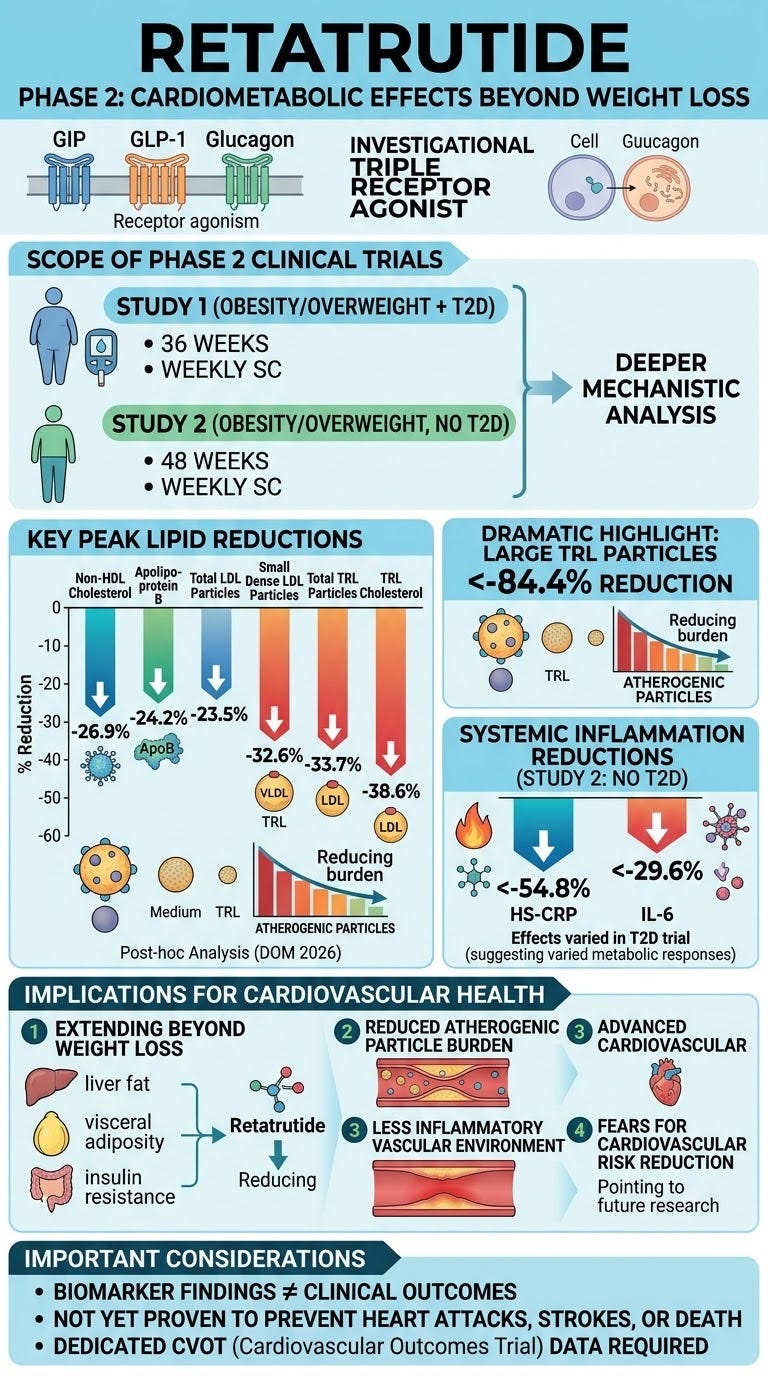
Retatrutide is an investigational triple receptor agonist that targets the GLP-1, GIP, and glucagon receptors. While previous pharmacological options like tirzepatide utilize dual agonism, the addition of glucagon receptor agonism introduces a unique mechanism that directly influences hepatic lipid metabolism and systemic energy consumption. Early clinical data heavily emphasized the dramatic total bodyweight reductions associated with this compound. However, a post-hoc analysis published in the journal Diabetes, Obesity and Metabolism in August 2026 shifts the clinical focus squarely onto cardiovascular health and systemic inflammation.
The primary objective of this specific publication was to characterize the cardiometabolic risk profile of patients using this compound by evaluating highly specific lipoprotein and inflammatory biomarkers. Instead of relying solely on standard metrics like total cholesterol or scale weight, researchers sought a deeper mechanistic understanding of how the drug alters the underlying physiological environment that drives atherosclerotic cardiovascular disease.
⸻
The Scope of the Phase 2 Clinical Trials
The data analyzed in this publication stems from two distinct randomized, double-blind, placebo-controlled Phase 2 clinical trials. These trials focused entirely on adult populations diagnosed with obesity or overweight conditions. The researchers deliberately separated the participants based on their baseline metabolic status to determine if the drug yielded different physiological responses depending on the presence of established insulin resistance and glucose intolerance.
Study 1 enrolled adult participants who were diagnosed with both obesity or overweight and type 2 diabetes. These individuals were treated with once-weekly subcutaneous injections over a period of 36 weeks.
Study 2 enrolled adult participants who had obesity or overweight but did not have a type 2 diabetes diagnosis. This non-diabetic cohort was monitored and treated over a slightly longer duration of 48 weeks. Fasting blood samples were collected at baseline and at regular intervals during the treatment periods to assess the specific lipid and inflammatory variables.
⸻
Evaluating Advanced Cardiovascular Biomarkers
Cardiovascular risk is often poorly defined by standard lipid panels, which is why this analysis focused on apolipoproteins, specific lipoprotein particle subclasses, and inflammatory markers. Apolipoprotein B is a primary structural protein found on all potentially atherogenic particles, including LDL, VLDL, and IDL. Because each of these atherogenic particles carries exactly one Apolipoprotein B molecule, measuring this specific marker provides an estimate of the total atherogenic particle burden circulating in the blood.
Researchers also evaluated specific sub-fractions of lipoproteins, including triglyceride-rich lipoproteins and small LDL particles. Small, dense LDL particles are highly atherogenic because they more readily penetrate the arterial endothelium and are associated with pathways involved in plaque formation. Triglyceride-rich particles are strongly associated with metabolic dysfunction and contribute to residual cardiovascular risk often seen in obese populations, even when standard LDL cholesterol appears relatively normal.
⸻
Detailed Improvements in Lipid Profiles
The resulting clinical data demonstrated substantial, dose dependent improvements across the measured atherogenic lipoproteins. The reduction in these specific markers indicates a shift away from a higher-risk cardiovascular phenotype.
Depending on the specific trial and the dosage administered, the researchers recorded the following peak reductions:
Non-HDL cholesterol decreased by up to 26.9 percent
Apolipoprotein B concentrations decreased by up to 24.2 percent
Total LDL particles were reduced by up to 23.5 percent
Small LDL particles were reduced by up to 32.6 percent
Triglyceride-rich lipoprotein cholesterol fell by up to 38.6 percent
Total triglyceride-rich lipoprotein particles decreased by up to 33.7 percent
The most drastic physiological change occurred within the sub-fraction of large triglyceride-rich lipoprotein particles. The concentration of these specific large particles fell by up to 84.4 percent.
This represents a major shift in the circulating lipoprotein profile. Triglyceride-rich lipoproteins and their remnants can contribute cholesterol to the arterial wall and are increasingly recognized as important contributors to atherosclerotic cardiovascular disease. The total number of triglyceride-rich lipoprotein particles was reduced regardless of their size, resulting in a substantially less atherogenic overall profile.
⸻
Reductions in Systemic Inflammation
Metabolic dysfunction and obesity are closely linked to chronic, low grade systemic inflammation. This inflammatory state contributes to insulin resistance and impaired endothelial function, both of which can accelerate cardiovascular disease development.
To measure this, researchers evaluated high-sensitivity C-reactive protein and interleukin-6. Interleukin-6 is a pro-inflammatory cytokine involved in hepatic C-reactive protein production, making both markers useful indicators of systemic inflammatory activity.
The post-hoc analysis revealed substantial decreases in these inflammatory markers, but the effects differed between the populations studied. In Study 2, which consisted of participants with obesity or overweight but without diabetes, researchers observed:
High-sensitivity C-reactive protein decreased by 54.8 percent
Interleukin-6 decreased by 29.6 percent
These reductions indicate substantial down regulation of systemic inflammatory markers. Interestingly, statistically significant reductions in these inflammatory markers were observed in the trial without diabetes but were not mirrored to the same extent in the type 2 diabetes trial. This discrepancy raises the possibility that the inflammatory response to retatrutide may differ according to baseline metabolic pathology, glycemic status, or the severity of established insulin resistance.
⸻
What the Phase 2 Data Could Mean for Cardiovascular Health
The broader takeaway from this Phase 2 analysis is that retatrutide’s effects appear to extend well beyond total bodyweight reduction. Previous clinical data have already demonstrated substantial reductions in bodyweight, visceral adiposity, liver fat, and markers of insulin resistance. This analysis adds another layer by showing meaningful changes in atherogenic particle burden and systemic inflammation.
Reductions in Apolipoprotein B, LDL particle concentrations, and triglyceride-rich lipoproteins suggest that fewer cholesterol-containing atherogenic particles are circulating and available to participate in plaque development. At the same time, large reductions in hs-CRP and IL-6 in the non-diabetic population suggest a potentially less inflammatory vascular environment.
That combination is clinically interesting because atherosclerotic cardiovascular disease is driven by more than scale weight or LDL cholesterol alone. Particle burden, triglyceride-rich remnants, metabolic dysfunction, adiposity, and inflammatory signaling all contribute to long-term risk.
The important limitation is that these Phase 2 biomarker findings do not yet demonstrate that retatrutide prevents heart attacks, strokes, or cardiovascular death. Those questions require dedicated cardiovascular outcomes data. What these findings do show is that retatrutide produced substantial improvements across several biological variables that are strongly connected with cardiovascular risk.
For a compound initially receiving attention almost entirely because of its weight-loss numbers, the evolving Phase 2 data suggest that its metabolic effects may be considerably broader than bodyweight reduction alone.
No posts
Comments
Nothing yet. Say the first thing.
Sign in to join the conversation.