
For research and educational purposes only. Nothing here is medical advice.
You’ve probably seen some version of it: glutathione and NAD+ compete. One blunts the other. They shouldn’t be run together. Pick one.
It gets repeated confidently enough that people build entire frameworks around it.
It’s wrong, and the reason it’s wrong is more interesting than the correction. These two aren’t rivals. They’re wired into each other. Once you can see the wiring, the claim falls apart on its own.
So let’s build the picture from the ground up. No assumed background.
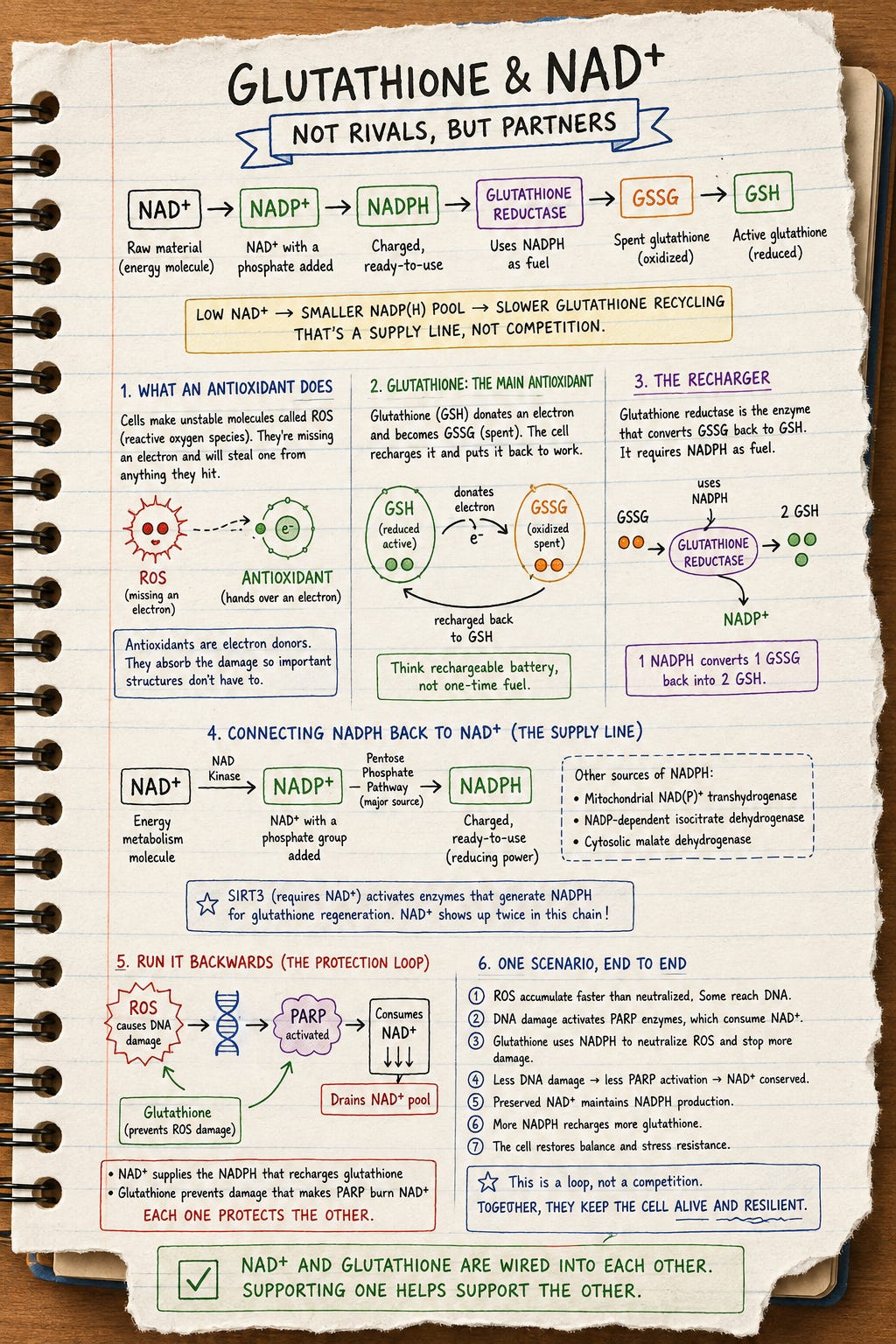
Start with the basics, because most explanations skip this and everything downstream stops making sense.
Cells constantly produce unstable molecules called reactive oxygen species, or ROS, mostly as a byproduct of energy production. Unstable here has a specific meaning: they’re missing an electron, and they’ll rip one off whatever they touch. That includes DNA, cell membranes, and proteins.
An antioxidant is a molecule that hands over an electron voluntarily. It absorbs the hit so something structurally important doesn’t have to.
That’s the whole job. Antioxidants are electron donors.
Glutathione is the main intracellular antioxidant. It’s a small molecule made of three amino acids, synthesized by the cell itself.
When glutathione donates an electron, it changes form. The useful, charged version is called GSH. After it gives up its electron, it becomes GSSG, the spent version.
Here’s the part that matters: the cell doesn’t have to discard GSSG and build new glutathione from scratch. It can recharge it. GSSG gets converted back into GSH and returns to circulation.
Think of it less like fuel that gets burned and more like a rechargeable battery. Total pool size matters, but so does the rate at which the spent form can be restored.
That recharging step is where NAD+ enters the picture.
Recharging doesn’t happen spontaneously. A specific enzyme does it, called glutathione reductase.
And that enzyme doesn’t work for free. It requires a fuel source, and the fuel is a molecule called NADPH.
The accounting is exact: one molecule of NADPH converts one GSSG back into two GSH.
Across an entire cell across a day, the cumulative NADPH demand of the glutathione system is substantial. Every cycle of the glutathione system spends NADPH restoring it.
So the question becomes: where does NADPH come from?
This is the step people skip, and it’s the one that resolves the whole debate.
The names are confusingly similar, so let’s separate them clearly:
NAD+ is the molecule everyone talks about for energy metabolism
NADP+ is NAD+ with a phosphate group attached to it
NADPH is the charged, ready-to-use version of NADP+
Getting from the first to the second is a single enzymatic step. An enzyme called NAD kinase attaches a phosphate to NAD+, producing NADP+.
That means the entire NADP(H) pool is built out of the NAD+ pool. These are not separate inventories. One is manufactured from the other.
Once NADP+ exists, it gets charged into NADPH primarily through the pentose phosphate pathway, a branch of glucose metabolism. That’s the main source, with additional NADPH coming from mitochondrial NAD(P)+ transhydrogenase, NADP-dependent isocitrate dehydrogenase, and cytosolic malate dehydrogenase.
One more connection worth knowing. SIRT3, an enzyme that requires NAD+ to function, activates other enzymes that generate NADPH for glutathione regeneration. So NAD+ appears twice in this chain: once as the raw material for NADP+, and again as the fuel for an enzyme that helps produce NADPH.
The chain, start to finish:
NAD+ → NADP+ → NADPH → glutathione reductase → GSSG recharged back into GSH
Low NAD+ means a smaller NADP(H) pool. A smaller NADP(H) pool means slower glutathione recycling. That’s not competition. That’s a supply line.
The relationship goes both directions, and this is the half that really kills the pick-one idea.
When ROS damage DNA, the cell calls in a family of repair enzymes called PARPs.
PARPs have an expensive habit. They don’t use NAD+ as a signal, they consume it as raw material. Heavy PARP activity is one of the fastest ways a cell drains its NAD+ pool.
By preventing oxidative DNA damage in the first place, glutathione limits PARP activation and preserves cellular NAD+.
So:
NAD+ supplies the NADPH that recharges glutathione
Glutathione prevents the damage that makes PARP burn through NAD+
Each one protects the other. That’s a loop, not a competition.
Let’s walk one scenario end to end, because this is where it gets concrete.
Picture a cell under heavy oxidative load.
Step 1. ROS accumulate faster than they’re being neutralized. Some reach DNA.
Step 2. DNA damage activates PARP enzymes, which consume NAD+ to perform repairs.
Step 3. Glutathione status decides how bad this gets. Depleted glutathione means more ROS reach DNA, more PARP activation, more NAD+ spent on damage control. Sufficient glutathione means ROS get neutralized earlier, less damage accumulates, and the NAD+ pool stays intact.
Step 4. Preserved NAD+ returns to its main job. Be careful here, because this gets stated backwards constantly: NAD+ is the empty form. It accepts electrons. It picks them up during glycolysis and the TCA cycle and becomes NADH.
Step 5. NADH is the loaded form. It donates. It hands those electrons to Complex I of the electron transport chain, which drives the process that produces ATP, the energy currency the cell runs on.
Put simply: glutathione keeps NAD+ from being spent on repair work, which leaves more of it cycling through energy production.
One honest caveat. Every individual step above is well characterized. The full chain as a practical claim is a model, not a finding. No published trial has tested whether raising both together produces measurable differences in ATP output or mitochondrial function compared to raising either alone.
If you’re evaluating research in this space, the model makes testable predictions. Effects should be clearest under high oxidative burden rather than at baseline. PARP activity and NAD+ consumption rate are the variables doing the mediating. GSH/GSSG ratio paired with NAD+/NADH ratio is what you’d want measured. That’s what would move this from plausible to established.
Three real things got flattened into one bad rule.
One: a solution chemistry rule that got garbled.
Glutathione is inherently unstable in aqueous solution. It oxidizes readily on exposure to air, light, and temperature variation. That instability is why it requires careful handling as a raw material, and why there are real constraints on what it can sit in solution with.
Those constraints are about chemistry inside a container. Somewhere along the way, “these can’t be premixed” became “these can’t be used together.” Those are entirely different statements about entirely different environments.
Two: a real warning about a different compound.
The co-formulation warning that actually exists is about vitamin C. Glutathione and vitamin C should not share a solution, because as competing antioxidants they oxidize each other in the container and degrade both.
That’s a legitimate chemistry rule. It’s also unfortunately shaped, because it sounds exactly like “antioxidants cancel each other out,” which people then generalize to every other pairing.
Three: real research about the wrong compounds.
There’s legitimate work showing antioxidant supplementation can interfere with exercise adaptation. ROS aren’t purely destructive, they also act as signals driving adaptation, and blunting that signaling may attenuate training-induced improvements in antioxidant capacity, mitochondrial biogenesis, and insulin sensitivity.
But look at what those studies used. The Ristow 2009 study that started the conversation used 1,000 mg per day of vitamin C and 400 IU per day of vitamin E. Most human work in this area has used general antioxidants that indiscriminately neutralize ROS from multiple intracellular sources.
Not glutathione. Not NAD+. Different intervention, different question.
If these systems truly competed, pushing one hard should visibly cost the other.
A 2023 clinical trial used high-dose nicotinamide riboside at 3,000 mg daily. Blood NAD+ rose five-fold. Glutathione and GSSG levels stayed stable.
A five-fold NAD+ increase with no glutathione penalty. That’s a direct test of the competition hypothesis, and it came back flat.
The aging literature points the same way. Elderly subjects show glutathione synthesis roughly 45 percent slower than young adults, with the GSH to GSSG ratio dropping from 18.9 to 7.4. Liver glutathione falls 35 to 50 percent in aged animals, and brain glutathione drops by at least half across adult aging. NAD+ declines with age as well.
Both fall together. That’s what coupled systems sharing infrastructure look like. If they were rivals, one declining would let the other rise.
I don’t want to write a piece that says “no interaction, carry on,” because there is a real shared node and almost nobody discusses it.
It’s methylation.
High-dose NAD+ precursors increase demand on methyl groups. Nicotinamide is cleared partly by an enzyme that methylates it, and that methylation spends a molecule called SAM.
Separately, glutathione synthesis requires cysteine, and cysteine comes substantially from a pathway that branches off homocysteine. Homocysteine sits downstream of that same methylation cycle.
So the two systems do touch, at one-carbon metabolism.
What I want to be clear about is that the direction of that effect isn’t established. You can argue it either way on paper. Increased methylation flux generates homocysteine that can feed forward toward cysteine and support glutathione synthesis. Or heavy methyl demand strains a shared pool. Neither scenario has been shown to meaningfully change glutathione status at typical experimental exposures.
Genuine connection, open question, not a rule. And note where it sits: upstream of glutathione synthesis, not at a point where the two compete for the same molecule.
Solution chemistry and pathway biology are two different subjects, and the myth exists because they got collapsed into one.
In a container, glutathione is a reactive, unstable molecule. It degrades on contact with air and light, and putting it in solution alongside another reactive antioxidant can consume both before either does anything. That’s real, and it’s a chemistry problem.
In a cell, glutathione and NAD+ occupy different positions in a single coupled pathway. NAD+ is upstream, supplying the NADPH that restores glutathione. Glutathione sits at the oxidative front line, limiting the DNA damage that would otherwise drain NAD+ through PARP.
Nothing about how two molecules behave sitting together in a vial tells you anything about how their pathways relate inside a cell. The myth is a chemistry observation wearing a biology costume.
Glutathione and NAD+ aren’t competitors. They’re two ends of the same redox system.
NAD+ becomes NADP+, which becomes the NADPH that recharges spent glutathione. Glutathione prevents the DNA damage that makes PARP enzymes burn through NAD+, which leaves more NAD+ available for energy production instead of repair. And the data shows a five-fold NAD+ increase with glutathione levels untouched.
The “they cancel each other out” narrative is a solution stability rule, a vitamin C co-formulation warning, and an exercise study on vitamins C and E, mashed into one claim that none of them supports.
The real interaction, if you want one, is at methylation, and it’s an open question rather than a rule.
Glutathione works by donating electrons. Once spent, it converts from GSH to GSSG. The cell recharges it rather than rebuilding it from scratch.
The recharging enzyme runs on NADPH. One NADPH converts one GSSG back into two GSH.
NADPH is built from NAD+. NAD kinase turns NAD+ into NADP+, which gets charged into NADPH mainly through the pentose phosphate pathway. The two pools are not separate inventories.
So low NAD+ means slower glutathione recycling. That’s a supply line, not competition.
It runs the other way too. Glutathione prevents the oxidative DNA damage that activates PARP enzymes, and PARPs consume NAD+ as raw material. Glutathione protects the NAD+ pool.
Net effect: glutathione keeps NAD+ from being spent on repair, leaving more of it cycling through energy production. That chain is a model built from established steps, not a proven outcome.
The myth has three sources: a solution stability rule about premixing, a vitamin C co-formulation warning, and exercise research that used vitamins C and E rather than either of these compounds.
The data doesn’t support competition. A trial raising NAD+ five-fold left glutathione and GSSG unchanged. Both systems also decline together with age, which is what coupled systems do.
The one real shared node is methylation, upstream of glutathione synthesis. Direction of effect unestablished. Open question, not a rule.
The core error: confusing how two molecules behave in a container with how their pathways relate in a cell.
Research use only. Not for human consumption.
— Derek
Merry TL, Ristow M. Do antioxidant supplements interfere with skeletal muscle adaptation to exercise training? The Journal of Physiology. 2016;594(18):5135-5147. PMID 26638792 — pubmed
Gomez-Cabrera MC, et al. Redox modulation of mitochondriogenesis in exercise. Does antioxidant supplementation blunt the benefits of exercise training? Free Radical Biology and Medicine. 2015. PMID 25889822 — pubmed
Glutathione-Related Enzymes and Proteins: A Review. Molecules. 2023;28(3):1447 — mdpi.com
Oxidative Stress Induces the Phosphorylation of NAD+ to NADP+ by NAD Kinase in Cultured Primary Rat Astrocytes. PMC12553597 — ncbi.nlm.nih.gov
Sekhar RV, et al. Deficient synthesis of glutathione underlies oxidative stress in aging and can be corrected by dietary cysteine and glycine supplementation. American Journal of Clinical Nutrition. 2011.
Skeletal Muscle Redox Signaling in Health and Disease. Antioxidants. 2026;15(6):678. doi:10.3390/antiox15060678
Note on sourcing: the NAD+/glutathione mechanistic summary and the 2023 high-dose nicotinamide riboside trial figures are relayed from a secondary clinical summary rather than the primary papers. The underlying mechanisms are independently supported by the peer-reviewed sources above. If you want to cite the NR trial specifically, pull the primary publication first.
No posts
Comments
Nothing yet. Say the first thing.
Sign in to join the conversation.