
Search semaglutide and vision loss and you get three things: lawyer ads, a Reddit thread where somebody’s glasses prescription changed, and a headline about people going blind.
Those are not the same event. Not even close.
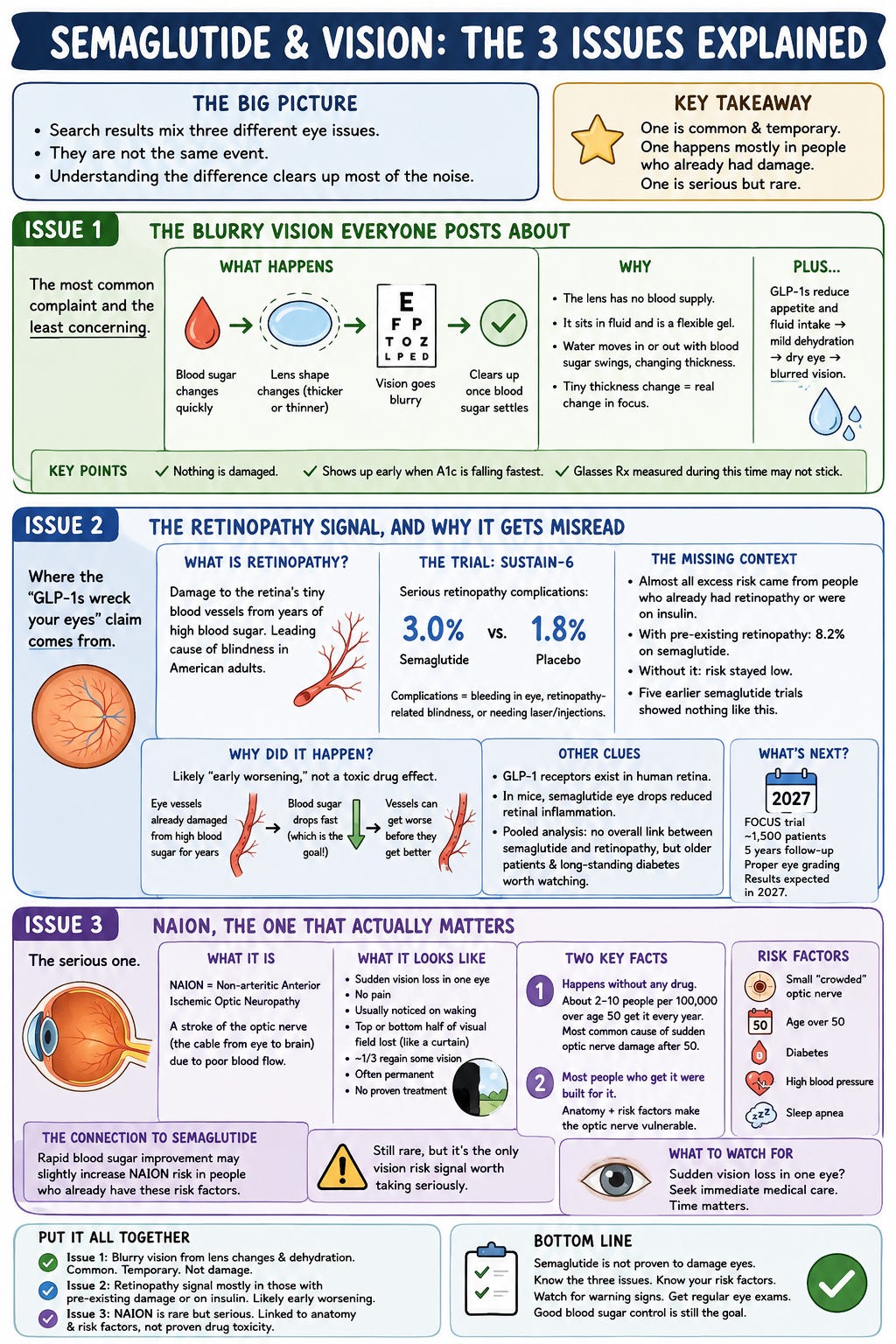
There are actually three separate eye issues in the research. One is common and goes away on its own. One shows up almost only in people who already had eye damage. One is serious and rare. Once you can tell them apart, most of the noise sorts itself out.
Here is what the research actually says.
This is the most common complaint and the least concerning.
Johns Hopkins explains it in one sentence: when blood sugar changes quickly, the shape of the eye’s lens changes with it, vision goes blurry, and it clears up once blood sugar settles.
Here is why. The lens is the part behind your pupil that focuses light. It has no blood supply. It just sits in fluid, and it is basically a flexible gel. When blood sugar swings hard, water gets pulled into the lens or pushed out of it. The lens gets slightly thicker or slightly thinner. And since the thickness of the lens is what sets your focus, a tiny change in thickness means a real change in how sharp things look.
Nothing is being damaged. The focusing part of your eye is temporarily the wrong shape.
That matches what people report. The blur shows up early, when A1c is falling fastest, and fades once blood sugar levels off. Hopkins also points out that a glasses prescription measured during that window is measuring a lens shape that will not stick around.
There is a second, smaller thing stacked on top. GLP-1s cut appetite and fluid intake, and mild dehydration causes dry eye, which blurs vision on its own.
This is where the “GLP-1s wreck your eyes” claim comes from. It traces back to one real trial result that almost never gets quoted with its context.
First, what retinopathy is. The retina is the light-sensitive tissue at the back of your eye, and it runs on an incredibly dense web of tiny blood vessels. Years of high blood sugar damages those vessels. That damage is diabetic retinopathy, and it is the leading cause of blindness in American adults.
Now the trial. In SUSTAIN-6, a large cardiovascular study of semaglutide, serious retinopathy complications happened in 3.0 percent of the semaglutide group versus 1.8 percent on placebo. Complications meant bleeding into the eye, retinopathy-related blindness, or needing laser or injections. That gap went onto the drug label and it has been circulating ever since.
Here is the missing context. Almost all of that excess came from two groups: people who already had retinopathy before they started, and people on insulin. Among those who already had retinopathy, the event rate on semaglutide was 8.2 percent. Among people who did not have it, risk stayed low. And the five earlier semaglutide trials showed nothing like this.
So why did it happen?
The leading explanation is not that the drug is toxic to the eye. It is something called early worsening, and doctors have known about it since long before GLP-1s existed. If someone’s eye blood vessels have spent years adapting to high blood sugar, and you then bring that blood sugar down fast, the already-damaged vessels can get worse before they get better. Two landmark diabetes studies, the DCCT and UKPDS, both documented this.
Semaglutide lowers A1c hard and fast. That is the whole point of it. But in an eye that already has significant damage, the speed of the drop looks like the problem, not the molecule.
Two other findings point the same way. GLP-1 receptors exist in the human retina, and when researchers gave semaglutide as eye drops to diabetic mice, retinal inflammation went down, not up. On top of that, a pooled analysis of randomized trials found no overall link between semaglutide and retinopathy, while flagging older patients and long-standing diabetes as worth watching.
The clean answer is still coming. A trial called FOCUS was built specifically for this question, with about 1,500 patients, five years of follow-up, and proper standardized eye grading. Results are expected in 2027.
Now the serious one.
NAION stands for non-arteritic anterior ischemic optic neuropathy. Skip the name. What it means is a stroke of the optic nerve, the cable that carries signals from your eye to your brain. Blood flow to that nerve fails.
It looks like this: sudden vision loss in one eye, no pain, usually noticed on waking. Classically it takes out the top or bottom half of the visual field, like a curtain coming down. About a third of people get some vision back on their own. For a lot of people it is permanent, and there is no treatment that has been proven to work.
Two facts frame everything else.
First, NAION happens without any drug involved. Roughly 2 to 10 people per 100,000 over age 50 get it every year. It is the most common cause of sudden optic nerve damage after 50, and researchers still describe the underlying cause as unknown.
Second, most people who get it were built for it. Most NAION patients have what eye doctors call a “disc at risk.” The optic nerve exits the back of the eye through a small opening, and in some people that opening is unusually tight and crowded. If anything in there swells, there is nowhere for it to go, so pressure rises and blood flow gets squeezed further. It is the same idea as a compartment syndrome anywhere else in the body. Most people have no idea whether they have this until someone looks.
The other known risk factors are age, diabetes, high blood pressure, high cholesterol, sleep apnea, obesity, and blood pressure dropping too low overnight.
Look at that list. It describes the exact population taking GLP-1s. That overlap is the single biggest reason this research has been so hard to interpret.
It started in 2024. A team led by Hathaway published in JAMA Ophthalmology reporting higher NAION rates in patients prescribed semaglutide. It was one clinic’s patient population and it got criticized hard on methodology, but it opened the question.
Bigger studies followed, and they split into two camps.
The studies that found a risk all had long follow-up. One team pulled from a database of over 3 million patients with type 2 diabetes and analyzed 174,584 semaglutide users against matched comparison patients. They found nothing at first, then risk roughly doubled starting at the two-year mark and stayed elevated at three and four years. A Danish study covered every single person with type 2 diabetes in the country, 424,152 people over six years, and found semaglutide exposure roughly doubled five-year NAION risk. A 2026 review pooling ten studies landed on the same rough doubling, and specifically noted the risk only became statistically meaningful after two years of use.
The studies that found nothing had shorter follow-up or narrower populations. One looked at 18,657 patients and found no significant increase, but with short follow-up and only white patients. A 21-country analysis also found nothing, with similar limits. A pooled analysis of randomized trials found no link to eye disorders overall, while noting those trials were never designed to catch something this rare. Another 2026 review found no difference at all and put total NAION rates under 0.1 percent at five years in every group.
Those two camps sound like they contradict each other. They mostly do not. If the risk only shows up after about two years, any study that stops before then will miss it.
What none of this proves is cause. Everyone taking semaglutide has diabetes or obesity, and both of those raise NAION risk by themselves. Separating the drug from the patient is the core problem, and no study has fully solved it.
One number is worth keeping in your head. In a study of over 1.5 million adults with type 2 diabetes, 35 people on semaglutide or tirzepatide developed NAION, compared to 19 on other diabetes drugs. That is 0.04 percent versus 0.02 percent. The risk roughly doubled. It also went from extremely rare to slightly less extremely rare. Both statements are true, and which one you lead with is basically an editorial choice.
Nobody knows. Since the cause of ordinary NAION is still unresolved, any drug-specific explanation is guesswork. Three ideas show up in the literature.
The rapid blood sugar drop. The same mechanism behind the retinopathy story. A fast metabolic shift changes fluid balance and blood flow regulation at the optic nerve. In a crowded disc with no room to swell, a small amount of swelling could be enough to cut blood flow past the tipping point. If this is right, the problem is the speed of change, not the drug itself.
Blood pressure. Weight loss, reduced fluid intake, and falling blood pressure all happen at once on a GLP-1. Blood pressure dipping too low overnight is a known NAION risk factor, and the optic nerve has almost no backup blood supply if its main supply falls short.
A direct effect. There are GLP-1 receptors in eye tissue. Whether switching them on changes blood flow at the optic nerve has not been studied.
One detail from the pooled review: semaglutide accounted for 86.5 percent of all reported GLP-1-related NAION cases. That could mean something specific about the molecule. It could also just reflect that semaglutide has been prescribed longer and far more widely than anything else in the class.
The regulators split by country, which explains a lot of the online confusion.
In June 2025, the European Medicines Agency concluded NAION is a very rare side effect of semaglutide and added it to product information, estimating roughly one extra case per 10,000 patients treated per year. The UK regulator followed in February 2026 with a warning of a likely association, noting three total reports filed against about 10.2 million packs dispensed over five years. Australia issued its own update in July 2026. As of mid-2026, the US label still carries no NAION warning.
There was also a March 2026 analysis reporting that the weight-loss version of semaglutide showed a signal in FDA adverse event data about five times stronger than the diabetes version. That number spread fast, and it needs a caveat. That FDA database is voluntary reporting. It cannot tell you how often something happens or whether a drug caused it, and reports go up when media coverage goes up. The weight-loss side has had far more coverage. The authors themselves said prospective studies were needed and did not treat it as a conclusion.
The most level-headed document in the whole pile is a 2026 joint statement from the North American Neuro-Ophthalmology Society and the American Academy of Ophthalmology. They describe the evidence as mostly retrospective database work with real limitations, note that some studies find a small increase and others find none, and say the overall size of the risk remains low.
They also declined to follow the European recommendation to stop semaglutide when NAION is diagnosed, on the grounds that stopping carries its own real risks for patients with obesity, hard-to-control diabetes, or heart disease. Their position is that this is a conversation between a patient and their care team, not a blanket rule.
Three different problems, not one.
Blurry vision is common, mechanical, and reverses. It tracks how fast blood sugar is changing, not damage.
Retinopathy worsening is real but lands almost entirely on people who already had retinopathy, and the evidence points at the speed of the blood sugar drop rather than the drug. The trial designed to settle it reports in 2027.
NAION is the one with a genuinely open question. The signal appears in studies with long follow-up and vanishes in studies with short follow-up. Where it does appear, relative risk roughly doubles, but the absolute numbers stay around a few cases per ten thousand patients per year. Cause has not been established, the mechanism is unknown, and the eye specialty societies looking at it are not telling anyone to abandon the drug class over it.
The internet flattens all of that into “GLP-1s make you go blind.” The research does not support that. It also does not support acting like the NAION question is closed. Both are true at the same time, which is exactly why the noise is so loud.
Johns Hopkins Medicine, Diabetes and Your Eyes: What You Need to Know (Cindy Cai, MD, Wilmer Eye Institute)
Hathaway et al., JAMA Ophthalmol 2024;142(8):732-739
Hsu et al., JAMA Ophthalmol 2025 (TriNetX cohort)
Danish five-year national cohort, 424,152 persons with type 2 diabetes
Asia Pacific J Ophthalmol 2026;15(1):100245
Natividade et al., JAMA Ophthalmol, August 2025
Ramsey et al., JAMA Netw Open 2025
Am J Ophthalmol 2026 systematic review and meta-analysis
NANOS and AAO joint consensus statement, Ophthalmology 2026
AOA GLP-1 clinical report, June 2025
SUSTAIN-6 trial data and semaglutide prescribing information
EMA PRAC, June 2025; MHRA Drug Safety Update, February 2026; TGA Medicines Safety Update, July 2026
British Journal of Ophthalmology FAERS analysis, March 2026
Effects of Topical Semaglutide on Retinal Neuroinflammation in Experimental Diabetes (db/db model)
Educational content only. Not medical advice.
No posts
Comments
Nothing yet. Say the first thing.
Sign in to join the conversation.