
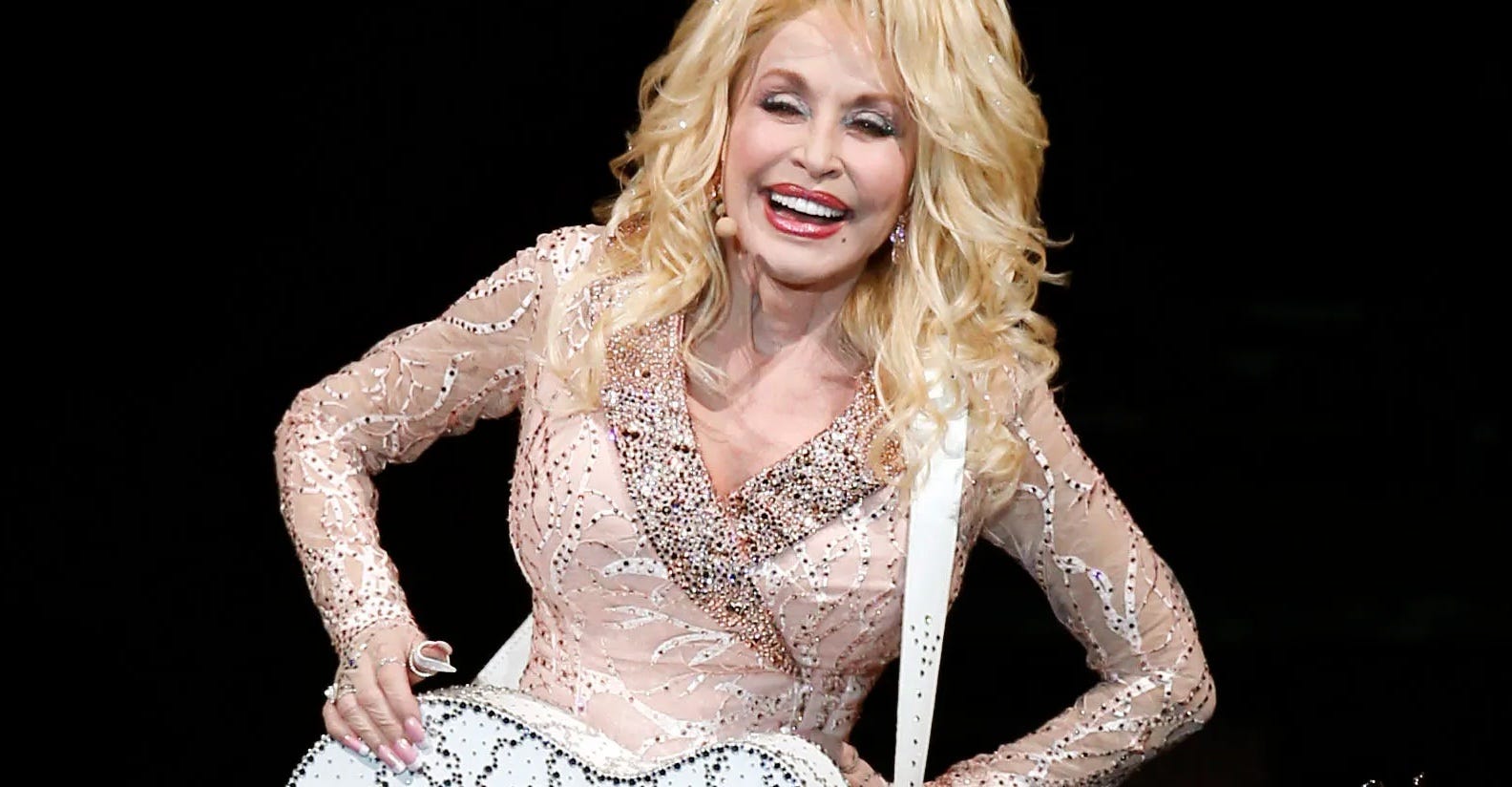
A March 2026 UMass/YouGov poll found a clear winner in terms of public approval. Dolly Parton scored +65, with 70% of Americans favoring her (and only 5% viewing her negatively).
Barack Obama scored +14. Taylor Swift came in at +3. Donald Trump? -18. Even Elon Musk scored better at -16.
After Parton passed earlier this week, online tributes dominated the algorithm. Of course, since we’re talking social media, a few “brave contrarians” decided to criticize her “since she had flaws.”
I’m not going to waste space on their whining. But I will highlight one of the reasons Dolly was such a badass: she owned her music. A much bigger deal than it reads, especially considering her quite humble origins and the fact she was a woman navigating the notoriously misogynistic music industry.
Before I get into that, enjoy this excellent summation of Parton’s exceptional career:
As well as this overview of why her business chops were above and beyond, which I’ll unpack in more detail:
As the last video notes, Parton handed over her first million to Porter Wagoner, a man who genuinely helped her build a career yet also became greedy once realizing she was going to surpass him in fame.
The following millions is where a bunch of post-Dolly criticism has come in. So-called “anti-capitalists” are furious that a successful woman amassed a fortune north of $600 million, claiming we should treat tributes with caution.
Rather than entertain petty grievances—Parton was one of the great philanthropists of our age, and could have easily been worth billions if she chose—we should understand just how impressive her business acumen was.
That’s due to her business chops. In music, a “song” is legally two separate things:
Publishing covers the composition: the melody, lyrics, and arrangement as a piece of intellectual property, independent of any specific performance of it
Recording covers the master: the captured audio of a specific performance of that composition
These distinct copyrights can be owned by different parties. An example: Bob Marley owned the composition copyright to “I Shot the Sheriff.” Island Records owned the master to the version cut by The Wailers. When Eric Clapton recorded the song, RSO Records owned that master. Marley earned publishing royalties from both; his name appears in the credits of Clapton’s version even though he never played on it.
Each “side” (publishing and recording) generates its own royalty streams and is licensed differently. Composition royalties go to songwriters and publishers, triggered by radio airplay, streaming, and cover versions. Sound-recording royalties go to the label and the performing artist, mainly from streaming and satellite and digital radio.
The composition side of copyright is old, dating back before recorded sound existed as a medium. The mechanical royalty traces to the 1908 Supreme Court case, White-Smith Music Publishing Co. v. Apollo Co, when justices ruled that player-piano rolls weren’t “copies” of sheet music because a piano roll’s punched holes weren’t humanly readable. This meant manufacturers don’t owe composers anything for reproducing their songs mechanically. Congress stepped in the following year to overturn that ruling. They passed the Copyright Act of 1909, creating a compulsory mechanical license. Anyone could now record a published song without the writer’s permission as long as they paid a fixed statutory royalty.
By contrast, sound recordings had no federal copyright until 1972. For most of the 20th century, the performance captured on a record had far weaker legal protection than a song written on paper.
Record labels typically demand masters. The basic flow: a label fronts the money to record, manufacture, and promote an album in exchange for owning the master recordings, often for the life of the copyright. The artist gets royalties rather than ownership.
They also have a lot less (or no) say in how their music is used. An artist without their masters can be blocked from using their own recordings for anything that could make them money—sync licensing, compilations, even performing the song commercially.
This adds up over time, when artists want to cash in on their catalogs. Like Dolly, Bruce Springsteen owned his music. In 2021, he sold his masters and publishing catalog for roughly $500 million to Sony. The Beatles split it up, selling the masters to Universal (part of a $1.9 billion deal) and publishing to Sony (through a very circuitous process) for $733 million.
Yet the musicians didn’t have full control: Paul McCartney and the Lennon estate have been reclaiming the catalog piece by piece, which shows the importance of owning all of your music.
Which is what Dolly Parton knew early in her career. After her first songwriting contact ended, she formed Owe-Par Publishing Company with her uncle, Bill Owens, so they could copyright their songs for themselves.
So when Elvis Presley’s manager called to record “I Will Always Love You,” Parton could (and did) say no. The King wanted half the publishing. The Queen held the power. Not an easy decision: by her own admission, Dolly cried all night. But foresight is key. When Whitney Houston recorded the song in 1992, Parton earned roughly $10 million in publishing royalties in the 1990s alone. She later joked it was “enough money to buy Graceland.”
Dolly being Dolly, she reinvested part of those royalties into a business development corridor in a historically Black neighborhood of Nashville.
The next time someone feels it necessary to point out Dolly’s “flaws,” ask that person what they’ve accomplished in life. Chances are, little more than “doing activism” on social media.
Then get back to celebrating the life of someone who actually did incredible things for the world.
No posts
Comments
Nothing yet. Say the first thing.
Sign in to join the conversation.