
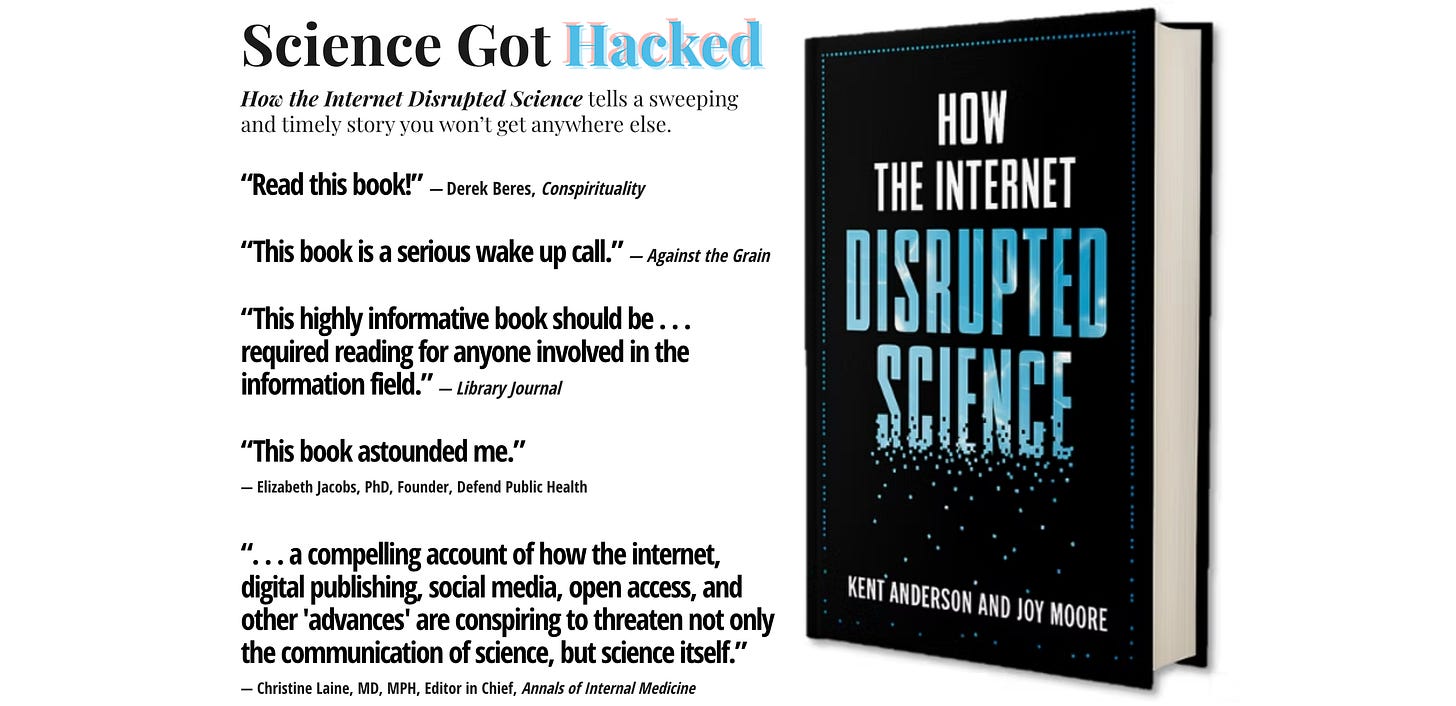
I read a lot of science books for fun, my job, and the satisfaction of understanding how things work. While I always learn something with every new book, How the Internet Disrupted Science by Kent Anderson and Joy Moore dives into an aspect of science I know a little about but had no idea just how deep this rabbit hole goes.
The authors write about the terrifying and troublesome world of scientific publishing. You know, journals. The things all the studies I report on go into. I've long defended scientists and researchers (and will continue to do so), but I was dismayed by how corrupt this publishing industry actually is.
That doesn't mean good science isn't being done. But it does mean there's a lot more really bad science out there. The type of science conducted for nefarious purposes and political agendas. The type of egotistical science done to have higher numbers and impact factors next to your name. Science that isn’t science written up to make a lot of money. And so much AI slop.
Below is part of my interview with Kent and Joy. You can listen to the full discussion here.
When criticizing anti-vax wellness influencers, I regularly receive this knee-jerk response that I’m pro-big pharma. Yet I believe a big reason we’re in this stew of medical misinformation is due to the perverse incentives of for-profit health care. So I’m very critical of that industry.
I also know there are issues across science and medicine, including scientific journals. What I didn’t know is the depth of just how skewed the incentives in scientific publishing actually is, which is the heart of your book.
Kent: We wrote the book because we’ve been analyzing the space, critiquing it, and cautioning about the incentives that are skewing things, or as you said, distorting them. Joy and I reconnected in 2024 and we realized we needed to ring the alarm for society at large: here’s this space that you don’t understand how much of an impact it has on a whole bunch of downstream ideas, including policies that affect daily life. And it’s being polluted upstream by people who are being paid to pollute it.
Joy: I had taken a couple of years off away from the scientific publishing industry, like so many people my age do. When I was ready to go back to work, I didn’t think I wanted to come back into scientific publishing, because I had been living in the real world and and seeing the effects of all the changes in our industry on society. That’s when I got in touch with Kent and said, What the heck is going on? We instantly clicked because we had both been there at the beginning of putting journals online, through all the different business models and consolidations. It just struck me as completely out of control.
A lot of people understand the value of a scientific study. Research says this, studies say that. But how did publishing scientific studies become such a cash grab? Why are they so valuable to the large tech companies and investors that you write about?
Joy: Scientific journals have been a cash cow for for decades. A lot of people attribute Robert Maxwell as the one who figured it out. Fundamentally, each paper is unique. There’s always a need for more papers; the community always needs more papers. It’s not like book publishing or magazine publishing or even newspapers. Rather, it’s integral to the practice of being a researcher or a practitioner. This information has got to be published and certified in the scientific record.
The big change came in the 90s, when we started to put things online. From there the hop, skip and a jump to: well now that it’s online it should be cheap. Now that it’s online, we can make it free. And so that changed the incentives.
Publishers used to be accountable to their subscribers. If you weren’t publishing the right information for your subscriber group, you could get canceled and then shut down a journal. It used to take multiple years to get to profitability for any given journal. When they flipped the model to an author pays or a funder pays up front, and then papers were free for whoever needs to use them, it completely changed the landscape into this more transactional model that anyone could jump on board with. You could start up any journal on any topic at any time, and you could start to make money before the content is even published.
Kent: One of the things that drove this was a cult-like belief in open access, open science, open culture, things like that. They were comparing that we have to be like software, it has to be open source. But to make it happen, you had to have payments up front and it turned it into a cash on the barrel head business. That invited all sorts of players into the market who normally wouldn’t be there.
They had a whole bunch of different goals. Sometimes it was simply scale, sometimes speed, sometimes to spray and pray marketing with emails and get as many papers in as they could and make their rent that month. So you have predatory publishers, and then it became industrial strength. Then paper mills started to emerge. Then LLMs were added to the mix, and that accelerated things even more.
Preprints, which are unreviewed manuscripts, have been platformed, which allowed transgressives from the nutraceutical, supplements, and longevity markets to publish papers that resemble scientific papers, but they aren’t intended for other scientists. They’re intended to decorate a marketing funnel.
You write that by 2023, up to 34% of neuroscience papers published in 2020 were likely made up or plagiarized. In medicine, their preliminary estimate was 24%. This gets to a heart of a problem that I encounter all the time: We’re asking the public to trust science, but how in an environment where AI is being used to generate papers, plagiarism is rampant, and information is not always reliable?
Kent: That’s why we pulled the alarm. This has been hiding in plain sight inside the industry. There are players incentivized to turn a blind eye to it, frankly. There’s good money; there’s growth. There are big commercial publishers who have consolidated around this open access model to a scale that doesn’t make sense.
They’ll say, well, the market is growing at 8%, but we plan to grow 20% next year. How do you get 20% more papers from 8% more funding? And this is on top of government funding cuts. So that doesn’t even make any sense.
They’re pumping their stocks up and toying with AI systems. There was a recent paper generated by AI. It went through an AI editorial process and was published with AI. No human was discernible in its production. That’s the ultimate efficiency high-scale, high-throughput, high-speed pay-to -lay journals are pursuing.
Joy: There are so many different types of publishers now as well. A lot of publishers went into this open access model with the best intentions. Now their editorial teams are trying to keep up with the volume coming their way. Because it’s so quick and easy to get these papers through, a lot of editorial operations who used to be able to be more restrictive, just simply can’t.
Then there are other publishers who have really lowered the bar on purpose, to say that any paper that has a title, abstract, hypothesis, and conclusion that looks like science should be should be published because it might be of some value to somebody somewhere.
There’s one line in your book that really jumped out at me: Elsevier launched, “a feed of data it sold for six figures to hedge funds interested in analyzing early scientific research reports for potential stock moves.”
Kent: That relates to a preprint server Elsevier acquired. Preprint servers don’t really have a business model. At least not a front-end business model. Nobody pays to submit to them, nobody pays to publish with them, nobody has to pay to subscribe to them. So they either hook their wagon to a funder, like Chan Zuckerberg Initiative, or to a large publisher to serve as the top end of their paper marketing funnel.
In the case of Elsevier, they had this preprint server. They leveraged part of it into preprints with The Lancet. They were also selling a feed to hedge funds so that they could parse it however the hedge fund wanted to parse it, with the idea that they would have early insights into potential scientific findings and market moves. They could get a jump on their competitors and make early-stage investments, play the market, or short stocks. Who knows how they were using the data. But that’s a novel way to fund a preprint server.
Joy: There’s no real business model, but there’s no cost of acquisition either. People are volunteering papers to these preprint servers for many different reasons. Ostensibly, to share it with people interested in their early work. There’s no copyright defense; there’s no quality control. Monetizing this free information has no restrictions.
Kent: One other minor point here: hedge funds aren’t the only ones monetizing these preprint servers. Meta does it. Google does it. OpenAI does it. Open Evidence does it. They’re all crawling these servers and feeding the information into their LLMs, and selling those on the market or getting their stocks to jump.
You write that the preprint market really took off during COVID. I remember the moment when it did, but it had existed before. Can you run through the definition of a preprint and why they’ve become so popular?
Kent: Preprints started to solve a problem in the high energy physics and astrophysics market. In the late eighties and early nineties was that a lot of machine readable data from radio telescopes and other places that started to become available. They didn’t have enough journals to catch all the data, but they wanted to have people write up as quickly as they could what they were able to find.
As the open access movement few, more fields started to see value in that, especially as a way to get authors into their systems early so they could convert them to paying to publish papers with them. It became a business strategy.
One of the spaces that was, in my mind, a no-fly zone was biomedicine. I was at the heart of the biomedical publishing field at New England Journal of Medicine at the time, cautioning these people not to do it. You need very careful vetting of these papers and it’s going to get abused. But they they were so deep into the cult that they did it. And it’s become a huge problem. A lot of what you’re seeing with Jay Bhattacharya and RFK Jr. came out of preprints.
Joy: There’s also the incentives. It’s not just authors who want to publish open access, it’s the funders, including the National Institutes of Health, Welcome Trust, Gates Foundation, and many others, which over the years have started to put in these open access mandates. While the authors may have wanted to publish in a journal that wasn’t open access, they had a requirement to make their content open access. Preprint servers came in as a way to tick that box: post your paper here and then you can publish it somewhere else later. That really added to a lot of adoption.
We’ve been hearing the term “open” a lot. I’m a public domain guy; I think that’s important. But there’s a very dark side to what could be copyrighted material. Can you give a taste of what’s wrong with this movement?
Kent: When it comes to Creative Commons, it was driven through scientific publishing, but for no good reason. There are norms that make it non-applicable: you can’t use passages from somebody else without attribution, without citing them, or that’s plagiarism; you can’t double publish because that’s against the rules. So there’s really no need for a lot of the things Creative Commons ostensibly tries to do.
It also makes it very easy for large technology companies to come in and take your content without acknowledging or paying for it. That drives the scale while opening up the content to technology firms.
Then you have this idea that the scientific paper is for the public. And that gets called public access in some settings. Our contention is that scientific papers are basically community-based notes being passed from scientist to scientist. That’s where they belong. Then it gets accumulated into something that society can use after a good bit of testing and a good bit of care.
Joy: I was part of the group of publishers who were really promoting open access to authors and societies who own the journals. Publishers don’t own all the journals that they publish, as a way to empower authors and write your own rules. What it turned out to be are basically labels on papers that don’t really have any meaning because there’s nobody to enforce those rules. When you transfer copyright to a publisher, a publisher can defend that copyright if it’s breached. A lot of the messaging around “open” went too fast and the rollout went too fast. It wasn’t completely thought through.
Kent: The bitter irony of it is Creative Commons licenses are imposed on preprint servers and a lot of authors have to actually pay your way out of them with some publishers. Because if you don’t use that license, your content’s not going to go into their aggregator deal.So you’ve got to pay the difference, basically.
You referenced an AI company scraping open access data. You also write about many breakthroughs that Silicon Valley runs on: internet protocols, hard drives, silicon-based semiconductors, multi-touch screens, LCD displays, lithium-ion batteries. These were all publicly funded breakthroughs that were sponsored by the government, as often happens in the pharmaceutical industry. Then these private companies are allowed to monetize them to no end.
Joy: What a lot of people don’t understand is that yes, pharma companies pay for their trials and they have to go through a lot of regulatory hoops. Sometimes they slide right through and there’s a lot of problematic history there. But they don’t start drug development until the basic research has gotten to a point where they think that they can turn it into something monetizable. There’s a huge mountain of publicly-funded basic research further up the pipeline.
GLP-1s came from research into the saliva of a lizard. Somebody was studying lizard saliva. Who cares about that? Well, that’s the long game there.
Kent: The reason society funds science is primarily economic. Science returns five dollars for every dollar invested in it. What benefit are we getting out of this? Well, you get lettuce that isn’t going to give you diarrhea. You get vaccines that are going to address cancer, maybe, and that research started in the 1980s. You get these materials that clever people can use to make things that make entire industries.
Joy and I are both using AirPods right now. There’s a ton of technology that can trace its heritage back to government funding. Look at all the jobs, economic activity, and growth in this research. Applied sciences and discovery sciences are both worth investing in.
What drives me nuts is these companies then try to say, well, that’s enough. We don’t need need to pay taxes. We don’t need to pay for more research. We want to have a little bit of a soft eugenics party and get people to cull the herd while we go off to our estates and and celebrate on our super yachts and ignore the boats in distress.
There’s many instances throughout the history of medicine of something being studied and becoming something else. Antidepressants famously started in textile mills. But you have someone like RFK JR, who will then come out and say, why are we paying for these things? We shouldn’t. We need to focus on this, which is just so backwards. One of my fears with him at HHS is playing out: you write about the fact that Jay Bhattacharya runs a journal funded by Real Clear Politics, which definitely has an agenda. My fear is that all of a sudden you’re going to see these new journals showing why vaccines cause autism.
Joy: They’re peer-reviewed journals in the simplest form: a group of friends who read each other’s papers, say they’re good, and publish them. They’ve really co-opted the the norms and standards, but also a lot of the branding. They’ve turned scientific publishing’s basic operations into catchphrases. They say this is a peer-reviewed journal, so we’re just as good as the other guys.
Kent: We require hairdressers and EMTs to have licenses to be certified to work on these things. Do we need scientific publishers to be licensed?
During COVID, a lot of these players realized that scientific publishing is a pretty soft target and it only takes a little bit of money to get a lot of weight out of things. Now they’re cosplaying journal publishers and there’s nobody able to say you can’t do that.
No posts
Comments
Nothing yet. Say the first thing.
Sign in to join the conversation.