
The Merchant of Venice, as it exists today, is, so to speak, really a “bad quarto”—and the masterpiece version of the work, written on a much grander scale both in terms of size and literary merit, has been tragically and irretrievably lost.
There really is no mystery here. In the post here—”One Giant Chart That Ends the Shakespeare Wars”—
we see exactly what plays “by William Shakespeare” were published during Shakespeare’s life (and up until 1621) and exactly what his contemporaries claimed he wrote. Every title page and every comment about Shakespeare is listed in this table—and they all tell the exact same story: Shakespeare was an uneducated adapter, mocked by contemporaries, and the plays that carried his name while he was alive were all briefer, simpler, less literary adaptations of longer, more literary plays—most of them written by some earlier genius.
Now, if we want to look at other evidence during Shakespeare’s life to help identify his writings, well, we can’t. There isn’t any. There’s no film footage of the era, so all we have are documents—and the only relevant documents are these:
The title pages of the plays;
Contemporaneous comments about and records involving Shakespeare, the theater, and the plays.
That’s it. The title pages and commentary I have presented in these posts are all the relevant records we have to go on. So there really is no mystery here.
As all documented evidence from his life confirms, Shakespeare, the reviser of old plays, wrote the adaptations attributed to him. These include the bad quartos—inferior, shorter, swifter-paced adaptations of the longer, literary versions we know today—and the apocryphal plays—lesser, differently styled works that have been removed from the official Shakespeare canon.
In other words, everyone agrees that Shakespeare wrote adaptations of old plays. Well, the “bad quartos” are those adaptations. And it is the literary masterpieces that were those old plays.
Okay, you say, but there were “good quartos” that were published and attributed to Shakespeare too—Titus Andronicus, The Merchant of Venice, Much Ado About Nothing, Love’s Labour’s Lost, A Midsummer Night’s Dream, Henry IV, parts 1 and 2. What about those?
Well, as their title pages state, Shakespeare wrote those too—or at least he adapted them. But, as we shall see, they aren’t really “good quartos”—and have been classified incorrectly.
Consider the irony: For over 150 years, Stratfordians and anti-Stratfordians have battled to prove that their candidate was really the “William Shakespeare” who is meant on the title pages. Yet whoever wrote those inferior adaptations was not the genius who wrote the masterpieces!
As shown, scholars still consider some of the plays published while Shakespeare was alive as authentically "Shakespearean." So why aren’t these works considered lesser, staged renditions too? Because with these works—Titus Andronicus, The Merchant of Venice, Much Ado About Nothing, Henry IV, parts 1 and 2—North’s original, literary versions have been lost, so we have nothing to compare them to. In fact, it is conventional that older lost versions of these plays did exist at one time—but were never published. The only new revelation added here is that these lost versions were the masterworks—and had the same relationship to the extant versions as the literary versions of Hamlet, Henry V, and Romeo and Juliet had with the “bad quartos” of Hamlet, Henry V, and Romeo and Juliet.1
This table provides the true authorship of the plays—and, again, this is consistent with the title pages:
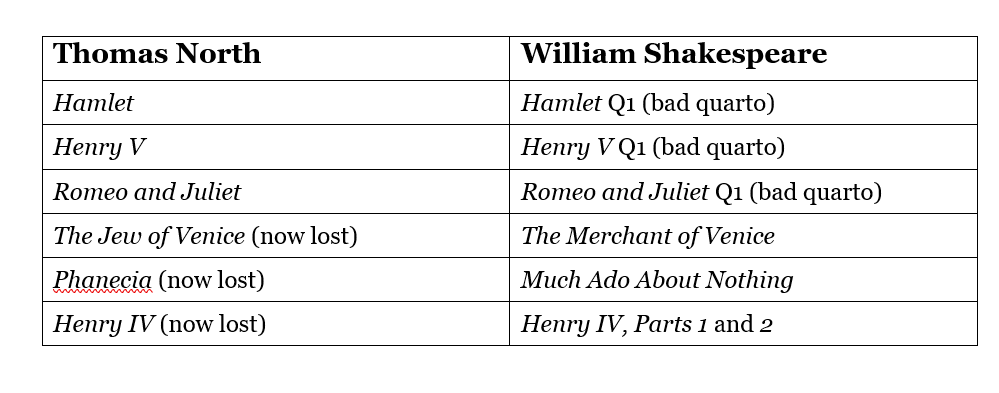
In other words, as opposed to the longer masterpieces, these supposedly “good quartos” of Titus Andronicus, The Merchant of Venice, Much Ado About Nothing, Henry VI, 1 and 2 still contain rather obvious signs of abridgment and adaptation and really have more in common with the “bad quartos.” Indeed, careful editors have uncovered the fossils of the longer, now-lost source plays in these “good quartos.” These include inexplicable references to past events that have not occurred or the names of characters that occasionally revert back to their old names from the original. One obvious case are the “unconformities” in Henry IV, Parts 1 and 2, in which so many hints of the previous work appear in the extant versions that orthodox editors agree that these works derive from some longer single-part version.2 Giorgio Melchiori, the editor of the New Cambridge Henry IV, Part II, refers to these remnants as "obvious fossils of the original version of the Henry IV play(s)."3
Unlike the literary masterpieces, all the “good” quartos show evidence that they were adapted from longer originals—just like the bad quartos. And the only reason we consider them “good” is that North’s longer originals of these versions have been lost.
Likewise, both external and internal evidence confirm that The Merchant of Venice was a theatrically motivated abridgment of a more complete source drama. Conventional scholars agree an older version existed because in School of Abuse (1579), published the year Shakespeare turned 15, Stephen Gosson refers to a play, The Jew, in which he describes the three major and distinctive elements of The Merchant of Venice—Jewish usurer, bloody debt, world-travelers making a choice based on greed.4 Orthodox scholars have also argued that the older play likely contained many of the seemingly missing elements of The Merchant of Venice—like the unmentioned reason for Antonio’s melancholy, an explanation for the peculiarly close relationship of Antonio and Bassanio,5 a fuller treatment of the story of Jessica, and, most notably, the missing dinner-masque scene that should occur just prior to Act 2, scene 7.
Specifically, the second act of The Merchant of Venice frequently induces anxiety for a dinner party that never occurs. The tension flows from the fact that Bassanio invites both Shylock and Lorenzo to a feast on the same night that the Christian Lorenzo plans to elope with Shylock’s daughter and steal his ducats as a dowry. Lorenzo still plans on both eloping and attending the dinner and masque but with Jessica disguised as a boy page so she will not be recognized at the revelry—especially by her father. The gears of this plot remain in motion until Lorenzo comes to fetch Jessica: she is wearing the male disguise, and the opening stage direction reads, “Enter the masquers, Gratiano and Salerio” (2.6.s.d.). Yet just as the dinner-masque appears set to begin, Antonio abruptly announces that the masque is canceled: “No masque tonight. The wind is come about” (2.6.64). The scene ends immediately. In other words, the repeated foreshadowing of Shylock’s interaction with Lorenzo and the concealed Jessica at the revelry as well as Jessica’s disguise as a boy and Gratiano’s and Salerio’s as masquers are entirely gratuitous. They occur for no explicable reason.
What happened here is obvious. As S. A. Small writes:
A close study of the text indicates that the original text of the play and probably the old play, called The Jew, contained a supper-scene, which probably occurred just before the entrance of Antonio in Act II, Sc. vi. But the proposed supper in The Merchant of Venice seems to be a part of a general masque in which Lorenzo and Jessica were to be the central figures. The supper and masque, then, can be assigned to The Jew…6
The renowned John Dover Wilson also discusses this point and agrees that the dinner and masque were part of the original play and were removed by Shakespeare from The Merchant of Venice.7
But taking out this scene should certainly strike Shakespeare enthusiasts as odd because it is hard to imagine a more obviously "Shakespearean" plot-device than mistaken identities and/or unwitting conversations with persons in disguise — and particularly females disguised as boy-pages. As You Like It, Twelfth Night, Comedy of Errors, Measure for Measure, Love’s Labour’s Lost, Henry V, Titus Andronicus, Coriolanus, Two Gentlemen of Verona — all involve misleading conversations with people in disguise. And Jessica from The Merchant of Venice, Viola from Twelfth Night, and Julia from Two Gentlemen of Verona disguise themselves specifically as the male pages of their love interests. Yet scholars must contend that this typically "Shakespearean" plot device was actually part of the original source-play, The Jew, and that Shakespeare was the one who cut it out.
More, Gosson also paraphrases a few passages from The Merchant of Venice in the very work in which he references an early version of the play. Specifically, in The Merchant of Venice, before Shylock leaves for the dinner, he warns Jessica not to be tempted by revelers outside the house or the music of the night-masque entering the windows:
What, are there masques? Hear you me, Jessica:
Lock up my doors, and when you hear the drum
And the vile squealing of the wry-necked fife,
Clamber not you up to the casements then,
Nor thrust your head into the public street
To gaze on Christian fools with varnished faces,
But stop my house’s ears—I mean my casements.
Let not the sound of shallow fopp’ry enter
My sober house. (2.5.29-37)
In the same work in which he speaks of The Jew, Gosson provides similar instructions for young women: “You need not go abroad to be tempted, you shall be enticed at your own windows … And if you perceive yourselves in any danger at your own doors … assaulted with music in the night; close up your eyes, stop your ears, tie up your tongues; when they speak, answer not.”8 Immediately prior, Gosson advises women not to use the theatre to help relieve grief: “lest that laboring to shun Scylla you light on Charybdis.”9 The Merchant of Venice also uses “shun” with a metaphor involving the same two Homeric monsters: “Thus when I shun Scylla, your father, I fall into Charybdis, your mother” (3.5.14-15).
J. C. Ross, who discovered these verbal similarities, had to assume that Shakespeare was the borrower or else admit that these passages originally appeared in the source work: “It is as if Shylock has been reading Gosson, and is applying this advice to his daughter.”10 But this is an extraordinary interpretation, as we know that it was Gosson who had seen Shylock. Indeed, Gosson identifies The Jew as one of a few plays he liked in the very tract where these similarities appear.11
Moreover, Gosson’s advisory relates to dialogue that anticipates the masque scene in The Jew, and certainly the masque with Jessica and Lorenzo would have appeared in this old play. Indeed, it would seem that the betrothed had much larger roles in The Jew that were later reduced by Shakespeare’s editing. Quoting Small:
Another place in The Merchant of Venice where matters have been ‘cut’ or condensed is to be found in the story of Jessica…. Most of the story of the two lovers, however, is a blank, so intent was the dramatist on cutting out things unessential to his dramatic purpose.12
Thus, The Merchant of Venice appears to have scenes that have been "cut" and characters that have been "condensed," all for the sake of swifter pace—and this type of editing should seem familiar as this is the precise method responsible for the "bad quartos." The Merchant of Venice should not be grouped with the longer and authentic versions of Hamlet, Henry V, and Romeo and Juliet—but with the “bad quartos” of Hamlet, Henry V, and Romeo and Juliet. And the title pages precisely reinforce what this internal evidence demands.
Moreover, while The Merchant of Venice shares so many characteristics with the other inferior staged adaptations, the original source-play The Jew is really the work that seems so peculiarly "Shakespearean." The plot of the pre-1579 play that offers a bloody warning about vengeance and over-extended debts, taken from a foreign legend; the interweaving of another historical legend—the choice of the caskets—into the main story; Jessica’s dressing up as the boy page of her lover; the unwitting interaction of Shylock with a disguised Jessica; even some of Shylock’s passages—all these elements that would seem so "Shakespearean" today were actually all part of the original source play, The Jew. “Shakespeare,” the man whose name is on the quarto, invented none of this—and in some cases (as with the Shylock-Jessica interaction)—he actually took it out.
In other words, The Merchant of Venice, as it exists today, is, so to speak, really a “bad quarto”—and the masterpiece version of the work, written on a much grander scale both in terms of size and literary merit, has been tragically and irretrievably lost. What is more, whoever wrote the extant 1598 adaptation of the Jewish usurer is not the genius who originally wrote the plays!
Not surprisingly, we do not find the original masterworks plagued with mysterious remnants and “unconformities” from supposedly earlier source plays. Hamlet, Henry V, and Romeo and Juliet do have a few errors, of course, often from copyists or later editors, but they have no obviously missing scenes, blatantly truncated characters, myriad unexplained references, or seemingly knowing allusions to phantom events. They do not brim with enigmatic disconnects or leftovers that entail that the work was an adaptation of an older play. This is true despite the fact that scholars must suppose that the comprehensive literary versions of Hamlet, Henry V, and Romeo and Juliet are indeed adaptations of older plays. They aren’t; these longer masterpieces are the older plays.
It is the staged revisions of these works—the “bad” first quartos—that are missing scenes and contain unexplained situations. G. R. Hibbard, editor of The Oxford Shakespeare edition of Hamlet, observes that, among the “loose ends and inconsistencies” in the first quarto of Hamlet, it “fails to explain how Hamlet escapes from the custody of Rosencrantz and Guildenstern, and from the ship that is carrying him to England—he is merely ‘set ashore’ at some unspecified place; and while it promises a fuller account of how it all happened, it never keeps that promise.”13
We find the same difficulties with the other staged adaptations. In other words, the allegedly “bad” first quartos of Hamlet, Henry V, Romeo and Juliet, Richard III, and 2 and 3 Henry VI appear to have been created by the same process of occasionally shoddy abridgment as the supposedly “genuine” “good” quartos of Titus Andronicus, Much Ado About Nothing, The Merchant of Venice, and 1 and 2 Henry IV. The only difference is that, with the allegedly “bad” quartos, North’s original literary versions have survived, so the adaptations are only considered “bad” or “non-authorial” relative to his originals, while with the “genuine” first quartos, the originals have been lost.
And Shakespeare’s contemporaries described Shakespeare’s methods exactly. In “On Poet Ape,” Jonson depicts Shakespeare’s plays as “locks of wool” taken from a more beautiful “fleece,” the “shreds from the whole piece.” In “Ode to Himself,” he refers to Shakespeare’s plays as the “scraps” and “sweepings” from “the best order’d meal.” Jonson is describing the method of crafting that went into the “bad quartos” —and plays like The Merchant of Venice, Titus Andronicus, and Much Ado About Nothing.
So once again it is obvious: The title pages were correct. There were no conspiracies or behind-the-scenes intrigue trying to give Shakespeare false credit for either the bad quartos or the good quartos. These are the plays Shakespeare really wrote.
Finally, consider the irony: For over 150 years, Stratfordians and anti-Stratfordians have battled to prove that their candidate was really the “William Shakespeare” who is meant on the play’s title pages. Yet whoever wrote those inferior adaptations was not the genius who wrote the masterpieces!
Both the bad quarto and good quarto of Romeo and Juliet were published during Shakespeare’s lifetime—in 1597 and 1599, respectively—but neither carried Shakespeare’s name so it is not included in the list.
New Cambridge Shakespeare editor Giorgio Melchiori refers to a number of “omissions and partial restorations,” along with “a greater number of … ‘unconformities’ than in any other Shakespearean history.” These include, in Part Two, the omission of the first scene in Act 3; the seemingly different locations of Justice Shallow’s dwelling; the loss of eight lengthy passages; the presence of two characters with the same name; the reference to the jailing of the prince for the striking of the chief justice (“an episode never mentioned in Part One though much emphasised in the sources of the plays …”); the mistaken use of the original speech prefixes for Falstaff, Peto, and Bardolf, who, in the earlier version, evidently had the names Sir John Oldcastle, Sir John Russell, and Harvey, respectively. See Giorgio Melchiori, ed., The Second Part of King Henry IV: The New Cambridge Shakespeare, (Cambridge: Cambridge UP, 2007), 6.
Giorgio Melchiori, ed., The Second Part of King Henry IV: The New Cambridge Shakespeare, (Cambridge: Cambridge UP, 2007), 10. Melchiori, of course, assumes that Shakespeare, himself, wrote this one-part source play.
In a 1579 anti-theater tract, Stephen Gosson describes a performance of the source play for The Merchant of Venice that he had seen in London and that was performed by Leicester’s Men. Specifically, Gosson refers to two plays—“The Jew & Ptolemy, shown at the Bull”—describing the former as portraying “the greediness of worldly choosers and bloody minds of usurers.” Scholars assume this refers to the source drama for The Merchant of Venice (which also was known as The Jew of Venice) because the description combines the peculiar plots of the play. The “bloody minds of usurers” alludes to Shylock’s effort to extract a bloody penalty on the defaulting Antonio. In the play, Antonio even describes Shylock as “my bloody creditor” (3.4.34) and, as Gratiano yells at the usurer, “thy desires / Are wolvish, bloody, starved and ravenous” (4.1.136–7).
Similarly, “the greediness of worldly choosers” refers to the covetous nature of the world-traveling suitors, who arrive “from the four corners of the earth” (2.7.39), including Naples, France, England, Scotland, Germany, and, of course, the two main suitors from Morocco and Aragon. To win the hand of Portia, the travelers had to choose correctly among gold, silver, or lead caskets The love of the more precious metals leads the Princes of Morocco and Aragon to the mistaken choice of the gold and silver caskets, respectively. The romantic local hero, Bassanio, observing that “The world is still deceived with ornament” (3.2.74), opts for the sturdy lead casket and wins Portia. Thus, Gosson specifically alludes to the three major and distinctive elements of The Merchant of Venice—Jewish usurer, bloody debt, worldly travelers making a choice based on greed. And no other known play includes all these particulars. Stephen Gosson, The Schoole of Abuse (London: Thomas Woodcocke, 1579), 22v. See also: Horace Howard Furness, ed., The Merchant of Venice, A New Variorum Edition (Philadelphia: J. B. Lippincott Co., 1895), 320-322.
In the first Act, Bassanio is referred to as the "most noble kinsman" of Antonio – even though the pair are only described as friends. Yet we know that in the original story of Il Pecorone (1565) that the character of Bassanio (Gianetto in Pecorone) was the adopted son of Antonio (Ansaldo in Pecorone), who was often referred to as his father. "Antonio’s enthusiastic affection for [Bassanio] has something fatherly in it," wrote the scholar Karl Elze, "and the relation between them is an exact imitation of that subsisting between Messer Ansaldo and Gianetto; Antonio’s wish to see his favourite once more before his death, is taken almost word for word from the Pecorone." It also helps explain Antonio’s willingness to give up his pound of flesh and die on behalf of Bassanio, with Antonio explaining that he is weaker and "Meetest for death" (4.1.115) and that Bassanio should live to write his epitaph. For reasons such as these, the researcher S. A. Small contended that the "your most noble kinsman" comment must be a left-over artifact that uncovers the original father-(adopted) son relationship of the two men in The Jew. See Karl Elze, Essays on Shakespeare (London: Macmillan and co., 1874), 115.
S. A. Small, “The Jew,” The Modern Language Review 26 (1931): 281-87.
John Dover Wilson, ed., The Merchant of Venice, The Cambridge Dover Wilson Shakespeare (1926; Cambridge: Cambridge University Press, 2009), 21:110-12.
Stephen Gosson, The Schoole of Abuse (London: Thomas Woodcocke, 1579), sigs. F4-F4v.
Gosson, The Schoole of Abuse, sig. F4.
J. C. Ross, “Stephen Gosson and The Merchant of Venice Revisited,” Notes and Queries 50 (2003): 36-37.
I originally published this argument about Gosson’s paraphrasing of The Merchant of Venice and referencing Ross’s paper in 2011. I have since discovered that the careful researcher Ramon Jiménez also made this same argument—though I can’t determine whether either of us has influenced the other or that we both independently happened upon this idea. Also, the brilliant Sabrina Feldman also argues, like I do, that Shakespeare wrote the bad quartos and apocryphal plays. See her “The Apocryphal William Shakespeare.”
S. A. Small, “The Jew,” The Modern Language Review 26 (1931): 281-87.
G.R. Hibbard, ed., Hamlet, The Oxford Shakespeare (Oxford: Oxford University Press, 1987), 72.
Comments
Nothing yet. Say the first thing.
Sign in to join the conversation.