
Indeed, the real question is not, what did Shakespeare write? The title pages and all contemporaneous documents make this clear. No, the real question is, why does anyone think Shakespeare was the literary genius who penned the original, refined dramas?
Here was the plan. I wanted to prove the following in this order.
Thomas North wrote a few early versions of plays that Shakespeare later adapted.
North wrote all the plays that Shakespeare later adapted.
North’s versions were the actual original masterpieces--and Shakespeare wrote the “bad quartos” and apocryphal plays.
Most subscribers are familiar with my works proving step one and two. Here again is the third step:
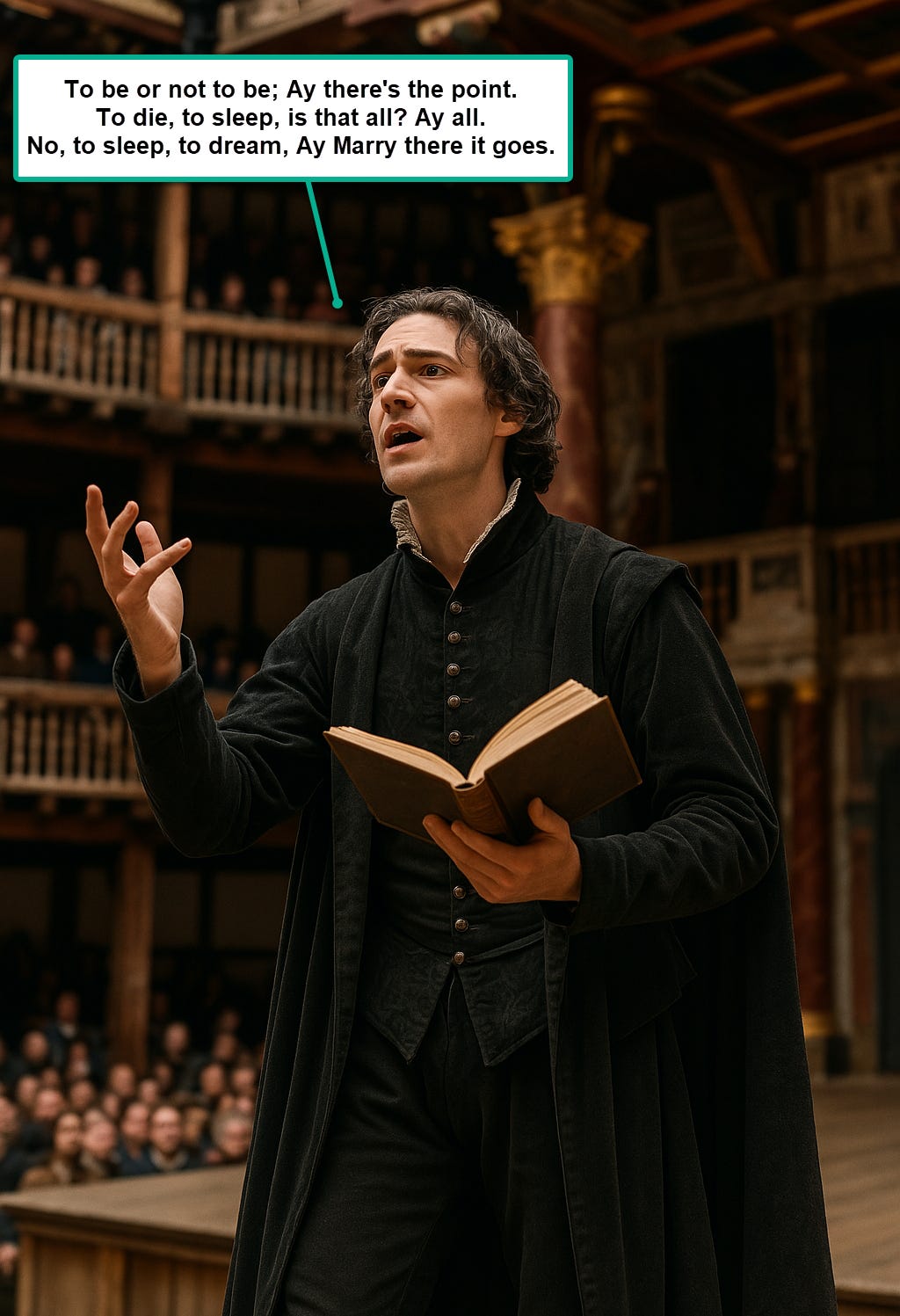
The bad quartos (aka the first quartos) are the inferior, abridged stage adaptations of the masterpieces that were published while Shakespeare was alive, that carried his name on the title pages, that his companies actually performed, and that Londoners really believed he wrote. They frequently accented action, had more comedy bits, and often included brief paraphrases of the longer monologues. The most famous example of the latter is the To be or not to be soliloquy in the bad quarto of Hamlet (or Q1 Hamlet), the opening lines of which reads as follows:
To be or not to be, Ay, there’s the point.
To die, to sleep, is that all? Ay all.
No, to sleep, to dream, Ay, marry there it goes.
This quote, of course, should seem all wrong, even bizarre — a sort of brief, slap-dash rendition of the opening to the real "To be or not to be" monologue. But that is because it comes not from the original, masterpiece version of Hamlet but from the cheaper, inferior, theatrical version that Shakespeare had shortened and simplified for the public stage. It comes from the printed 1603 rendition that had Shakespeare’s name on the title page and actually represents the briefer, swifter-paced adaptation.
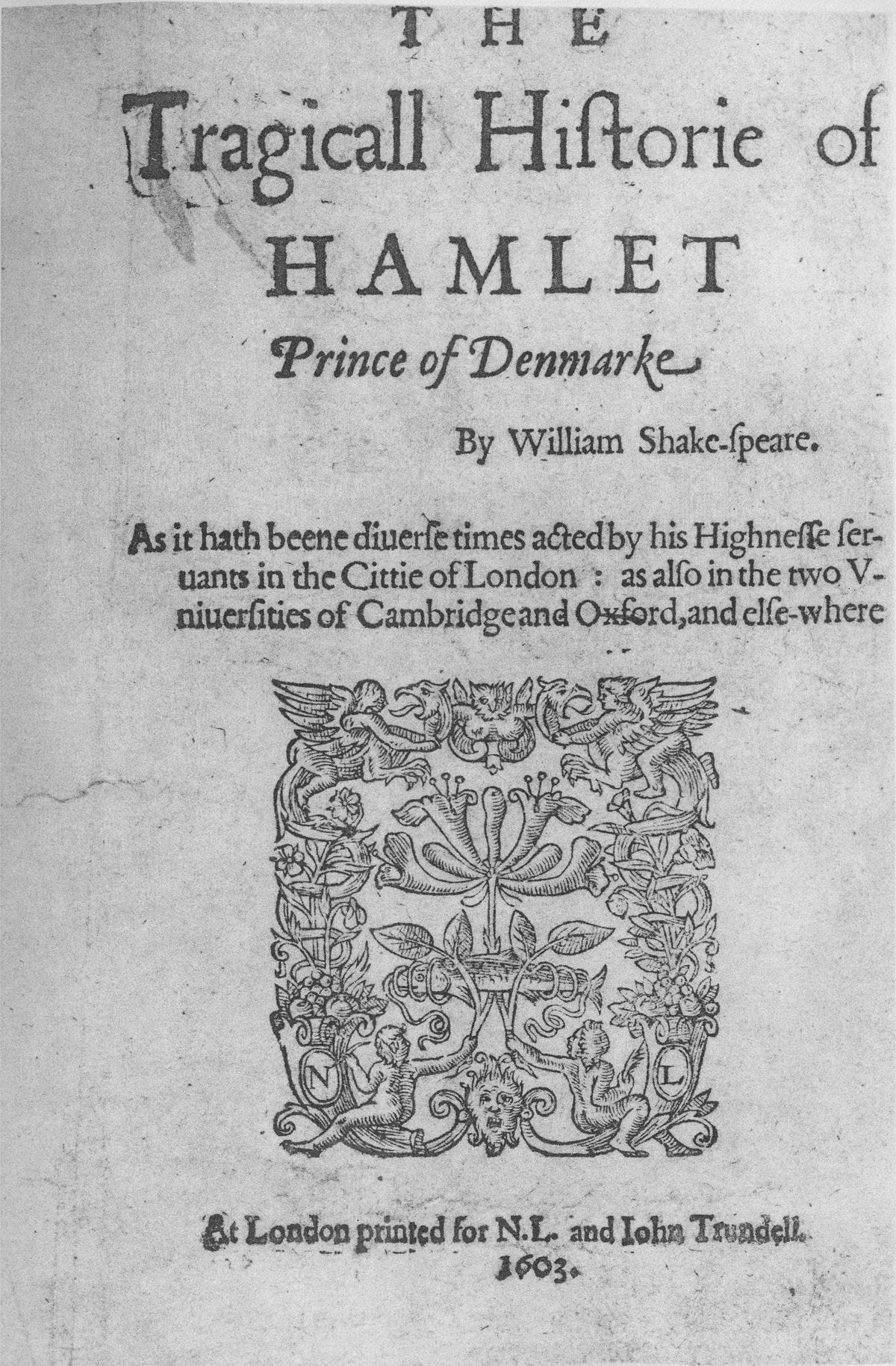
This Hamlet, though demonstrably poorer in literary quality, was still quite effective dramatically. It still sparked and jumped. This is why some theater companies today will occasionally perform this staged version.
About this adaptation, the scholar Leah Marcus wrote, "Q1 Hamlet, if recent testimony by actors, directors, and audiences is any guide, can work wonderfully well in the theater." Marcus described it as "Hamlet with the brakes off," and noted that "what it lacks in terms of philosophic range and refinement of language, it compensates for through an abundance of theatrical energy."1 Kathleen O. Irace, the editor of The First Quarto of Hamlet, also underscored the simplicity but dramatic effectiveness of this staged adaptation, detailing numerous "features that make Q1 easier to understand (the streamlined plot, the simpler villain, the more appealing queen) or more amusing (the added puns and gags) or more convenient to play (the shorter running time)…."2 This shorter, funnier, more action-packed Hamlet is the version that Shakespeare actually wrote. And this certainly took some talent on the Stratford dramatist’s part. He not only understood Hamlet well enough to simplify it, he also had the gift of knowing how to juice it up, to accent its thrills.
It was Sir Thomas North who, some 15 years prior, penned the original, literary version of Hamlet in 1588. This is the version referenced by Thomas Nashe in 1589 (far too early to be Shakespeare’s) as having been written by “English Seneca” (and Schlueter and I have an article soon coming out confirming Nashe was referring to North as “English Seneca.”)
North wrote this original Hamlet to be performed by Leicester’s Men, hopefully at court in front of the Queen, and if not, at least for Leicester3 and other higher-ups of the privy council as well as at the Universities and Inns of Court. North’s work was much longer and much more lyrical, sophisticated, and challenging than Shakespeare’s adaptation — as can be seen from his more familiar opening to his most famous of soliloquies:
"To be, or not to be, that is the question,
Whether ‘tis nobler in the mind to suffer
The slings and arrows of outrageous fortune,
Or to take Arms against a sea of troubles,
And by opposing, end them. To die to sleep
No more, and by a sleep, to say we end
The heartache, and the thousand natural shocks
That flesh is heir to; ‘tis a consummation
Devoutly to be wish’t. To die, to sleep,
To sleep, perchance to dream, Aye, there’s the rub...," (3.1.56-65)4
Shakespeare, the theater-savvy public play-producer, didn’t write this version; he purchased this version—and then converted it into a more popular form for the public theaters.
And Hamlet was not the exception. Although this is not widely known, the plays Henry V, Richard III, Henry VI, part 2 and Henry VI, part 3 also exist in two very different versions: in the genuine, familiar literary form — and as a rewritten, briefer, less erudite, faster-paced staged adaptation. In each case, conventional scholars had always assumed that Shakespeare had written the longer masterpiece, yet it is only their lesser, rewritten theatrical renderings that had ever reached print during Shakespeare’s lifetime—and by 1620, four years after Shakespeare had died, each of these lesser adaptations had been attributed to the Stratford dramatist via the title page. These rewritten versions are so inferior to the originals that orthodox scholars have had a difficult time accounting for Shakespeare’s name on the title pages. So, up until now, conventional scholars had blamed all these lesser works on a system of conspiracies, occurring over decades. Supposedly, various groups of unknown anonymous actors working within the Stratford dramatist’s theater companies rewrote these plays and then secretly sold them to corrupt printers with Shakespeare’s name on the title pages.
Yet these staged adaptations were not the only inferior works from the era credited to William Shakespeare. Most people have never heard of plays like A Yorkshire Tragedy, London Prodigal, or Thomas Lord Cromwell—even though each of these works was published while Shakespeare was living near London, attributed to Shakespeare via its title page, and performed by Shakespeare’s theater company. These plays remain unfamiliar because scholars have deemed them so beneath the lofty style of the "Shakespearean" masterpieces that they have removed them from the official canon—no matter what their title pages state. In reality, the reason these plays seem so unShakespearean is that they weren’t based on an original play by North, so they lacked his storylines, characters, speeches, metaphors, etc. Regardless, once again, orthodox academics must suppose some more clandestine and conspiratorial mischief — this time involving anonymous playwrights who never wanted credit for their work.
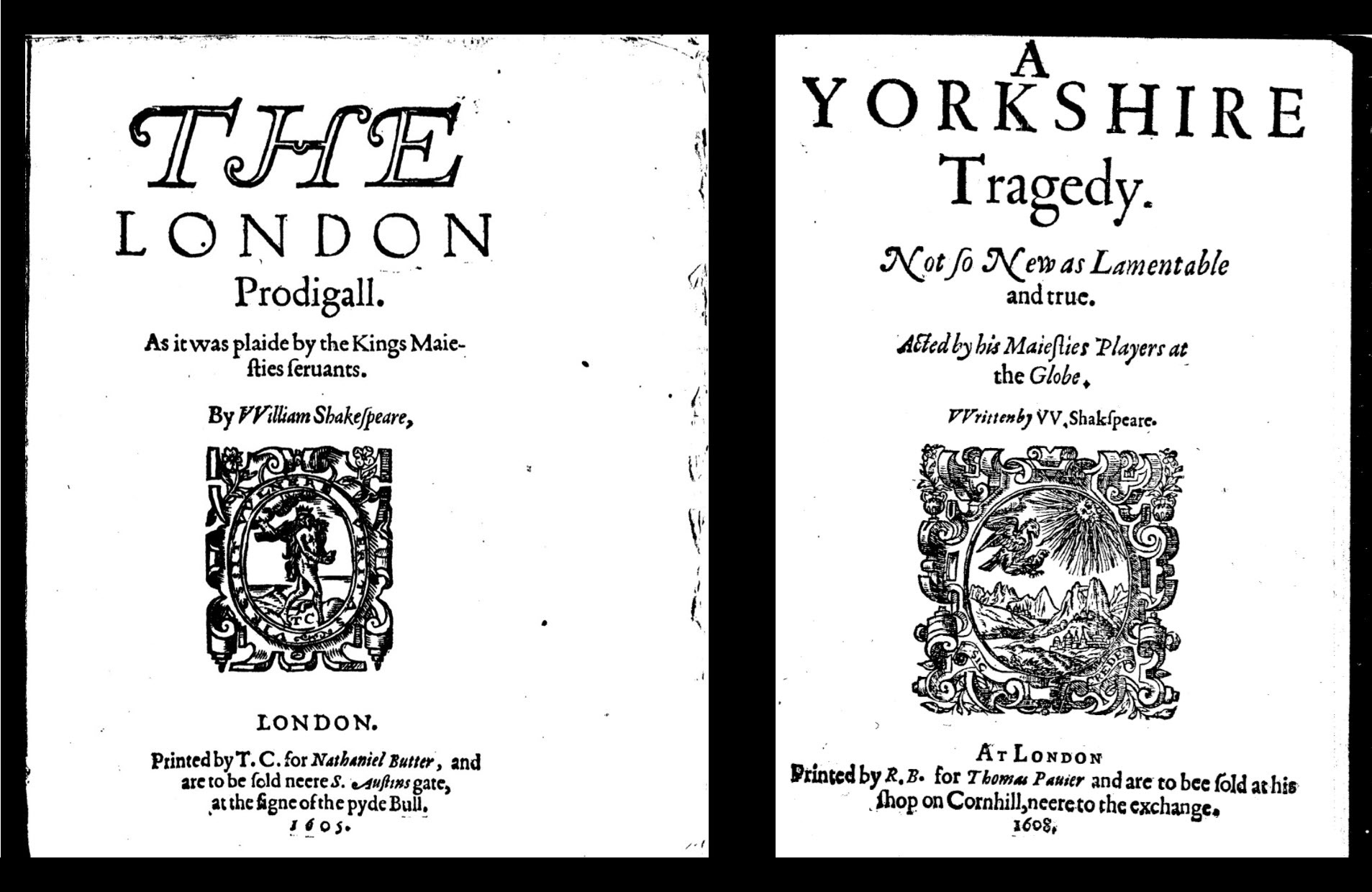
But Shakespeare is the only playwright from the time who has such an apocrypha, the only writer who had single plays published and attributed to him while he was alive that he supposedly had no part in writing. It is absurd for Shakespeare scholars to argue there is no Shakespeare authorship question when they themselves question Shakespeare’s authorship of many plays previously credited to him.
In an earlier post, I listed every play “by William Shakespeare” prior to 1620 (see pic below), and over this current series of posts, I will prove that every unambiguous designation is accurate and honest. Yet, orthodox scholars, confronting these dramas, must suppose the existence of more than a dozen different conspiracies, operating over at least 25 years, involving different groups of thieving, anonymous actor-playwrights from various theater companies (Pembroke’s Men, Lord Chamberlain’s Men, and The King’s Men), with each group working in cahoots with a corrupt printer and publisher—all plotting, at different times, to profit on Shakespeare’s name and publicly frame him for inferior plays. Yet, incredibly, no one ever found out about any of this. All the while Shakespeare was in London, with all these lesser dramas and adaptations circulating about town and his name stamped prominently on their title pages, he never realized it. Or at the very least, no evidence suggests he ever complained about it or tried to stop it. And no one else ever mentioned any of these conspiracies against Shakespeare either.
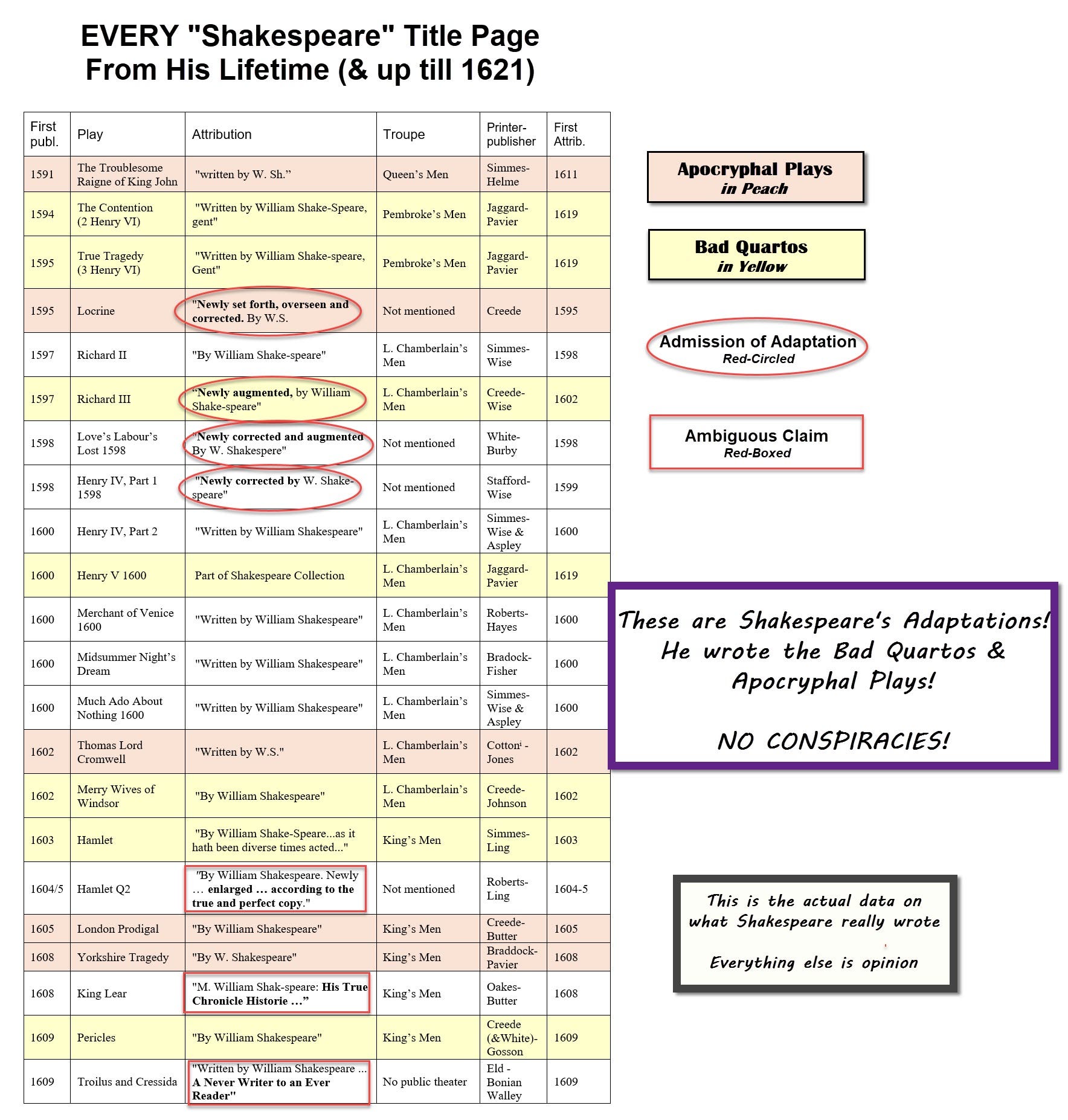
In reality, all these title pages were correct, and Shakespeare actually worked his quill in every play clearly attributed to him during his lifetime. Specifically, he purchased all the source dramas; he reorganized their plots; he cut out lines and characters; rewrote at least a few of their scenes, or hired other writers to help him with the chore; and he was generally in charge of all creative aspects of the finished product his company put on stage. This was his primary duty as one of the main sharers in his theater companies, the Lord Chamberlain’s Men and King’s Men. This was how he became wealthy, earning a healthy percentage of all the profits. What he didn’t do, however, was write the original masterpieces.
As we have shown, it was Sir Thomas North who was the true author of the literary and renowned versions of Hamlet, Henry V, Romeo and Juliet, Richard III, Antony and Cleopatra, etc. He first wrote many of these plays for Leicester’s Men, and they were performed in private settings at court, nobleman’s manors, the prestigious law schools known as the Inns of Court, or at Cambridge University. Shakespeare, the theater entrepreneur, later purchased these works in the 1590s, and adapted them for the public theater, then frequently sold his renditions to printers. In reality, there were no conspiracies or behind-the-scenes intrigue. And William Shakespeare really did write (or at least adapt) every work that was attributed to him up until 1620.
Shakespeare had to rewrite North’s works because North’s court-dramas were simply not viable for the public stage in their current form. As English Professor and Shakespeare scholar Deborah Schwartz wrote about the literary Hamlet:
"In Shakespeare’s day, this ‘full text’ would never have been performed. By contrast, Kenneth Branagh’s recent film version of the ‘complete’ text runs about four hours, far too long for an Elizabethan audience, only a portion of whom were seated."5
In fact, "the groundlings," who paid the cheapest prices, a penny for a performance, and stood in the yard in the uncovered section before the stage of Shakespeare’s Globe theater, typically drank beer and threw food at the more detestable characters. Imagine them having the patience or desire to stand quietly through the Hamlet we know today, sometimes in the rain, to reflect on four hours of blank-verse philosophizing; stoic speculations on mortality, lust, and fear; arcane legal allusions about rights to inheritance, etc. Even today, the original four-hour Hamlet is frequently cut in half, and this for an audience who has been taught its deeper meaning and who has been raised to cherish its literary merits.
The following provides another illustration of Shakespeare’s method of adaptation. Below is part of Laertes’ warning to his sister Ophelia in North’s original Hamlet followed by Shakespeare’s rewriting of this passage:
Laertes: "For Hamlet, and the trifling of his favour,
Hold it a fashion, and a toy in blood;
A violet in the youth of primy nature,
Forward, not permanent, sweet, not lasting;
The perfume and suppliance of a minute...
"For nature crescent does not grow alone
In thews and bulk; but as this temple waxes,
The inward service of the mind and soul
Grows wide withal. Perhaps he loves you now,
And now no soil nor cautel doth besmirch
The virtue of his will; but you must fear,
His greatness weigh’d, his will is not his own;
For he himself is subject to his birth....
"Then weigh what loss your honour may sustain
If with too credent ear you list his songs,
Or lose your heart, or your chaste treasure open
To his unmast’red importunity.
Fear it, Ophelia, fear it, my dear sister,
And keep you in the rear of your affection,
Out of the shot and danger of desire." (1.3.5-35)
Beautiful, to be sure. But can anyone seriously believe that the groundlings saw this Hamlet in 1600, immediately fell in love with it, and showered the author with acclaim? Of course not. North’s version, which filled up four hours with many such speeches, was simply not a practical choice for the public theaters. So Shakespeare, in his briefer, staged adaptation, took Laertes’ passage above and transformed it, skillfully and accurately, into the following simple statements:
Laertes: "I see Prince Hamlet makes a show of love;
Beware, Ofelia, do not trust his vows.
Perhaps he loves you now, and now his tongue
Speaks from his heart; but yet take heed, my sister."
This is what the groundlings heard. This is what Shakespeare actually wrote. And, again, this is from Shakespeare’s first published version, the first quarto, which appeared in print with his name on the title page in 1603. When people at the time referred to Shakespeare’s Hamlet, they were referring to this staged version.
And we find this same method of operation—this same capacity for converting erudite masterpieces to Globe theater hits—in all of Shakespeare’s revisions. Shakespeare scholar Lukas Erne wrote that while the original, literary version of Romeo and Juliet "amplifies introspection, lyricism, and characterizations, Q1 favours pace and action."6 Researcher and English Studies professor Marco Mincoff wrote something similar about the simplified quarto of Henry VI, Part 2, describing it as "a taut, swift acting version that might well be more effective on the stage than the more literary version...."7 In other words, Shakespeare’s works were just like the popularized cinematic versions of classical novels. Shakespeare, the theater-entrepreneur, understood his audience. So we often see a producer-like cunning in his theatrical renditions, which often seemed to hold to one overruling motto: Less chit-chat, more sword fights.
In most of my articles, books, and posts detailing evidence for North’s authorship of the original Shakespeare plays, I have steered clear of the more devastating proofs of what exactly Shakespeare wrote. That is because the latter is far more controversial. Accepting that North wrote the original Hamlet (1588), Romeo and Juliet (1561), and Henry V (1581-2) before Shakespeare later adapted them still fit snugly within a traditional view of Elizabethan literature. After all, scholars all know about references to the early versions of these plays. And someone had to write these earlier plays.
But showing that what Shakespeare wrote were the lesser, abridged staged adaptations of Hamlet, Romeo and Juliet, and Henry V—the bad quartos of those plays which were the first renditions ever published—and that Thomas North’s versions were the masterpieces, well, that’s an entirely disruptive, paradigm-destroying event. And this is true even though this is the easiest fact of all to prove, for all documentation—all the title pages and insider comments—repeatedly confirms it.
Given all this, one may well wonder why anyone is uncertain about what Shakespeare wrote. If indeed it is well known that:
Shakespeare was a reviser of older plays;
the "bad quarto" versions were inferior, shortened, staged revisions of older literary plays;
Shakespeare’s theater company performed those bad-quarto adaptations;
these adaptations, along with a number of other mediocre plays, were printed in London prior to 1620 with Shakespeare’s name on the title pages
—THEN HOW CAN THERE BE ANY CONFUSION OVER WHAT SHAKESPEARE WROTE?
Indeed, the real question is not, what did Shakespeare write? The title pages and all Shakespeare-era documents make this clear. No, the real question is, why does anyone think Shakespeare was the literary genius who penned the original, refined dramas?
For more info, also check:
Explaining the First Folio (and the Final Shakespeare Mystery)
·
June 6, 2025
As we have shown over the last few weeks, the simple solution to the mystery of Shakespeare’s plays is to recognize that, yes, Shakespeare’s name does indeed appear on the plays that he crafted, and no, no one was trying to give him false credit. It is just that the correct title pages are the ones that fronted the inferior staged adaptations that his
Leah S. Marcus, Unediting the Renaissance: Shakespeare, Marlowe, Milton (New York: Routledge, 1997), 145.
Kathleen O. Irace, The First Quarto of Hamlet (Cambridge: Cambridge UP, 1998), 19.
The Earl of Leicester ended up dying on 4 September, 1588, which caused the disbanding of his theater troupe. North likely completed Hamlet not long after this date—and needed a new patron.
Quotations of Shakespeare plays reference (Act, Scene, Lines) from Richard Proudfoot, Ann Thompson, and David Scott Kastan, eds., The Arden Shakespeare: Complete Works (London: Arden Shakespeare), 2001.
Debora B. Schwartz, Establishing a Text II: The Example of Hamlet, California Polytechnic State University English Department, (1996-2002).
Lukas Erne, ed., The First Quarto of Romeo and Juliet / The New Cambridge Shakespeare (Cambridge: Cambridge UP, 2007), 26.
Marco Mincoff, "3 Henry VI and The True Tragedy," English Studies 42 (1961): 283.
Comments
Nothing yet. Say the first thing.
Sign in to join the conversation.