
Environmental victories are rare and hard to achieve these days. So a ruling by the Michigan Supreme Court Friday is not just a cause for celebration, it’s practically a mandate.
The 6-1 decision in effect overturns the Public Service Commission’s approval of the Enbridge Line 5 replacement tunnel and sends it back to PSC for review and decision. Even more than that, it sends the message that the nationally recognized 1970 Michigan Environmental Protection Act (MEPA) is not a mere policy statement, as some bureaucrats have held.
Instead, MEPA imposes a duty on state agencies to protect the “air, water, and other natural resources and the public trust in these resources from pollution, impairment, or destruction.”
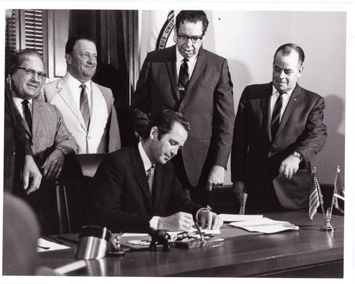
Gov. William Milliken signs the Michigan Environmental Protection Act into law on July 27, 1970.
MEPA was not easy to get on the books. Drafted by legendary University of Michigan law professor Joe Sax, MEPA became law only because a vibrant statewide citizen campaign led by West Michigan Environmental Action Council co-founder Joan Wolfe pushed the Legislature into approving. (Her interesting history of the fight to pass MEPA can be found here.)
All that effort was worth it. MEPA served as a valuable tool to protect the environment in its early years. But courts have chipped away at it.
In Friday’s opinion, the justices recognized that MEPA is not a gesture — it is a law that governs the conduct of agencies, who must analyze the effect of their actions on public trust resources, including the Straits of Mackinac in this case. MEPA says “conduct shall not be authorized or approved that has or is likely to have such an effect if there is a feasible and prudent alternative consistent with the reasonable requirements of the public health, safety, and welfare.”
What does this mean for Michigan and its citizens? It means the environment will be better protected. Government agencies have clear duties to the environment, and when they don’t do their job, citizens can use MEPA through the courts.
What does this mean for Michigan and its citizens? It means the environment will be better protected. If agencies don’t do their job, MEPA gives citizens standing to sue and force them.
In vindicating the importance of MEPA and the public trust protection it mandates, the Supreme Court has demonstrated that the nearly 2,000-year-old public trust doctrine endures. And citizens can use that doctrine to access to Great Lakes shoreline and prevent commercialization of Great Lakes water.
We will all benefit.
NOTE: A talented legal team should be credited with successfully urging the Supreme Court to affirm MEPA. It includes attorneys for four federally recognized Tribes — the Little Traverse Bay Band of Odawa Indians, Bay Mills Indian Community, the Grand Traverse Band of Ottawa and Chippewa Indians, and the Nottawaseppi Huron Band of the Potawatomi, the Environmental Law and Policy Center, the Michigan Climate Action Network, and FLOW Water Advocates. Great job!
And congratulations to Jim Olson, founder of FLOW and a proselytizer for MEPA and the public trust doctrine; Liz Kirkwood, FLOW Executive Director and champion of the public trust doctrine; and Skip Pruss, a FLOW advisor who has made the public trust doctrine work by advocating and using it for decades.
No posts
Comments
Nothing yet. Say the first thing.
Sign in to join the conversation.