
The fact that the Porcupine Mountains encompass a majestic state park is not to be taken for granted. Advocates have poured enormous effort over three generations into saving the bulk of the area from resource exploitation.
It’s taking a lot of work for the present generation, too.
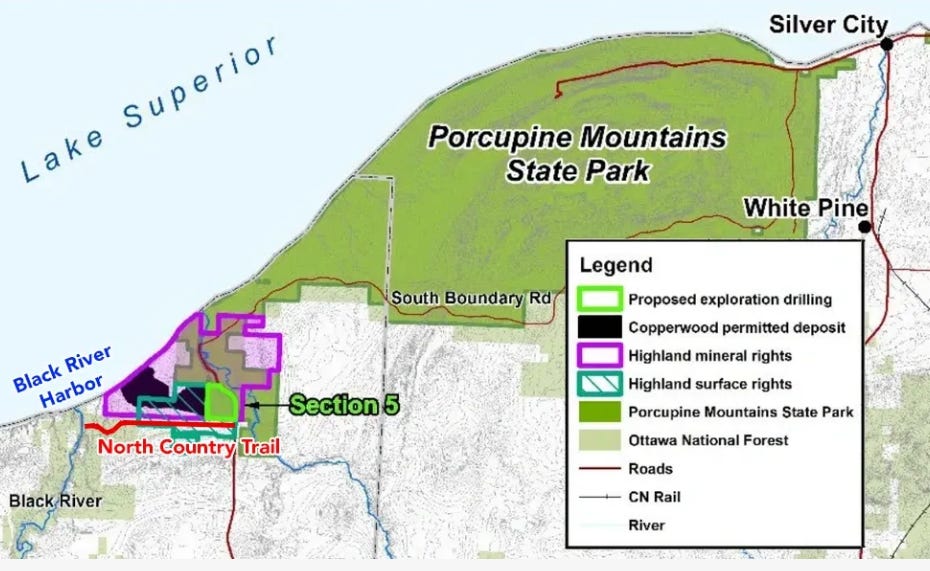
Battled by the citizens group Protect the Porkies, the plan for a proposed copper mine adjacent to and underneath the westernmost portion of the Porcupine Mountains State Park includes excavation as close as 100 feet from Lake Superior and under a portion of the state park. Mining undertaken by Highland Copper would inherently result in noise and light pollution of the wilderness.
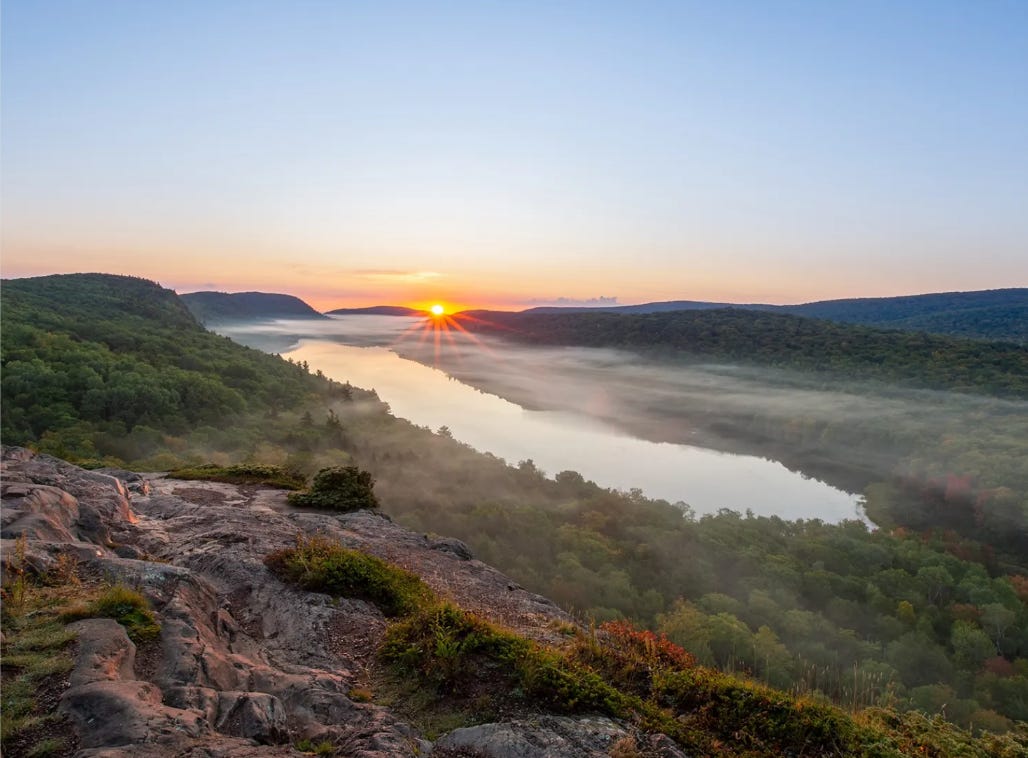
Lake of the Clouds, Porcupine Mountains Wilderness State Park
The low grade of the ore involved means a high amount of waste. Highland Copper is proposing a 323-acre, 171-foot-tall tailings disposal site that could be seen from the park’s Lake of the Clouds. (323 acres is the equivalent of 244 football fields.)
Perhaps of most concern is the potential for failure of a dam holding mining wastes back from Lake Superior. The Great Lakes Indian Fish and Wildlife Commission said its modeling showed that a dam failure could unloose tailings that reach Lake Superior in less than an hour and could contaminate the Presque Isle River in less than 90 minutes.
Environmental laws are not adequate to address this threat. The company has already acquired the permits required from the state. All that holds back the project is $450 million in capital — and the US Export/Import Bank has indicated its willingness to provide $250 million of it. Opposing the financing heads the list of actions recommended by Protect the Porkies.
This threat is reminiscent of the circumstances that birthed the park in the 1940s, and the fight over a different copper mine and a highway in the 1950s and 1960s.
In the 1920s, state parks director P.J. Hoffmaster called for creation of a state park in the Porkies, declaring, “No other place in Michigan contains the extensive rock formations – bold cliffs and striking topography; no other portion typifies so well primitive Michigan with untouched forests.” But the Legislature never appropriated the money.
As World War II progressed, demand for timber intensified, and the uncut hardwoods of the Porcupine Mountains beckoned. Lumberman Gordon Connor accelerated his timber cutting as conservationists and state officials tried to put together a state appropriation to purchase the area.
“As one walks through these dimmed forest aisles with the rays of the sun slanting through the treetops, and the ground soft under foot and free from underbrush, one feels a sense of reverence and peace.” — Raymond Dick of Ironwood, founder of the Save the Porcupine Mountains Association.
In early 1944, Governor Harry Kelly asked the Legislature for a $5 million appropriation to help buy land in the Porcupines as well as southeast Michigan parklands. He said the area should be “purchased for preservation as a timber museum” to hold the land in trust for future generations. The Legislature acted with unusual swiftness, but the woods were not yet safe.
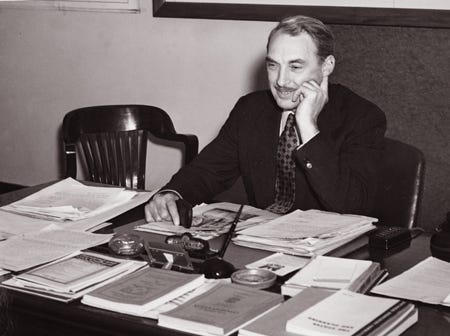
In the 1920s, state parks director P.J. Hoffmaster envisioned a preserve in the Porcupine Mountains. He was director of the Department of Conservation when the state successfully took the land for a park at the end of World War II.
Connor wanted to skin lands along the Presque Isle River and timber along the shoreline between the river mouth and the mountains. By then the company had laid track for a railroad across the Presque Isle River to cut through three-quarters of a mile of the park to get into land it owned outside the boundaries. Ultimately, the state took Connor’s land through condemnation.
“…[I]t is no exaggeration to say it is being done in the nick of time,” wrote Dorothea Kahn of the Christian Science Monitor. “The axes of lumbermen could be heard at the borders of the forest.” National Parks Magazine editorialized, “It is little short of a miracle to have succeeded in this endeavor in the midst of a war.”
But the park still wasn’t safe.
In 1958 mineral companies took an interest in copper ore believed to lie beneath the park. The Bear Creek Mining Company asked for a lease to explore over 900 acres under the park and another 5,200 acres of Lake Superior bottomland.
A broad coalition that included the United Auto Workers and the Michigan AFL-CIO opposed the lease. The organizing effort worked. Unwilling to commit to a timetable for exploring and developing whatever copper underlay the park and buffeted by the opposition’s wilderness cries, Bear Creek lost its support on the Conservation Commission and withdrew its request for the lease in January 1959.
But the park still wasn’t safe.
In the early 1960s, the Legislature approved funds to extend a state highway west from the park entrance far into the heart of the park at the Presque Isle River, but Governor John Swainson vetoed the sum.
But the park still wasn’t safe.
In 1962, local State Senator Joe Mack called for reducing the 30,000 acres of virgin timber in the park to only 10,000 acres to promote economic development. The same coalition that had turned back the copper mining proposal thwarted this proposal as well.
But the park still wasn’t safe.
In 1971, the Department of Natural Resources proposed a state management plan to set aside 35,000 acres of the park as permanent, unspoiled wilderness. Gordon Connor, president of the firm which had raced in 1944 to log what was now the state park, opposed the plan. The public rejected his position. The park got a new name: “Porcupine Mountains Wilderness State Park.”
But the park still isn’t safe.
When a special area is threatened, there is always some government agency or private business that insists the resource is needed for the public welfare. Proponents say the copper is needed to produce EV batteries. The question is whether sites like the Porcupines should be sacrificed first or be protected at least until the amount of copper required for needed uses and the environmental tradeoff is known.
There’s an old saying in conservation, “There are no permanent victories, but there are permanent defeats.” But this Porcupine exploitation business is ridiculous.
No posts
Comments
Nothing yet. Say the first thing.
Sign in to join the conversation.