
Qi (氣) tends to be confusing in translation because taken out of nuanced cultural context, it becomes presented as some magical thing which evades empirical evidence and logical intellectual analysis. Context really helps for most Chinese characters, but qi in particular is a broad and vague term, both in its original historical use and definition as an immanent concept and process of Chinese cosmology. The modern use of the term has various uses in modern Chinese. The localized Japanese term, ki (気), also has so many contextual variations of meaning or use cases in the language, it becomes a particularly confusing term among language learners.
Even if qi is personally experienced and understood properly via context and active practices like neijia or feng shui, it still cannot be objectively proven, or distinguished uniquely and separately as its own self-evident phenomenon. Which is… why it is categorized as a pseudoscientific concept. And yes, truly, many problems are caused by superstitious beliefs and affectations and New Age woo nonsense, or people trying to place qi into frameworks which are problematic (like pushing theories about it to medical science).
But when kept in its proper modern lane, it’s both possible and remarkable to experience qi as it is used and described in neijia, neidan, feng shui, and other traditions.
Like every discussion of qi, we gotta look at the character itself. Chinese characters are all logograms, but a small percentage of characters are pictograms (which some people mistakenly assume is true of all Chinese characters). The classical Chinese character for qi is considered one such pictogram.

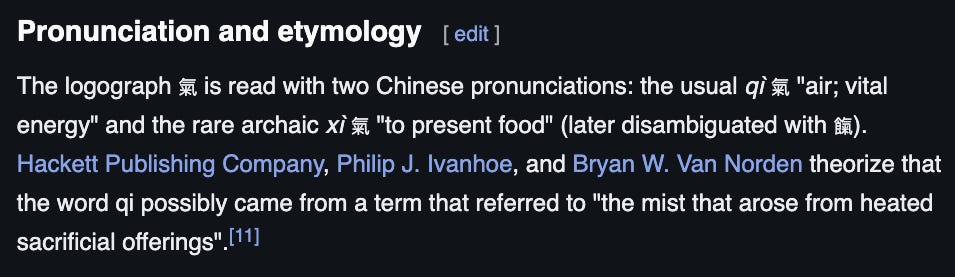
Qi visually communicates steam rising from cooked rice or grains (or any sacrificial offerings, as suggested above), out of a heated cauldron. It’s not that the qi is the steam, but that the process of the steam rising from food or grain cooked in a pot over fire exemplifies which kind of activities in the world are associated with qi. Recognizing the circumstances where qi is abundant will through contextual understanding give a better familiarity with what qi is thought to be and what it does.
The process of the rising steam indicates a type of process wherein qi features undeniably. Qi is not a magical substance or power within the physical realm, but a symbolic or referential assignation for the phenomenal process of constant change and transformation.
We all know intuitively that there is something psychologically and physiologically special about sunrise and sunset. And there’s plenty of scientific and biological research explaining how calendrical and even daily astronomical cycles effect living beings and terrestrial planetary processes (ocean currents and tides, northern lights from solar winds, evil underworld forces capturing and moving the Moon to block out the Sun creating total eclipses which look totally sweet). Sunrise and sunset hours (5-7 AM and 5-7 PM) also traditionally have the most potent and rejuvenating qi of each daily cycle, and have always been ideal windows for meditation or cultivation practices.
Optimal earth qi is particularly robust in certain ways and places during those early morning hours: the mist rising up from a river-valley, the morning dew in briefly cool dawn summer air, or slow-moving rolling clouds hiding the earth between high mountain peaks. The “amount” of qi in such cases doesn’t necessarily dissipate later in the day, but the interplay of the landscape with the weather changes its organization and activity.
The topic gets more confusing when considering qi is also divided into three types by the traditional Chinese categories of heaven, humanity, and earth. Despite such organization of qi processes, the definition and function is still the same: qi is a reflection of the activity of change and transformation. The shifting cycles of weather each year, or the shifting polarity causing the reorientation of night sky constellations over the centuries, various processes in the human body, the landscape and relationships of our outdoor surroundings—all of these are currents of phenomenal change across differently sized scales (local vs. interstellar).
It’s understandable why qi became prevalent within or alongside the cosmological ideas of early Chinese history some indeterminable amount of time before the Han dynasty’s formalization and adoption of a Daoism absent of cosmic deities or creator gods. The oldest classic book or literary text (jing, 經) in Chinese culture is the Yijing or I Ching, (易經) the Book of Change(s). And much older still, with its age unknown, is the bagua (八卦) circle of eight directional trigrams—which stacked together in all variations (8 times 8, potentially suggesting or symbolizing multiplying the pre-heaven trigrams by the post-heaven trigrams) becomes theYijing’s 64 hexagrams.
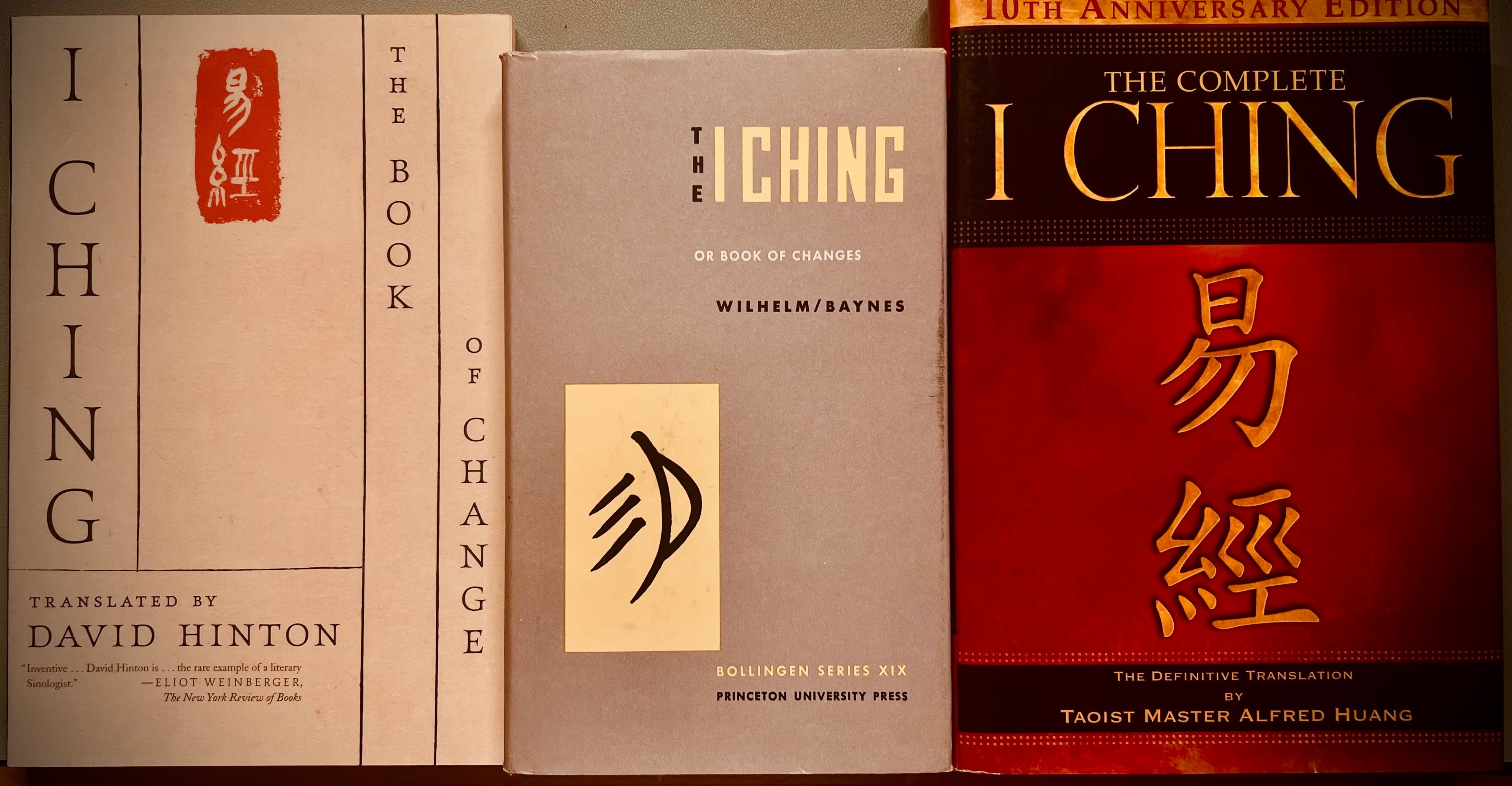
Since the late 19th century, translations of the Yijing have become ever more abundant and internationally popular. The initial “accessible” translation, still in print today, is the German translation by Richard Wilhelm, as are its various translations into other languages, like Cary Baynes’ English translation above. Wilhelm’s translation infamously contains an enthusiastic introduction by Carl Jung. Jung emphasizes the Yijing’s nature as the pinnacle text and transmitted tradition for the casual or sophisticate’s engagement of divination, practiced in some form by all peoples of the world in prior ages. At the same time, Jung is kinda, well… doing what Jung always does (presuming all mystical traditions conveniently pursue and express the same things as his own theory of psychology).
One theory absent from the English translations I’ve read, which has long been a speculation of mine, is that the hexagrams represent the various cosmic patterns of qi. Such that it’s a catalog of snapshots of the different archetypal orientations which make up (or reflect) causal reality, of which the ceaseless activity and movement behind all such phenomena reflects or is reflected by qi. It’s not that qi is the change itself, but it is a symbolic messenger of the actual medium.
Qi is not something you can measure or capture, nor trace to some beginning or ending. In this way it’s a bit like another commonly misunderstood concept, that of Buddhist kamma (karma, in Sanskrit). It’s madness to try and fully perceive the infinite complexity that is past kamma in order to determine the reason for current particular events transpiring in our lives or the present moment of the world. It’s like trying to figure out what reasons God has for letting terrible things to happen to good people(s). Qi is in the activity, movement, and changes (impermanence/inconstancy) of all causality. It’s not the actual physical nature of things, as physical phenomena is more like the shadow cast by the processes of change.
Some people deny the existence of qi, and this kind of skepticism is understandable. Sometimes it’s the healthy perspective. I also think the all-suffusive and encompassing character of qi means it need not be a conscious topic of focus. Discerning its aspects will naturally happen at some later point for anybody cultivating related practices like neijia, or neidan, if it becomes undeniably powerful and perpetually present within and around the body. If it doesn’t happen, it doesn’t mean it isn’t real, but that you can spend your time consciously thinking about other stuff instead.
Comments
Nothing yet. Say the first thing.
Sign in to join the conversation.