
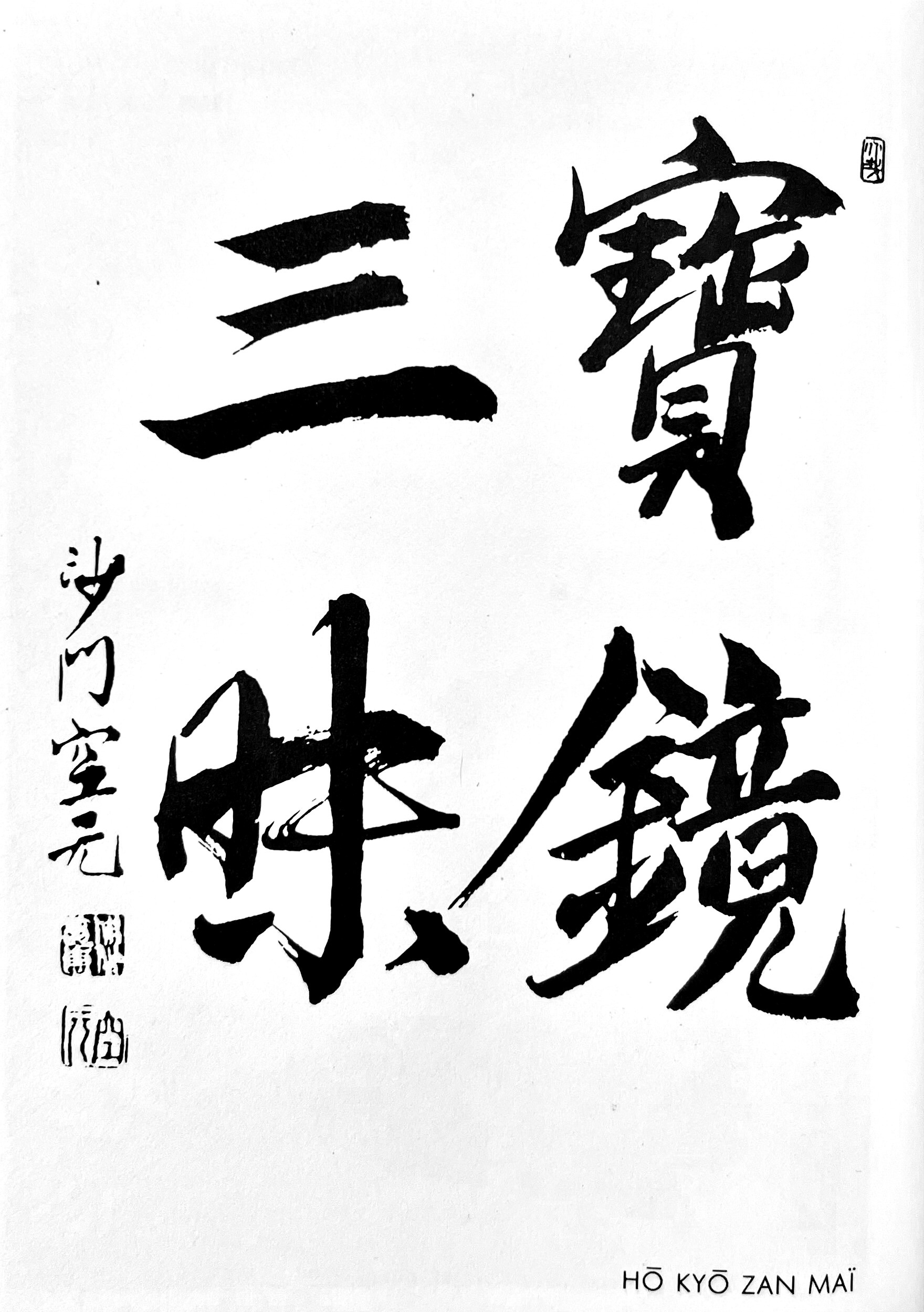
Taisen Deshimaru’s books introduced me to Buddhism and meditation as a teenager. Decades later, I still re-visit them periodically for a reliably wholesome metaphysical boost. Particularly with The Ring of the Way, an older, out-of-print volume of his short essays in English. The other books are transcriptions of retreats, or else Q&A sessions with his French students back in the 1970s-80s. Those are nice for how they capture his teaching style and humor, but for me, Ring of the Way contains his most personal and energetic presence.
Both Deshimaru, and his famous teacher, Kodo Sawaki, conveyed a vibrant quality which is rare among Zen teachers. The atmosphere around them has always felt like the mind and spirit which emerges over time from diligent, rigorous traditional martial arts training. Perhaps not so surprising, both having been notable Zen teachers and mentors to plenty of 20th century Japanese budo students and teachers. It’s the focus too of Deshimaru’s most widely printed book, a classic among late 20th century traditional Japanese martial arts maniacs, The Zen Way to the Martial Arts. Particularly wonderful in tZWttMA: Deshimaru’s asked about Taijiquan (“Tai Chi”), and how its apparent merits compare to Zen practice, and his response is spectacularly incorrect—projection even. Amazing stuff! All too perfectly human.
Probably Zen Buddhism today has an even milder active base than the Taijiquan scene. Zen is not exactly a thriving, popular practice in Japan. The character and spirit in question wasn’t so common there in Deshimaru’s day, to hear him tell it. But devoted Zen practice has the fresh, natural, renewable resource of mental and physical energy, and it led me to martial arts decades ago as a teenager. Mental space, balance, focus, and all of that good stuff. Just as much so, in the martial arts, it’s rare to find places or people who really have the right spirit (and by this I don’t mean a character which is overly enthusiastic about fighting).
Sometimes the most agreeable and socially healthy places don’t transmit the proper feeling at all—healthy, rejuvenating vibes. Sometimes effective practices and teachers are really draining for no clear reason—they can’t energize you, only exhaust instead. People have surprising chemistries, people respond to different approaches, different traditions. People assert themselves, get in the way, instead of relinquishing themselves.
Within martial arts and religions, it becomes clear when people are propelled purely by their illusions or cannot parse their own nature, or indeed are motivated by the urgency of blotting out reality—as with certain types of mental disorders. We discuss the fallible nature of memory, of how often people just make up their own past histories, and yet some personality types are more disposed to such inaccurate behaviors. There are also people in these spaces whom tread the water of life by urgently figuring out successful, sensitive ways to “create space” in their psyche, so they’re able to survive in the machinery of society. A meeting of the minds—a conflagration of the crazy. The profundity of Deshimaru’s core message can be recognized here: becoming normal. His direct students like Stéphane Kosen Thibaut, still teach today, and I hope to visit one of their zendos in the future.
As the Demon Hand Classic says, “real recognize real, fake indistinguish fake”.
HOKYO ZANMAI
THE MIRROR SAMADHI
During a talk one day, the Buddha Shakyamuni picked up a flower and turned it gently in his fingers. None of the disciples gathered around him understood his gesture; only Mahakashyapa smiled.
So the Buddha said to him:
“The secret of nirvana, my wonderful secret, you alone have realized it and I give it to you now.”
That is the samadhi of the spirit of Buddha, the Buddha-mind.
The Buddha-mind is like a mirror, and the mind of Mahakashyapa was reflected in it. The reflected image was a perfectly pure spirit, original mind, in perfect and total unity with the mind of the Buddha. The Buddha was the mirror. Mahakashyapa’s mind entered the mirror. Only karma, only Mahakashyapa’s form, was looking at the mirror; but what the mirror reflected was not Mahakashyapa, it was original mind, pure and at one with the mind of Buddha and the light of Buddha.
Mahakashyapa’s reflection had become Buddha. Looking at the Buddha’s mind, Mahakashyapa was looking at his own mind, and he understood this.
The image in the mirror is you
but you are not the image.
Your existence is not the mirror-image. When we look into the mirror, the mirror does not make the reflection by itself and it cannot grasp the form. The combination of the two is necessary. Even if there is a mirror, you cannot see the reflection unless you look into it.
The relationship among consciousness, wisdom, and the cosmos is the same as that among mirror, reflection, and form.
Never, as long as we live, can we see our own face. All we know is the reflection in the mirror; we never see ourselves di-rectly. We have to have the intermediary, the reflection in the mirror. But the mirror is not truth, only a mirror.
Five hundred monkeys were looking at the moon’s reflection in the water and thinking, “What a gorgeous melon, let’s go pick it.” All together, from valley to lake they went, holding each other’s hands to make a chain, trying to pick the wonderful moon-melon mirrored in the water, and every last one of them fell in the lake.
It is like trying to put the sky in a bucket, trying to catch the wind and tie it up in a rope. That is typical of our civilization, and that is why it says in the Shodoka that you must not try to catch the moon in a bucket or the wind in the sky.
During zazen we have illusions produced by our five senses—colors, voices, smells, tastes, touch. But we shouldn’t worry about them, because samadhi, mirror concentration, remains perfectly untainted.
We must not separate shiki from ku, phenomenon from essence; instead, we must just let go of both, not only shiki but ku as well.
We must not make categories. In everyday life, in our arguments, it is always, “I’m right and you’re wrong.” We always want to compare and compete with each other.
So in the sutras—the Nirvana Sutra, the Lotus Sutra, the Diamond Cutter Sutra —the Zen monk speaks with a boneless tongue. That means he must speak in every direction, embrace every contradiction, without resistance.
Comments
Nothing yet. Say the first thing.
Sign in to join the conversation.