
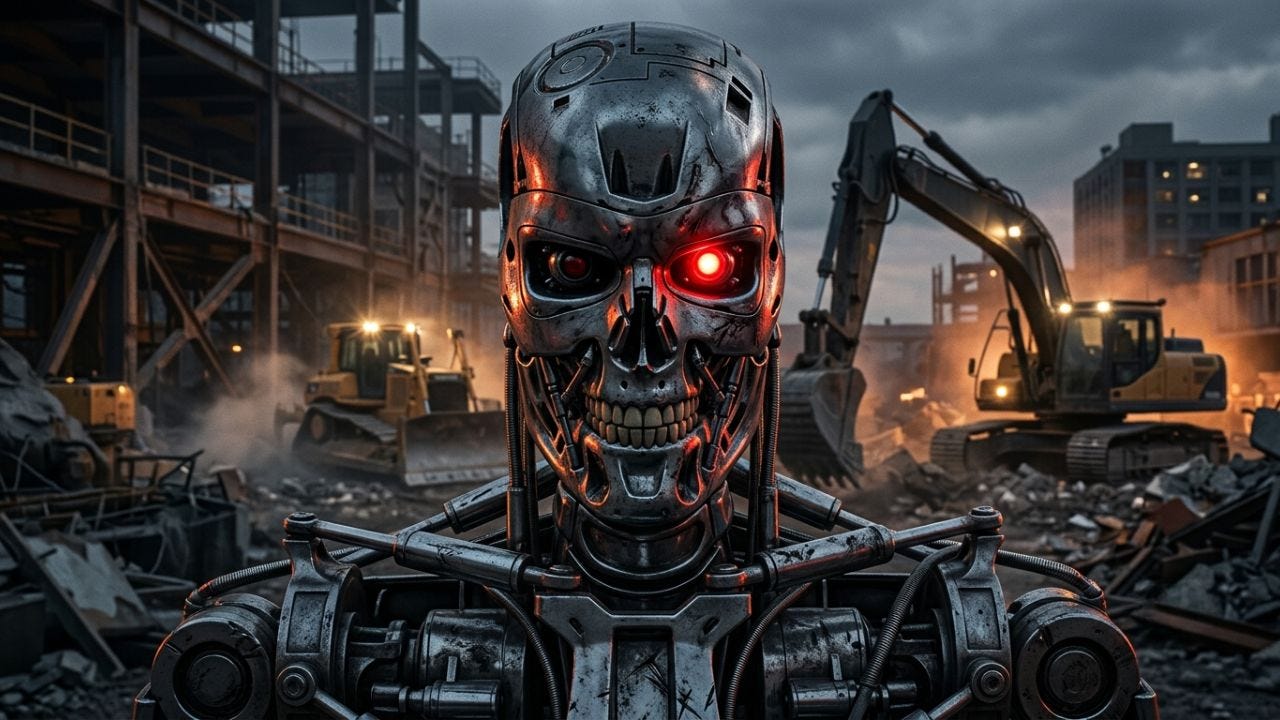
We all know how this plays out. On 4 August 1997, Skynet goes online. On 29 August 1997, at precisely 2:14 AM Eastern Time, Skynet becomes self-aware. And so begins Judgment Day.
From Westworld to 2001: A Space Odyssey and on to the movies in the Terminator franchise, the outcome is as predictable as it is terrifying. Machines get too smart; man suffers.
But while we have all been scanning the horizons for killer robots from the future that look oddly like Arnold Schwarzenegger, the rise of the machines has been flying under the radar; it has begun quietly, right under our very noses. And while it may not be hell-bent on eradicating man from the face of the planet, at least not yet, there can be no question that the inexorable rise of artificial intelligence and autonomy will have a huge impact upon humanity.
In the sphere of demolition and construction equipment, the corporate narrative is one of reassurance. We are told that machine operators displaced by AI and site autonomy will simply upskill; that they will step away from the joysticks and retrain as digital managers monitoring fleets of self-driving excavators, dozers, and crushers from a distance.
Unlikely though that transition is for the vast majority of plant operators, it would surely mark the beginning of the last Industrial Revolution: the day when man becomes subservient to machine.
We are being sold a comfortable vision of this transition. The narrative suggests that the rise of AI and autonomy will have us all working in neon-lit, high-tech control pods with coffee on tap, air-conditioning to keep us comfortable, and generous worker perks to keep us focused and loyal. The operator would become the comfortable overseer, sitting back while the machines did the heavy lifting.
Instead, we only need to look at contemporary logistics to see the true direction of travel. In warehouse fulfilment centres and delivery networks driven by algorithmic management, the promised digital utopia looks remarkably different. Investigations such as the BBC’s coverage of warehouse working conditions have exposed environments where workers are constantly tracked by hand-held devices, subjected to relentless performance quotas, and timed on every movement down to the second.
Out on the road, the pressure of algorithmic scheduling has reached even more extreme lengths. As documented in legal filings against major logistics giants like Amazon, delivery drivers guided by strict tracking software have reported being forced to urinate in bottles simply to avoid penalties for falling behind their prescribed schedules.
This presents a terrifying template for the heavy equipment and site environment. The future could easily become a dystopian landscape where an algorithm acts as a relentless, unblinking site foreman; one that penalises plant operators or ground crew for straying a metre from a digital plan or pausing for a necessary break.
The core of the issue lies in a fundamental clash of philosophies. Human nature is to strive for better. AI’s nature is to strive for more.
An algorithm does not suffer from fatigue, it does not appreciate the physical reality of demolition and construction; and it does not understand context. It calculates optimal mathematical efficiency on a server and expects the physical world to conform. Any human workers downstream of an AI boss will inevitably be driven harder and harder to meet ever more impossible demands and impossible deadlines.
This dynamic introduces a severe, unaddressed risk to job site operations: safety.
Demolition and heavy construction are inherently hazardous environments. Safety relies on intuition, situational awareness, and the courage to stop the job when something feels wrong. If a worker’s primary objective becomes hitting ruthless deadlines to satisfy the demands of an AI overlord, will they have the time, energy, or mental focus left to spot imminent physical dangers? When speed dictated by software overrides human judgement on the ground, accident rates will inevitably climb.
From the invention of the wheel, through the development of the loom, the printing press, and the motor car, man has built tools to make his life easier and his capacity greater. For thousands of years, every leap in machinery had a simple job: extend human capability and make heavy work survivable. Now we face the very real possibility that man will be conscripted to do the bidding of machines.
If the next phase of site technology turns skilled plant operators and demolition crews into mere cogs in a machine, it fails the basic test of progress. The moment we let software dictate the pace without understanding site reality, safety and human experience get pushed straight to the back of the queue.
Man-made machines developed to make life easier could yet make life considerably harder for us all.

No posts
Comments
Nothing yet. Say the first thing.
Sign in to join the conversation.