
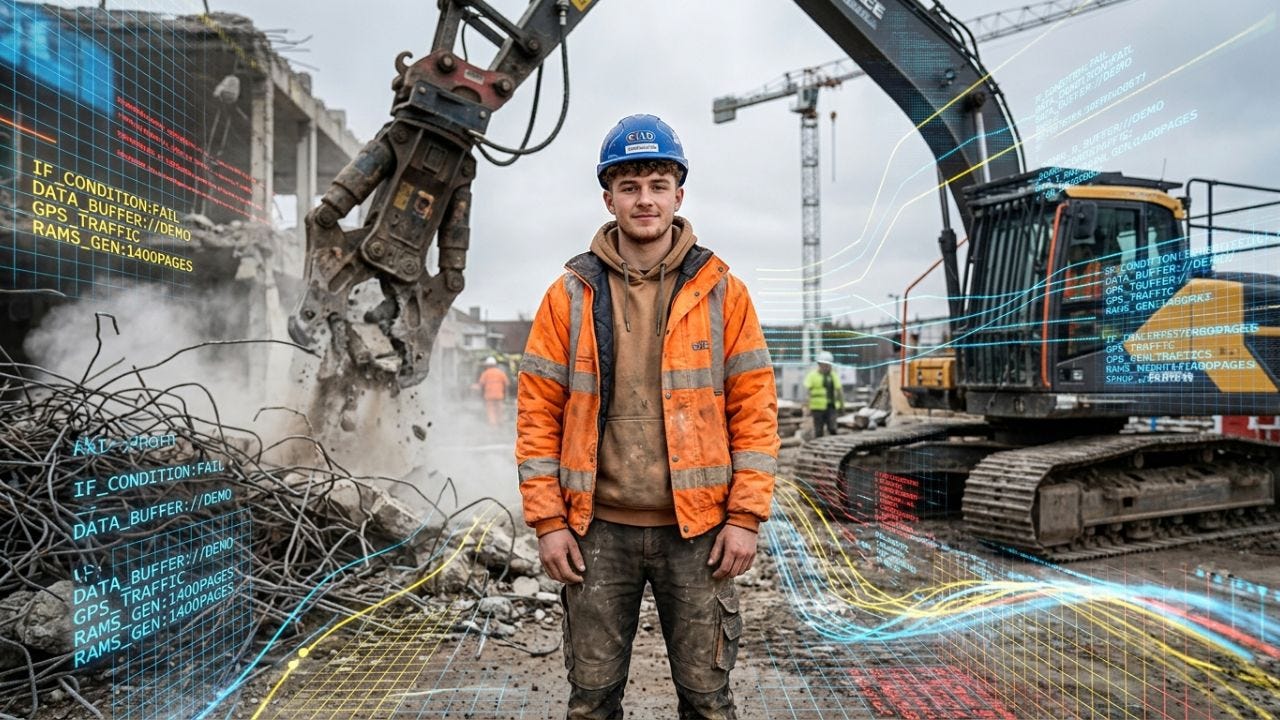
It is easy to look at headlines about artificial intelligence and autonomous excavators and assume robots are coming for everyone’s job tomorrow morning. They are not—at least, not yet.
If you are a veteran plant operator with thirty years under your belt or a site manager eyeing retirement, you can relax. Chances are you will be on the beach or the golf course long before site-wide autonomy takes over completely.
However, if you are eighteen years old, standing on your first site, or just finishing an apprenticeship, the landscape looks vastly different. You face a forty-year career where smart algorithms, GPS-guided machinery, and AI-driven management systems will steadily absorb routine, repetitive tasks and roles.
If all you bring to the table is an ability to pull levers or follow a checklist, you make yourself easily replaceable.
To survive and thrive in this sector over the next four decades, you must cultivate skills no silicon chip or digital twin can replicate. Here are six ways to ensure you remain far more valuable than any algorithm:
An autonomous excavator can dig to a millimetre-perfect digital model all day long without taking a tea break. What it cannot do is feel a structural load shift in a concrete frame that strays from the architect’s drawings. Sensory foresight comes from experience, paying attention, and keeping your eyes open. It is the ability to spot subtle ground movement, hear a change in a hydraulic pump’s whine, or recognise structural stress before a sensor alerts you. Learn to read the unpredictable reality of a site, not just what a screen tells you.
AI can generate a hundred pages of legally compliant Risk Assessments and Method Statements in three seconds flat. What it cannot do is spot the massive gap between what is written on paper and what actually happens on the ground. Avoid becoming a passive operator who follows a plan blindly. Question assumptions, and notice when site conditions drift from the original schedule. Real value on a modern site lies in critical thinking and making sharp, sensible judgment calls when the paper plan meets reality.
Algorithms run on probability and historical data. They excel when everything goes according to plan, but in demolition and heavy construction, that is rarely the case. When a main power cable turns up where no drawing said it should be, or a sudden downpour turns a haul road into a canal, the machine stops and waits for input. Human beings thrive in chaos. Treat unexpected site disruptions as a problem-solving exercise rather than an inconvenience. The faster you learn to adapt on your feet, the harder you are to replace.
Demolition and construction remain contact sports built entirely on trust, non-verbal cues, and split-second communication. A cluster of autonomous machines cannot read site morale, resolve a row between two subcontractors, or teach a green apprentice how a breaker ought to feel in a heavy reinforced slab. Soft skills sound soft, but on a working site, they are hard assets. Clear, plain-speaking communication, leadership, and genuine teamwork are rapidly becoming the ultimate technical advantages.
A machine executes a task without understanding why it does it or what happens next. It has no conscience, no ethics, and no sense of responsibility. Train yourself to look at the bigger picture. Understand the impact of your work on local residents, the environmental cost of material waste, the true salvage value of stripped assets, and the long-term safety of the site. When you take genuine ownership of outcomes rather than just tasks, you move from being a cog in the machine to a site leader.
The fastest way to fall behind is assuming you learned everything you needed in your first year in the trade. Technology evolves, standards change, and new methods emerge constantly. If you rely solely on your employer to send you on training courses, you are already behind. Take control of your own professional development. Pick up skills that broaden your usefulness, read about new demolition and construction techniques, and understand the business side of the sector. A worker who stops learning becomes obsolete long before their machinery does. Learn how digital systems work so you can manage them. AI is not specifically coming for your job; it does not know you exist. You are merely a data point. But as AI will likely be your co-worker for years, if not decades, it pays to know your digital colleague.
The shift towards AI and automation is coming, whether we like it or not. You can either sit back and watch it shrink your career prospects, or you can build the human capabilities that make you indispensable.
The choice is yours. Pick up the mantle, start thinking for yourself, and make sure you are the one directing the technology, not the other way around.
No posts
Comments
Nothing yet. Say the first thing.
Sign in to join the conversation.