
By Evan Buckingham
By Monday in Marfa, the internet had become less useful than asking another person.
Hours were fluid, inventory was uncertain, and the reclusive artsy getaway I had imagined became what the oracles described: a place where posted hours were aspirational and institutional knowledge was infrastructure. Local knowledge moved across bar tops, music venues, and food-truck-adjacent operations from someone who had already made the mistake you were about to make. And you will make it in Marfa.
That was the rhythm of the week. You learned by showing up, getting something wrong, asking again, and then seeing the same person two hours or two days later somewhere else. Someone working one night might be standing next to you at a show the next. Even the overheard mistakes had texture. One patron, reaching for “specific,” landed instead on “pacific,” which felt more accurate for the spirit of West Texas, especially in the absence of a large body of water.
Phones were still everywhere, because West Texas does not suspend modern life; it only curbs it or makes it that much more essential. The contrast was harder to ignore there, under that sky, in a place where the internet could tell you less than the person standing next to you.
Marfa has its own contradictions: glamping in rugged country, curated roughness, expensive minimalism, and middle-aged hostel kids who never fully surrendered the fantasy of being temporarily lost. At times it felt like a place where everyone knows your name, except they also follow you on Instagram. Still, beneath the art-world sheen was an older form of social life: repetition, proximity, inconvenience, and the obligation to deal with whoever is actually there in real time.
That obligation extends beyond people. In West Texas, even darkness is something residents have learned to protect. The New York Times describes Terlingua as a place where dogs roam free, parking is informal, and the night skies feel almost endless; on the darkest nights, the Milky Way is bright enough to alter the desert floor. I felt the dog part first: the summer sun in the high desert meant carrying my old black dog so his paws were spared from the heat. Nothing there lets you pretend physics are theoretical.
West Texas does not feel empty when you are there. It only looks vast and empty on Google Maps and in the dearth of Yelp reviews.
Big Bend National Park is now being treated, again, as something that can be understood from far away: desert, river, towns, guides, workers, flood risk, border history, local economies, dark sky, and local memory flattened into a line on a national security map.
In May, U.S. Customs and Border Protection (CBP) awarded Southwest Valley Constructors a $1.7 billion contract for Big Bend 4, a project the Department of Homeland Security (DHS) describes as hundreds of miles of patrol roads and 17 miles of vehicle barriers in remote canyon country. By August, the Big Bend Sentinel reported that heavy equipment had moved into the park, survey crews had been spotted along river roads, staging areas had appeared north of the park, and local officials still did not have straight answers. The same article reported that the project is slated to cost at least two-thirds of last year’s entire National Park Service budget, on a stretch of border that sees fewer than 0.045% of illicit cross-border traffic. (Big Bend Sentinel)
CBP says the plan does not include 30-foot steel walls inside Big Bend Ranch State Park, Big Bend National Park, or Black Gap Wildlife Management Area. The work is described as road upgrades, surveillance equipment, and limited low-profile barriers. A road is different from a wall, and a sensor is different from a steel fence. Still, the vocabulary can narrow the question in haste. A national park is being folded into a border-security buildout with almost no macroeconomic logic.
Toward the end of my West Texas tour, I entered Big Bend proper after driving a stretch of road in Big Bend Ranch State Park that made my car feel like a bougie rollercoaster. Only when my old dog woke up along the route did I realize I was pushing the limits of comfortable physics for large mammals. It was beautiful in the way places are beautiful when they make your own existence seem irrelevant. You do not conquer that landscape. You adapt.
The modern wall is steel in some places and something more dispersed in others: roads, barriers, surveillance equipment, eminent domain, staging areas, contractors, shifting maps, legal waivers, lighting, and machines arriving before many residents understand what has been decided.
The dark-sky issue makes this visible. The New York Times reports that Big Bend National Park was certified as a dark sky site in 2012, and today the park, Big Bend Ranch State Park, and Black Gap Wildlife Management Area sit inside the largest dark sky reserve on Earth — established in 2022 and spanning more than nine million acres across the U.S.-Mexico border. Darkness is part of the landscape, the draw, the economy, and the mental escape that satisfies both city folk and locals.
The threat is not only the wall itself, but the ecosystem that comes with it: worker housing, road upgrades, surveillance stations, and lighting connected to construction and enforcement. CBP told The Times that lighting would depend on location and operational needs, and that not all sections would be illuminated. Yet in a place this dark, even distant light matters. Terlinguans can already see the artificial glow from Presidio roughly 50 miles away.
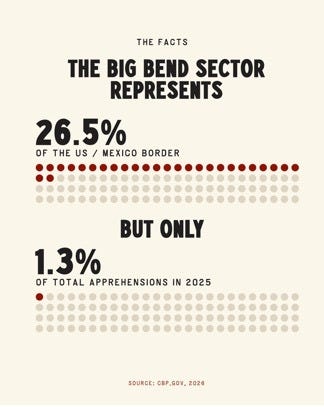
The Big Bend Sector represents 26.5% of the U.S.-Mexico border but only 1.3% of total apprehensions in 2025, citing CBP data. (No Big Bend Wall)
West Texas is easy to misread because distance does strange things to the political imagination. From far away, open land can look like nothing. Up close, it becomes the distance to a hospital, a school, a grocery store, a mechanic, a courthouse, a river crossing, or a venue that may or may not be open.
Texas’ 23rd Congressional District has long made this visible. Third Way describes it as nearly 58,000 square miles across two time zones, more than twice the size of West Virginia, with fewer than one million residents represented by one member of Congress. The same report notes that, despite the district’s proximity to Mexico and the wall debate, immigration does not dominate local conversations the way national politics might suggest. (Third Way)
A Marfa local told me Terlingua can hold conservatives and liberals who disagree about nearly everything but still share one operating principle: they are off-grid for a reason, and they do not want the government in their business. That does not fit the cable-news version of border politics. It is more local and more stubborn than that — people who know the place versus institutions that treat it as a security canvas.
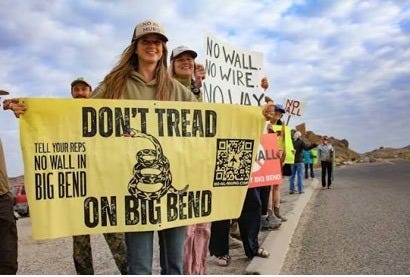
The Times lands in the same place, noting that Big Bend residents, including some Trump voters, have been energized against the wall by a shared desire to keep the region wild. In West Texas, the divide is not always left versus right. Sometimes it is near versus far.
The procurement story deepens the concern. A Big Bend Sentinel, ProPublica, and Texas Tribune investigation reported that Posillico Civil alleges CBP awarded nearly $14 billion, about 73% of the Texas border-wall contract value at issue, to Fisher Sand & Gravel and Barnard Construction out of 11 prequalified vendors. DHS secured $46.5 billion for border-wall construction in 2025. CBP says the bidding process was fair and that contracts were awarded based on qualifications, timeliness, and prices deemed fair and reasonable. (Big Bend Sentinel)
The civic problem does not wait for a final ruling. The same reporting notes that government planning has been accelerated and opaque, while residents have had to rely on shifting maps to understand what may be built near them. In a low-trust country, procurement becomes part of legitimacy. Pew found in 2024 that only 22% of Americans said they trust the federal government in Washington to do what is right just about always or most of the time. (Big Bend Sentinel)
The trust issue was not abstract for me either. My dog and I were diverted into CBP inspection twice during the trip. One stop was invasive. The other felt benign enough that, when I described it to a close Peace Corps friend, his interpretation was simple: “You’re not who we’re looking for.” I am very light-skinned and drive a German car. The experience did not make me an expert in border enforcement. It reminded me that security is never experienced evenly.
That is where the story gains its democratic center. At a park meeting for outfitters and concerned residents, the Sentinel reported that outfitter Charlie Angell was grateful for the park’s communication but disappointed that neither CBP nor Southwest Valley Constructors attended. Michael Ryan, a former river ranger, planned to record contractor activity because so many natural and cultural-resource protections had been waived. (Big Bend Sentinel)
Costs always travel downward. The benefits are announced at scale; the losses arrive locally. The language gets cleaned up along the way. Resource manipulation becomes modernization. Risk becomes optimization. Political uncertainty becomes an immovable mandate.
In Presidio, the bill may land on a levee.
The Presidio Municipal Development District and Democracy Forward sued DHS in June, arguing that construction through the Presidio Flood Control Project could threaten the levee system protecting the city from flash flooding. City officials fear that replacing the earthen slope of the existing levee with concrete and 30-foot steel bollards could alter how water interacts with the system. (Big Bend Sentinel)
At that point, the wall stops being a symbol and becomes a question of practical power, water, and risk. The wall is sold as protection. In Presidio, the fear is that it will interfere with what already protects the town.
Big Bend is not just scenery; it is an economic pillar of West Texas. The Sentinel reports that Big Bend generates around $63.7 million annually for local businesses, with around a quarter directly tied to Rio Grande access through river tours and camping trips. The access concern is not theoretical either: more than 140 outfitters and business owners wrote to Texas officials warning that planned vehicle barriers would cut across practically every campground and boat launch in the backcountry, severely limiting public access. (Big Bend Sentinel)
None of this requires pretending every border-security measure is illegitimate. It requires taking the place seriously enough to ask what kind of security is being built, for whom, at what cost, and through what process. Big Bend is one of the few landscapes in America where scale still disciplines the ego. When I entered the park, I imagined Jurassic Park creatures roaming the grounds. The background seemed AI-generated. The place felt that old, that indifferent, that capable of making human urgency look ridiculous.
National politics often struggles to read places that way. It sees distance and assumes emptiness. It sees a national park and assumes scenery. It sees darkness and assumes nothing is there.
The hopeful part, to the extent there is one, is civic insistence. Presidio sued. Residents organized. Journalists kept asking the right questions. Business owners tried to explain why river access, park integrity, and the night sky are not just decorative adornments.
People who know the place are still trying to make the government respect it, and not destroy it.
America loves openness as scenery, and frames it as freedom, but it has a harder time with openness as politics.
Text within this block will maintain its original spacing when published
Evan Buckingham writes from lived experience shaped by Peace Corps service in El Salvador, finance work across North America and the Caribbean, and leadership roles across startups and global firms. His work brings a grounded, international lens to economics, business, and culture, tracing how incentives, institutions, and technology shape everyday life.
No posts
Comments
Nothing yet. Say the first thing.
Sign in to join the conversation.