
By Harral Burris
Don’t it always seem to go, that you don’t know what you’ve got till it’s gone?
-Big Yellow Taxi, Joni Mitchell, 1970
The short answer: nobody knows. Recessions are notoriously hard to predict. The economy is still growing, albeit at a slowing rate. Early second-quarter numbers show a 1.5% annualized expansion, not thrilling, but at least positive, while unemployment stands at 4.2% with steady payroll gains and a low quits rate. Inflation sits at an elevated 4.5% and is at best stable.
At the July meeting, a divided Federal Reserve voted to hold the federal funds rate at 3.5%-3.75%. Employment seems steady, but with slowing GDP growth, it might not take much of a rate rise to send the economy into negative growth.
On the other hand, several economic indicators are still flashing green. Initial jobless claims are low, and manufacturing production numbers have been in expansion for the last six months. How much of that expansion is AI-driven is not clear.
Wall Street analysts and the IMF put the probability of a recession at 20%-30%, although their track record for predictions is terrible. Of the 60 recessions in various countries since 1989, only two were forecast. Since 1968, there have been 23 quarters of negative growth in the U.S., and yet not a single analyst called a drop.
A simple yes-no prediction should produce a roughly 50% hit rate by chance. Well-trained economists have produced something a whole lot worse than random. It’s so bad it looks rigged, because it is, sorta.
Most analysts, either explicitly or implicitly, have a bullish bias. The Wall Street types understand that their bosses want a growing economy and that a bearish prediction could be a career-limiting decision. Even if there’s no professional connection between an analyst and the likes of Goldman or JPMorgan, there is still a huge reputational risk in calling for a recession and then being wrong. A call like that can stay with you for life, while being wrong with the herd never hurts a year-end bonus.
Key indicators are still positive. The yield curve, the difference between short-term and long-term yields, remains positive. An inversion, when the 2-year note begins to yield more than the 10-year bond, has preceded every U.S. recession since 1968, with only one false positive.
Credit spreads, the gap between junk bond yields and Treasury yields, tend to widen meaningfully before recessions. The current level is slightly elevated but not close to recessionary levels.
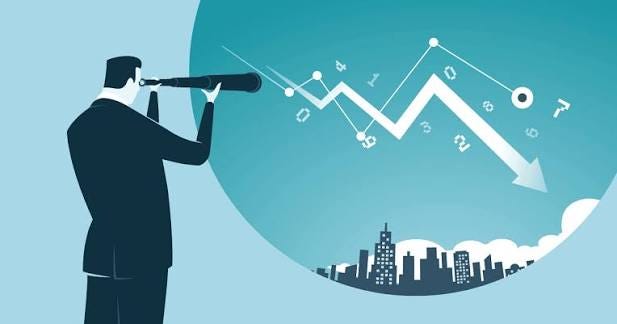
Based on these indicators, a recession is likely not imminent. Still, while no one knows the future direction of the economy, there are clear risks that bear watching.
Global stocks of gasoline, and especially diesel and jet fuel, are quite low, and strategic reserves have been drawn down to critical levels. Yet, there doesn’t seem to be an off-ramp for either side. The Houthi rebels have at least partially shut the Bab el-Mandeb Strait, and the all-important Hormuz Strait remains open by Iranian invitation only.
An oil spike north of $100 would hit inflation and consumer spending just before the Fed’s September meeting. An oil price shock coupled with slowing consumer spending is the most direct path to stagflation.
Fed Chair Kevin Warsh would rather not put his boss on the warpath so early in his tenure, but there’s a level of oil price shock and inflation spike that simply can’t be ignored, at least if he wants to keep a scintilla of respectability. Central banking rules say that raising rates when the economy is falling is not recommended. Stagflation is a cruel mistress.
AI is a marvelous thing, but whether it’s profitable in its current configuration is still an open question. If either OpenAI or Anthropic admits that Chinese competition is making its path to profitability difficult, the data center buildout could stall, along with all those construction jobs and tech hardware purchases. A significant reduction in AI capital spending would remove the economy’s primary growth engine, with no obvious replacement.
Labor market growth has already lost considerable momentum, down to 60k per month from the 200k pace of 2023-2024. A further softening, whether from AI data center buildouts, white-collar job losses from AI adoption, or tariff-related manufacturing disruptions, would turn off consumer spending and send growth expectations south quickly.
At current levels, the federal deficit is roughly 6-7% of GDP, with total debt sitting at 128% of GDP. The only other time federal debt levels came close was in 1946, at the end of WWII, when it stood at 119% of GDP. During the war years, the government spent $2 of borrowed money for every $1 of tax revenue; financing the war consumed 40% of GDP at its peak, but Rosie the Riveter’s paychecks never bounced. This time, tax breaks for the wealthy and corporations, coupled with out-of-control entitlement and defense spending, caused the imbalance.
The whataboutism crowd likes to point out that Japan’s debt load is an astounding 260% of GDP, while Greece comes in at 177% and Italy at 145%. Still, Japan built up its debt over a 30-year slowdown when rates were almost zero, and I for one don’t want the U.S. compared to the examples of Greece or Italy. Regardless of what goes on in Rome or Tokyo, the U.S. spends $1.33 for every dollar of tax revenue it collects. That is not good, and it might not be sustainable.
At the moment, the economy is still growing, the indicators are mostly green, and analysts rate the odds of a recession as low. Still, there are storm clouds on the horizon, and the risks are converging: a war with no end in sight, an AI boom yet to prove profitable, a labor market losing momentum, and a bond market beginning to smell blood in the water. Nobody rings a bell at the top. The economy just quietly slows to a crawl and stops. We’re not there yet, but the combined risks say we’re closer than we’ve been in years.
And always remember: hope is not a strategy.
Text within this block will maintain its original spacing when published
Hal is a retired investment professional with 40 years of experience in money management. The interface between geopolitics and global investments has always been his area of specialization. History has always been one of his interests and passions, in fact, that’s how Hal and Jeremi became friends in Madison, Wisconsin.
No posts
Comments
Nothing yet. Say the first thing.
Sign in to join the conversation.