
By Jeremi Suri
Since the Second World War, Canada has been America’s best ally. On every major military and economic issue, the Canadians have helped the United States. The two countries have an integrated air defense system (NORAD) that provides mutual monitoring of foreign attacks and joint responses to territorial threats. This arrangement was the foundation for American nuclear security during the Cold War, and that remains the case in the twenty-first century. Canada’s huge northern landmass and its surveillance capabilities support U.S. defenses. Canada supplies critical minerals, including uranium for nuclear weapons and samarium and gadolinium for missiles.
Canada is America’s second-largest trading partner, with nearly $900 billion in goods and services exchanged in 2025. Approximately 1.4 million American jobs are tied to this trade. Although the largest U.S. exports to Canada are manufactured goods, the Canadians mainly export raw materials south of the border – including petroleum, aluminum, and steel – that fuel American industry. In 2024, more than 20 million citizens from each country visited the other for work and pleasure; Americans spent $15.6 billion annually in Canada, and Canadians spent an even larger sum, more than $20 billion, down south. Like security, prosperity for the two countries is deeply interdependent.
Donald Trump has ruined this relationship. He is not the first American leader to enter difficult trade negotiations with Canada, but he is the only president since the Second World War to flagrantly insult and bully our friends up north. He has repeatedly called Canada the “fifty-first state.” (That should be Washington, D.C. or Puerto Rico!) He regularly refers to the prime minister in Ottawa as an American governor. Most significant, Trump has levied high unilateral tariffs on Canadian exports to the U.S., particularly aluminum and steel, and he has threatened grave harms when Ottawa has retaliated with its own tariffs on American automobiles and whiskey. At best, Trump has treated Canada as a weak little brother; at worst, he has tried to bully them into becoming a colony subject to his personal whims.
The breakdown of recent trade negotiations intensifies this self-defeating dynamic. Trump made daily threats and promised an imminent “deal” because he believed the Canadian negotiators would have no choice but to bow before American strength. Throughout the negotiations, a disorganized U.S. team raised its demands, including last-minute insistence that Canada weaken French-language protections and follow American dictates on trade with other countries, especially China.
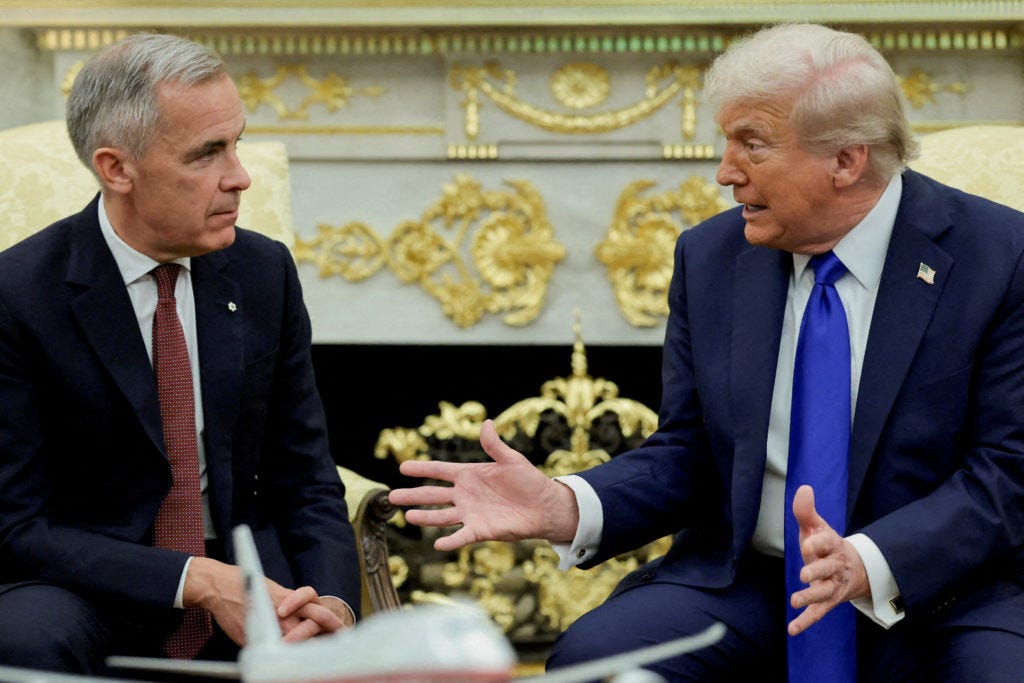
Trump overplayed his hand. As in Iran, excessive bullying in Canada unified national resistance to American power. Canadian Prime Minister Mark Carney has widespread support across all parties and provinces to push back against Trump. Carney’s rebuke of the president was wildly popular: “We cannot accept what they offered and we will not give what they asked,” Carney firmly announced. “We were not prepared to compromise Canada’s sovereignty or undermine our key industries.”
Trump made it worse with his response, on social media, of course: “Canada wants the benefits of being a State, without being one,” the president wrote. “No more!!!” These belligerent words only increase Canadian fears of American bullying.
“You’re at war when you’re attacked,” Carney calmly explained in a national speech, “and we got attacked.” The prime minister described how Trump’s rhetoric and tariffs “are designed to hurt and divide us.” But he assured listeners: “They are a miscalculation because Canadians will always take care of each other. We know we’re stronger together.”
Just a few years ago, Canadians and Americans believed they would take care of each other. Recent polling finds that Canadians now see the United States as a greater threat than Russia. Two-thirds of Canadians expressed a belief that Washington did more to hurt than help its allies. And Canadians are voting with their feet. Their trips to the United States dropped 25% in the last year, reducing personal and business spending by more than $2 billion. The friends we insult don’t want to visit us (or our tourist sights) any more.
As with every relationship ruined by Trump, the main beneficiaries are the Chinese. Earlier this year, Carney made the first visit for a Canadian prime minister to China in almost a decade. He spoke explicitly of building a “new strategic partnership” with Beijing. Canada opened its market to more Chinese electric vehicles, and China reduced tariffs on Canadian agricultural products. In both sectors – automobiles and agriculture – Canada-China trade replaces U.S.-Canada and U.S.-China trade. Ottawa and Beijing pledged to “collaborate closely” in pursuit of multilateralism, a clear contrast to Trump’s unilateralism.
This is really bad for the United States. America’s best military and economic ally is now collaborating closely with America’s most dangerous adversary. As Washington and Ottawa remain locked in a trade war, Canada’s trade with China will grow rapidly. China will benefit from further penetration of our northern neighbor, including access to the resources that fuel continental defenses and job growth. The United States will suffer further supply chain difficulties and job losses. Although Canadian industry is deeply dependent on the United States right now, the damage to the American economy will be at least as serious. The harm to American security – in both defense cooperation and critical mineral supplies for depleted munitions – will be even worse.
There were many good reasons why the United States treated Canada as a valued, respected, and irreplaceable ally for more than seventy-five years. We were friends who made each other stronger and more prosperous. Although the United States has always been more powerful, it has long depended on Canada for its military security and economic growth. This was a mutually dependent and mutually beneficial relationship.
Trump does not understand those words. His world is filled with bosses and slaves. He is a boss, and he believes Canada is a slave that he can push around. The people of Canada, like those in other societies Trump has targeted, are rallying to resist this treatment and find new friends.
That is what Prime Minister Carney meant when he called for “middle powers to live the truth.” Former American allies are accepting a break in old relationships and seeking out new partners with confidence. Canada is doing that, and it is leaving the United States in the dust. Canada is moving on:
“Canada has what the world wants. We are an energy superpower. We hold vast reserves of critical minerals. We have the most educated population in the world. Our pension funds are amongst the world’s largest and most sophisticated investors. In other words, we have capital, talent…we also have a government with immense fiscal capacity to act decisively. And we have the values to which many others aspire. Canada is a pluralistic society that works. Our public square is loud, diverse, and free. Canadians remain committed to sustainability. We are a stable and reliable partner in a world that is anything but…A partner that builds and values relationships for the long term.”
Very soon, Americans will regret the damage to the Canadian alliance. Americans will feel the pain as our neighbors find new partners hostile to us.
The sooner we recognize our mistakes, the better. Americans must remember how important Canada is to our security and prosperity. We must stop alienating our northern friends and show that we truly value them as a sovereign, equal state. The United States needs Canada at least as much as Canada needs us.
Text within this block will maintain its original spacing when published
Also see in:
German, Turkish, Chinese, Spanish

Jeremi Suri holds the Mack Brown Distinguished Chair for Leadership in Global Affairs at the University of Texas at Austin. He is a professor in the University’s Department of History and the LBJ School of Public Affairs. Professor Suri is the author and editor of eleven books on politics and foreign policy, most recently: Civil War By Other Means: America’s Long and Unfinished Fight for Democracy. His other books include: The Impossible Presidency: The Rise and Fall of America’s Highest Office; Liberty’s Surest Guardian: American Nation-Building from the Founders to Obama; Henry Kissinger and the American Century; and Power and Protest: Global Revolution and the Rise of Détente. His writings appear in the New York Times, Washington Post, Wall Street Journal, CNN.com, Atlantic, Newsweek, Time, Wired, Foreign Affairs, Foreign Policy, and other media. Professor Suri is a popular public lecturer and comments frequently on radio and television news. His writing and teaching have received numerous prizes, including the President’s Associates Teaching Excellence Award from the University of Texas and the Pro Bene Meritis Award for Contributions to the Liberal Arts. Professor Suri hosts a weekly podcast, “This is Democracy.”
No posts
Comments
Nothing yet. Say the first thing.
Sign in to join the conversation.