
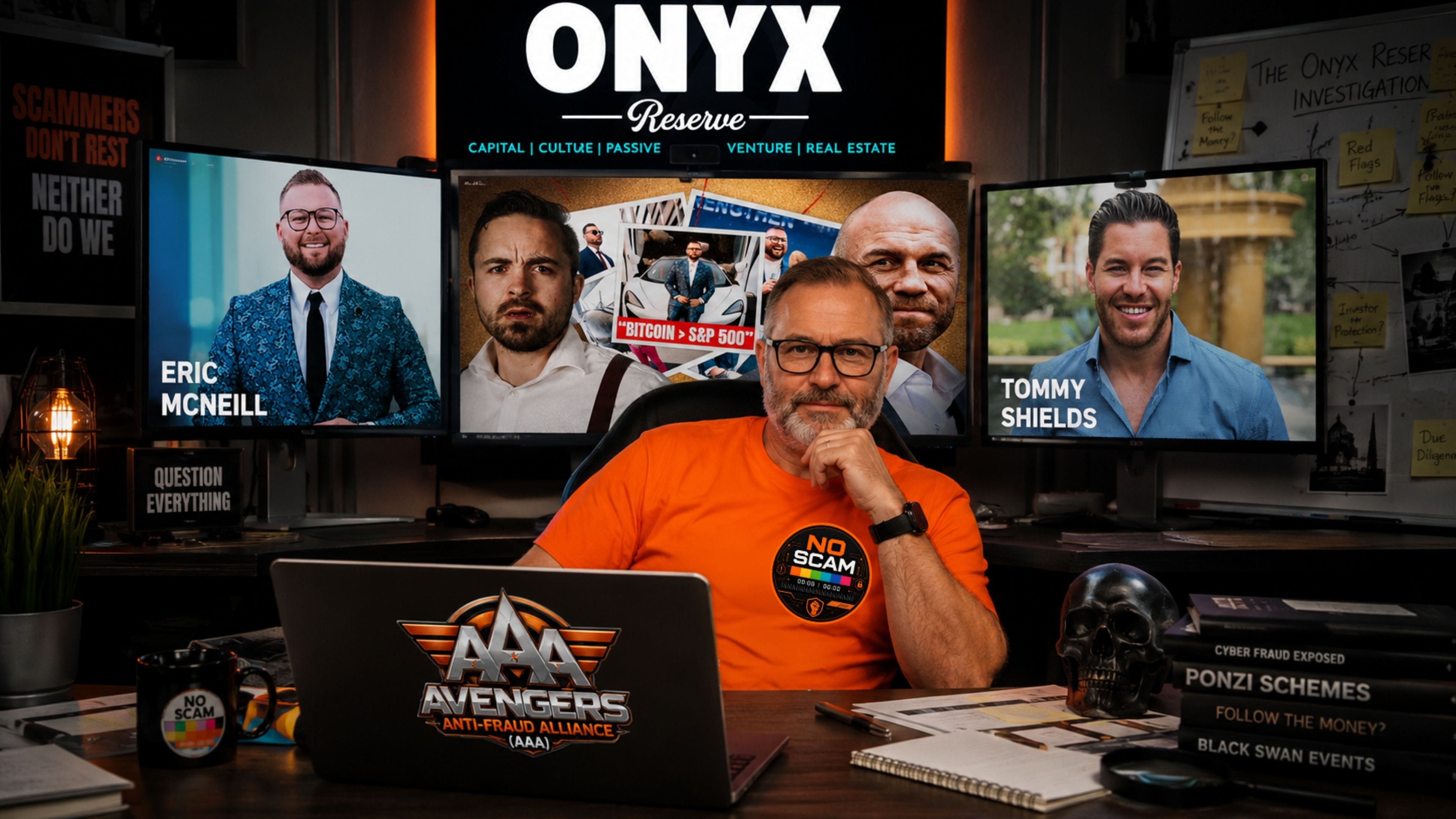
“Year to date, we’re up over 101% for the year, which makes it four straight years of 100-plus-percent returns.”
In reality, Couture had become concerned about McNeil after one of his younger fighters was approached about investing, and he was gathering information.
What followed is one of the most extraordinary investment pitches I have reviewed.
McNeil claimed more than 100% annual returns for four consecutive years. He described a Bitcoin trading strategy he said was less risky than simply putting money into the S&P 500. He said investors could examine approximately four years and 850 trades, describing the numbers as reviewed or audited and pulled directly from Binance. He later offered Couture 5% per year on investor capital he introduced, explaining how referrals totalling $1 million could generate $50,000 a year in compensation, paid monthly.
And when Couture asked about the legality of being compensated for raising capital, McNeil offered reassurance.
He said the ambassador agreement had been written by an SEC attorney, “battle tested,” and audited by SEC attorneys. Then he joked:
“I don’t look good in orange, Randy. I look good in black.”
McNeil said he wasn’t going to do anything stupid that might jeopardise that.
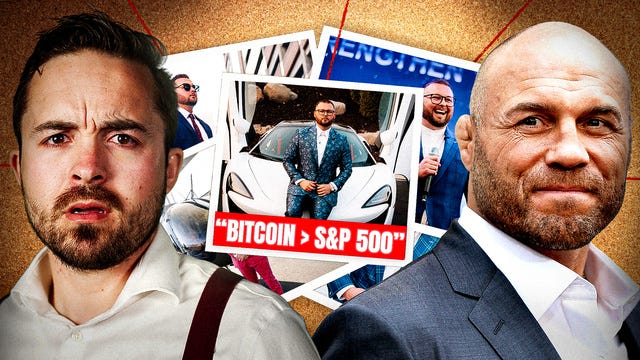
UFC Fighter Accidentally Exposes a Ponzi Scheme
That conversation would eventually become part of an investigative trail involving Hindenburg Research and Coffeezilla. According to Coffeezilla, Couture’s team originally sent its evidence to Hindenburg, which investigated McNeil before shutting down without publishing the story. Coffeezilla later approached Hindenburg, obtained its case file and data room, and continued the investigation himself.
What he says he found goes considerably further than questionable marketing.
Coffeezilla reported that trading records presented around McNeil’s operation identified CPA David Rosenbaum as the reviewer. In a recorded call from the investigative material, the person contacted about that purported review responded that he had no idea how his name appeared there and didn’t know the people involved. Coffeezilla also identified apparent trades showing identical opening and closing timestamps while recording substantial profits, including amounts approaching $40,000.
Coffeezilla ultimately described it as his strong opinion that the operation was an “obvious Ponzi scheme.” Importantly, he also acknowledged that there had been no legal finding establishing that conclusion and said regulatory action would be required before it could be stated as fact. I make the same distinction in this investigation.
But my involvement in this story began somewhere completely different.
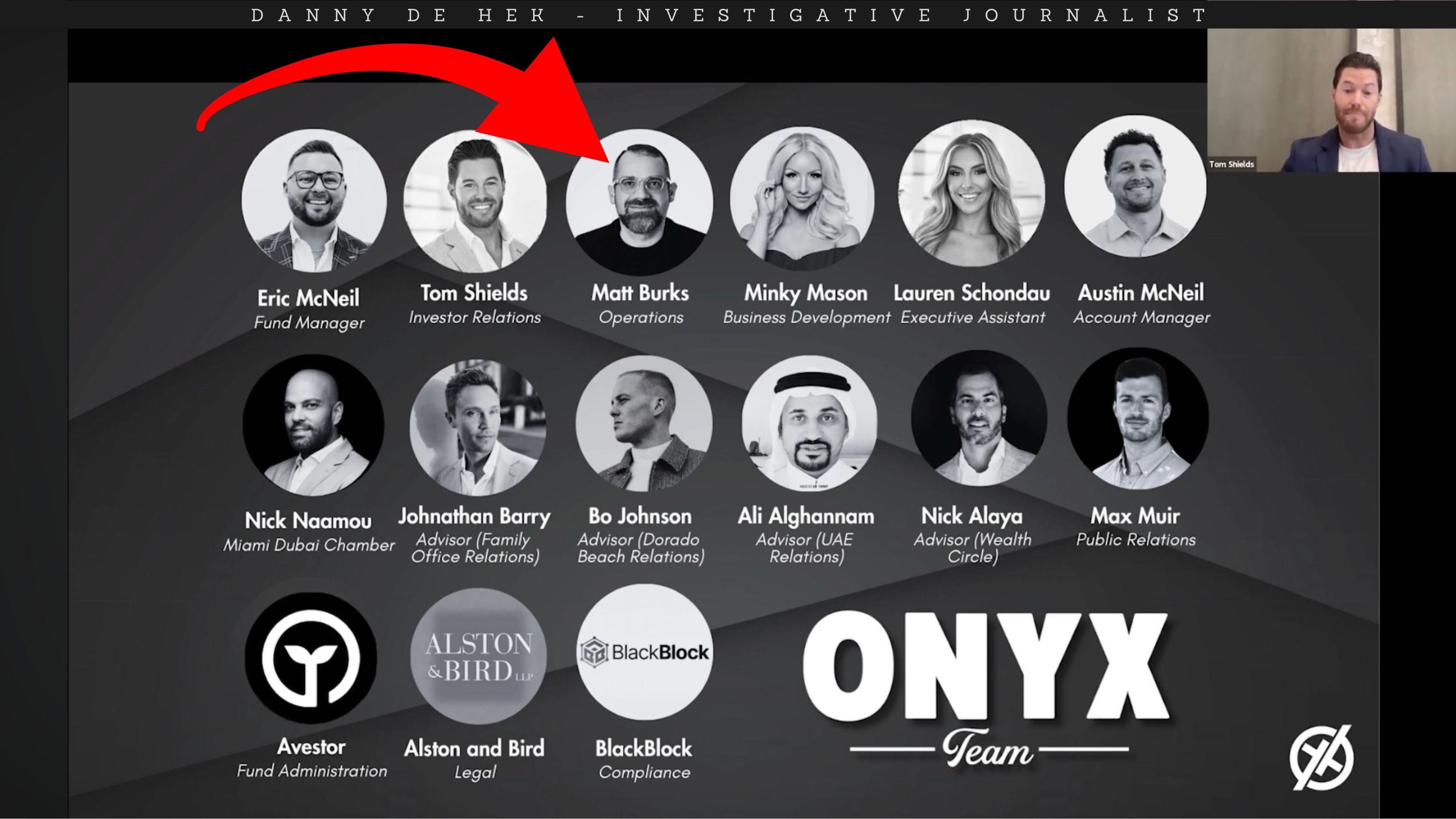
Listed on the ONYX team page: Matt Burks (Operations) and BlackBlock (Compliance)
I was investigating Goliath Ventures, the massive investment operation surrounding Christopher Delgado. While following the people and organisations around Goliath, I discovered Matt Burks presented publicly as Operations Manager of another investment organisation called The Onyx Reserve.
That connection became considerably more significant after Goliath unravelled.
Coffeezilla subsequently described Goliath as a roughly $300 million Ponzi scheme and said his examination of the Hindenburg material uncovered multiple overlapping people and organisations between Goliath and Onyx, not merely Matt Burks.
But I didn’t have to chase The Onyx Reserve for an explanation.
They contacted me.
On 20 December 2025, Eric McNeil emailed me, introducing the correspondence as coming from “Eric McNeil and Tommy Shields here with the Onyx Reserve.” They told me what I had uncovered concerning Matt and Goliath was “eye opening,” said they had “immediately stripped his name of any and all material” while completing further due diligence, denied sending money to Matt or Goliath and denied having any affiliation with the Goliath group.
Then they asked me to remove my post because the association could damage their reputation.
I refused.
Instead, I gave them something much more valuable: a right of reply.
I asked where investor distributions came from, whether investor capital was ever used to service earlier investors, how the funds were structured, who controlled investor money, what regulator had jurisdiction, whether audited financial statements or independent performance reports existed, whether other Goliath-connected people had participated in promotion or capital raising, and what relationship existed behind promotional references to Patrick Bet-David.
I explicitly told them I was not alleging wrongdoing and invited them to provide evidence that I could incorporate into my reporting.
Those questions were not substantively answered at the time.
Then, months later, Onyx Reserve reappeared in my inbox with an extraordinary new proposition.
The organisation announced that it had completed its venture-capital fund and was moving into luxury real estate through the Onyx Reserve Signature Estates Fund. It claimed more than $21 million in luxury-real-estate transactions in just 30 days, named major developments, highlighted transactions alongside internationally recognised athletes and announced that after completing Fund I it intended to launch Fund II with a targeted $100 million capital raise.
So I gave them another opportunity.
On 16 July 2026, I sent a second detailed right of reply asking The Onyx Reserve to substantiate the new claims before I published updated reporting. I asked for the legal identity of the fund, offering documents, regulatory filings, manager, administrator, custodian, auditor, assets under management, investor numbers, evidence supporting the claimed $21 million in transactions, ownership structures and the precise nature of the athlete and developer relationships.
Again, no substantive response arrived before this investigation was published.
That position has now changed.
Following publication and further questions from me, both Tom Shields and Eric McNeil have responded. Their responses contain several important clarifications, and where those clarifications correct or refine the factual record, I have incorporated them into this investigation.
But there is an equally important distinction.
Their responses have not provided the underlying evidence needed to resolve several of the central questions raised by the Hindenburg and Coffeezilla material.
Eric now says that at the time of the Randy Couture conversation, Onyx operated a fund-of-funds strategy, that Onyx itself was not the underlying trader, and that the strategy and performance information he communicated came from the partners and managers Onyx was working with at the time.
That is important new information.
But it also raises an obvious question: who were those partners and managers, and what independently verifiable evidence supported the extraordinary performance Eric was communicating to prospective investors?
I have now asked Eric directly.
I have also asked him to address the trading records examined by Hindenburg and Coffeezilla, the apparent identical opening and closing timestamps, the questions surrounding the purported CPA review and, most importantly, whether investor distributions were ever funded directly or indirectly from incoming investor capital rather than genuine investment profits.
At the time of this update, those central evidentiary questions remain unresolved.
By then, I was no longer looking at one questionable association involving Matt Burks. I had McNeil’s own recorded investment pitch, extraordinary performance claims, a paid capital-referral proposition, questions surrounding the purported verification of trading records, anomalous trade data, the Hindenburg case file, Coffeezilla’s investigation, multiple reported overlaps with Goliath Ventures, a new luxury-real-estate strategy, a proposed $100 million fundraising target and now direct responses from both Eric and Tom that provide additional context but still leave key financial evidence outstanding.
That doesn’t give me the authority to declare The Onyx Reserve a Ponzi scheme as an established legal fact.
It does give me more than enough reason to investigate.
So that is exactly what I did.
Since this investigation was originally prepared, both Tom Shields and Eric McNeil have responded to my questions, with their latest responses arriving shortly before my scheduled 21 August 2026 broadcast.
Where their responses corrected or clarified the factual record, I have updated this investigation accordingly.
Tom clarified the meaning of the $21 million-plus property figure, the advertised 30–40% discount and the proposed $100 million Fund II target. Eric says the historical strategy was a fund-of-funds arrangement, that Onyx was not the underlying trader, and identified Avestor as the third-party fund administrator. Both men also emphatically deny any affiliation with Goliath Ventures or Christopher Delgado.
Those clarifications are now incorporated throughout this article.
However, several central evidentiary questions remain unresolved, including the identity of the underlying historical managers, independent verification of the extraordinary performance claims, the trading anomalies examined by Coffeezilla, the questions surrounding the purported CPA review and, most importantly, what generated the historical investor returns and distributions.
Where the evidence changed the story, I changed the story. Where questions remain unanswered, I have left them on the record.
This is a detailed investigation, so I have included the index below to help you navigate the evidence. Follow the story from Eric McNeil’s investment claims and athlete network through the Hindenburg and Coffeezilla investigations, the Goliath Ventures connections, unanswered rights of reply and The Onyx Reserve’s proposed $100 million Fund II.

The Onyx Reserve
Before getting into the undercover recording, Hindenburg Research, Coffeezilla or the extraordinary trading records, I needed to establish something much more basic: what exactly is The Onyx Reserve, and what is it asking investors to believe?
That question has become harder to answer over time because the investment proposition itself has evolved. When Eric McNeil and Tommy Shields contacted me in December 2025, they described their fund’s “primary thesis” as early-stage venture. Public material around Onyx also promoted passive-income opportunities and strategies involving digital assets.
Today, however, Tom Shields has explicitly asked me to distinguish the historical Liquidity Pool from Signature Estates, the real-estate business he says he is personally involved with.
That distinction is important, and I accept it.
Tom has now confirmed that the historical Liquidity Pool offering has been closed for many months. He describes Signature Estates as a separate real-estate strategy focused on acquiring luxury properties through relationships with established developers and athlete and talent partners.
The current Onyx website describes the organisation as “an investment fund offering both passive-income strategies and venture-growth opportunities” and promotes passive income, venture opportunities and real estate. Its website also states that Onyx Reserve Fund is a private investment vehicle offered pursuant to Regulation D, Rule 506(c) to accredited investors only.
Onyx has further told me that Signature Estates is structured as a Rule 506(c), 3(c)(1) offering.
Those are important clarifications, but investors need to understand what they do—and do not—establish.
A Form D or reliance upon a Regulation D exemption is not SEC approval. It does not mean the SEC has audited the fund, approved its investment strategy, verified historical returns or endorsed the people operating it.
That distinction becomes particularly important when large numbers are used around an investment operation.
One of those numbers is $21 million.
Earlier Onyx material announced more than $21 million in luxury real-estate activity. I specifically challenged Onyx to explain what that figure represented.
Tom has now answered.
According to Tom, the $21M+ figure represents the aggregate contracted purchase price/property value of four units across Colette, Opus and Viceroy.
Crucially, he states that it does not represent $21 million of investor capital raised or deployed.
That clarification materially changes how the figure should be interpreted, and I am recording it accordingly.
The same applies to Onyx’s claim concerning substantial property discounts.
The website says strategic athlete partnerships secure “30–40% off market values” on iconic real estate. I questioned what Onyx actually meant by “market value.”
Tom has now clarified that the benchmark being used is developer list price.
According to him, the strategy involves negotiating property acquisitions at approximately 30–40% below developer list price. He specifically says Onyx is not representing that every transaction has been independently appraised at 30–40% below fair market value.
That is an important distinction between a discount from an asking price and a discount from independently established market value.
Then there is the proposed $100 million Fund II.
Again, I asked Onyx to explain precisely what that figure represented.
Tom has now confirmed that $100 million is a fundraising target. It does not mean that $100 million has already been raised, subscribed or committed.
Those answers provide considerably greater clarity around the current Signature Estates proposition.
But they do not resolve the historical questions surrounding the Liquidity Pool.
Years before the current Signature Estates proposition, McNeil was already publicly discussing fund management and the economics of aggregating investor capital. In a June 2023 interview, he explained how a fund could pool money, negotiate access to investment opportunities and potentially retain the spread between what an underlying investment generated and what investors received.
He gave a simple example: if the fund received 15% while investors were paid 10%, the fund manager could retain the remaining five percentage points.
McNeil also contrasted fund management with his earlier experience as a financial adviser. He discussed how registered advisers operated under compliance restrictions and described moving toward a structure where money could be aggregated into a fund and invested from there.
That interview provides historical context, but it does not establish that the vehicle McNeil discussed in 2023, the subsequently acknowledged Liquidity Pool and today’s Signature Estates offering are legally or operationally the same thing.
I am now expressly treating those as matters requiring separate examination unless evidence establishes otherwise.
That distinction becomes especially important when we reach Eric McNeil’s later recorded conversation with Randy Couture, where Eric represented that his operation had achieved more than 100% annual returns for four consecutive years.
Tom has now told me that he had nothing to do with that conversation, that my correspondence was the first time he became aware of it, and that he will not speculate about historical trading records, exchange transactions, timestamps or CPA verification that he did not personally create, execute or verify.
I accept that position for the purposes of accurately reporting Tom’s involvement.
It means the unresolved historical questions become considerably more focused.
What exactly was the historical Liquidity Pool? Who operated it? Where was investor capital deployed? What generated the returns? Who executed the trading? Why was it closed? And can Eric McNeil’s extraordinary historical performance representations be independently verified?
Those are questions for Eric McNeil.
And separating Signature Estates from the historical Liquidity Pool does not make those questions disappear.
It simply makes clearer who needs to answer them.
The Onyx Reserve investigation ultimately comes down to the people asking investors to trust them with significant amounts of money. In the correspondence sent to me on 20 December 2025, there was no ambiguity about who was speaking for the organisation. Eric McNeil wrote on behalf of himself and Tommy Shields, opening with: “This is Eric McNeil and Tommy Shields here with the Onyx Reserve.” They referred to “our fund”, described its investment thesis, addressed the Matt Burks issue and asked me to remove material they believed could damage the reputation they had built.

Eric Mcneil
Eric McNeil had already spent years building a public profile around finance, athlete relationships and wealth management.
In a June 2023 interview, he described his background as beginning in banking before moving into financial advice and later fund management. He said he had worked at Wells Fargo, moved into wealth management, operated Diamond Financial and eventually transitioned into McNeil X, which he described as combining business, branding and wealth management for athletes and entrepreneurs. He also said he had launched a fund-of-funds model in which client money could be allocated across fixed-income, opportunity and real-estate strategies.
The interview is revealing because Eric speaks openly about what attracted him to fund management.
He explained that as a financial adviser, compensation was commonly based around a percentage of assets under management. By becoming a fund manager, he said he could charge more and participate in carried interest, describing the potential for his own income to increase dramatically. He also said the fund structure reduced the compliance and licensing burden he had experienced as a registered adviser.
At one point, McNeil described the transition in striking terms. He said that instead of managing hundreds or even thousands of individual clients as a fiduciary, he now effectively had “one client” — the fund. He repeatedly described the fund-management model as easier, less regulated and more profitable for him.
That doesn’t establish misconduct. Private funds can be entirely legitimate, and fund managers can lawfully earn management fees and carried interest. But when somebody later promotes extraordinary returns, solicits investor capital and discusses referral compensation, that earlier explanation of why the fund model appealed to him becomes relevant context.
McNeil also described a highly deliberate approach to marketing.
He told the interviewer that he had used “shock marketing” through McLarens, watches, courtside seats, Miami trips and yachts because flashy imagery attracted attention. He then explained the intended conversion: capture that attention and direct people toward his fund, e-commerce opportunities and passive-income products. In his own words, the message eventually became:
“Invest in my fund. Talk to me about e-commerce. Talk to me about passive income.”
That matters because the luxury imagery wasn’t merely incidental to his lifestyle. McNeil himself described it as part of the marketing strategy.
He also outlined an aggressive investor-acquisition process. According to the 2023 interview, his team had compiled thousands of names from the athlete world, including emails and social-media accounts, and he personally carried out large volumes of daily outreach across Instagram, Twitter and LinkedIn. Prospects were moved into automated email campaigns, introductory videos and webinars before being placed on his calendar for sales conversations.
McNeil was unusually candid about the objective.
He said that by the time somebody reached his calendar, “that business needs to be closed”, because they had already been contacted, introduced to him and watched a webinar.
This gives valuable context to the later Randy Couture recording.
Eric wasn’t passively waiting for wealthy investors to discover him. By his own account, he had built a systematic prospecting machine aimed at athletes and entrepreneurs, using social proof, personal outreach, automated funnels and investment presentations to move people toward his funds.

Tommy Shields
Tommy Shields’ public role appears different.
The material supplied to me identifies Shields as Senior Investor Relations at The Onyx Reserve. That title places him directly on the investor-facing side of the operation. And when the Goliath issue arose, he was not presented as a distant employee. Eric’s December 2025 email explicitly included Tommy as part of the team speaking for Onyx, and both were positioned as people concerned about the organisation’s reputation and its relationship with Matt Burks.
It is important not to transfer every statement made by Eric onto Tommy.
Where Eric makes the investment claims, I attribute them to Eric. Where Tommy appears in investor-relations material or joint correspondence, I attribute that involvement to Tommy. Where a claim appears in Onyx Reserve marketing, I treat it as a corporate representation unless evidence identifies the individual responsible.
That distinction matters because the evidence surrounding Eric becomes progressively more serious.
By the time Randy Couture entered the story, McNeil wasn’t merely talking publicly about how fund managers make money or how social media helps attract clients.
He was making specific representations to someone he believed could invest and introduce additional investors.
And Couture had decided to record the conversation.
One part of Eric McNeil’s operation deserves particular attention: professional athletes are central to both his business identity and The Onyx Reserve’s credibility.
Eric’s YouTube profile states “Managing 60+ pro athletes” alongside the striking claim “Passive income of 5–7% every month.” The current Onyx website similarly says its wealth-building strategies are trusted by everyone from working families to “professional athletes and entertainers.”
The website also displays endorsements attributed to Zack Moss, Raleigh Webb, Andrew Adams, Dan Ige, Alex Barrett, Keelan Doss and Matt Bushman, alongside other investors and people associated with Eric’s network.
Several testimonials specifically reference investment performance.
NFL player Keelan Doss is quoted describing “fantastic investment returns.” Raleigh Webb refers to “the money I’ve made with him!” Other testimonials describe “consistent returns,” “highest monthly returns” and Eric’s fund being a “game changer” for an investor’s family investment strategy.
These testimonials do not independently prove investment performance. Testimonials are marketing representations, not audited financial statements. But they demonstrate how investment returns and personal relationships are being used to establish credibility.
One name is particularly significant.
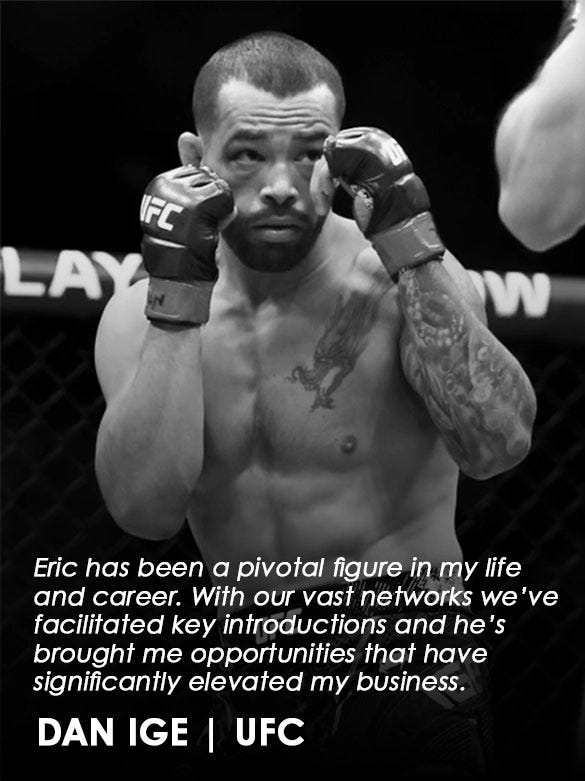
Dan Ige.
Onyx currently features the UFC fighter in a testimonial describing Eric as “a pivotal figure” in his life and career and praising the introductions and opportunities Eric brought him.
That matters because Ige is also the fighter at the centre of the events that led Randy Couture to investigate Eric McNeil.
According to Couture’s account presented by Coffeezilla, Eric approached Ige while the younger fighter was considering how to invest his earnings. Couture became concerned enough about the proposition to consult people he trusted and eventually speak with Eric himself while gathering information.
I need to be precise: I have not established that Dan Ige invested in an Onyx fund, and his current testimonial does not say that he did.
But the connection is important because Eric has previously described athletes as a deliberate target market.
In a 2023 interview, Eric discussed building databases containing thousands of athlete contacts, conducting extensive outreach through social media and moving prospects through emails, webinars and ultimately onto his calendar.
He also described using cars, watches, courtside seats, yachts and travel to attract attention before directing prospects towards his financial opportunities.
The Randy Couture recording demonstrates how valuable an established athlete could potentially become within that network.
Eric discussed paying Couture 5% annually on investor capital he introduced. Using $1 million of referred capital as an example, Eric explained that Couture could receive $50,000 per year.
He also recognised the credibility Couture himself could provide, telling him prospective investors would see that “Randy, you’re in it and you vouch for it.”
That is why the athlete network matters.
An athlete can potentially bring more than capital. They bring teammates, managers, agents, business contacts, followers and credibility.
And when Onyx surrounds its investment proposition with professional-athlete testimonials, those relationships become part of the way prospective investors assess the people asking for their money.
The financial question, however, remains much simpler.
What investment activity generated the returns being promoted, and can those returns be independently verified?
I would welcome Zack Moss, Raleigh Webb, Andrew Adams, Dan Ige, Alex Barrett, Keelan Doss, Matt Bushman or anyone else whose testimonial appears in Onyx Reserve’s marketing to contact me and explain their experience.
Positive or negative, firsthand evidence matters.
Because ultimately, the athletes are not the evidence of investment performance. The financial records are.
The current Onyx Reserve website makes the investment proposition clear: Onyx describes itself as “an investment fund offering both passive-income strategies and venture-growth opportunities.”
Its marketing presents three areas: Passive Income, Venture and Real Estate.
Under Passive Income, prospective investors are offered “stable, consistent, passive cash flow.” Venture opportunities are described as providing “venture upside paired with passive quarterly distributions.”
The real-estate proposition is now particularly important because Eric McNeil says Onyx has exited its previous strategy and is focused exclusively on real estate.
Onyx promotes athlete partnerships as providing access to luxury properties at substantial discounts.
Tom Shields has now clarified exactly what the advertised 30–40% discount means.
According to Tom, Onyx is negotiating acquisitions approximately 30–40% below developer list price. He is not claiming that every property has been independently appraised at 30–40% below fair market value.
That is an important distinction, and I have updated this investigation accordingly.
A discount against developer list price does not necessarily establish an equivalent discount against the property’s actual market value. Investors therefore still need to understand the purchase price, comparable sales, financing, incentives and independent valuation of the underlying property.
Tom has also clarified another major figure appearing in Onyx’s recent marketing.
The claimed $21 million-plus in luxury real estate represents the aggregate contracted purchase price/property value of four units across Colette, Opus and Viceroy.
It does not represent $21 million of investor capital raised or deployed.
Again, that clarification matters.
The remaining financial questions are therefore more specific: which entities are purchasing the four units, how much investor equity is being deployed, what financing is involved, what economic interest belongs to Onyx investors and how will those assets be valued?
The website also states that Onyx Reserve Fund is a private investment vehicle offered pursuant to Regulation D, Rule 506(c) to accredited investors only.
That provides useful regulatory context, but investors should understand that relying on a Regulation D exemption does not mean the SEC has approved the investment, verified its performance or endorsed its managers.
The same principle applies to Onyx’s marketing.
Terms such as “proven results,” “stable, consistent” passive cash flow and substantial property discounts are claims investors should examine against the underlying financial evidence.
Onyx says its new direction provides greater visibility and control over identifiable real-estate assets.
That may prove to be an important distinction from its historical strategy.
But ultimately, the real estate needs to stand on its own numbers: what was purchased, what was paid, who owns it, how it was financed and what returns it actually produces.
That is the evidence prospective investors need to see.
One of the strongest themes running through The Onyx Reserve’s current marketing is institutional credibility.
The website presents Eric McNeil as President and Tom Shields as Senior Investor Relations, alongside business-development staff, relationship managers, advisers and investor-relations personnel.
Most significantly, Avestor is named as Fund Administration.
Eric has now specifically addressed that relationship. He says Avestor has had access to the fund’s banking and investment accounts and provides investor reporting, including K-1 access through investor portals.
That is relevant information and provides more context than was available when I originally began asking questions.
But the distinction between administration and independent verification remains important.
A third-party fund administrator can perform accounting, reporting and administrative functions without necessarily auditing the underlying investment manager or independently authenticating every performance claim communicated to investors.
That distinction becomes particularly relevant following Eric’s latest explanation that Onyx was not the underlying trader in its historical strategy.
According to Eric, the performance information he communicated came from external partners and managers.
Those parties have still not been identified to me.
The Onyx website also makes broader credibility claims, including “$100s of millions raised and managed across hedge funds, venture capital, and real estate opportunities” and “Nearly 50 years of capital advisory experience.”
Those statements may represent the combined historical experience of people associated with Onyx rather than Onyx Reserve itself. Prospective investors should understand exactly what those figures represent.
The same principle applies to the advisers, athletes, administrators, lawyers and other professionals appearing around an investment operation.
Association is not verification.
A professional-looking team page can create confidence, but investors still need to know who actually controls the assets, who prepares the financial statements, who verifies valuations, who oversees compliance and who independently verifies investment performance.
That distinction is particularly important here because the Hindenburg material examined by Coffeezilla raised questions about the professional infrastructure surrounding the historical operation.
Some of the relationships presented by Onyx may provide genuine independent oversight.
Others may provide administration, advice, introductions or credibility.
Investors need to know which is which.
Randy Couture did not enter this story because he was looking for an investment fund.
According to the material presented by Coffeezilla, Couture became concerned after Eric McNeil approached UFC fighter Dan Ige about investment opportunities. Couture consulted trusted financial professionals before eventually speaking with Eric himself while gathering information.
Eric believed he was speaking with a genuine prospective investor.
During that conversation, Eric discussed the investment strategy, its performance and what became an especially important part of the pitch: an ambassador arrangement.
Eric told Couture he could receive 5% per year on investor capital he introduced. His example was straightforward: $1 million introduced into the fund could generate Couture $50,000 annually, paid throughout the year.
Eric also recognised Couture’s value as social proof, explaining that prospective investors would see:
“Randy, you’re in it and you vouch for it.”
Couture then questioned whether receiving compensation for bringing investors into the fund was legal.
Eric said the ambassador agreement had been written by an SEC attorney, had been “battle tested” and reviewed by SEC attorneys.
Then came the memorable line:
“I don’t look good in orange, Randy. I look good in black.”
Eric said he wasn’t going to do anything stupid that could jeopardise him.
Eric has since provided important new context about this conversation.
He says that at the time, Onyx operated a fund-of-funds strategy and was not the underlying trader. According to Eric, the strategy and performance information he communicated to Couture had been provided by the external partners and managers Onyx worked with.
Eric says Onyx has since ceased doing business with those parties and exited the historical strategy entirely.
That explanation matters.
But it also makes the identity and performance of those underlying managers particularly important, because Eric was communicating their claimed results to someone he believed could become both an investor and a source of additional investor capital.
Eric has also told me that he did not consent to the Couture conversation being recorded or published, citing his understanding of Florida’s recording laws.
I record that objection as part of his right of reply.
For this investigation, however, the significance of the conversation is not simply that it was recorded.
It is what Eric said while he believed he was speaking privately with a prospective investor.
And Couture kept asking questions.
What he and the investigators eventually obtained was supposed to provide something far more important than assurances.
The trading records.
When Randy Couture asked Eric McNeil whether the extraordinary performance could be verified, Eric said it could.
He described approximately four years of trading activity and around 850 trades, saying the records had been pulled directly from Binance and had been reviewed.
Those records should have provided the evidence needed to test the performance claims.
Instead, Coffeezilla says the material obtained through the Hindenburg Research case file raised serious questions.
The documentation identified CPA David Rosenbaum in connection with reviewing the transactions. But when Hindenburg’s investigators contacted the person identified as the reviewer, he reportedly responded:
“I have no idea how my name got on there. I don’t even know who these people are.”
That does not establish who created the document or how Rosenbaum’s name came to appear on it.
But if financial records were being presented to prospective investors as independently reviewed, the identity and involvement of the reviewer matter enormously.
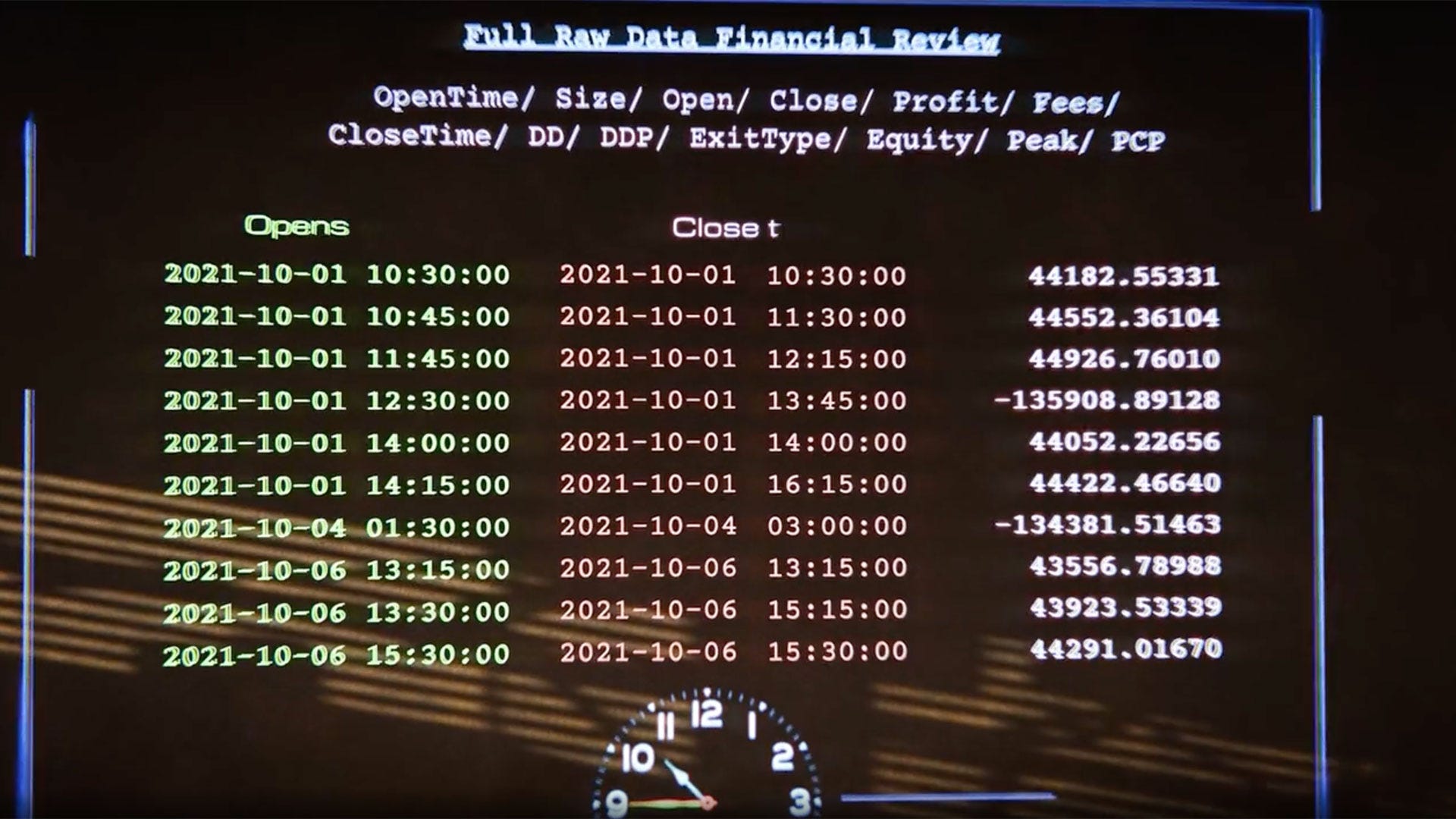
exactly the same opening and closing time
Coffeezilla also identified apparent anomalies within the trading data, including transactions showing identical opening and closing timestamps while recording substantial profits, in some cases approaching $40,000.
There may be a technical explanation for those records.
If there is, the original exchange data should establish it.
Eric has now provided an important clarification.
He says Onyx was operating a fund-of-funds strategy and was not responsible for the underlying trading. According to Eric, the performance information he communicated came from the partners and managers Onyx worked with at the time.
That shifts an important question away from whether Eric personally executed these trades.
But it creates another:
Who did?
Eric has not identified those underlying managers to me or provided records independently verifying the performance information they supplied.
He says Onyx has since ended those relationships and exited the strategy.
But closing the strategy does not resolve the historical evidence.
If approximately 850 genuine trades produced four consecutive years of returns exceeding 100%, the original exchange records should allow that performance to be independently reconstructed.
The same evidence could explain the timestamp anomalies and establish who actually produced the trading records.
The records were supposed to prove the returns.
Until the underlying records are independently reconciled, they remain one of the biggest unanswered questions in this investigation.
Randy Couture’s concerns did not originally go to Coffeezilla.
According to Coffeezilla, Couture’s team first provided its material to Hindenburg Research, the forensic financial research firm known for investigating companies and investment operations.
Hindenburg investigated Eric McNeil but shut down before publishing a report. That distinction matters: there is no published Hindenburg finding against Eric McNeil or The Onyx Reserve that I can responsibly present as fact.
Coffeezilla says the unfinished investigation nevertheless left behind a substantial case file and data room, including recorded conversations, investment material and trading documentation.
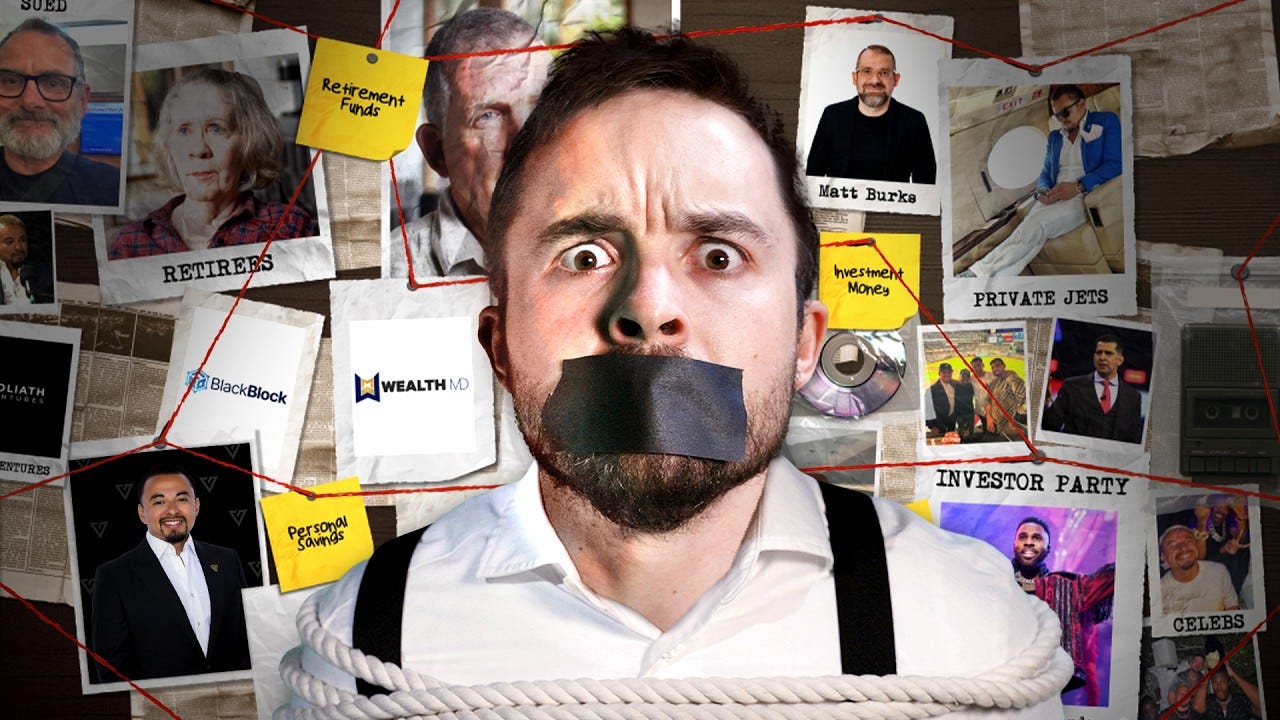
Exposing a $300,000,000 Scam
The material resurfaced during Coffeezilla’s separate investigation into Goliath Ventures, published as $300 Million Goliath.
One familiar name connected the two stories:
Matt Burks.
Burks had appeared around Goliath Ventures and had also been publicly presented in an operations role with The Onyx Reserve.
While investigating Goliath, Coffeezilla recognised that overlap and contacted Hindenburg about its unfinished McNeil investigation. According to Coffeezilla, Hindenburg then provided him with the underlying material.
That is important because Coffeezilla was not simply repeating allegations from Randy Couture.
He was examining evidence accumulated during Hindenburg’s unfinished investigation.
That material led him to the disputed trading records, the purported CPA review and what he described as multiple overlaps between people and organisations appearing around Onyx and Goliath Ventures.
Eric McNeil and Tom Shields have now made their position on Goliath unequivocal.
They say neither they nor Onyx raised or referred capital for Goliath, invested Onyx capital into Goliath, managed or controlled Goliath, or had any relationship with Christopher Delgado.
Eric says Onyx worked with Matt Burks independently for a brief period and terminated that relationship after learning more about his involvement with Goliath.
I have no evidence establishing that Onyx was involved in Goliath’s operation, and I am not alleging that it was.
But the professional overlaps identified through the Hindenburg material remain relevant to understanding why Onyx entered both Coffeezilla’s investigation and mine.
And Matt Burks was only the beginning.

Matt Burks
The deeper Coffeezilla examined the Hindenburg material, the harder it became to treat Matt Burks as the only overlap between The Onyx Reserve and Goliath Ventures.
One organisation he highlighted was BlackBlock, which had appeared publicly around Onyx in a compliance role.
According to Coffeezilla, BlackBlock also appeared around Goliath Ventures and had made representations concerning Goliath’s financial backing.
Coffeezilla also highlighted Alston & Bird, which had appeared as part of Onyx’s legal infrastructure, while the firm was separately named in litigation concerning services provided around the Goliath enterprise.
Those allegations are claims made in litigation, not findings of wrongdoing against the law firm, and I make no such finding here.
But the overlaps matter because professional names can create substantial credibility around an investment operation.
A recognised law firm creates confidence.
A compliance provider creates confidence.
Professional athletes and advisers create confidence.
But association is not independent verification of an investment.
Eric McNeil and Tom Shields have now responded directly to the Goliath issue.
Both emphatically deny that Onyx had any affiliation with Goliath Ventures.
They say neither they nor Onyx raised or referred capital for Goliath, invested Onyx investor capital into Goliath, managed or controlled Goliath, or had any relationship with Christopher Delgado.
Eric has also clarified the relationship with Matt Burks.
According to him:
“We worked with Matt Burks independently for a brief period.”
Eric says that once they learned more about Burks’ involvement with Goliath, they ended that relationship and have no working relationship with him today.
I have no evidence establishing that Onyx participated in Goliath’s operation, and I am not alleging that it did.
The significance of Goliath is therefore not that I can demonstrate money flowed between the two operations.
I cannot.
The significance is that people and professional service providers appearing around Goliath also appeared around Onyx, and those overlaps were significant enough to attract the attention of both Coffeezilla and me.
That is particularly relevant because Eric says the lessons from Goliath contributed to Onyx changing direction.
He told me that what emerged around Goliath and similar groups reinforced their decision to leave that broader alternative-investment space and move exclusively into real estate, where they wanted greater control and transparency over investments and investor capital.
That is an important development.
But it does not erase the historical questions that brought Onyx into this investigation.
Goliath was the doorway into this story. It was never the entire story.
On 20 December 2025, Eric McNeil contacted me directly, writing on behalf of himself and Tommy Shields after seeing my reporting connecting Matt Burks with The Onyx Reserve.
They described what I had uncovered concerning Matt and Goliath as “eye opening stuff.”
Eric said they had “immediately stripped his name of any and all material” while conducting further due diligence. He also denied that Onyx had sent money to Matt or Goliath and denied any affiliation with the Goliath group.
Then came the request.
Eric explained that the association could damage the reputation they had worked to build and asked whether I would remove my post “for now.”
I refused.
Matt Burks had been publicly presented as part of The Onyx Reserve. Removing documented information simply because the association had become uncomfortable would not have been responsible reporting.
But I gave Eric and Tom something more useful than deleting it.
I gave them a right of reply.
I wanted to know what role Matt had actually performed, how he became involved with Onyx and what their subsequent due diligence uncovered.
More importantly, I wanted to understand the investment operation itself.
Eric has now provided additional context about Matt.
He says Onyx worked with Burks “independently for a brief period” and ended that relationship after learning more about his involvement with Goliath. Eric and Tom continue to emphatically deny any affiliation with Goliath Ventures or Christopher Delgado.
I have no evidence establishing otherwise.
But my investigation had already moved beyond whether Onyx was connected to Goliath.
If Eric and Tom wanted the public record corrected and their reputation protected, I wanted the financial claims being made around their own operation independently explained.
So I put those questions to them in writing.
That is where the real investigation into The Onyx Reserve began.
My response to Eric McNeil was not an accusation that The Onyx Reserve was connected to Goliath Ventures.
I had already recorded their denial.
What interested me was something more fundamental: how did their own investment operation work?
Onyx was promoting stable, consistent passive income and distributions. So I asked where that distributable cash flow actually came from and whether investor capital was ever used to service earlier investors.
I asked how investor money was structured, where the fund was domiciled, who controlled the accounts and which regulator had jurisdiction.
Then I asked about performance.
If Onyx had “proven results,” I wanted independently verifiable evidence. I asked whether audited financial statements or third-party performance reports existed and who had verified the returns.
I also asked whether anyone beyond Matt Burks who had been associated with Goliath had participated in promotion, introductions or capital raising for Onyx.
Finally, I questioned promotional references suggesting a connection with Patrick Bet-David. I wanted to know precisely what that relationship meant—investment, partnership, endorsement, informal connection or something else.
I made my position explicit:
“I am not alleging wrongdoing at this stage. I am collecting evidence, assessing claims made to the public, and ensuring that representations about passive income, venture upside, and investor safety are accurate and substantiated.”
Eric has now provided some additional information.
He says the historical operation was a fund-of-funds strategy, that Onyx was not the underlying trader and that Avestor acted as third-party fund administrator.
Those answers provide useful context.
But the most important question I asked remains unresolved with independently verifiable evidence:
What generated the money being paid to investors?
That question would become considerably more important once I saw what Coffeezilla had uncovered.
After sending my December 2025 questions, I received no substantive answers at the time.
Eric and Tom had contacted me because they were concerned about the reputational impact of Matt Burks appearing around both Onyx and Goliath. But when I asked about Onyx’s own investment structure, performance verification and source of investor distributions, the correspondence stopped.
That distinction matters.
I was not asking them to prove they were innocent of wrongdoing. I was asking them to substantiate financial representations being made around an investment operation.
For months, those questions remained unanswered.
Then, shortly before this investigation and my scheduled 21 August 2026 live broadcast, both Tom and Eric began providing detailed responses.
Their responses have now been incorporated throughout this article.
Eric says the historical investment model was a fund-of-funds strategy, that Onyx was not the underlying trader and that the performance information he communicated came from external partners and managers.
He also identified Avestor as the third-party fund administrator and says the historical offering has since been closed.
Those are important answers that I did not have previously.
But they also leave several questions unresolved.
Eric has not identified the underlying partners and managers responsible for the historical strategy. I have not been provided with independently verifiable records substantiating the extraordinary performance he communicated, and the questions surrounding the trading records examined by Coffeezilla remain unresolved.
Most importantly, I still have not received independently verifiable evidence answering the question I first asked in December:
What was the source of the money used to pay historical investor returns and distributions?
So it would no longer be accurate for me to say Eric and Tom simply “never answered.”
They have now responded.
The more accurate position is that some questions have been answered, some claims have been clarified, and some of the most important financial questions remain unresolved.
And while those historical questions remained open, Onyx was already moving into an entirely new investment proposition.
Luxury real estate.
Months after my original questions went unanswered, The Onyx Reserve returned to my inbox with a very different proposition.
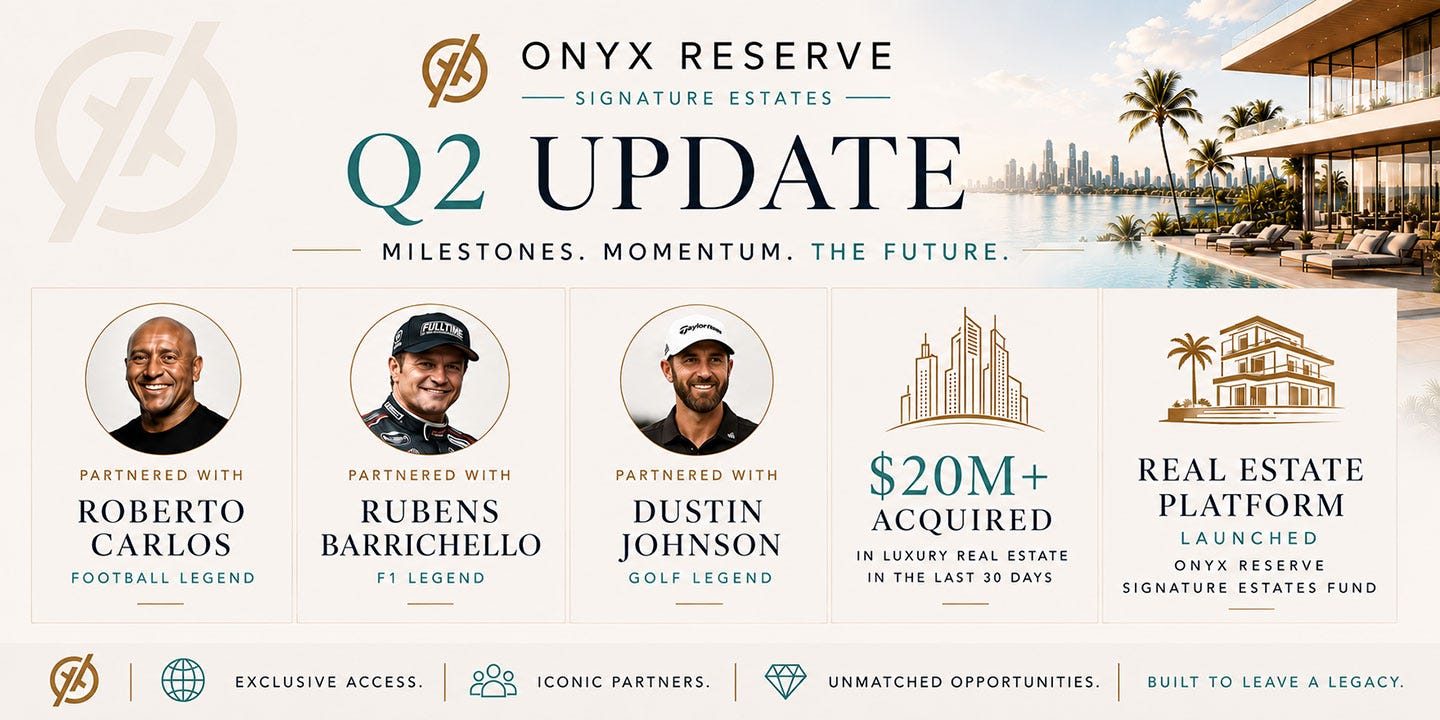
A New Chapter for Onyx Reserve
The newsletter announced “A New Chapter for Onyx Reserve.” and introduced the Onyx Reserve Signature Estates Fund, focused on luxury real estate alongside athletes, entertainers and major developers.

Then came the headline figure:
“In the last 30 days alone, we’ve closed on more than $21 million in luxury real estate.”
The newsletter named Viceroy Residences Fort Lauderdale, The Colette and Opus Coconut Grove, and referenced transactions or relationships involving high-profile athletes and entertainers.
It also announced that after completing Fund I, Onyx intended to launch Fund II targeting a $100 million capital raise.
Tom Shields has now provided important clarification about those figures.
He says the $21 million-plus represents the aggregate contracted purchase price/property value of four units across Colette, Opus and Viceroy.
It does not represent $21 million of investor capital raised or deployed.
Tom also clarified that the advertised 30–40% property discounts refer to discounts negotiated against developer list price, not independent appraisals establishing the properties were purchased 30–40% below fair market value.
And importantly, the $100 million Fund II figure is a fundraising target.
It does not mean $100 million has already been raised, subscribed or committed.
Those distinctions materially improve the factual picture, and I have updated this investigation accordingly.
The athlete and celebrity relationships still require equally careful interpretation.
The newsletter referenced names including Roberto Carlos, Rubens Barrichello, Dustin Johnson, Flo Rida, French Montana and Jordan Spieth.
But appearing alongside an investment proposition can mean many different things.
A celebrity purchasing a property is not necessarily an investor in an Onyx fund. A promotional relationship is not necessarily an equity partnership. And completing a transaction “alongside” somebody does not establish precisely what financial relationship exists.
That is why I wanted those relationships defined rather than assumed.
The arrival of Signature Estates also changed the urgency of my investigation.
Onyx was no longer simply associated with historical questions about trading and passive income. It was presenting investors with a new strategy involving luxury property and preparing for a potentially substantial new capital raise.
So before publishing updated reporting, I gave The Onyx Reserve another opportunity to explain exactly what it had built.
On 16 July 2026, I wrote directly to Tom Shields after he sent me The Onyx Reserve newsletter announcing Signature Estates.
This was not an unsolicited attack. I was responding to new investment claims Onyx itself had placed in my inbox.
I asked Tom to identify the legal structure and jurisdiction of the fund, its regulatory basis, manager, administrator, custodian and auditor, and to provide the relevant offering documents.
I also asked him to explain the $21 million-plus luxury-real-estate figure, the ownership of the properties and the precise relationships with Colette, Opus and Viceroy.
Then I asked about the athletes and entertainers appearing around the proposition.
Were they investors, purchasers, promotional partners or something else? Were they compensated? Had they authorised their names to be used in connection with the investment opportunity?
Finally, I asked about Fund II and the proposed $100 million raise.
I gave Onyx 14 days to respond and explicitly told Tom:
“This email is intended to provide Onyx Reserve with a full and fair opportunity to clarify or substantiate the representations made in its latest newsletter before I publish any updated reporting.”
No substantive response arrived within that period.
Tom has now responded and clarified several important points.
The $21 million-plus figure represents the contracted property value of four units, not investor capital raised or deployed. The 30–40% discount refers to developer list price, and the $100 million Fund II figure is a fundraising target, not capital already raised or committed.
I have incorporated those clarifications throughout this investigation.
But many of the documentary questions I originally asked—including the detailed fund structure, ownership, financial controls and supporting evidence—have still not been answered with the documentation I requested.
The right of reply therefore achieved something important.
It corrected parts of the story.
But it did not resolve all of it.
By the time I originally prepared this investigation, The Onyx Reserve had been given two separate rights of reply.
The first followed Eric McNeil’s December 2025 email, written on behalf of himself and Tom Shields. The second followed Tom’s Signature Estates newsletter, when I sent detailed questions on 16 July 2026 and gave Onyx 14 days to respond.
Neither produced substantive answers within those periods.
That position has now changed.
Both Tom and Eric have responded, and where their answers corrected or clarified the record, I have updated this investigation.
Tom clarified that the $21 million-plus figure represents the contracted property value of four units, the 30–40% discount is measured against developer list price, and the proposed $100 million Fund II is a fundraising target.
Eric provided new information about the historical strategy. He says Onyx operated a fund-of-funds model, was not the underlying trader and relied on information supplied by external partners and managers. He also identified Avestor as the third-party fund administrator and says the historical offering has since closed.
Both men also emphatically deny any affiliation with Goliath Ventures or Christopher Delgado, and I have no evidence establishing otherwise.
Those responses matter.
But responding is not the same as resolving every question.
Eric has not identified the underlying managers responsible for the historical strategy. The disputed trading records remain unexplained, and I have not received independently verifiable evidence establishing the source of historical investor returns and distributions.
So the record is no longer two opportunities and two silences.
It is more accurately:
Two opportunities, two eventual responses—and several important financial questions that remain unresolved.
After reviewing the Hindenburg material, Randy Couture recording and trading records, Coffeezilla reached a much stronger conclusion than I am prepared to state as established fact.
He described the historical operation as, in his opinion, an “obvious Ponzi scheme.”
Importantly, Coffeezilla also acknowledged that there had been no legal finding establishing that conclusion.
Eric McNeil has now responded directly:
“Any suggestion that I am operating a Ponzi scheme is an extremely serious characterization and does not accurately represent me or our business.”
His denial belongs in the record.
Eric also says Onyx was operating a fund-of-funds strategy, was not the underlying trader and relied upon performance information supplied by external partners and managers. He says those relationships have since ended and the historical offering has closed.
But that does not resolve the central financial question.
Where did the money paid to investors actually come from?
To establish a Ponzi scheme, I would want to follow the money: investor deposits, underlying investments, genuine trading profits, withdrawals and distributions.
That is why one of the questions I asked Onyx in December 2025 remains so important:
Was investor capital ever used to service prior investors?
Eric says investors could withdraw their money or reinvest into the real-estate offering and points to Avestor’s third-party administration and accounting.
Those are relevant facts.
But the ability to withdraw money does not, by itself, establish the source of the returns being paid.
Likewise, third-party administration does not automatically prove that an underlying trading strategy generated the performance being represented.
Eric has not identified the external managers responsible for that historical strategy, and I have not been provided with financial records independently establishing the source of those returns.
There is also an important distinction between the historical operation and today’s Signature Estates strategy.
I am not alleging that the current real-estate offering is a Ponzi scheme simply because unresolved questions remain about the historical strategy.
But changing strategies does not erase those questions either.
So the position is straightforward.
Coffeezilla believes the historical operation was a Ponzi scheme. Eric emphatically denies it. There has been no judicial or regulatory finding establishing that it was.
I am not asking readers to choose between Coffeezilla’s opinion and Eric’s denial.
The financial records should decide that.
The proposed $100 million Fund II is where this investigation stops being purely historical.
Tom Shields has clarified an important point: Onyx has not claimed that $100 million has already been raised. It is a fundraising target, not capital already subscribed or committed.
That correction is now reflected throughout this investigation.
But a $100 million target still potentially means a substantial new pool of investor capital.
Before investors participate, they should be able to understand what happened with the funds and strategies that came before it.
Eric says the historical offering has closed and that investors either withdrew their money or reinvested into the real-estate offering. He also says Avestor provided third-party administration and accounting.
The unanswered question remains whether independently verifiable records establish how the historical returns were generated and where investor distributions came from.
Signature Estates creates a separate set of questions.
Tom says the $21 million-plus figure represents the contracted property value of four units across Colette, Opus and Viceroy—not investor capital raised or deployed.
He also says the 30–40% discount refers to developer list price rather than independently appraised fair market value.
Those clarifications narrow what prospective Fund II investors need to establish.
How much investor capital has actually been deployed? Who owns the properties? What financing is attached to them? What economic interest belongs to investors? What fees are being charged? And what has Fund I actually produced?
The athlete and celebrity relationships should also be separated from those fundamentals.
Recognisable names can create confidence, but celebrity proximity does not establish the financial performance of a fund.
Eric says Onyx moved into real estate because it wanted greater control and transparency over investments and investor capital.
If that is the new standard, prospective Fund II investors should expect the documentation to demonstrate it.
The historical strategy and Signature Estates are different propositions, and I am not suggesting that unresolved historical questions establish wrongdoing in the current real-estate offering.
But investment managers do not lose their history simply because the strategy changes.
Before Onyx attempts to turn a $100 million fundraising target into $100 million of actual investor capital, prospective investors should be able to independently verify the people, assets, ownership, performance and financial controls behind the operation.
That—not the size of the target—is the real $100 million question.
Throughout this investigation, I have tried to separate documented evidence from allegations, disputed claims and unanswered questions.
Eric McNeil and Tom Shields have now both responded.
Tom clarified that the $21 million-plus Signature Estates figure represents the contracted property value of four units, that the 30–40% discount refers to developer list price, and that the proposed $100 million Fund II is a fundraising target.
Eric says the historical operation was a fund-of-funds strategy, that Onyx was not the underlying trader and that the performance information he communicated came from external partners and managers.
He also says Avestor acted as third-party fund administrator, that the historical offering has closed and that investors could withdraw their money or reinvest into the real-estate offering.
Both Eric and Tom emphatically deny affiliation with Goliath Ventures or Christopher Delgado.
I have incorporated those clarifications and denials into this investigation.
Eric also rejects Coffeezilla’s characterisation of the historical operation as a Ponzi scheme, describing that suggestion as extremely serious and inaccurate.
His denial is recorded alongside Coffeezilla’s allegation, which remains Coffeezilla’s opinion and not a judicial or regulatory finding.
But several important questions remain unresolved.
Eric has not identified the external partners and managers responsible for the historical strategy. I have not received independently verifiable records substantiating the extraordinary historical performance, resolving the trading anomalies identified by Coffeezilla or explaining the circumstances surrounding the purported CPA review.
Most importantly, I still have not received independently verifiable evidence establishing the source of the historical investor returns and distributions.
That is not something I intend to fill in with speculation.
If Eric, Tom, The Onyx Reserve, Avestor or the underlying historical managers provide documentation answering those questions, I will review it and update this investigation where the evidence warrants it.
The same standard applies if anything I have published is demonstrated to be factually wrong.
I will correct it.
That is what a right of reply is for.
Eric and Tom have now exercised theirs.
Their responses are part of the evidence. They do not replace the evidence still being requested.
I began investigating The Onyx Reserve because Matt Burks appeared somewhere I didn’t expect to find him.
What followed led to Eric McNeil’s historical investment claims, Randy Couture’s undercover conversation, the unfinished Hindenburg Research investigation, Coffeezilla’s findings and eventually Onyx’s new Signature Estates real-estate strategy.
Since publishing this investigation, Eric McNeil and Tom Shields have both responded, and where they have provided factual clarification, I have updated the article.
Their responses have established important distinctions.
Onyx says it had no affiliation with Goliath Ventures or Christopher Delgado. Eric says the historical strategy was a fund-of-funds arrangement and that Onyx was not the underlying trader. Tom has clarified the meaning of the $21 million property figure, the 30–40% discount and the proposed $100 million Fund II.
Those clarifications deserve to be recorded.
But they do not answer everything.
The underlying managers responsible for the historical strategy have not been identified to me. The extraordinary performance Eric communicated to Randy Couture has not been independently substantiated to me. The apparent anomalies in the trading records examined by Coffeezilla remain unexplained, as does the disputed CPA review.
And the most important question remains remarkably simple:
What generated the historical investor returns?
Eric says Avestor provided third-party administration and that investors were able to withdraw or reinvest their funds. That is relevant information, but it does not independently establish where the profits used for distributions originated.
I don’t need to speculate beyond that.
If the historical returns were genuine, the financial records can demonstrate it.
If the trading anomalies have an innocent explanation, the original records can demonstrate it.
If Signature Estates owns the assets and produces the returns represented to investors, the property and financial records can demonstrate it.
And if the current real-estate strategy provides the greater control and transparency Eric says Onyx wanted, that should be demonstrable too.
Coffeezilla has expressed his opinion that the historical operation was an “obvious Ponzi scheme.” Eric emphatically denies that characterisation. There has been no judicial or regulatory finding establishing that Onyx operated a Ponzi scheme, and I am not presenting one.
That leaves the evidence.
Luxury properties cannot replace it.
Professional athletes cannot replace it.
Celebrity relationships cannot replace it.
Testimonials cannot replace it.
And neither can assurances from the people managing the investment.
The evidence has to speak for itself.
Eric McNeil and Tom Shields know the questions being asked. They have now responded, and their responses are included throughout this investigation.
If they provide further independently verifiable evidence, I will examine it.
Until then, I will continue doing what brought me into this story in the first place:
Following the people. Following the claims. And above all, following the money.
In the hours immediately preceding my scheduled 21 August 2026 broadcast, I received further responses from both Tom Shields and Eric McNeil.
Those responses arrived after The Onyx Reserve had already been provided with two detailed opportunities to respond: the first following Eric’s approach to me in December 2025, and the second through my formal right of reply sent to Tom on 16 July 2026.
I have nevertheless treated their latest responses exactly as I would any other evidence.
Where they corrected or clarified facts, I updated this investigation before going live.
Tom clarified the meaning of the $21 million-plus property figure, the advertised 30–40% discount and the proposed $100 million Fund II.
Eric clarified that the historical strategy was a fund-of-funds arrangement, said Onyx was not the underlying trader, identified Avestor as its third-party fund administrator, confirmed the previous offering has closed and reiterated that Onyx had no involvement with Goliath Ventures or Christopher Delgado.
Those statements are now reflected throughout this article.
What their responses have not provided is the independently verifiable financial evidence I have repeatedly sought.
I still have not been given the identity of the underlying managers responsible for the historical trading strategy, original records independently substantiating the extraordinary performance claims, an explanation for the trading anomalies identified in the Hindenburg material examined by Coffeezilla, or evidence resolving the disputed CPA review.
Most importantly, I still have not received independently verifiable evidence establishing what generated the historical investor returns and distributions.
The timing of these responses does not make them invalid, and I will not speculate about Eric or Tom’s motives for responding when they did.
But the chronology matters.
They had months to address these questions. Their decision to respond shortly before publication does not lower the evidential standard.
A late answer deserves the same consideration as an early one.
And a claim made in response to an investigation requires the same verification as a claim made in an investment presentation.
I have therefore updated this investigation where the facts warranted correction while leaving the unresolved questions exactly where they belong:
On the record, waiting for evidence.
This investigation relies entirely on OSINT — Open Source Intelligence — meaning every claim made here is based on publicly available records, archived web pages, corporate filings, domain data, social media activity, and open blockchain transactions. No private data, hacking, or unlawful access methods were used. OSINT is a powerful and ethical tool for exposing scams without violating privacy laws or overstepping legal boundaries.
I’m DANNY DE HEK, a New Zealand–based YouTuber, investigative journalist, and OSINT researcher. I name and shame individuals promoting or marketing fraudulent schemes through my YOUTUBE CHANNEL. Every video I produce exposes the people behind scams, Ponzi schemes, and MLM frauds — holding them accountable in public.
My PODCAST is an extension of that work. It’s distributed across 18 major platforms — including Apple Podcasts, Spotify, Amazon Music, YouTube, and iHeartRadio — so when scammers try to hide, my content follows them everywhere. If you prefer listening to my investigations instead of watching, you’ll find them on every major podcast service.
You can BOOK ME for private consultations or SPEAKING ENGAGEMENTS, where I share first-hand experience from years of exposing large-scale fraud and helping victims recover.
“Stop losing your future to financial parasites. Subscribe. Expose. Protect.”
My work exposing crypto fraud has been featured in:
Coffeezilla 2026): Featured in the investigation exposing the alleged $328M Goliath Ventures Ponzi scheme
Bloomberg Documentary (2025): A 20-minute exposé on Ponzi schemes and crypto card fraud
News.com.au (2025): Profiled as one of the leading scam-busters in Australasia
OpIndia (2025): Cited for uncovering Pakistani software houses linked to drug trafficking, visa scams, and global financial fraud
The Press / Stuff.co.nz (2023): Successfully defeated $3.85M gag lawsuit; court ruled it was a vexatious attempt to silence whistleblowing
The Guardian Australia (2023): National warning on crypto MLMs affecting Aussie families
ABC News Australia (2023): Investigation into Blockchain Global and its collapse
The New York Times (2022): A full two-page feature on dismantling HyperVerse and its global network
Radio New Zealand (2022): “The Kiwi YouTuber Taking Down Crypto Scammers From His Christchurch Home”
Otago Daily Times (2022): A profile on my investigative work and the impact of crypto fraud in New Zealand
No posts
Comments
Nothing yet. Say the first thing.
Sign in to join the conversation.