

“The more I investigated Global Glamping, the bigger the story became. Every answer uncovered another question. Every document led to another witness. Every phone call introduced another player. Eventually I realised this wasn’t just about Devon Allan Towle anymore.”
I thought I had reached the end of the story.
Instead, it was just the beginning.
Since that investigation was published, my inbox has been flooded with evidence. Victims have shared contracts, bank records and emails. Former insiders have trusted me with recordings, internal communications and documents that have never been seen publicly. Companies that once worked alongside Global Glamping have opened their files. I have now spent hours interviewing people who helped market the opportunity, people who sold it, people who later claimed they were deceived themselves, and investors who are still trying to recover what they lost.
One name kept appearing over and over again.

Lorenzo Ayres – Americas Outdoor Adventure Park
To some investors, Lorenzo was the friendly voice who explained the opportunity, answered their questions and guided them through the paperwork. To others, he now presents himself as someone who was misled by Devon and who has spent the last year helping victims pursue justice. After spending more than an hour speaking with Lorenzo myself and comparing that interview with contracts, emails, CRM records and recordings from multiple independent sources, I believe his role deserves much closer examination than it has received to date.
Another unexpected development came from PhoneSales.
When I contacted the company, I expected a brief denial or perhaps no response at all. Instead, they did something I wish more companies would do. They opened their records. They provided CRM data, contracts, internal messages, recordings, timelines and documents explaining exactly how their relationship with Devon and Lorenzo unfolded. Whether readers ultimately agree with PhoneSales’ commission model is a separate discussion. What matters is that they produced evidence, and that evidence fundamentally changed my understanding of how Global Glamping was marketed and sold.
As I followed the paper trail, another surprise emerged. Lorenzo is now the public face of America’s Outdoor Adventure Park, another resort development promoting high-value investment opportunities. That discovery raised an obvious question. Had one chapter ended only for another to begin? I approached that question with an open mind, determined to judge the evidence rather than the personalities involved.
This investigation is not about proving guilt. It is about documenting the facts, testing competing narratives and allowing the evidence to tell the story. Devon Allan Towle has provided his explanation. Lorenzo Ayres has provided his. PhoneSales has opened its records. Investors have shared their experiences. My job is to put those pieces together and present them as accurately and fairly as I can.
What follows is the investigation I never expected to write.
Because the deeper I dug into Global Glamping, the less this looked like the story of one failed resort.
It became the story of how the opportunity was sold, who profited from promoting it, what happened behind the scenes when everything began to unravel, and why so many investors are still searching for answers today.
This is a long-form investigation, and there is a lot of ground to cover. For readers who want to jump directly to a particular part of the story, I’ve included the complete index below. I recommend reading from the beginning because the evidence builds chronologically, but each section examines a different part of the Global Glamping story, the people involved and the questions that remain unanswered.

Devon Allan Towle
The biggest change in this investigation came when PhoneSales, the outsourced sales company hired to market and sell Global Glamping opportunities, contacted me directly.
Until then, most of what I had been working with came from the purchaser side: contracts, payment records, emails, promises, complaints and accounts from people who said they had paid substantial sums for glamping projects that were never delivered as expected. PhoneSales gave me something different. They had been inside the sales operation. They had generated leads, spoken with prospective purchasers, worked with Devon and Lorenzo, tracked deals through their CRM and retained records from the period when Global Glamping was actively being sold.
What followed wasn’t simply another interview. PhoneSales began opening its files.
They provided CRM records, sales data, contracts, DocuSign material, internal communications and recordings. They also gave me a recorded meeting in which Devon Allan Towle was confronted directly about sales PhoneSales believed had been closed without being reported back to them. Suddenly, I wasn’t relying solely on memories reconstructed after everything had gone wrong. I was looking at contemporaneous records created while the business relationship was still operating.
That evidence also forced me to reconsider the roles of people surrounding Devon. Lorenzo Ayres appeared repeatedly across the material — communicating with purchasers, supplying projections and sales information, appearing on agreements and, according to PhoneSales, later working directly with Devon after his relationship with the sales company ended.
But before I could properly understand any of that, PhoneSales told me something about its own arrangement with Global Glamping that stopped me in my tracks.
The commission was approximately 40%.
When PhoneSales first explained the commercial arrangement, I genuinely thought I had misunderstood them.
According to the records and explanations they provided, PhoneSales was entitled to approximately 40% of the cash collected on reported Global Glamping sales. On a US$100,000 transaction, that could mean roughly US$40,000 flowing into the sales operation before considering the costs of actually generating and closing that customer.
That immediately raised questions for me. What kind of margin did Global Glamping need to build the promised accommodation, install infrastructure, operate the resort and generate the returns being presented to purchasers if such a substantial percentage of incoming money was being consumed by customer acquisition and sales?
PhoneSales didn’t hide from the number when I challenged them about it. They explained that the 40% wasn’t simply handed to one salesperson as profit. Their operation funded advertising, lead generation, appointment setters, sales representatives, management and other costs required to acquire customers. They say the Global Glamping campaign ultimately lost them money, despite how extraordinary the headline commission appears.
That distinction matters, but so does the number.
A high commission doesn’t prove that an opportunity is fraudulent. Businesses can legitimately spend heavily acquiring customers, particularly when selling expensive products. But when purchasers are paying six figures for physical assets that still need to be manufactured, transported, installed and operated, the economics behind a 40% sales structure deserve scrutiny.
It also changed how I viewed the people selling these opportunities.
The sales operation wasn’t incidental to Global Glamping. It was an expensive and important part of the business model. Purchasers weren’t simply discovering Devon’s resorts and deciding independently to buy a dome. Money was being spent to find prospects, nurture them, present the opportunity and close substantial transactions.
And that created another question.
If PhoneSales was entitled to approximately 40% of the sales it generated, what happened when one of those customers bought — but the sale was never reported back to PhoneSales?
That question became important when PhoneSales began examining deals it believed should have appeared in its own records.
PhoneSales told me it had paid to generate prospective customers for Global Glamping, placed those leads into its CRM and assigned salespeople to work them. Under its arrangement with Devon, when those customers purchased, the transaction should have been reported so the agreed commission could be calculated. But PhoneSales says it eventually discovered something troubling: some prospects appeared to be progressing towards purchases without the completed sales being reported back through its operation.
The company supplied me with CRM records, DocuSign material and contracts that it says allowed it to reconstruct what had happened to particular leads. The significance wasn’t simply that PhoneSales believed it had missed out on commission. These records potentially provided a contemporaneous trail showing who first generated the customer, who communicated with them, who prepared the paperwork and where the transaction eventually went.
Lorenzo Ayres became important to that trail because he had originally worked within the PhoneSales operation selling Global Glamping. PhoneSales says that after its relationship with Lorenzo deteriorated, it began seeing evidence suggesting that some customers generated through its marketing were continuing through Global Glamping outside the original sales arrangement.
I want to be precise about what that proves. A lead appearing in a CRM doesn’t automatically establish that somebody stole it, secretly diverted a commission or committed fraud. Customers can move between salespeople, return independently or deal directly with a business for legitimate reasons. The significance comes from the surrounding records and the pattern PhoneSales says it identified, not from a single CRM entry.
PhoneSales didn’t simply complain about it privately.
They eventually put the issue directly to Devon.
And they recorded the meeting.
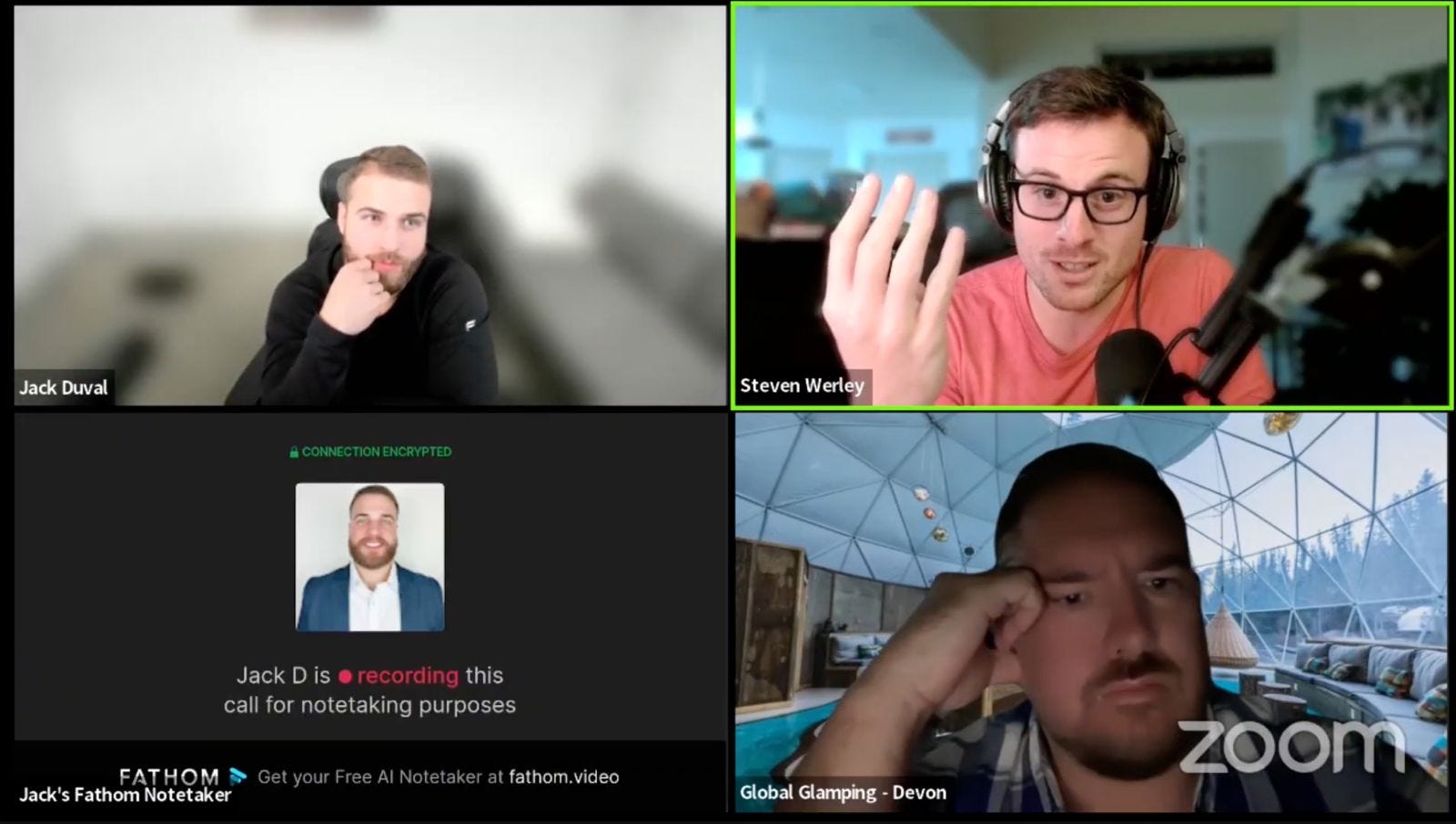
PhoneSales Confronted Devon Allan Towle During Recorded Zoom Meeting
One of the most revealing pieces of evidence PhoneSales provided was a Recorded meeting with Devon Allan Towle in which the company confronted him about Global Glamping transactions it believed had originated from leads generated through its own marketing but had never been reported back as completed sales.
The importance of the recording is its timing. This wasn’t an interview conducted for my investigation after relationships had broken down. It captured PhoneSales trying to work out, in real time, why customers appearing in its CRM also appeared to have signed Global Glamping agreements without the corresponding transactions being recorded through PhoneSales.
At the beginning of the discussion, Devon appeared to believe Lorenzo Ayres had only closed one deal. PhoneSales then started going through its records. Names were raised individually and matched against CRM information and signed agreements. Among the examples discussed was a transaction involving the Barber Family Trust for US$300,000, along with another involving Anil Kumar for US$100,000. PhoneSales believed these customers had originated through leads assigned to Lorenzo.
As the meeting progressed, Devon appeared confused.
PhoneSales pointed out that agreements had been sent through DocuSign and questioned how multiple transactions could apparently exist without Devon knowing about them. Devon then made an admission that I think is particularly important when viewed against everything that followed.
“Anything that comes through, I just sign it. Like, I don’t really check it.”
That statement matters. Much later, Lorenzo would explain to me that while he helped prepare and edit agreements, Devon controlled the contracts and ultimately signed them. Here, in a contemporaneous recording, Devon himself appears to confirm that documents were indeed coming to him for signature — while also acknowledging that he wasn’t necessarily checking what he was signing.
PhoneSales then asked Devon directly whether he had made some separate arrangement with Lorenzo outside its existing sales agreement. Devon said no.
The conversation became even more unusual when PhoneSales asked Devon to search his banking records while they were on the call. Names and transaction amounts were checked, including the US$300,000 figure, but Devon said he couldn’t locate the corresponding payments. That left the people on the call openly trying to understand how signed Global Glamping agreements could exist while the transactions apparently weren’t showing up where they expected.
At one point, the possibility was raised that Lorenzo might somehow have been receiving money elsewhere. But even Devon recognised the problem with that theory: the contracts were sitting inside his own DocuSign account. The discussion ended without a clear explanation for where the transactions had gone or why PhoneSales hadn’t been told about them.
I don’t think this recording proves that Lorenzo stole leads or diverted purchaser money, and I won’t use it to make an allegation the evidence doesn’t establish. Nor does Devon’s inability to locate a payment during a live meeting prove that Global Glamping never received it. Those questions require the underlying banking and transaction records.
What the recording does establish is something more valuable.
PhoneSales wasn’t inventing its concerns after the relationship collapsed. It confronted Devon directly, showed him the customers and agreements it had identified, and asked him to explain what had happened.
And Devon didn’t appear to have an answer.
By this stage, Lorenzo Ayres was no longer a name sitting quietly in the background of the investigation. His name appeared in investor correspondence, CRM records and contracts. PhoneSales was alleging that leads generated through its campaigns had later been handled directly by Lorenzo and Devon. More importantly, investors began contacting me independently and describing Lorenzo as the person who had introduced them to Global Glamping.
One couple provided a particularly useful paper trail. They told me Lorenzo had been their initial marketing contact, supplied the information and financial projections, and guided them through the opportunity before they signed their Global Glamping agreements. Their documents supported that account, including agreements carrying “Prepared By: Lorenzo Ayres.” They later contacted him again when the promised revenue failed to materialise, only to learn that he was no longer working with Global Glamping. By then, their problem had shifted from deciding whether to invest to trying to understand what had happened to the substantial amount of money they had already committed.
That evidence made Lorenzo important to the story, but it didn’t tell me what he knew at the time. A salesperson can promote something they genuinely believe is legitimate and later discover they were wrong. I needed to establish what Lorenzo had done, what he had been paid, what due diligence he had undertaken and when he first realised something was wrong.
So I contacted him directly.
Initially, getting answers wasn’t easy. I reached out through LinkedIn and later by email and iMessage. Eventually Lorenzo provided an extensive written right of reply in which he strongly rejected the suggestion that he had knowingly participated in anything improper. He described leaving PhoneSales to become a 1099 independent sales contractor for Devon, said his direct involvement lasted less than six or seven months, and portrayed that decision as “the single biggest professional mistake” of his life.
Lorenzo’s position was clear: he believed Global Glamping was legitimate when he sold it, and when he eventually realised buyers weren’t receiving what they had been promised, he became one of the people fighting Devon.
Some of the evidence supported parts of that account. Other material raised questions that couldn’t be answered simply by describing Lorenzo as another person deceived by Devon.
I wanted to hear those answers directly from him.
Eventually, Lorenzo agreed to talk.
We spoke for well over an hour.
Lorenzo’s central defence is straightforward: he says he was deceived by Devon too.
In his written response, Lorenzo said he believed Global Glamping was legitimate because Devon could point to real operating properties, existing revenue and what appeared to be a proven hospitality business. He says Devon repeatedly represented that the necessary zoning and approvals were in place, or progressing, and shared documents that appeared to support those representations. Lorenzo says he relied on that information when speaking with prospective purchasers and passed it along in good faith.
Lorenzo also draws a firm distinction between selling the opportunity and controlling what happened afterwards. Devon owned Global Glamping, controlled the money and was responsible for delivering the projects. Lorenzo says neither he nor the other outside service providers were in a position to independently know whether Devon was actually securing permits, building the promised units or using purchaser funds as represented.
That distinction is important. Nothing I have reviewed establishes that Lorenzo knew, when he was making these sales, that purchasers would later be left without what they had paid for.
But being deceived and being involved are not mutually exclusive.
Lorenzo was compensated for selling these opportunities, dealt directly with purchasers and appeared on agreements as “Prepared By.” He later became one of the people helping those same purchasers pursue Devon. That creates a complicated story in which Lorenzo can potentially be both someone who helped sell the problem and someone who later tried to solve it.
The evidence therefore required something more useful than simply deciding whether Lorenzo was a villain or a victim.
I needed to understand exactly what he did while the money was still coming in.
The conversation with Lorenzo was important because I wasn’t interested in catching him out with a single sentence. I wanted to understand the entire journey in his own words: how he became involved with Global Glamping, what he believed he was selling, how closely he worked with Devon, what involvement he had with the contracts, how he was compensated and, crucially, when he realised something was seriously wrong. Lorenzo was articulate and clearly wanted me to understand that distinction. His central argument was that Devon owned the company, controlled the money and was ultimately responsible for delivering what purchasers had paid for.
On that central point, there is substantial evidence supporting him. The Global Glamping agreements I’ve reviewed were contracts with Devon’s businesses, and Devon was responsible for construction and operation of the projects. Lorenzo wasn’t the person who ultimately had to put a dome on the ground. But our conversation became more interesting when I started drilling into what happened before the money changed hands.
Lorenzo acknowledged working directly with customers, presenting the opportunity and moving agreements between the purchaser and Devon. We discussed the fact that his name appears as the person who prepared contracts. His explanation was that he would make or facilitate requested changes and send the documents through, while Devon was responsible for their substance and ultimately signed them. Lorenzo himself acknowledged that he edited agreements while working between the customer and Devon, while maintaining that he hadn’t meaningfully read or analysed those contracts in the way someone responsible for their legal substance would have done.
I found that difficult to simply brush aside.
Not because it proves Lorenzo knew the agreements wouldn’t be fulfilled — it doesn’t — but because it raises a practical question about responsibility. If you’re helping sell six-figure opportunities, discussing their economics, editing agreements and guiding purchasers through the process, is it reasonable to later say you didn’t really know what was contained in the documents because somebody else ultimately signed them?
Lorenzo’s answer remained consistent: Devon controlled the offer and Devon was responsible for delivering it.
Then Lorenzo told me something else I wasn’t expecting.
After his relationship with Global Glamping had deteriorated and problems with purchasers were becoming apparent, he went back to work with Devon again.
His explanation for why he did that would open an entirely new line of inquiry.
One of the most important moments in my conversation with Lorenzo Ayres came when we discussed what happened after his relationship with Global Glamping had already begun to unravel. Lorenzo acknowledged that he went back to work with Devon Allan Towle again. That immediately caught my attention. If you had reached the point where you believed buyers were being harmed and Devon couldn’t be trusted, why would you put yourself back inside the same operation?
Lorenzo’s explanation was that his motives had changed. He presented his renewed involvement as part of his efforts to understand what Devon was doing and gather information that could ultimately help the affected buyers. In other words, Lorenzo says he wasn’t returning because he once again believed in Global Glamping; he was getting close enough to Devon to find out what was happening behind the scenes.
I can understand the logic of that explanation, but the timing deserves scrutiny. By then, Lorenzo wasn’t an inexperienced outsider discovering Global Glamping for the first time. He had already sold the opportunity, dealt directly with purchasers and worked closely with Devon. He knew buyers were having problems and says he had become sufficiently concerned that he would eventually help organise those same purchasers against Devon.
Lorenzo has pointed to what he did afterwards as evidence of where his loyalties ultimately sat. He says he helped organise affected buyers, worked towards a settlement, contributed towards legal costs and assisted efforts to hold Devon accountable. Those actions are relevant and should form part of the record.
But they don’t erase what happened before them.
The investors I’ve spoken with are also looking at who sold them the opportunity, supplied the projections, answered their questions, helped prepare or edit their agreements and earned money when those transactions closed.
That is where Lorenzo and some of the affected buyers appear to view his role very differently.
And it led directly to another question I needed answered:
How much did Lorenzo actually make selling Global Glamping?
Once Lorenzo’s role became clearer, there was an obvious question I needed answered: how much was he actually paid for selling Global Glamping? There is an important difference between someone who made a few introductions and someone who earned substantial commissions from transactions involving purchasers who are now fighting to recover their money.
Based on the sales information, contracts and commission records provided to me, Lorenzo appears to have earned more than US$300,000 in commissions connected with Global Glamping sales. I want to be precise about that figure: it is based on the records currently available to me, not a complete forensic accounting of every dollar Lorenzo received. The final amount could be different, and Lorenzo should produce his own records if he disputes it. What the evidence does establish is that his financial involvement was significant.
That creates an uncomfortable contrast with the purchasers.
Several are still trying to recover substantial amounts from contracts that weren’t fulfilled as expected. Lorenzo, meanwhile, has told me about the work he later did helping organise buyers, contributing towards legal costs and pursuing Devon. Those efforts deserve acknowledgement. But they don’t make the commissions irrelevant. The salespeople were paid because purchasers bought, and many of those purchasers are now carrying the losses.
I have seen no evidence that Lorenzo has returned those commissions to the affected purchasers. That doesn’t mean he was legally required to do so, nor am I suggesting a salesperson automatically becomes liable for another company’s contractual failure. Lorenzo’s position is that Devon received the purchaser funds, controlled Global Glamping and carried the obligation to build and deliver the projects. There is considerable force to that argument.
But the commissions remain part of the story.
And when I discovered what Lorenzo was doing after Global Glamping, they became considerably more relevant.
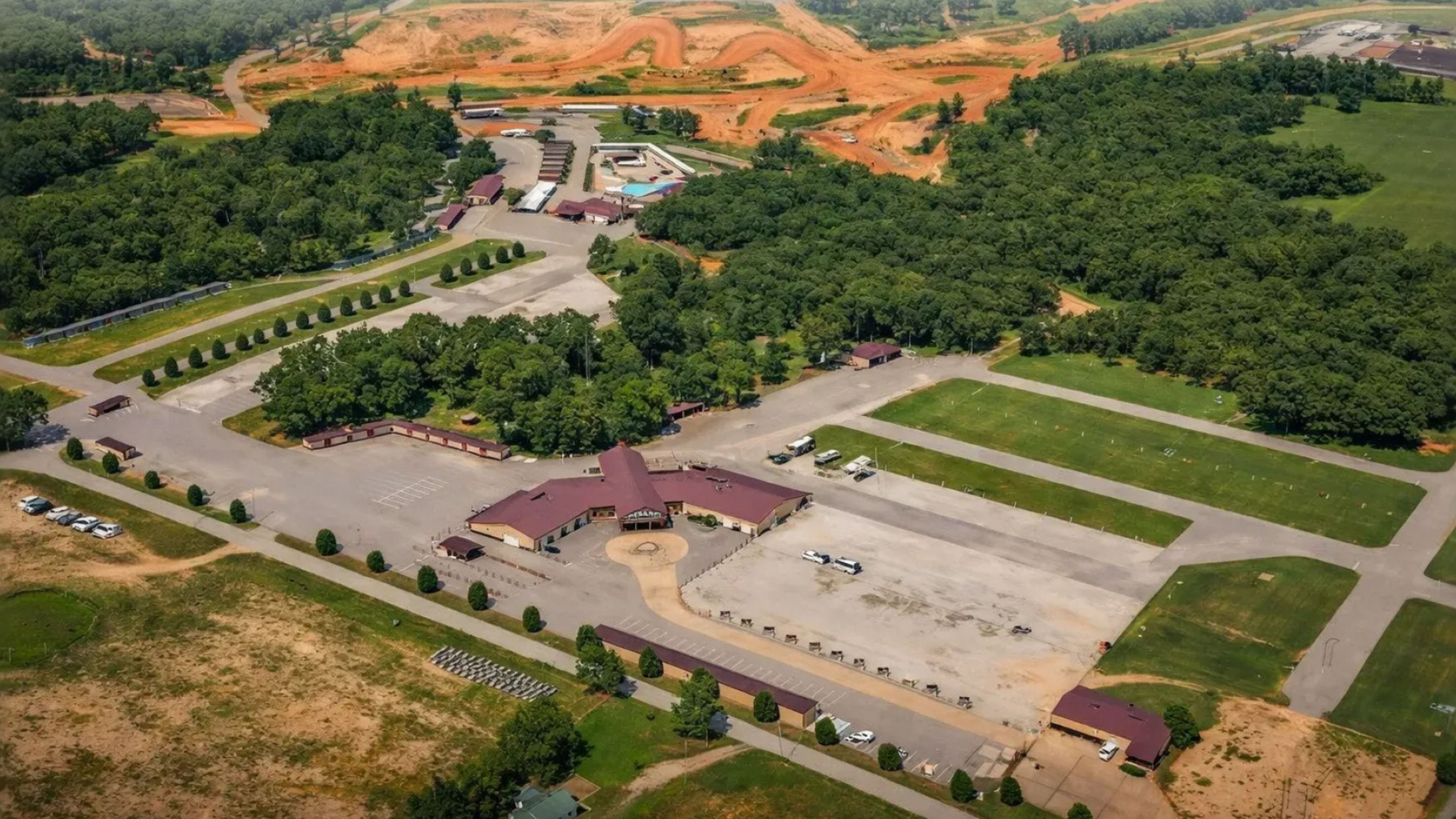
America’s Outdoor Adventure Park LLC (AOAP)
This is where Lorenzo’s story took a turn I wasn’t expecting. While Global Glamping purchasers are still trying to recover money from deals Lorenzo helped sell, I discovered he is now Co-Founder of America’s Outdoor Adventure Park LLC (AOAP) in Jay, Oklahoma.
And the similarities are difficult to ignore.
AOAP is currently advertising directly to accredited investors with one of the most aggressive headlines I encountered while researching Lorenzo’s new business:
“Invest $300k. Up to $1.2M Write off. Get paid every month.”
The website describes a US$300,000 minimum investment and promotes what it calls 4:1 tax leverage, a potential US$1.2 million write-off, 7% contractual cash flow and a 23.96% target IRR. It tells prospective investors they can obtain direct ownership of a luxury cabin inside a 383-acre resort while AOAP handles bookings, maintenance, marketing and operations.
The pitch is remarkably straightforward: put in US$300,000, acquire an asset, potentially obtain substantial deductions against active income and receive monthly payments while somebody else operates the hospitality business.
That immediately reminded me of the fundamental attraction behind Global Glamping.
I want to be very clear about the comparison. I am not saying America’s Outdoor Adventure Park is Global Glamping 2.0, and I am not alleging AOAP is fraudulent. There are significant differences. AOAP says its offering is conducted pursuant to Rule 506(c) of Regulation D, is restricted to accredited investors and is accompanied by a Private Placement Memorandum and extensive risk disclosures. Its website explicitly warns that the investment is “highly speculative” and suitable only for investors capable of withstanding the total loss of their investment.
But the irony is impossible for me to overlook.
Lorenzo has spent considerable time explaining to me how he became involved in Global Glamping because he believed Devon had a genuine operating hospitality business behind the investment opportunity. He says he trusted the existing resorts, relied on Devon’s representations and believed purchasers would receive accommodation assets producing income while somebody else operated them.
Now Lorenzo is a co-founder of a company marketing direct ownership of accommodation inside an operating resort, professional management, monthly contractual payments and projected investment returns.
There is another crucial difference this time.
Public-facing AOAP material identifies Lorenzo Ayres as Co-Founder and says he “drives operations and growth” while maintaining a focus on investor outcomes. This time, Lorenzo isn’t simply a salesperson working for somebody else’s company.
This time, Lorenzo is one of the people behind the opportunity.
The more closely I examined America’s Outdoor Adventure Park, the more significant its marketing became.
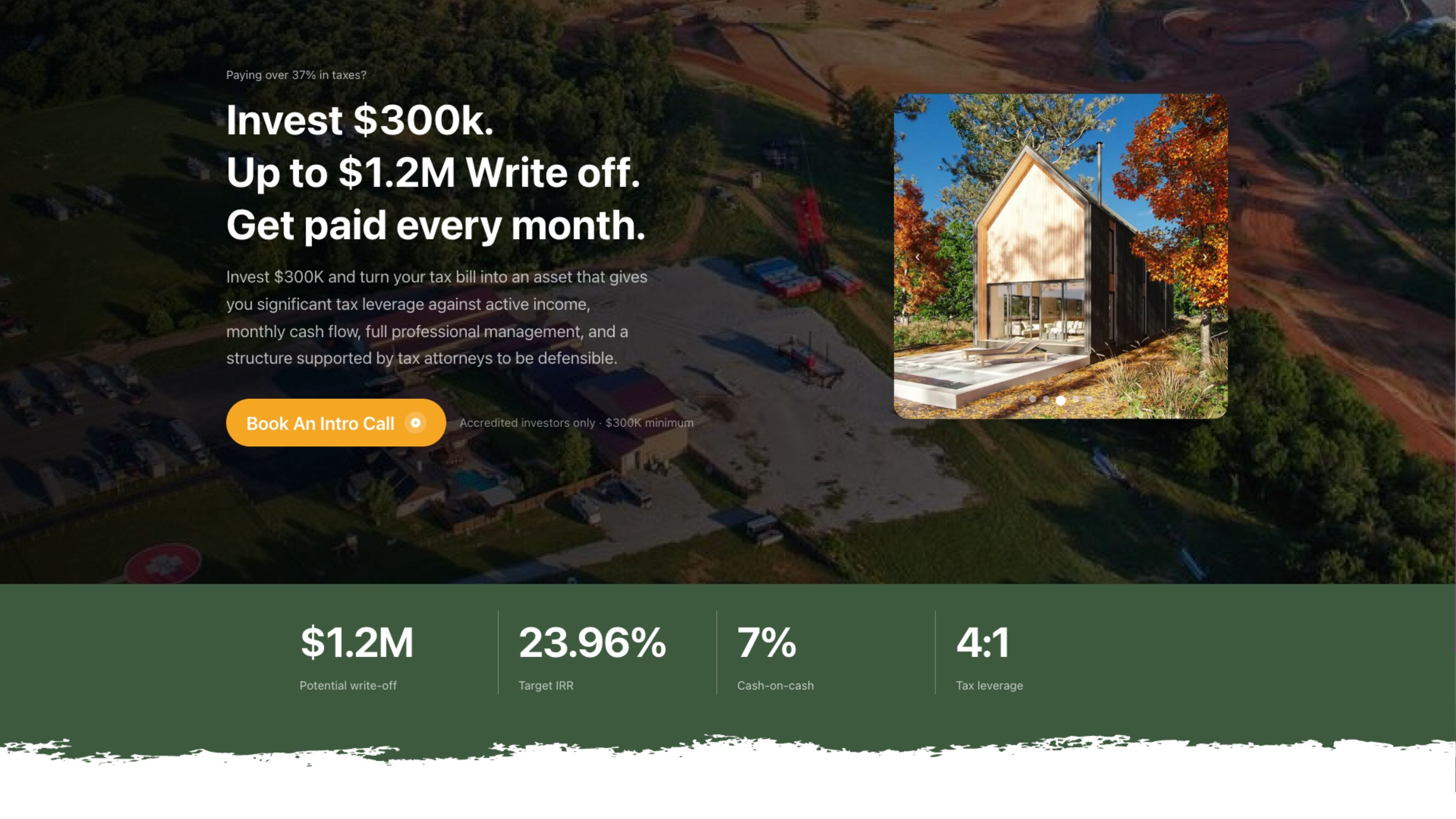
Invest $300k. Up to $1.2M Write off. Get paid every month
The headline alone deserves attention:
“Paying over 37% in taxes?”
Followed immediately by:
“Invest $300k. Up to $1.2M Write off. Get paid every month.”
AOAP then tells prospective investors that a US$300,000 investment can provide “significant tax leverage against active income, monthly cash flow, full professional management, and a structure supported by tax attorneys to be defensible.” Elsewhere on the same page, the numbers are presented as US$1.2 million potential write-off, 23.96% target IRR, 7% cash-on-cash and 4:1 tax leverage.
The website goes further. Under “What Your $300K Gets You,” AOAP promotes direct title to a luxury cabin, a leveraged first-year write-off, significant tax savings, “7% Contractual Cash Flow”, a “23.96% + Targeted IRR”, full management and one free week at the resort each year. It tells investors they don’t need to manage bookings, maintenance, housekeeping, landscaping or even “worry about occupancy rates (Contractual Yield).”
That last claim becomes particularly interesting when you read the disclosures further down the very same webpage.
AOAP warns that it “may not generate sufficient revenue from park operations to meet contractual payment obligations.” It explains that the minimum payments exist regardless of individual cabin performance and acknowledges that these obligations could strain company cash flow, particularly during periods of lower resort revenue. The disclosures also warn that cabin values may fluctuate, there is no established secondary market, projections may prove inaccurate, development may experience construction delays and cost overruns, and permitting issues could adversely affect expansion.
That contrast is precisely why investors need to read beyond the headline.
The sales page says:
“Fund. We operate. You get paid.”
The risk disclosure says the company may not generate sufficient revenue to meet those payment obligations.
Those statements aren’t necessarily legally contradictory — one is marketing the contractual structure while the other describes the risks surrounding the company’s ability to perform — but an investor needs to understand both before committing US$300,000.
The tax claims deserve the same treatment.
AOAP markets a 4:1 leveraged write-off and says the year-one deduction can equal 400% of the amount deployed. It describes the structure as designed by specialised tax attorneys, supported by opinion letters and confirmed by CPAs. It also contrasts its strategy with cost segregation, oil and gas, syndications, equipment leasing, charitable giving and land easements, presenting AOAP as the option that checks all of its listed boxes.
But at the bottom of the page, AOAP’s tax disclaimer is considerably more cautious. It says results vary according to the investor’s tax profile, entity structure and level of participation. It states that deductions under the cited provisions require proper structuring and qualification as part of an active trade or business, tells investors to consult their own professionals and makes clear that AOAP does not provide individual tax advice.
Again, that doesn’t establish that the proposed tax strategy is improper.
But “Invest $300k. Up to $1.2M Write off” is an extraordinarily powerful marketing proposition, and anyone considering it should have the entire structure independently reviewed by a tax attorney and CPA who are working for the investor — not simply rely on the headline or professionals associated with the offering.
The website itself ultimately contains perhaps the most important warning. Its disclosures state that its internal estimates have not been independently audited or reviewed, that the company doesn’t guarantee its estimates or projections will be achieved, and that investors must be capable of withstanding the total loss of their investment.
Those are the words prospective investors need to read alongside the 23.96% target IRR and US$1.2 million potential write-off.
The marketing tells you what could go right. The risk disclosures tell you what could go wrong. Read both.
Lorenzo’s position is that Global Glamping taught him painful lessons. He says he trusted Devon’s representations, believed the existing resorts demonstrated that the model worked and had no visibility over Global Glamping’s internal finances. When problems emerged, he says he stopped selling, organised affected purchasers and turned his attention towards trying to recover their money.
If that experience genuinely changed the way Lorenzo approaches investment opportunities, America’s Outdoor Adventure Park provides an extraordinary opportunity to see those lessons being applied in real time.
There are meaningful safeguards in AOAP’s current offering. The website says it operates under Regulation D Rule 506(c), restricts participation to accredited investors, provides a Private Placement Memorandum and tells prospective investors that they should conduct their own due diligence and obtain independent financial, legal and tax advice.
But the marketing is also extraordinarily confident.
AOAP tells prospective investors “This Isn’t a Concept. It’s Already Running.” It describes the resort as “already built, already cash-flowing”, promotes an 80%+ peak occupancy figure for family cabins and says investors don’t need to worry about occupancy because of the contractual yield. It presents a US$300,000 investment alongside a potential US$1.2 million write-off, monthly contractual cash flow and a 23.96% target IRR.
Yet AOAP’s own disclosures acknowledge risks that sound remarkably familiar after investigating Global Glamping: construction delays, cost overruns, permitting issues, inaccurate revenue projections, insufficient operating revenue and the possibility that contractual payment obligations could strain the company’s cash flow.
That doesn’t mean those problems will happen to AOAP. Risk disclosures exist precisely because businesses need to explain what could go wrong.
But Lorenzo’s defence of his Global Glamping involvement repeatedly comes back to the same dividing line. He sold the opportunity, but Devon was responsible for delivering it. He presented information, but much of that information came from Devon. He worked with the contracts, but Devon controlled and signed them. He earned commissions, but Devon controlled the purchaser money.
With AOAP, Lorenzo can no longer create that same distance between himself and the underlying operation.
AOAP’s own website identifies him as Co-Founder and says he “drives operations and growth, ensuring seamless execution across all departments while maintaining a strong focus on investor outcomes.”
That makes the lesson from Global Glamping particularly important.
Lorenzo now has an opportunity to demonstrate that the person promoting the investment understands not merely how to sell the vision, but how to make sure the underlying business can actually deliver it.
This time, the promises aren’t coming from somebody Lorenzo works for. They’re coming from a company he helped build.
The public record around America’s Outdoor Adventure Park added another layer to Lorenzo’s story. In early 2025, public announcements presented Lorenzo Ayres and Michael Hyams as the people behind the redevelopment of the former MidAmerica Outdoors property in Oklahoma. The plans were ambitious: cabins, additional accommodation, RV sites, off-road trails, pools and a wider hospitality development designed to attract both guests and investors.
By April 2026, that partnership had deteriorated badly enough for America’s Outdoor Adventure Park LLC and Lorenzo Ayres to take Michael Hyams to court.
According to the court documents supplied to me, the plaintiffs alleged that Hyams had been removed as a manager “for cause” and accused him of unauthorised financial disbursements, writing company checks to himself, using company credit cards for personal expenses, interfering with operations and threatening the financial stability of the business. They also alleged his conduct was affecting AOAP’s ability to raise capital. These are civil allegations, not findings that Hyams committed those acts.
The following day, Lorenzo appeared before the District Court in Delaware County, Oklahoma, without an attorney and gave sworn testimony in support of emergency relief. The court required a US$10,000 bond and granted a temporary ex parte restraining order, with a further hearing scheduled. That order was temporary and was made before the court had heard the full case from both sides, so it should not be treated as proof of the underlying allegations.
What interested me was the chronology.
Only a little over a year earlier, Lorenzo and Hyams had been publicly presented as partners building the future of AOAP. Now Lorenzo was asking a court to restrict Hyams’ access to company property, bank accounts, credit cards and digital systems.
That doesn’t prove a pattern of wrongdoing by Lorenzo. Business partnerships fail, sometimes dramatically.
But after spending more than an hour listening to Lorenzo explain how he had once trusted the wrong person at Global Glamping, another major partnership ending in accusations over money, control and business operations was difficult to ignore.
For most of our conversation, Lorenzo was relaxed and willing to talk at length. We discussed Devon, PhoneSales, the contracts, commissions and the purchasers who had lost money. He repeatedly encouraged me to concentrate on where Global Glamping’s money went and spoke confidently about his efforts to help affected purchasers.
Towards the end of our conversation, however, I turned the spotlight away from Devon and started asking about America’s Outdoor Adventure Park — and, specifically, the money Lorenzo himself had earned from Global Glamping.
Based on the records supplied to me, Lorenzo appears to have earned more than US$300,000 in commissions connected with Global Glamping sales. Some of the purchasers behind those transactions remain substantially out of pocket.
So I asked Lorenzo about giving those commissions back.
His answer deserves to be recorded accurately because he did indicate that he was willing to return them.
Lorenzo explained that under his current arrangement with AOAP he receives only around US$3,000 a month in salary. He said he had deliberately negotiated his compensation differently, effectively accepting a low salary while receiving what he described as the “vast majority of the shares” in the company.
When we discussed the commissions, Lorenzo acknowledged that repaying such a substantial amount from US$3,000 a month would take years. But he didn’t reject the idea of returning the money. Instead, he told me:
“Once that contract is up, I will be much more willing to, you know, give those commissions back.”
I think that statement is important, and Lorenzo deserves credit for putting it on the record.
It is not the same as an immediate, unconditional commitment to repay every commission, and I don’t want to represent it as one. But Lorenzo has now publicly expressed a willingness to return commissions he earned from Global Glamping once his current contractual circumstances change.
That also creates something measurable.
If Lorenzo believes, as he told me, that he was deceived by Devon and genuinely wants to help the purchasers affected by Global Glamping, then returning commissions earned from those transactions would be a significant demonstration of that position.
His present financial circumstances are also more complicated than a US$3,000 monthly salary might suggest. Lorenzo told me that the trade-off for accepting that salary was receiving the vast majority of the shares in AOAP. A low salary therefore doesn’t necessarily mean a lack of financial interest or potential wealth.
And AOAP is now actively soliciting accredited investors with a US$300,000 minimum investment, advertising a potential US$1.2 million write-off, 7% contractual cash flow and a 23.96% target IRR. Lorenzo is identified on that website as Co-Founder and the person who “drives operations and growth.”
There is nothing inherently improper about a founder taking a small salary in exchange for substantial equity. That is common in growing businesses. The relevance here is much narrower.
Lorenzo has put his willingness to return his Global Glamping commissions on the record.
For purchasers who are still waiting to recover their money, that statement is important.
Now there is something concrete they can eventually hold him to.
Lorenzo’s explanation of his role is important, but the affected purchasers don’t necessarily see him the same way. After parts of our recorded conversation were shared with the investor group, the reaction was strong. Several purchasers rejected the idea that Lorenzo should be regarded simply as another victim of Devon.
Their perspective comes from direct experience. Lorenzo wasn’t someone they discovered after Global Glamping collapsed. For some, he was the person they dealt with while deciding whether to invest. They remember his confidence in the opportunity and the role he played in getting their transactions completed. Whatever Lorenzo may or may not have known about Devon’s finances behind the scenes, those purchasers regard him as part of the sales process that convinced them to proceed.
His involvement with America’s Outdoor Adventure Park has made that resentment stronger. Investors who are still trying to recover money from Global Glamping can now see Lorenzo building another hospitality business, holding substantial equity and describing ambitious plans for its growth. At the same time, he acknowledges that returning his Global Glamping commissions from his current US$3,000 monthly salary would take years.
There is an important distinction here. Anger from victims is not evidence of wrongdoing. I have not established that Lorenzo knowingly sold investments he believed would fail, and his later efforts to organise purchasers and pursue Devon remain relevant evidence in his favour.
But Lorenzo cannot define how the people he sold to should view his role.
For some of those purchasers, the issue isn’t whether Lorenzo eventually helped them. It is whether someone who profited from their original decision to invest carries a continuing responsibility when the opportunity he helped sell was never delivered as expected.
They don’t necessarily see the salesman and the victim as the same person.
There is another side to this investigation that deserves recognition. When I approached PhoneSales with difficult questions about its involvement in Global Glamping, the company could easily have distanced itself from the entire mess.
Instead, it opened its files.
PhoneSales provided me with CRM records, contracts, DocuSign material, internal communications, sales information and recordings created while its relationship with Global Glamping was still active. Most importantly, it provided the recorded meeting in which Devon was confronted about transactions the company believed had not been properly reported through its sales operation.
That level of access allowed me to test what PhoneSales was telling me rather than simply repeating its version of events. It also exposed information that wasn’t necessarily flattering to the company itself, including the approximately 40% commission structure and the extent to which it had relied upon Devon’s representations when allowing its sales operation to market Global Glamping.
PhoneSales has acknowledged that its due diligence should have gone further. That admission matters. When you’re helping sell six-figure opportunities, relying on the person paying you to verify the fundamentals isn’t enough. The company says it ultimately lost money on the Global Glamping engagement after advertising, lead generation, sales staff and other operating costs were taken into account.
Whether every conclusion PhoneSales has reached about Devon and Lorenzo is correct is a separate question. What impressed me from an investigative perspective was something much simpler: they gave me material capable of testing their own claims.
That is what I want from anyone involved in an investigation like this.
Not another polished explanation.
Show me the records.
While working through the records, another detail caught my attention. A separate company called Phone Sales LLC had been registered in Montana, with Devon Allan Towle and Lorenzo Ayres connected to it.
That was immediately confusing because it was not the same company as the PhoneSales business that had originally been contracted to generate leads and sell Global Glamping. The similarity in names makes the distinction important: PhoneSales, the outsourced sales company whose records I had been reviewing, told me it had no ownership or involvement in this Montana entity.
The timing also matters. The Montana company appeared during the period when the relationship between the original PhoneSales operation, Devon and Lorenzo was deteriorating and Lorenzo was moving towards working directly with Devon. Against the allegations about leads and transactions occurring outside the original PhoneSales arrangement, the existence of another company with such a similar name naturally raised questions.
But I don’t want to take the evidence further than it goes.
A corporate registration establishes that the entity existed and identifies the people connected with it. It does not, by itself, prove that the company was created to divert leads, avoid commissions or deceive the original PhoneSales business. I have not seen evidence establishing that as its purpose.
What the Montana entity does provide is another piece of the chronology. Lorenzo had moved from selling Global Glamping through PhoneSales to working directly with Devon, and the two men were subsequently connected through a company carrying essentially the same business name as the sales organisation that had originally brought them together.
Given everything PhoneSales had already shown me about its dispute over customers and commissions, that was not something I was prepared to ignore.
While examining Lorenzo Ayres’ background, I found another document that deserves to be included in this investigation — not because it proves anything about Global Glamping, but because it provides additional context about his previous employment in the financial services industry.
An official Investment Adviser Public Disclosure (IAPD) report for Lorenzo Ayres, CRD #6749765, shows that he was previously registered with Fidelity Personal and Workplace Advisors in American Fork, Utah, between August 2018 and August 2019. The report states that Lorenzo is no longer registered as an Investment Adviser Representative and records one disclosure event involving a termination.

The disclosure was reported by Fidelity Brokerage Services LLC.
According to the record, Lorenzo was “Discharged” on August 8, 2019.
The allegation recorded by Fidelity reads:
“Allegation regarding whether employee did not pay for food from firm’s cafeteria.”
I want to be precise about what this document does — and doesn’t — establish.
The disclosure records an allegation reported by Lorenzo’s former employer and the fact that he was discharged. It does not say Lorenzo was convicted of theft, doesn’t document a criminal charge and doesn’t provide a finding that he stole anything. The IAPD itself warns readers that disclosure information can include allegations that may be contested, unresolved or unproven.
On its own, an employment dispute over unpaid cafeteria food from 2019 would have little relevance to an investigation into Global Glamping years later.
But Lorenzo is now helping market a US$300,000 minimum investment opportunity through America’s Outdoor Adventure Park, and his history in financial services forms part of the background prospective investors may reasonably want to understand. His IAPD record also shows he passed the Series 66 Uniform Combined State Law Examination in June 2018 but is not currently registered as an Investment Adviser Representative.
I’m therefore publishing the record for what it is, without exaggerating what it says.
Lorenzo was discharged by Fidelity following an allegation concerning unpaid cafeteria food. Anything beyond that would go further than the evidence.
By this point, Lorenzo’s role no longer depended on how anyone chose to describe it. The documents were beginning to speak for themselves.
Investor records showed Lorenzo communicating directly with prospective purchasers, supplying information, discussing financing and appearing on agreements as “Prepared By: Lorenzo Ayres.” PhoneSales’ records placed him inside the same chain from another direction, with leads moving through its CRM and agreements subsequently appearing for customers it believed had originated through its marketing.
The recorded PhoneSales confrontation added an important piece to that paper trail. When Devon was shown agreements connected to customers he appeared not to recognise, he acknowledged how he had been handling documents arriving for signature:
“Anything that comes through, I just sign it. Like, I don’t really check it.”
That statement helps clarify something that later became important when I questioned Lorenzo about his involvement with the contracts. Lorenzo acknowledged helping prepare and edit agreements while working between purchasers and Devon. Devon’s own recorded comments support the other side of that process: the agreements were reaching him through DocuSign and he was signing them on behalf of his business, apparently without always examining them closely.
None of that proves Lorenzo knew Devon would fail to deliver, nor does it prove that any transaction was deliberately concealed. But it prevents the paperwork from being interpreted too far in either direction. Lorenzo’s name appearing as “Prepared By” demonstrates meaningful involvement in the sales and contracting process. Devon’s signature demonstrates something different: the contractual obligation ultimately belonged to Global Glamping.
The more records I reviewed, the clearer it became that two things could be true at once. Devon could carry responsibility for what his companies promised and failed to deliver, while Lorenzo could still carry responsibility for what he personally presented, represented and helped sell.
That is why I stopped trying to decide whether Lorenzo was simply a salesman or simply a victim.
The better question was much narrower:
What did the records show he actually did?
Whatever questions remain about Lorenzo’s role in selling Global Glamping, the evidence also shows that his role changed once the problems became undeniable.
Lorenzo says that by early 2025 he was no longer trying to sell Devon’s projects. Instead, he began communicating with affected purchasers, comparing their experiences and helping bring people together who had previously been dealing with Devon individually. That distinction matters because isolated buyers have very little leverage. A coordinated group with contracts, payment records and a common timeline is much harder to ignore.
By April 2025, Lorenzo was involved in organising a formal default process against Devon. He says this eventually developed into coordinated legal action and settlement negotiations involving affected purchasers. Some of the investors I’ve spoken with confirm that Lorenzo played an active role during this period and helped them communicate, organise documentation and pursue a collective response.
That doesn’t rewrite what happened during the sales period, and I don’t think it should. Helping purchasers afterwards doesn’t automatically cancel responsibility for what happened beforehand. Equally, it would be unfair to investigate Lorenzo’s involvement in selling Global Glamping while ignoring documented efforts he later made to help the people affected by its collapse.
This is one of the uncomfortable realities running through the entire investigation.
Lorenzo helped sell the opportunity.
Then, when it fell apart, he helped organise some of the people who had bought it.
The effort to organise purchasers eventually produced something more concrete: a settlement intended to resolve the outstanding Global Glamping claims.
For affected buyers, this represented an important shift. They were no longer relying on individual assurances that construction would eventually happen or that refunds would arrive. The settlement created a formal pathway through which Devon could resolve the claims and begin returning money to people who had been waiting for answers.
Lorenzo says he played an active role in getting that process across the line. He worked with purchasers, helped coordinate information and has pointed to the settlement as evidence that his priorities had shifted from selling Global Glamping to helping clean up the damage left behind.
For the purchasers, however, the value of any settlement ultimately depends on whether it is honoured.
According to Lorenzo and affected buyers I’ve spoken with, Devon defaulted on the settlement. What had been presented as a route towards resolution therefore became another broken commitment for people who had already endured missed delivery dates, absent revenue and unsuccessful refund attempts.
That failure matters because by this stage the dispute was no longer about whether Global Glamping might eventually overcome construction problems or operational setbacks.
The buyers had already negotiated their way out. They were simply waiting to be paid.
As more purchasers began comparing notes, another pattern became difficult to ignore: the explanation for why Global Glamping wasn’t delivering kept moving.
At different stages, buyers say they were told delays were connected to permitting, zoning, weather, contractors, financing, property issues and other circumstances outside Devon’s control. Some of those explanations may have reflected genuine difficulties. Resort developments are complicated, approvals can take time and construction projects do encounter unexpected problems. But the issue wasn’t any single excuse. It was what happened when one explanation no longer accounted for the delays and another appeared in its place.
The same pattern surfaced in my own dealings with Devon. When I gave him an opportunity to respond to the allegations, he insisted Global Glamping was not a fraud or scam and told me he could prove it. He pointed to years of work, thousands of reviews and operating hospitality businesses as evidence that his underlying vision was genuine. He also argued that unfortunate circumstances had affected projects and asked for additional time to assemble answers, photographs, videos and supporting material.
I gave Devon the opportunity to answer the substantive questions.
What I needed wasn’t another explanation of his vision. I needed evidence showing where the purchasers’ money went, why contracted projects weren’t delivered, why promised revenue wasn’t paid and why agreed refunds or settlements remained outstanding.
That is the distinction running through this investigation. A business can encounter genuine setbacks. Plans can fail. Permits can be delayed and projects can become uneconomic.
But as the explanations accumulate, eventually the investigation has to move beyond why things supposedly went wrong and ask a much simpler question:
What happened to the money?
Throughout this investigation, almost everyone involved has at some point described themselves as being on the receiving end of someone else’s actions. PhoneSales says it lost money running the campaign and later discovered leads it believed had been diverted. Lorenzo says Devon misled him and that he eventually began helping purchasers pursue him. Devon has pointed towards third parties, business problems and circumstances he says contributed to Global Glamping’s failure.
But there is one group whose losses aren’t theoretical.
They are the people who actually handed over the money.
One couple who contacted me invested US$120,000 through BlueOcean Mountain LLC after initially dealing with Lorenzo. They told me they received none of the promised revenue sharing and eventually managed to get Devon onto a Zoom call. At one stage they were offered a refund but chose to remain with the project because they still believed it could succeed. When nothing improved, they accepted a later refund offer. According to the records they provided me, only US$4,000 of their original US$120,000 had been returned.
That detail tells an important part of this story. These weren’t people who transferred money and immediately regretted their decision. They waited. They asked questions. They accepted explanations and gave Global Glamping repeated opportunities to deliver. Even when offered a way out, they initially chose to stay because they still believed the project could work.
Other purchasers I’ve spoken with describe variations of the same journey. The amounts and properties differ, but the progression is familiar: money was paid, expectations were created, delays followed and explanations were offered. Eventually, the question changed from “When will my investment start producing revenue?” to “How do I get my money back?”
That is why I don’t want the human story buried underneath arguments between Devon, Lorenzo and PhoneSales.
Their disputes help explain how Global Glamping operated. The commissions, contracts, sales arrangements and allegations about diverted leads all matter. But ultimately, those aren’t the losses that brought me into this investigation.
The purchasers aren’t arguing about who deserved the commission. They’re trying to recover the principal.
By this point, the central question had become remarkably simple. Purchasers had paid substantial sums for projects that were not delivered as expected, so where did their money actually go?
The commission structure already tells us that not every dollar paid by a purchaser was available to build their project. PhoneSales says approximately 40% of cash collected on sales it generated could flow into the sales operation. But what happened to the remaining money after it entered the wider Global Glamping operation remains far less clear.
The recorded PhoneSales confrontation demonstrates why a proper accounting is so important. During that meeting, Devon was asked to search for specific transactions while everyone was on the call, including a US$300,000 deal PhoneSales believed had been completed. Devon searched by names and amounts but said he couldn’t locate the corresponding payment.
That moment shouldn’t be taken further than the evidence allows. Devon’s inability to find a transaction during a live meeting doesn’t prove Global Glamping never received the money, and it certainly doesn’t prove somebody else did. But it does show something extraordinary: the people involved in generating the customer, preparing the agreement and signing the contract couldn’t immediately reconcile where a substantial transaction had gone.
And that is the missing piece.
Devon has spoken about permitting problems, contractors, natural disasters and other setbacks affecting the projects. Some of those explanations may account for operational failures, but they don’t answer the financial question. If someone paid US$100,000, US$120,000 or US$300,000 in connection with one of these transactions, there should ultimately be records showing who received the money, where it went and what it paid for.
I have not seen a complete forensic accounting capable of answering those questions.
Until that exists, the strongest evidence in this investigation won’t come from another explanation, another Zoom call or another promise to make things right.
It will come from the bank records.
By the time I had spoken with PhoneSales, Lorenzo and multiple purchasers, another uncomfortable question had emerged: who actually verified what Devon was telling everyone before these deals were sold?
PhoneSales acknowledges that its due diligence should have gone further. Lorenzo’s position is that he relied heavily on Devon because there were real properties, paying guests and what appeared to be an operating hospitality business. Purchasers, in turn, relied partly on the confidence of the people presenting the opportunity to them. The result was a chain of trust in which too many people appear to have relied on information flowing from the same source — Devon.
That matters particularly when it comes to permitting and zoning. Purchasers weren’t buying a cheap consumer product. They were committing substantial sums to projects whose viability depended on land use, infrastructure, utilities, local approvals and the legal ability to operate accommodation at the proposed locations. Those aren’t minor administrative details to sort out after the sale. They go directly to whether the promised project can function at all.
I am not suggesting every salesperson should personally become a planning lawyer, accountant or construction expert before presenting an opportunity. But when six-figure transactions depend on claims about approvals, projected revenue and future development, somebody needs to independently verify the fundamentals rather than simply passing assurances down the sales chain.
That is one of the clearest lessons from Global Glamping.
The purchasers believed the salespeople. The salespeople say they believed Devon.
But belief is not due diligence.
One reason Global Glamping looked credible was that there were real hospitality businesses behind the marketing. Devon could point to operating properties such as Diamond Glamping and Triple G Resorts, along with photographs, bookings and reviews. Lorenzo says he visited the locations himself and saw what appeared to be genuine operations. PhoneSales relied on the same public footprint when assessing whether Devon was already doing what he claimed he could do.
That credibility mattered because purchasers weren’t being asked to invest in an entirely imaginary concept. They could see evidence that Devon had built and operated accommodation before. The problem is that an existing resort does not prove that a new development is permitted, funded or capable of being delivered on the same terms.
That distinction became especially important with the Stevensville project. Purchasers weren’t simply buying a geodesic dome as a standalone structure. They were buying the expectation that it would sit inside a functioning resort, be managed on their behalf and generate revenue. If the land, infrastructure, utilities or approvals weren’t ready, then the business opportunity itself wasn’t ready either.
This is where the sales pitch and the underlying development needed to be separated.
The existing resorts helped prove that Devon had experience in hospitality.
They did not prove that every future project being sold was ready to operate.
And that is the question purchasers should have been able to answer before the money changed hands.
Once I started asking that question, the investigation moved into an area that glossy presentations and projected returns couldn’t answer. What zoning, permits, water systems, wastewater approvals and development permissions were actually in place when these opportunities were being sold? If purchasers were being asked to pay substantial sums for revenue-producing accommodation at a particular location, those fundamentals should have existed — or purchasers should have been clearly told what was still conditional.
Lorenzo’s position is that planning, zoning and permitting were Devon’s responsibility. He says Devon repeatedly represented that he had approval to launch the projects and was working towards approval for additional units, and that documents were shown to the salespeople which appeared to support those representations. That may explain why Lorenzo believed what he was selling, but it also exposes a weakness in the process: the people presenting these projects appear to have been relying heavily on information supplied by the same person responsible for delivering them.
The contracts themselves make the importance of permitting difficult to dismiss. One Global Glamping agreement I reviewed specifically states that Global would complete the work necessary to make a dome suitable for short-term rental, including “obtaining all necessary permits and certificates of occupancy.” The same agreement contemplated a 90-day building phase followed by guaranteed distributions. Permitting therefore wasn’t some unrelated administrative issue — it sat directly underneath Global Glamping’s contractual ability to put the accommodation into operation and begin producing revenue.
I have also received allegations from people familiar with the Stevensville property concerning longstanding water, septic and regulatory problems. Those allegations are serious, but I am not going to turn them into established facts without the underlying government records. The correct way to answer what Global Glamping was legally authorised to build is through the permits, planning records and regulatory documentation themselves.
And that leaves a very straightforward evidential test.
If Devon was telling salespeople and purchasers that the projects had the approvals necessary to proceed, there should be paperwork capable of proving it.
Show us the approvals.
One of the reasons Global Glamping was so convincing was that Devon wasn’t pitching from an empty shell. He had real properties, real guests, real reviews and accommodation people could actually book. Lorenzo visited Diamond Glamping and Triple G Resorts himself, while PhoneSales relied on the same visible footprint when assessing whether Devon appeared capable of delivering what he was selling.
That credibility was powerful.
A prospective purchaser could look online and see evidence of an operating hospitality business. They could see domes, cabins, photographs and reviews. To many people, that made the next stage of expansion feel like a continuation of something already proven rather than a speculative development starting from scratch.
But that is where the distinction becomes critical.
An existing resort can demonstrate experience. It cannot prove that a different site has the permits, infrastructure, financing or capacity required to deliver another project.
This is one of the patterns I see repeatedly in investment schemes that later unravel. Something real is used to create confidence in something that has not yet been delivered. The genuine part of the business becomes evidence for the future promise, even when the two are not commercially or legally equivalent.
Global Glamping had enough reality around it to make the expansion believable.
The purchasers weren’t paying for what Devon had already built. They were paying him to deliver what came next.
The marketing created the vision, but the contracts made it feel real.
The agreements I reviewed didn’t read like vague expressions of interest. They set out specific obligations, timelines and financial arrangements. One contract stated that Global Glamping would complete the work necessary to make the dome suitable for short-term rental, including obtaining the required permits and certificates of occupancy. It contemplated a 90-day building phase, after which the revenue-sharing arrangement was supposed to begin.
For a purchaser, that changes the psychology of the transaction. You’re no longer relying solely on photographs, projections or promises made during a sales call. You have a signed document describing what is supposed to happen next.
The PhoneSales confrontation provides revealing context about how some of those agreements were being handled behind the scenes. When Devon was confronted with contracts he appeared not to recognise, he explained:
“Anything that comes through, I just sign it. Like, I don’t really check it.”
That admission is significant. Lorenzo has acknowledged helping prepare and edit agreements while working between purchasers and Devon. But Devon’s own words confirm the other end of that process: agreements were reaching him through DocuSign and he was signing them, apparently without always examining closely what he was committing his companies to.
That doesn’t transfer responsibility for the contracts to Lorenzo. Nor does it establish that Devon intended not to honour them. What it does reveal is a remarkably casual approach to agreements involving substantial amounts of purchaser money.
Once Devon signed those documents, however, the promises weren’t merely part of a sales presentation.
They were contractual obligations Global Glamping had agreed to fulfil.
For some purchasers, the decision to ask for a refund should have marked the end of the story. They were no longer waiting for a dome to be completed or hoping future revenue would make everything right. They wanted out.
But several purchasers have told me that getting Devon to agree to a refund and actually receiving the money became two very different things. Promises were made, payment arrangements discussed and expectations reset, only for buyers to find themselves waiting again.
One couple’s records illustrate the problem particularly well. After investing US$120,000, they initially rejected an opportunity to exit because they still believed Global Glamping could deliver. When the promised revenue failed to arrive, they eventually accepted a refund arrangement. According to the documentation they provided me, only US$4,000 was returned.
By then, the nature of the dispute had fundamentally changed.
These purchasers weren’t demanding projected profits or arguing about whether a resort had performed as expected. They were trying to recover money Devon had already agreed should be returned.
That distinction matters because each new promise bought more time. First purchasers waited for construction. Then they waited for revenue. When those expectations failed, some waited for refunds.
For others, the attempt to recover their money would eventually move beyond individual promises altogether.
It would become a formal settlement.
By 2025, the problems surrounding Global Glamping were no longer confined to purchasers asking where their domes, revenue payments or refunds were. Lawsuits and creditor claims were creating an external paper trail of a business under increasing financial pressure. That mattered because court records gave me something independent of the competing explanations I had been hearing from the people involved.
The litigation wasn’t all brought by disappointed Global Glamping purchasers. Some disputes involved creditors and businesses claiming they were owed money. Lorenzo also told me that after leaving Global Glamping he discovered liabilities he says weren’t visible to him while he was selling the opportunity, including merchant cash advance and factoring arrangements. His position is that these obligations helped explain why a business that appeared healthy from the outside may have been under considerably greater financial pressure underneath.
I need to be careful with that claim. Lorenzo didn’t have access to Global Glamping’s complete books while he was selling, and neither do I now. I cannot establish from the material currently available exactly when every liability arose, how much was outstanding at any particular point, or whether purchaser funds were being used to service unrelated debts.
But the chronology raises legitimate questions.
PhoneSales says its involvement ended in September 2024. Lorenzo says his final Global Glamping sales activity continued until around December 2024. By early 2025, purchasers were reporting missed payments and non-delivery, and as the year progressed more disputes and financial problems became visible.
That takes the investigation beyond whether Global Glamping simply suffered a series of unfortunate setbacks.
The question is what was the true financial condition of the business while new purchasers were still being encouraged to sign contracts and transfer substantial amounts of money?
Answering that properly requires more than allegations or explanations.
It requires the books, the bank records and the transaction history.
By this stage, I was effectively dealing with three different accounts of the same business relationship.
Devon says Global Glamping was a legitimate business that encountered serious problems and unfortunate circumstances. PhoneSales says it was hired to generate and close customers, relied on information supplied by Devon and later discovered transactions it believed had bypassed its sales operation. Lorenzo says he genuinely believed in the opportunity, was himself misled by Devon and later switched sides to help the purchasers.
Those accounts aren’t mutually exclusive in every respect. PhoneSales and Lorenzo can both have been wrong about Devon without necessarily knowing they were wrong at the time. Devon could also have genuinely intended to build successful resorts while still ultimately failing to meet contractual obligations. Intent is one of the hardest things to establish after a business collapses.
That is why I keep coming back to the records.
The contracts tell us what Global Glamping agreed to deliver. CRM records show how prospective purchasers moved through the sales process. Commission records help establish who was paid when deals closed. Communications show what purchasers were being told. Court records document disputes that later emerged. And ultimately, bank records should be capable of showing where the money went.
I don’t need to choose the most convincing storyteller.
The documents allow us to test all three stories against the same evidence.
For someone who had spent more than an hour speaking openly with me, there were still limits to what Lorenzo Ayres was prepared to discuss publicly.
At several points, Lorenzo referred to information he said he had learned about Devon, Global Glamping and the movement of money but was reluctant to provide details that could compromise legal action, law-enforcement enquiries or people who had supplied information privately. I respected that distinction. An investigation doesn’t become stronger by publishing claims simply because somebody tells me they exist.
That left me in an unusual position. Lorenzo was encouraging me to follow the money, while also making it clear that some of what he believed he knew couldn’t yet be placed on the public record.
For me, the standard remains the same regardless of who provides the information. If Lorenzo has evidence showing where purchaser funds went, that evidence could become extremely important. But until I can independently review and corroborate it, I am not going to present private allegations as established fact.
There is also a broader point here. Lorenzo has given me considerably more access than Devon has. He agreed to a lengthy recorded conversation, answered difficult questions about his own involvement and discussed matters that were plainly uncomfortable for him. That cooperation deserves to be acknowledged.
It doesn’t mean his version of events should simply be accepted.
The unanswered questions remain unanswered until the evidence answers them.
From the beginning of this investigation, I have tried to give the people involved an opportunity to explain their side of the story. A right of reply isn’t a courtesy reserved for people I agree with. It is part of doing the investigation properly.
Devon was given detailed questions about the allegations being made against Global Glamping. He responded that he cared about his clients, partners and guests, pointed to more than 2,000 reviews and an average rating of 4.6, and insisted: “we are not fraud or scam and I can PROVE that.” He said he was assembling answers, photographs and videos and offered to participate in a recorded Zoom interview.
Devon also argued that I had given him only a few days to answer questions covering years of business activity. I disagree with his characterisation of the timeline, but his position is documented and readers should know what he said. The more important issue for me was never whether Devon could produce another explanation. It was whether he could produce evidence addressing the specific concerns raised by purchasers, PhoneSales and the records I had reviewed.
Lorenzo took a different approach. After some initial difficulty establishing contact, he provided an extensive written response and later agreed to speak with me for more than an hour. I challenged him directly about his commissions, contracts, relationship with Devon, decision to return to Global Glamping and his current involvement with America’s Outdoor Adventure Park. Some of his answers helped clarify the record; others created further questions.
PhoneSales also engaged with the investigation and, crucially, backed its account with records I could examine independently.
Giving someone a right of reply doesn’t mean accepting their explanation.
It means putting the allegations in front of them, recording what they say, and then testing that response against the evidence.
After working through the contracts, CRM records, communications, court filings, purchaser accounts and recorded conversations, there are some things I can say with confidence and others I cannot.
The evidence establishes that purchasers paid substantial sums to Global Glamping for projects that, in multiple cases I have examined, were not delivered as contracted. Expected revenue wasn’t paid, refund promises weren’t fully honoured and a later settlement intended to resolve claims was itself allegedly defaulted upon. It also establishes that PhoneSales played a significant role in generating and closing customers, that Lorenzo Ayres sold Global Glamping opportunities and earned substantial commissions, and that Devon Allan Towle controlled the businesses responsible for delivering the projects.
What the evidence does not establish is equally important.
I cannot say that every person involved in selling Global Glamping knew the projects would fail. I have not established that Lorenzo knowingly deceived purchasers, nor that PhoneSales knowingly marketed an opportunity it believed to be fraudulent. I also cannot yet provide a complete accounting of where every dollar paid to Global Glamping ultimately went.
That last question remains the most important.
There are competing explanations about who knew what, when relationships broke down and who should carry responsibility. Those disputes matter, but they shouldn’t distract from the facts that can be documented.
Money was paid. Contracts were signed. Obligations were created. Some of those obligations were not fulfilled.
The next level of accountability depends on evidence that has not yet been made fully available: the banking records, accounting records, permit files and complete transaction history capable of showing exactly what happened after purchasers transferred their money.
Until that evidence is produced, I will continue to distinguish between what I can prove, what people allege and what remains unanswered.
The evidence places Devon Allan Towle at the centre of Global Glamping. His companies entered into the agreements, received purchaser funds and carried the responsibility for delivering the projects. Whatever happened elsewhere in the sales chain, that central fact shouldn’t become blurred.
But accountability doesn’t necessarily stop with the person at the top.
When substantial financial opportunities are sold through professional sales operations, everyone involved carries some responsibility for what they personally say and do. PhoneSales generated leads and helped sell the opportunity. Lorenzo Ayres worked directly with purchasers and earned commissions from completed transactions. Their level of responsibility isn’t necessarily the same as Devon’s, and the evidence does not justify treating them as though it is.
What matters is individual conduct.
Did the salesperson accurately represent what they knew? Did the marketing company undertake reasonable due diligence before putting its people in front of prospective purchasers? Were warning signs acted upon when they appeared? And when things started going wrong, did those involved continue selling, walk away, or try to help the people affected?
PhoneSales has acknowledged that its due diligence should have been stronger and subsequently opened its records to this investigation. Lorenzo maintains that he genuinely believed Devon’s representations and later helped organise affected purchasers against him. Those facts belong in the story alongside the commissions, contracts and unanswered questions.
Accountability isn’t about forcing everyone into the same box.
It is about establishing what each person knew, what each person did, what each person earned — and what responsibility they accepted when the promises they helped sell weren’t delivered.
Publishing this investigation doesn’t mean the work is finished. In many ways, the most important evidence may still be missing.
The central unanswered question remains where the purchaser money went. Contracts, CRM records, commission information, communications and court filings can reconstruct much of what happened around the sales process, but they cannot provide a complete financial accounting. That requires bank statements, accounting records and transaction histories showing how funds moved after they entered Global Glamping’s control.
There are other gaps too. I want to see the underlying planning and permitting records for the properties where projects were sold, particularly where purchasers were led to believe accommodation would soon become operational. I also want to understand the full extent of Global Glamping’s liabilities while new deals were still being closed, and whether the people selling those opportunities were given an accurate picture of the company’s financial position.
Then there is America’s Outdoor Adventure Park. Lorenzo’s involvement doesn’t make AOAP fraudulent, and I have found no evidence that would justify making that allegation. But given his history with Global Glamping, the substantial investment being sought and the financial and tax claims being presented to prospective investors, I believe continued scrutiny is justified.
This investigation will therefore remain open.
If additional purchasers, former employees, contractors, salespeople or others with first-hand knowledge come forward, I will continue reviewing what they provide. What I am interested in isn’t gossip or speculation. I want contracts, emails, payment records, bank records, permits, internal communications and other evidence that can be independently tested.
Global Glamping has already produced enough competing stories.
What this investigation needs next is more evidence.
After all the contracts, commissions, sales records, lawsuits, explanations and competing versions of events, it is easy to lose sight of the people who matter most in this story.
The purchasers.
These are people who trusted what they were being shown and told. Some committed six-figure sums believing they were buying into real hospitality projects that would be built, operated and generate revenue. They weren’t expecting to become investigators, organise legal action or spend months chasing refunds. They expected the agreements they signed to be honoured.
I have spoken with purchasers who are angry with Devon, frustrated with Lorenzo and questioning how the sales process was allowed to operate without stronger due diligence. Others acknowledge Lorenzo’s later efforts to help them while still believing he carries responsibility for having sold the opportunity in the first place. Their experiences aren’t identical, and neither are their opinions about who should ultimately be held accountable.
What they share is much simpler.
They paid the money.
Everything else in this investigation — the 40% commission structure, the disputed leads, the sales relationships, the excuses, the settlement, the court proceedings and the arguments over who knew what — happened around that fundamental fact.
The people who paid shouldn’t have to become collateral damage in an argument between salespeople, business partners and company owners over who was responsible.
They deserve answers.
And where money is owed, they deserve their money back.
This investigation relies entirely on OSINT — Open Source Intelligence — meaning every claim made here is based on publicly available records, archived web pages, corporate filings, domain data, social media activity, and open blockchain transactions. No private data, hacking, or unlawful access methods were used. OSINT is a powerful and ethical tool for exposing scams without violating privacy laws or overstepping legal boundaries.
I’m DANNY DE HEK, a New Zealand–based YouTuber, investigative journalist, and OSINT researcher. I name and shame individuals promoting or marketing fraudulent schemes through my YOUTUBE CHANNEL. Every video I produce exposes the people behind scams, Ponzi schemes, and MLM frauds — holding them accountable in public.
My PODCAST is an extension of that work. It’s distributed across 18 major platforms — including Apple Podcasts, Spotify, Amazon Music, YouTube, and iHeartRadio — so when scammers try to hide, my content follows them everywhere. If you prefer listening to my investigations instead of watching, you’ll find them on every major podcast service.
You can BOOK ME for private consultations or SPEAKING ENGAGEMENTS, where I share first-hand experience from years of exposing large-scale fraud and helping victims recover.
“Stop losing your future to financial parasites. Subscribe. Expose. Protect.”
My work exposing crypto fraud has been featured in:
Coffeezilla 2026): Featured in the investigation exposing the alleged $328M Goliath Ventures Ponzi scheme
Bloomberg Documentary (2025): A 20-minute exposé on Ponzi schemes and crypto card fraud
News.com.au (2025): Profiled as one of the leading scam-busters in Australasia
OpIndia (2025): Cited for uncovering Pakistani software houses linked to drug trafficking, visa scams, and global financial fraud
The Press / Stuff.co.nz (2023): Successfully defeated $3.85M gag lawsuit; court ruled it was a vexatious attempt to silence whistleblowing
The Guardian Australia (2023): National warning on crypto MLMs affecting Aussie families
ABC News Australia (2023): Investigation into Blockchain Global and its collapse
The New York Times (2022): A full two-page feature on dismantling HyperVerse and its global network
Radio New Zealand (2022): “The Kiwi YouTuber Taking Down Crypto Scammers From His Christchurch Home”
Otago Daily Times (2022): A profile on my investigative work and the impact of crypto fraud in New Zealand
No posts
Comments
Nothing yet. Say the first thing.
Sign in to join the conversation.