
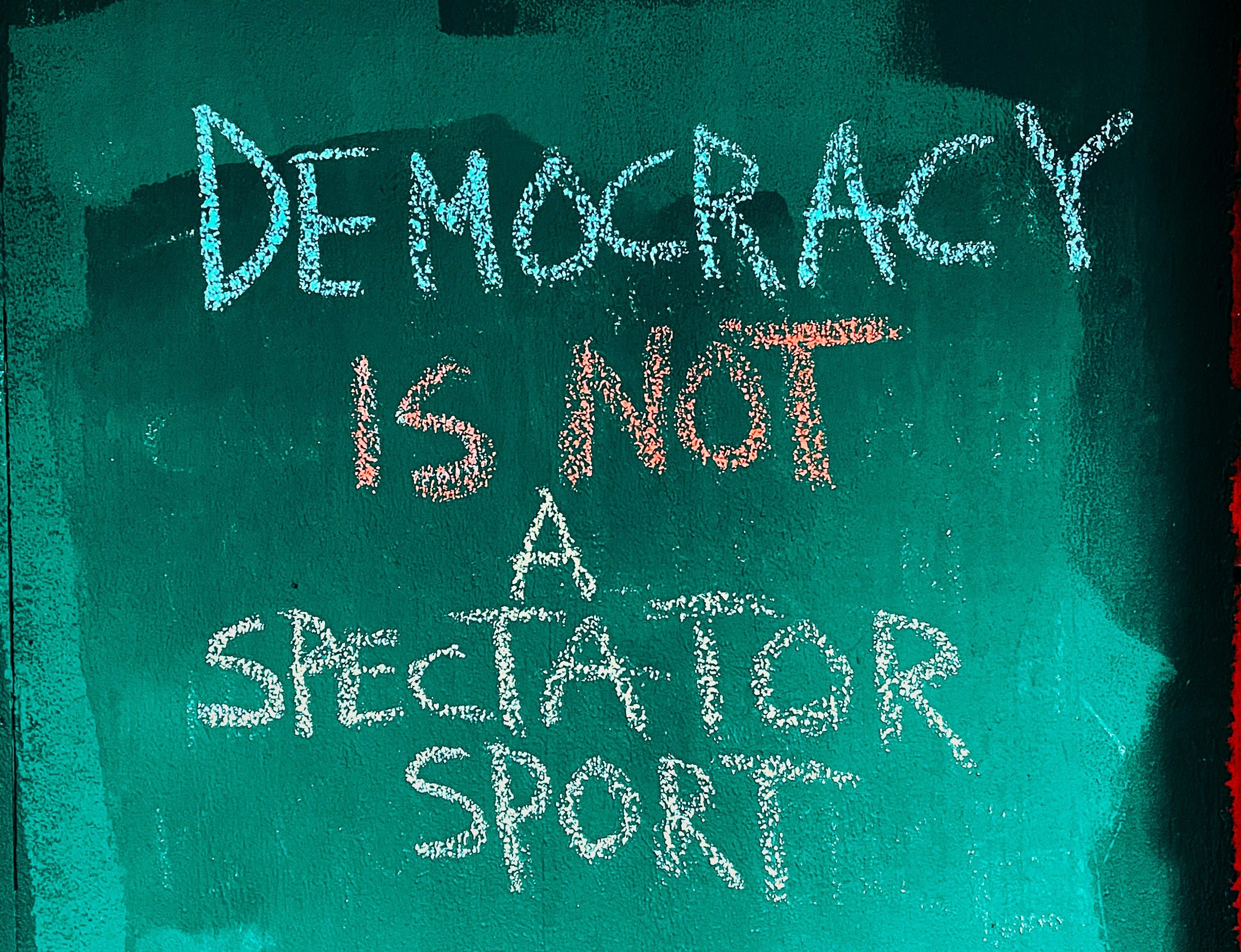
Photo by Jon Tyson on Unsplash
A paper was recently published in Science Direct titled: Sustainable and inclusive wellbeing governance: Reinventing democracy after the crisis. Its authors list include a who’s who in the sustainability and ecological economics world.
The authors start from the premise that degrowth policies are popular and most people around the world want them, but standing in the way of those policies being adopted is how collective decisions are made for a society. Said more plainly, the governments of the people who want that change won’t let them have it.
The report offers deliberative democracy as an alternative to our current system because it better represents societal values. The authors also offer sociocracy as a tool that emphasizes consent and can improve the deliberative process.
If you are new to the concepts of deliberative democracy and sociocracy, you are not alone. They are not part of many government systems around the world. But that is changing.
The authors of the report note that contemporary governance systems are increasingly shaped by concentrated economic and political power, undermining their capacity to act in the collective interest and to pursue long-term sustainability goals.
The report shows that our governance structures have become a choke point for sustainability transitions. Citizens want change, but the elites with the power do not want it - so change doesn’t come.
The authors recommend an increased use of deliberative assemblies that operate independently of partisan and special-interest control and have demonstrated success at several scales. Alternate decision-making methods, such as sociocracy, emphasise consent over majority rule and provide tools to reduce polarization and foster inclusive agreements within deliberative processes.
As faith in our current political systems degenerates, this may provide an opening to adopt more sustainable and inclusive forms of governance, grounded in deliberation, consent, and collective wellbeing.
The report explains that deliberative democracy is based on the idea that democratic legitimacy can be strengthened through inclusive and reasoned public deliberation that is institutionally designed to reduce distortions associated with unequal economic and political power.
Deliberations can include a whole population, or most of a population if the group is small enough (a town hall). For larger groups (as will be the case most often) random selection of participants through a process of “sortition” or lottery is an option. Deliberations can be quite large and involve a cross-section of a whole country such as recent citizen’s assemblies in Ireland, France or Belgium which were designed to address national issues.
Before you jump to the conclusion of replacing our whole political system with sortition, consider that some sortition scholars argue that randomly selected assemblies may create accountability gaps if the broader public are asked to defer to small groups of selected citizens that no one voted for. Many of these experts advocate for hybrid democratic systems that combine elected institutions with citizens’ assemblies and participatory mechanisms.
Sortition would also take much of the money out of politics. So much money is spent on elections and lobbying these days, that it is instructive to think of that money going to more useful endeavors. The authors of the paper give the example of elections in the as a test case:
For example, United States spent an estimated $18 billion on the extremely polarizing 2020 national and state elections and $16 billion on the 2024 elections. Imagine for a moment if this had been done using sortition. The President and Vice President would be selected at random from a large pool of qualified candidates. This pool could consist of all members of Congress and State governors, all of whom would have been selected by the same process. This would spell the end of political parties, lobbyists, political campaigns, and attempts to buy influence. It would be largely free from the distortions of unequal political power and would better represent true democratic representation.
If you use sortition (or a hybrid model) to get all those people together to address an issue, how do you make decisions? Enter sociocracy.
Sociocracy is governance by the socius or group or society, and is based on four key ideas:
The principle of consent governs decision-making, rather than consensus or majority rule. Majority rule disadvantages and disenfranchises the minority, while requiring absolute consensus can stall progress indefinitely. Consent, by contrast, requires that all participants can “live with” the decision. Participants ask themselves if the decision is “good enough for now and safe enough to try.” If there are participants who cannot consent to a decision, then a discussion aimed at finding an acceptable adaptation to the original proposal that satisfies the objection is started. This often leads to an improved proposal that can accommodate the shared interests of the whole group.
Overlapping networks of semi-autonomous “circles” as the fundamental structure, rather than a hierarchy. The circles are groups appropriately sized to deal with the domain of responsibility that has been allocated by the overall group. Consent, as described above, is used for decision-making in all circles as well as for selection of individuals for specific roles within the circle. Circles are overlapping with shared membership in each overlap.
Egalitarian selection of individuals for leadership and functional tasks. Elections are also taken by consent. Members of a circle first nominate either themselves or other members of the circle for a role. They must present the rationale for why they or their choice would be the best person for the role. There is then a deliberative discussion about the nominations with the possibility to change nominations. At some point, the discussion leader will recommend the election of the person for whom there are the strongest arguments. If any circle members have reasoned objections, there is further discussion until consent is achieved.
Double linking of circles to facilitate vertical and horizontal networking and communication. Circles are overlapping and at least two individuals are included in each of the overlaps. At the highest level of the organization, there is a “top circle” that works within the policies of the circle structure rather than ruling over it. This is analogous to a board of directors for a company or a Parliament for a country. The members of the top circle can include external experts with expertise in law, government, finance, community, and the organization’s mission.
The authors detail other potential principles for making a sociocracy stronger, but I leave it to you to explore those as you wish.
I can understand if many readers are skeptical that any system that uses deliberation and sociocracy could begin to replace some of the ways we govern ourselves. Most of us have trouble seeing the actors in our current political system stepping aside for deliberation and sociocracy.
But they already are.
As mentioned above, there have been famous examples in Ireland, France and Belgium (with the Belgium deliberation group made permanent). I have a friend who is helping to organize a six weeklong citizen’s assembly on the topic of wealth inequality in a major American city in 2027. The project is being done with the blessing and coordination of the local government. I will write about it in this space when the idea goes public.
Other examples of similar scope are popping up around the world. If you have the time you can read through a list of past, current and future citizen’s assemblies: here. The list of deliberative events is much longer, but there is no official source for it as these deliberations are often informal and unannounced outside of the small groups participating in them.
Companies are adopting deliberations and sociocracy in house to help include more workers in decision making.
Arketa Institute, the think-tank I helped found, will be hosting the first of a planned series of deliberations on reforming our pension and financial systems this fall in Switzerland.
As our current cultural, economic and political systems collapse, people will look for new ways of governing. Deliberation and sociocracy are likely to be a large part of that. But you don’t have to wait for the world to collapse. Learn more about these tools and employ them in your community.
I encourage you to look around in your community for citizen assemblies and deliberations. They are likely looking for people like you to participate.
Comments
Nothing yet. Say the first thing.
Sign in to join the conversation.