

DSA is legitimate word in Scrabble … right?
The election of the Democratic Socialist, Zohran Mamdani, as Mayor of New York in 2025 signaled to the nation the growing popularity of democratic socialism in the United States.
In 2017, 15 Democratic Socialists of America (DSA) members were elected to state and local offices, bringing DSA membership at any level of government in the U.S. to a total of 35 DSA officeholders. Today, over 250 DSA members currently hold elected office, with representation at every level of government.
In Michigan Democratic Abdul El-Sayed, who is NOT a DSA member, won the nomination of the Democratic party. He says he is not a member of the DSA but he has attended and headlined multiple DSA events between 2017 and 2020, and has been described by the organization as “a longtime friend of Detroit DSA”. The Republican party in Michigan is already running adds calling him a socialist.
In the not-too-distant past, anyone calling themself a socialist or even hanging out with such people would have been committing political suicide. But as with degrowth, the Overton Window is moving toward Democratic Socialism.
What is going on here? And what does the DSA think of degrowth?
The Democratic Socialism of today is not the same as the Social Democrats of FDR about 100 years ago - but they rhyme. Their aims are similar - power to the people - but the context is different because the times are different. FDR and the social democrats of his day were operating within a capitalist system that was not seen the same way as it iss today. People had lost some faith in capitalism following the great depression, but FDR and the social democrats were very much building a scaffolding of social programs within the capitalist system. One-hundred years later, discontent with our current economic system is growing, as more and more Americans see capitalism as an unfair and exploitative system favoring the few over the many.
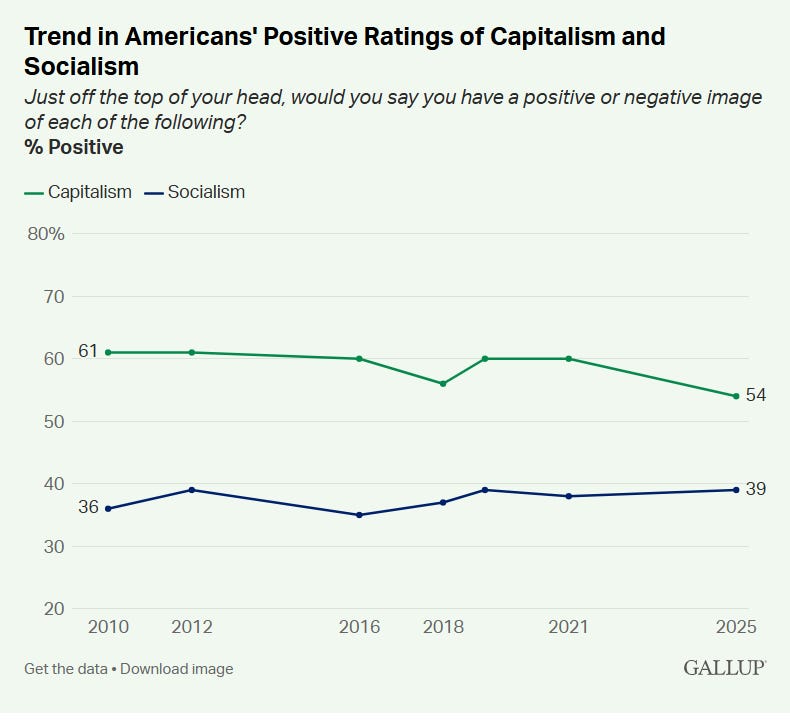
The discontent with capitalism is not surprisingly more evident in younger Americans. They see a world in which the environment is being destroyed, the cost of living is rising while it is harder than ever to get a job or buy a house.
A poll of over 1,500 college students conducted late in 2025 showed that 67 percent of students surveyed held a positive or neutral opinion of the word “socialism,” compared with only 40 percent of respondents holding the same opinion regarding “capitalism.”
According to the survey, “Negative views of capitalism outweigh negative views of socialism by an even greater difference: 53% v. 23%. One in three has a neutral view of socialism. One in four has a neutral view of capitalism,”
This data echoes a 2021 survey by the American Enterprise Institute, which found that only 47% of 18–34-year-olds in 2021 held a favorable view of capitalism.
After World War II, the “red scare” of socialism was everywhere. The main enemy of the United States would be the Union of Soviet Socialist Republics. Go back and consume the media, politics and culture of the day. Go back and read the comic books of the day - which targeted young boys - the red scare was everywhere.
But the Soviet Union is gone and capitalism is proving to be a harder and harder sell for a population that increasingly realizes that capitalism treats them as just a factor of production, and not as someone who their country should benefit. Crying the socialist wolf has lost its mojo.
Democratic socialism and degrowth are not big fans of our current economic system, both pointing out that capitalism has led us to less than desirable outcomes of hyper-inequality, environmental degradation, economic instability and a steady degradation of wellness in our body politic.
Both ideas reject the primacy of endless economic growth in our economy and culture. Democratic socialism calls for increased democratization of control over production in our economy (more worker-led co-ops, participatory budgeting and similar steps) so that we focus more on human well-being and ecological protection.
Degrowth can be framed as a necessary step in such a change by focusing on decreased energy and material throughput and increasing outcomes that benefit a broader swath of society. Jason Hickel has argued that degrowth would naturally emerge during a democratic socialist transformation, and that integrating degrowth into socialist paradigms is valuable.
While degrowth focuses on a reduction in production and consumption as a core political goal, it doesn’t often speak to what political forces will bring that about. Could that force be democratic socialism? Well … maybe.
Degrowth and democratic socialism may be compatible, they may both just be parts of a larger movement to bring more people and communities together to take the reins of power. But we have to acknowledge that while they do share a lot of ideas and the people that like them tend to shop at the same places, degrowth and economic socialism are very different things. Degrowth is a very broad idea and democratic socialism is a real “on the ground” political movement.
Degrowth is simply not a political movement. It is an idea. That means it is malleable. Degrowth is an idea you discuss in philosophy class about how the world should work. The democratic socialists are the kids in student government who hear those ideas and run with them.
Degrowth’s focus on decreased production and consumption fits nicely into a DSA agenda that aims to give power back to the people and workers that actually make an economy run. Democratic socialism focuses on coordinated, state-led or participatory planning as essential for restructuring our economy.
Degrowth is just an idea. If it is an idea whose time has come, it will be people organizing in first small communities and then bigger ones to take it forward. Will those people be democratic socialists? Maybe.
It is no surprise that degrowthers and democratic socialists hang out in a lot of the same political, cultural and economic spaces. Both movements think it best to get to some kind of post-capitalist future that addresses both social equity and ecological limits. Democratic socialist policies that seek to reduce overproduction, prioritize human wellbeing over profit maximization and reorganize work so that puts people over profits are all compatible with degrowth. At the same time most degrowth policies like a four-day workweek, universal basic income, universal basic services, a right to repair, and others all make sense on a democratic socialist platform. (See below).
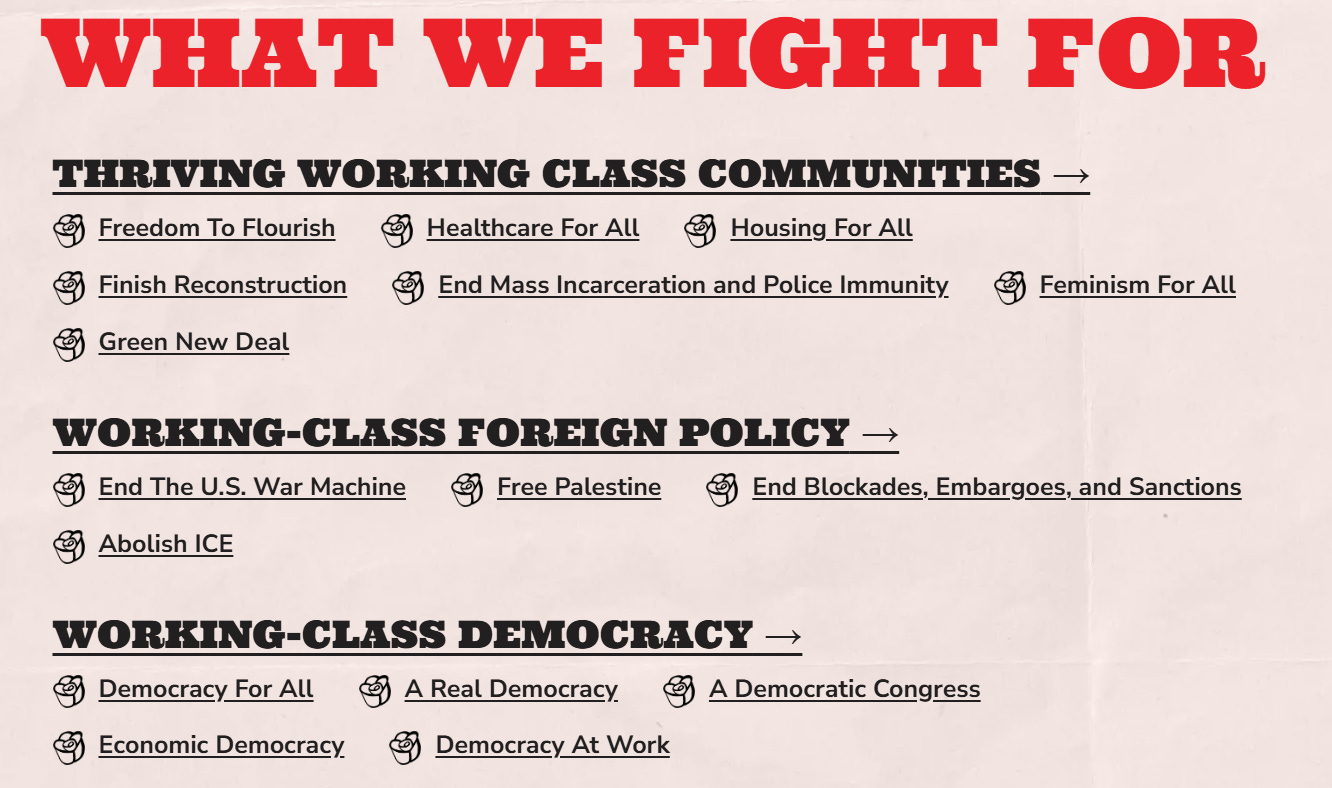
DSA platform from www.dsausa.org
Both movements are about putting people and the communities they live in first in line ahead of the needs of capital.
It will be interesting to watch what happens in the coming years as democratic socialism and the DSA grow in popularity. Will some in the DSA feel pressure to endorse the abundance argument that some in the Democratic party have? Such a stance says that capitalism is fine, it just needs to be reformed. Some more centrist democrats have taken this road, but I don’t those at the DSA doing so. Look at those policy objectives above. They don’t focus on getting people more stuff. They focus on getting people more power.
I would encourage those in the DSA to reach out to those in the degrowth world, if they haven’t done so already. But maybe do so quietly.
It has taken about 80 years, and the obvious failure of the current system for Americans to start feeling okay with the word socialism. The word degrowth is brand new to most Americans and while they like most degrowth policies, they don’t like the word.
But I encourage the degrowthers in this space to learn more about the DSA, and those in the DSA to learn more about degrowth. You are both trying to get to the same place. It will be easier to get there together.
Comments
Nothing yet. Say the first thing.
Sign in to join the conversation.