
As the new year begins, many of us are still recovering from a challenging 2025. Some of us are entering 2026 feeling exhausted after a year of being in constant motion, navigating one crisis after another, and contending with compressed timelines, information overflow, urgent demands, and constant triage.
Given the news that is breaking within just a few days of 2026, it is more than likely that our attention will be drawn to multiple places and that our capacity will be tested this year. The question though is not whether we will show up, but how we can do so in ways that are both strategic and sustainable.
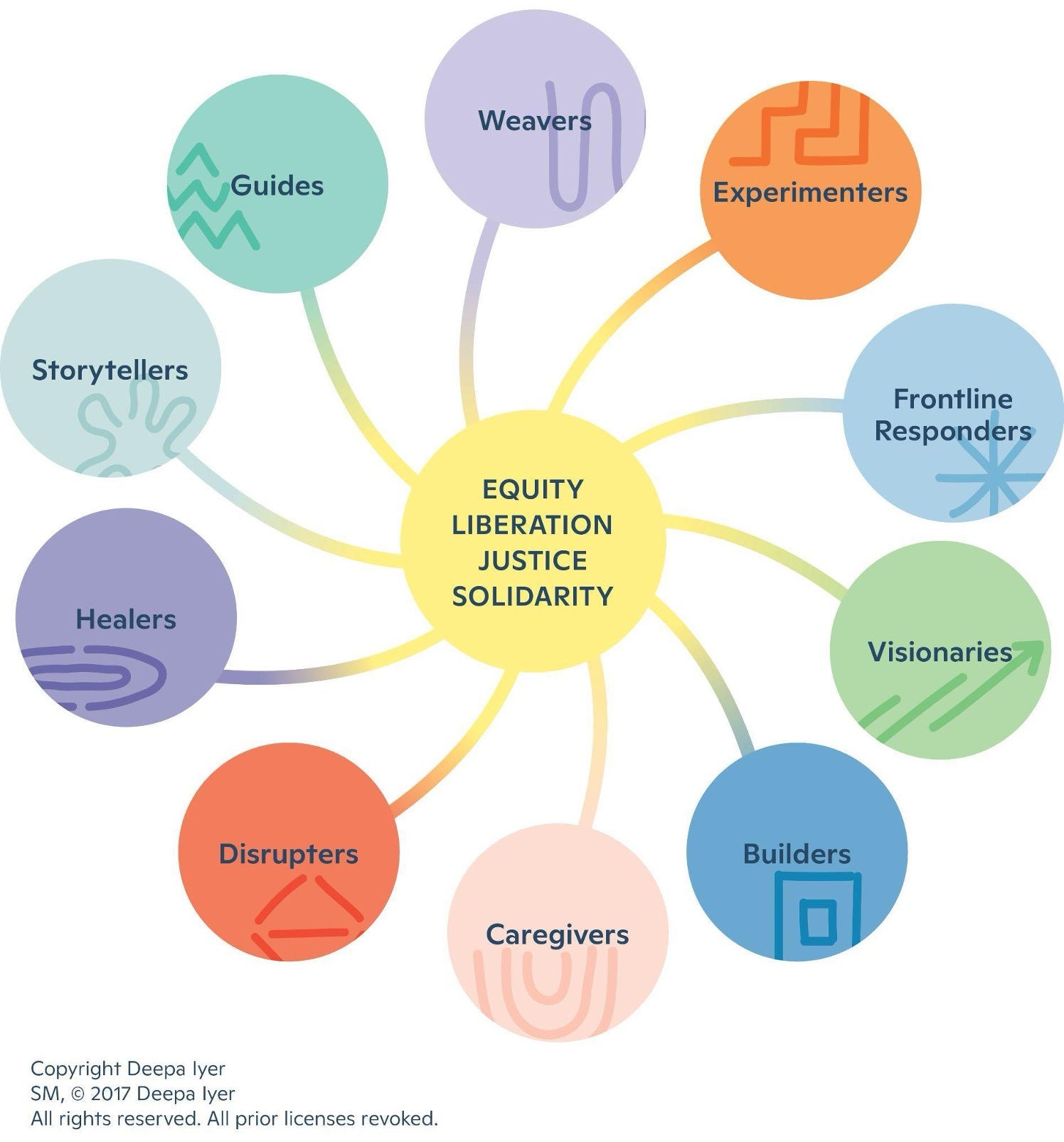
Below is a discernment practice called the Target, Stretch or Safety Approach I’ve developed that can be used by individuals and institutions to organize our social change roles in 2026. It draws upon the Social Change Ecosystem Framework © and the social change roles we often play - storytellers, disrupters, experimenters, visionaries, healers, builders, guides, caregivers, weavers, or frontline responders. (For those new to this framework, more information can be found here and here, and at www.socialchangemap.com.)
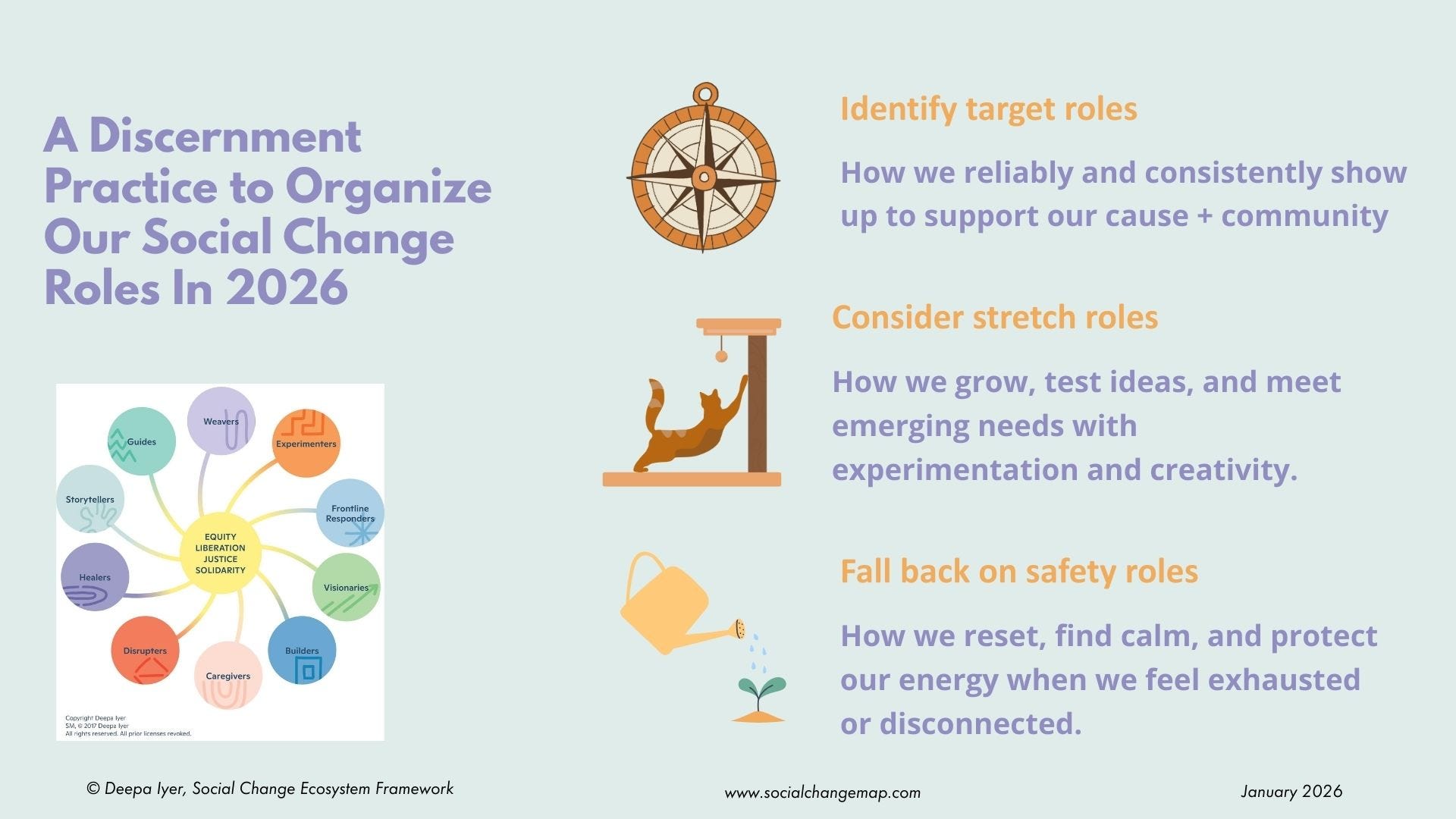
Using this approach can help us discern the conditions under which we play our target roles (where we are most reliable and consistent over time), experiment with our stretch roles (where we feel called upon to meet emerging needs in our communities), and fall back on our safety roles (where we regulate, ground, and restore our capacity to contribute).
This is a fluid approach that can be used as we embark upon or evaluate a project/initiative; on a quarterly basis; or when we recognize that our effectiveness and capacity are fading. As we recognize that our target, safety and stretch roles are in conversation with each other, we can become comfortable leaning into them at different times.
Here is a flow to use the approach:
Begin by identifying your target roles on the Social Change Ecosystem map.
Our target roles can support best when:
Our ecosystem needs consistency, follow-through, or maintenance
Our base/constituency has explicitly asked us to play these roles
Playing our target roles can offer steadiness, continuity, or historical knowledge during a period of instability
Playing our target role allows others to stretch or step into safety
Then ask whether and how these target roles should be played in 2026.
What scaffolding or support do you need to play them effectively? What roles are being required by the broader ecosystem? When do target roles become too much to hold? In those cases, are there safety roles to identify?
Notice generally when it may be time to step into safety roles.
It might be time for our safety roles when:
We feel numb, constantly stressed, and in a state of mental fogginess
The work is depleting us faster than it’s sustaining us
We notice (or others reflect to us) savior or martyr stances creeping in
We are repeating the same task without learning or renewal
We notice that our sense of worth has become tightly tied to how much we are producing or how quickly we are responding
We use the time in our safety role to make plans for the scaffolding we need when we shift back to our target role
Consider at different points of the year whether new needs are emerging in the community that call for us to play stretch roles.
It may be time for our stretch roles when:
We feel curiosity or the pull to be generative and future-oriented
Our stretch roles can address emerging needs/gaps
Our ecosystem needs to shift, course correct, or meet the moment differently
We have support already in our target roles
When choosing any of these approaches, here are some inquiries to keep in mind:
Have we checked in with what affected communities and the broader ecosystem need from us before switching roles?
Have we communicated clearly with our broader ecosystem that we are switching roles?
If we switch to safety or stretch roles, have we identified what we will focus on, and who is handling our target roles?
What are the time constraints—and exit points—around choosing stretch or safety roles?
What is our accountability plan to ourselves, our partners, colleagues, and communities?
What follows are examples of how using the target-stretch-safety approach can play out in real contexts for both individuals and institutions.
Consider an immigrant defense ecosystem where different people have come together to support a local community that is vulnerable to immigration enforcement.
A Builder in this ecosystem could be responding to crisis by organizing rapid-response infrastructure such as a legal referral hotline or a cadre of volunteers with specific tasks. This is their target role.
From there, they might stretch into the role of Storyteller because they discern that in order to widen the scope of referrals or volunteers to meet increasing needs, they need to share more information. In their stretch role as a Storyteller, they might draft a report about the conditions they’re witnessing—family separations, gaps in legal access, the cumulative harm of policy shifts—in order to make the case for stronger and responsive infrastructure.
When Builders in the ecosystem feel exhausted, numb, and unable to generate new systems, they might move into a safety role as a Guide, advising newer groups that are trying to build similar infrastructure. They’re still steadily contributing—but through wisdom rather than constant execution.
Now consider a mutual aid association that is supporting neighbors losing access to benefits such as Head Start or SNAP.
This association is often playing the role of a Frontline Responder to collect survival resources and help people navigate government systems.
The organization may decide to stretch into the role of Experimenter, piloting a new intake process or partnership to save time and be more efficient.
When the institution feels that it is unable to keep up with its pace, it may move into a safety role as a Caregiver, facilitating a brief period of reflection, grief processing, or peer support for staff and volunteers. In this way, the organization is tending to the very human needs of the people who keep it running.
Feel free to use these in your own reflection or at staff meetings and during planning periods. This practice is best paired with my workbook on the ecosystem framework, Social Change Now: A Guide for Reflection and Connection, available anywhere books are sold, and in audio and e-book versions at Skinner House.
For Individuals
– Which roles have I been playing most often in 2025? Have I stretched into a role? What has been the overall impact on me and on my organization/community?
– How would I describe my target roles? Am I able to play these consistently? What support do I need?
– How do I know when I’m ready to stretch? And, where might I stretch briefly and intentionally in 2026? What conditions would make that stretch generative rather than depleting?
– How do I know when I need to move into a safety role? What early warning signs can I learn to notice around fatigue and burnout?
– Who do I need to communicate with when I want to shift roles? What supports and scaffolds need to be in place to support others?
-What happens if the ecosystem is not able—or willing—to support me in shifting my roles?
Organizational
-If I’m a supervisor/leader, what support can I provide as a guide to my team in helping them discern their target, stretch and safety roles? What communications mechanisms exist for people to share when they might be ready to embody those roles?
-As an organization, consider what your constituency or base might need from you (this could be the target role), and what roles are already being played by the broader ecosystem in which you operate (to help your organization identify a stretch role). How can community and stakeholder input/feedback shape how you make decisions about your roles?
I’d love to know if this discernment practice is useful for you - please share your comments below or send me a note (deepa@deepaiyer.com).
Comments
Nothing yet. Say the first thing.
Sign in to join the conversation.