
I heard about Neko Health, and then I heard Neko Health’s CEO on The Healthtech Podcast. I’ve seen a fair share of preventive health companies but a European company with expansion plans in the US this spring? Let’s see what the deal is. They have what every healthtech company wants: 76% same-session rebooking rate and a 300K global waitlist. But I hope they have a US-only website in the works because right now it’s not talking to America.
Neko, co-founded by Daniel Ek and Hjalmar Nilsonne, offers a full-body “scan” and the whole spiel that comes after. The same Daniel Ek of Spotify fame. Your classic exited tech founder wanting to revolutionize health now. We have a few of those on our home turf.
I’m all for people in tech bringing their perspectives to healthcare. But I do get a good chuckle when they look at biology and say “oh this is machine learning” when it’s really the other way around.
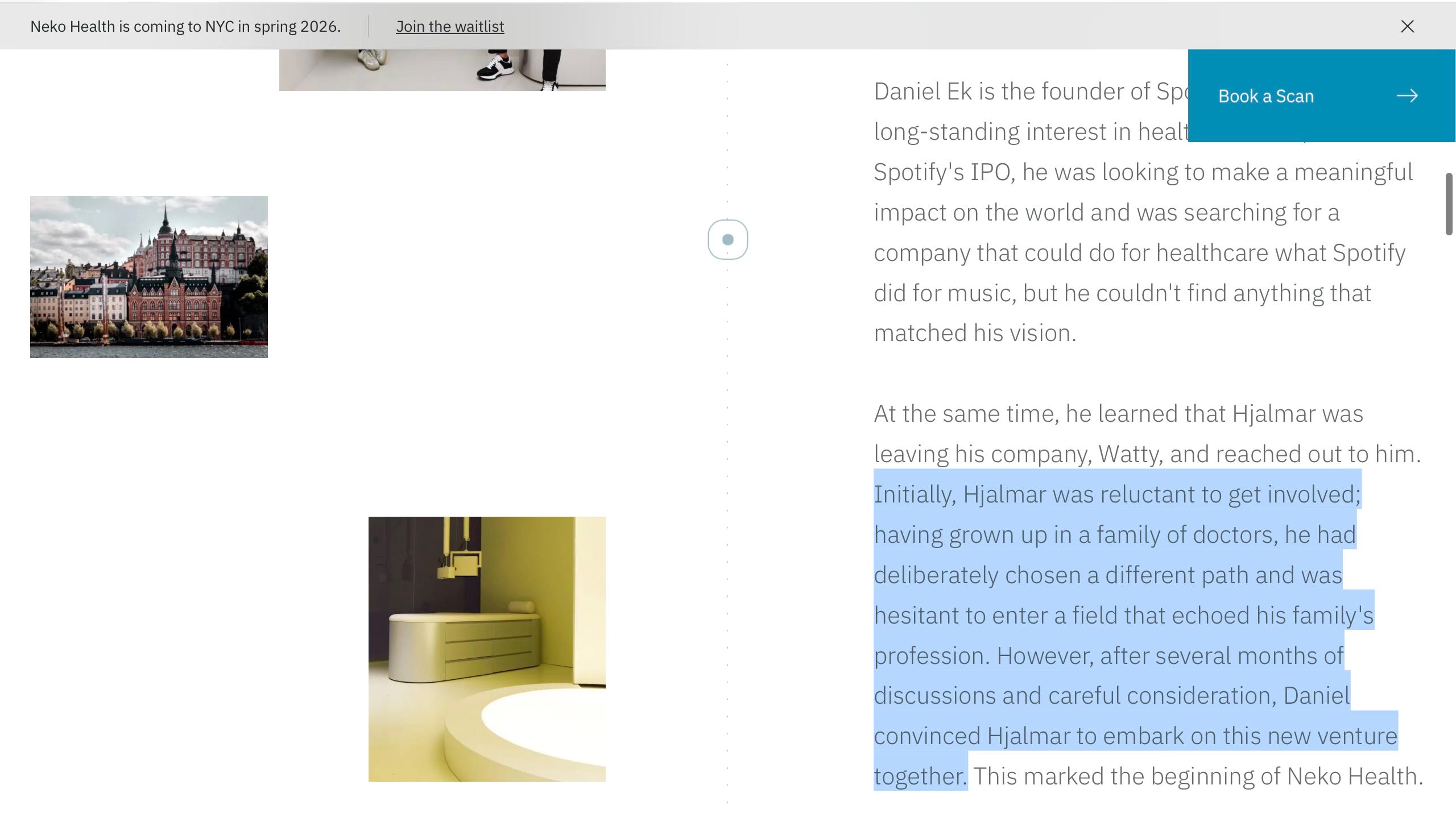
Anyway, Hjalmar grew up in a family of doctors, deliberately chose engineering and climate tech to get as far away from medicine as he could, until Daniel convinced him to join him in the Spotification of healthcare. On the podcast, the story lands. It’s personal, told in his voice, and it ends with him unable to not throw himself at this exciting problem. But the same story on the website reads like he wasn’t even interested in starting the company and reluctantly showed up (Exhibit 1). If I hadn’t heard it from the horse’s mouth before landing on that About page, I’d be skeptical about trusting the company with my health. It may have worked in Sweden where Daniel Ek is the poster boy of success and his name carries the story. In America, the copy has to do that work.
But I’m getting ahead of myself here. I documented my thoughts as I navigated their website for the first time. Where their positioning needs some tweaks here and 180 degree turns there — before they’re ready for the US market.
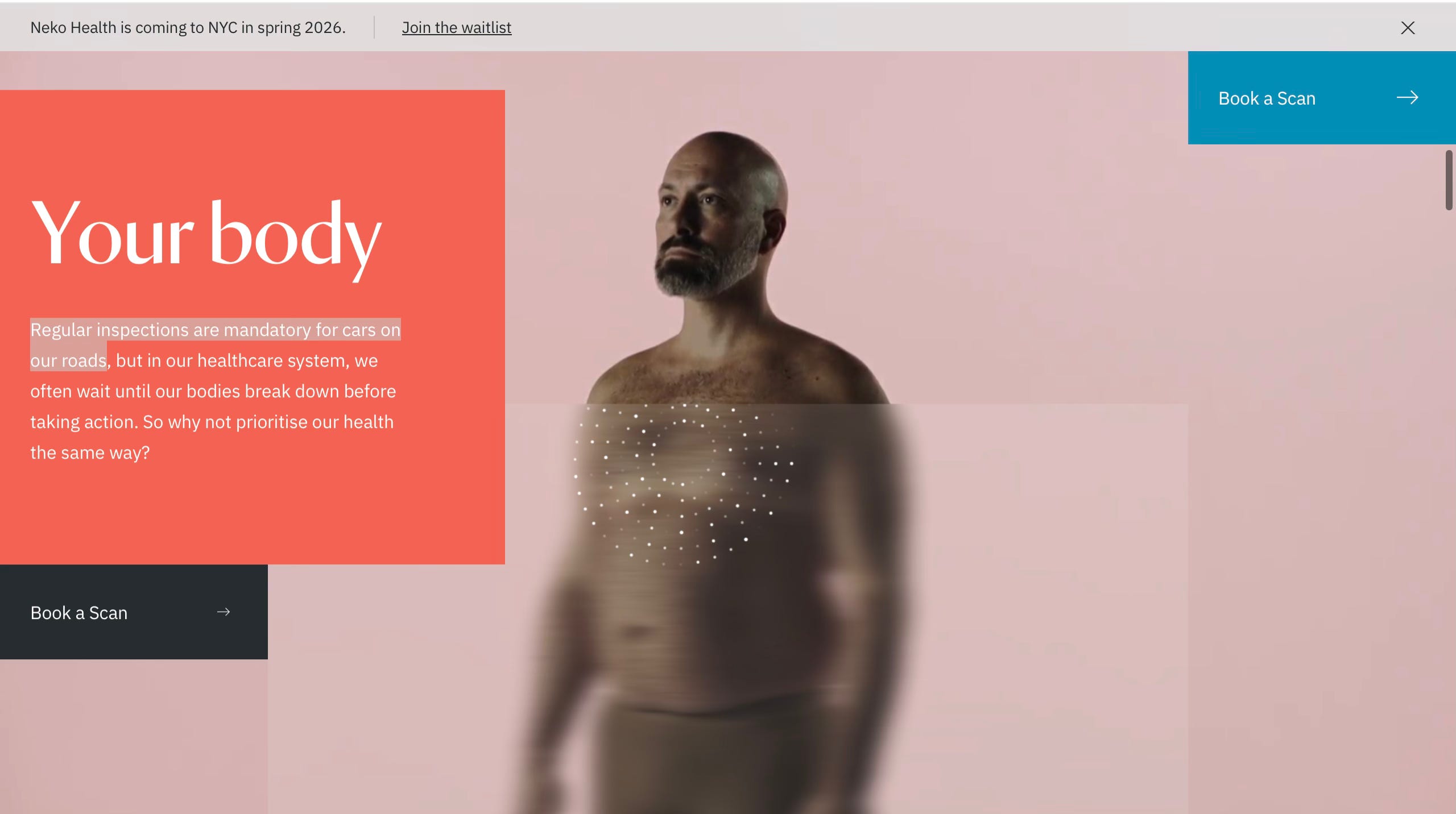
The homepage opens with a clichéd car inspection analogy that’s trying to convince you preventive health is important (Exhibit 2). The American who navigated to Neko’s website already agrees. They obsess over their Oura sleep score. They take more supplements than the number of countries in Europe. They’re already a member with Function. They’re here because they’re deciding where to spend their money. Selling the concept to someone who’s already bought into it is a wasted homepage moment.
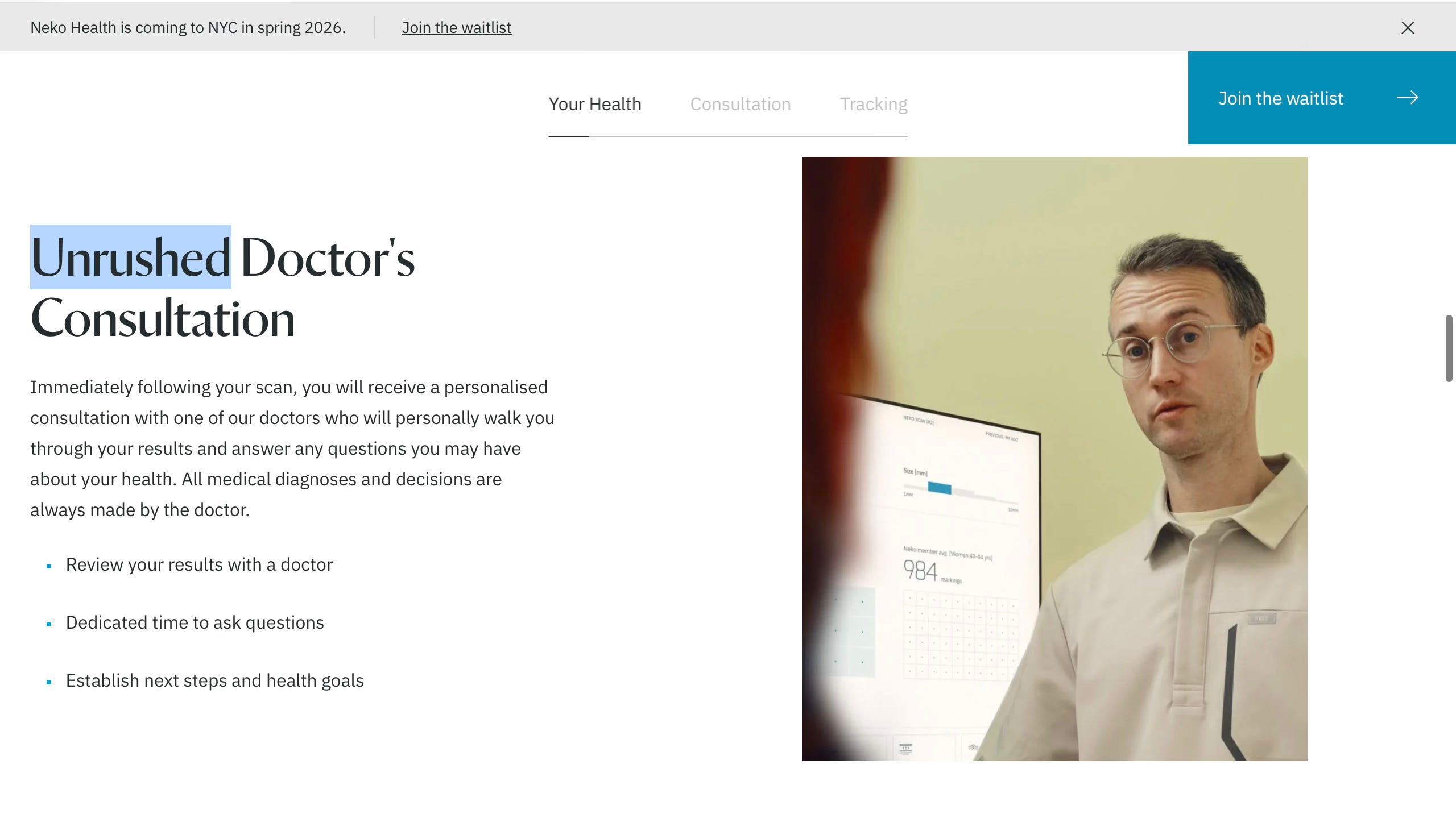
Scroll down and you see “Unrushed Doctor’s Consultation” (Exhibit 3). Hjalmar confirmed on the podcast that each patient gets 20 minutes with a Neko doctor. In the US, a doctor’s outpatient schedule is usually booked in 15-minute slots. Is 5 extra minutes really “unrushed”? What Neko could say is that those 20 minutes are with a doctor who just reviewed your full scan results and is ready for all the questions you will fire at them. As a relatively healthy person in the US healthcare system, the problem with going to a specialist you spent 30 minutes researching and waiting 3 months to get to your appointment day is that you have to first talk to a nurse, their PA / resident, and then you get to hear the doctor dismiss your concerns in 5 minutes. Neko appears to be solving for this. Their positioning just isn’t leaning into their best differentiator.
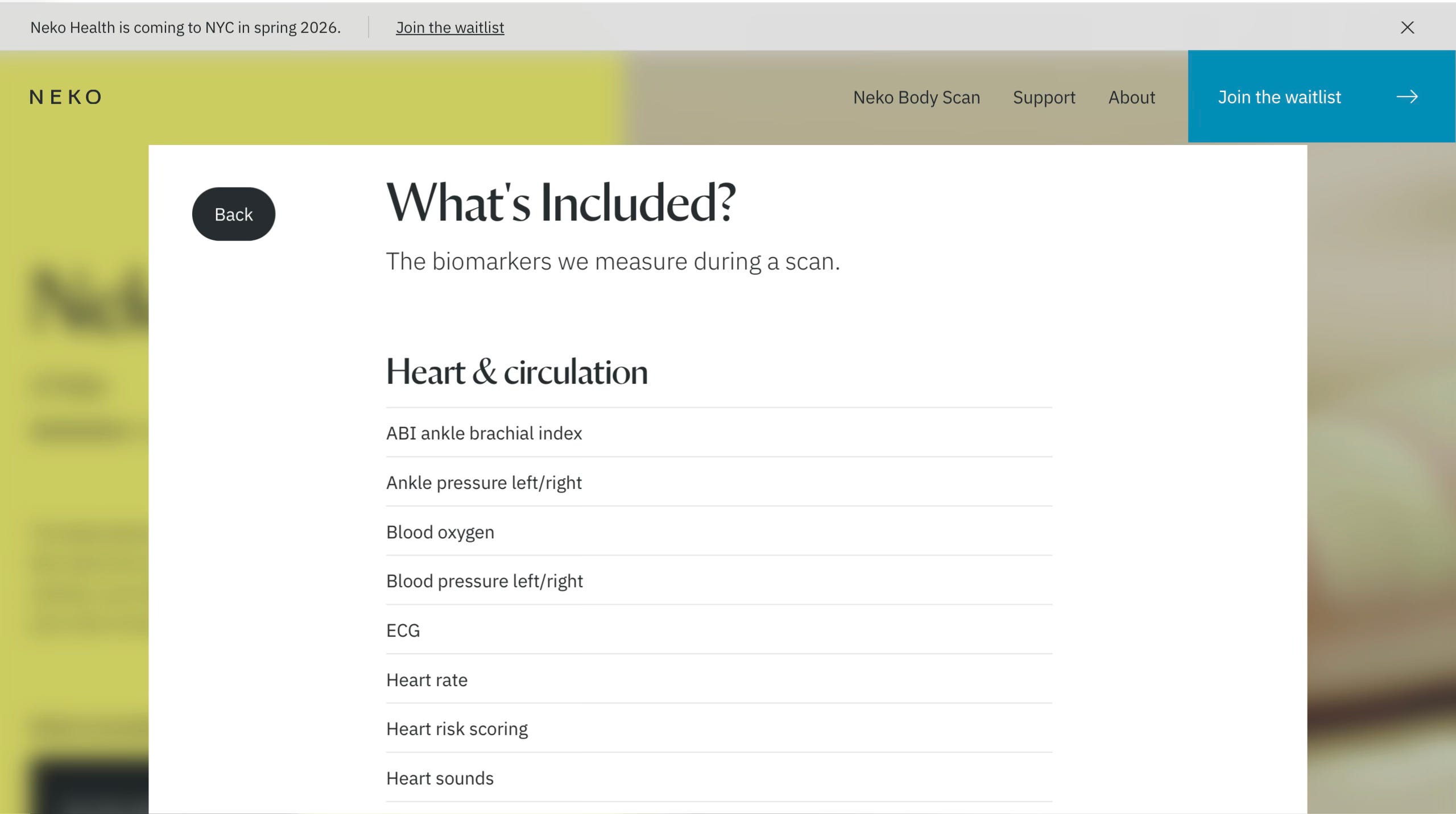
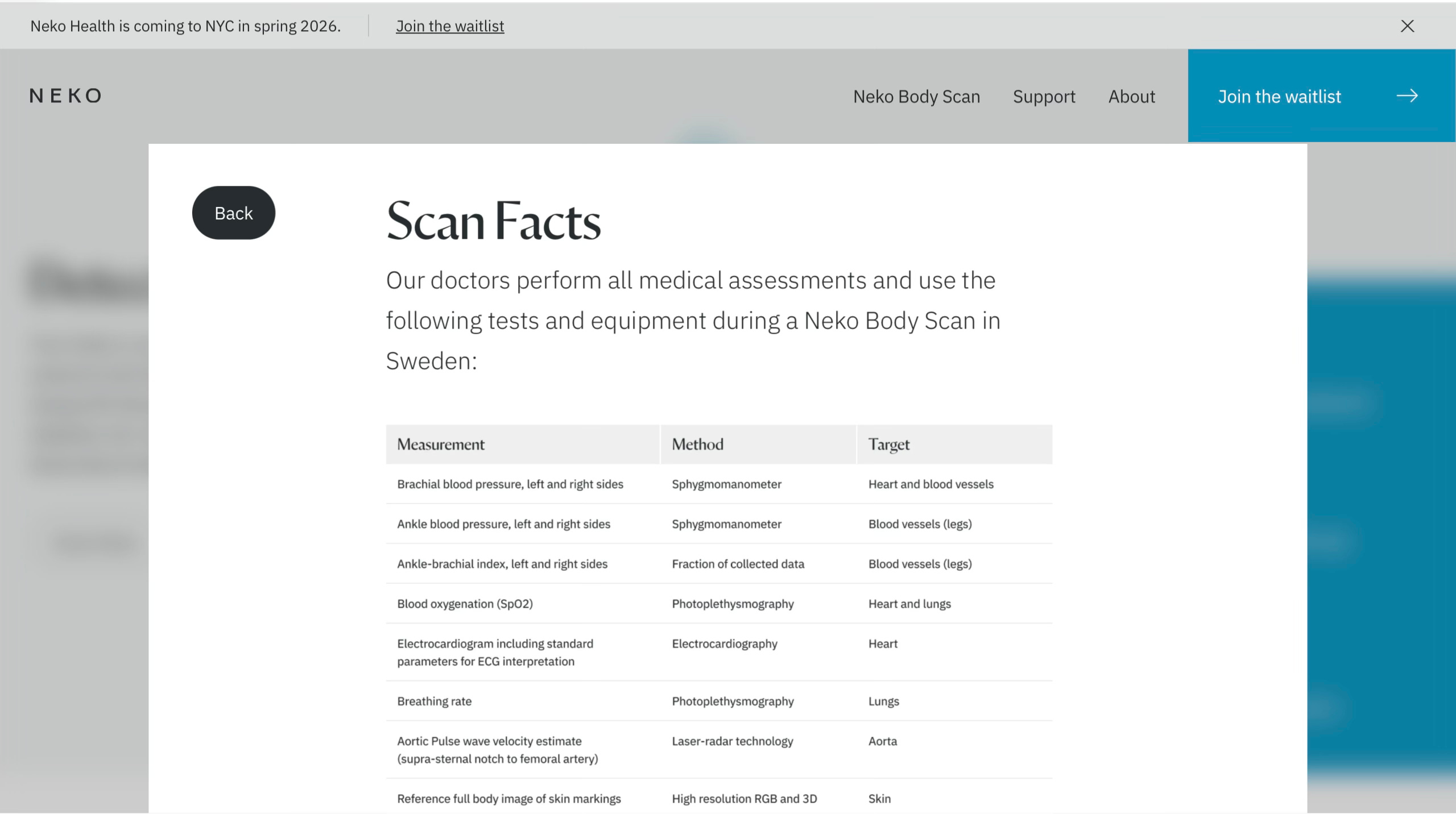
The biggest miss with the website though is that it takes three clicks before I get the answer to what Neko even scans for. And when I do, it’s a raw list — “ABI ankle brachial index”, “heart sounds”, “eosinophils” — with no plain-language explanations (Exhibit 4). What healthcare shoppers are looking for, and what gets cited by AI platforms they turn to with questions, is: what do you offer beyond my annual physical and other cash-pay products I’m considering or already spending my money on? The information architecture jumps from homepage philosophy to spec sheet with nothing in between. It should instead go: here’s what we scan, here’s what that means for you and here’s what you’d miss without it.
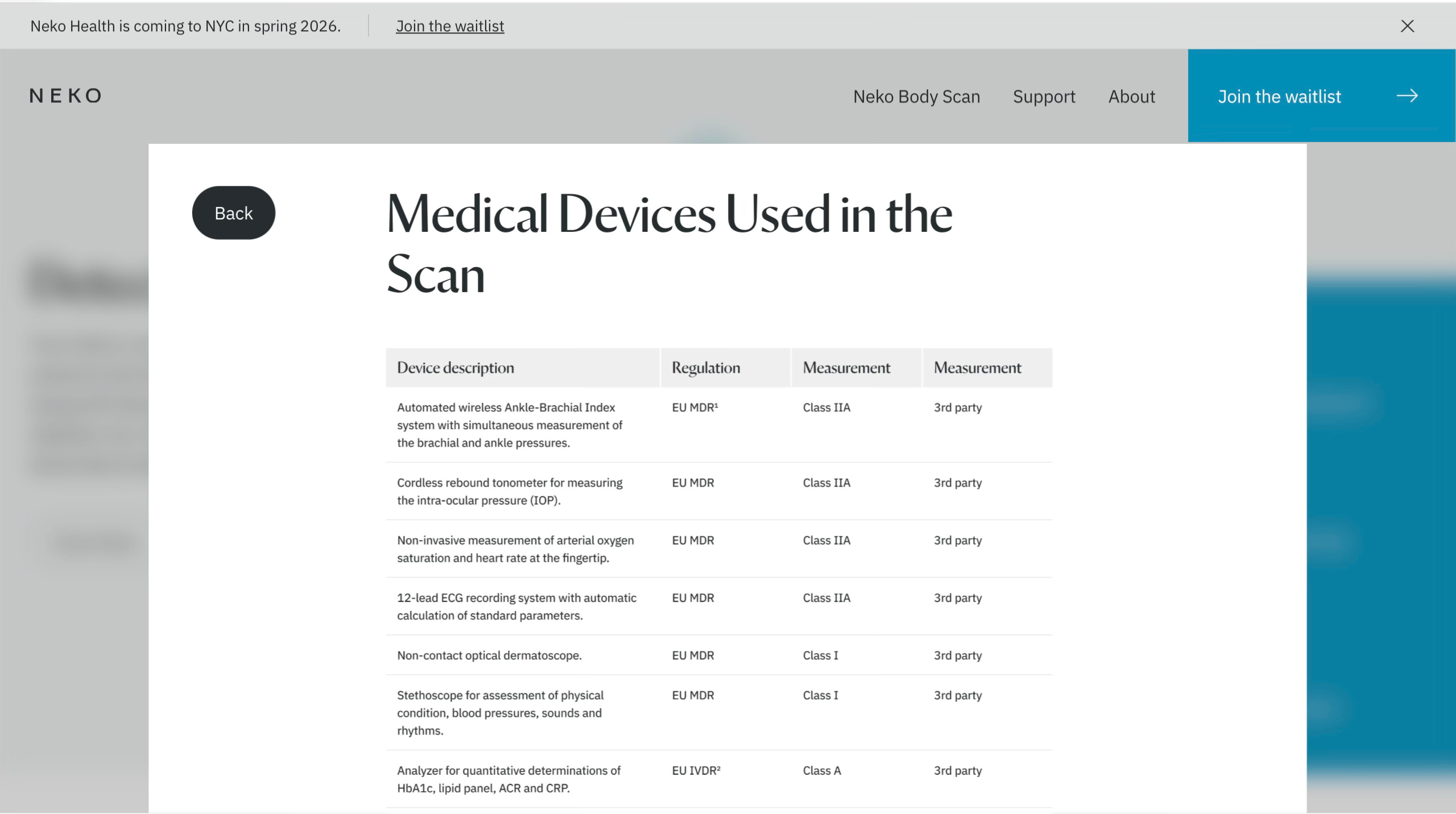
A secondary CTA leads you to nerdy facts about the scans, specifically what instruments are used, what class of medical device they are, and whether they are 3rd party or in-house. That’s a jarring switch from consumer-focused language to medical jargon that would be suitable if Neko was selling to providers. The CEO said on the podcast they had to develop their own instruments to measure certain biomarkers to capture the highest quality data. But on the website copy, it reads as a long list of 3rd party devices with two in-house ones buried at the bottom. I consider myself part of Neko’s ICP and my N=1 data on this whole “what’s included in the scan” section is: cloudy, with the wrong details.
Scroll down on the ‘Book your scan’ CTA page and you see more sections trying to sell you on preventive health. There are several phrases in here that made me raise my eyebrows.
The first value proposition listed for becoming a Neko member is: “you will be helping pioneer the future of health.” (Exhibit 5) Before your own longitudinal health data. Before value to the paying user. In Sweden, that order probably lands — there’s a cultural contract in universal healthcare systems where contributing to collective health is a shared value. In the US, the person paying out of pocket for preventive health has already opted out of the collective system. They want to know what they’re getting first. Then you can pitch the greater good. In my Function Health piece, I made the case for leaning into the greater good as a secondary hook, but it shouldn’t trump buyer value.
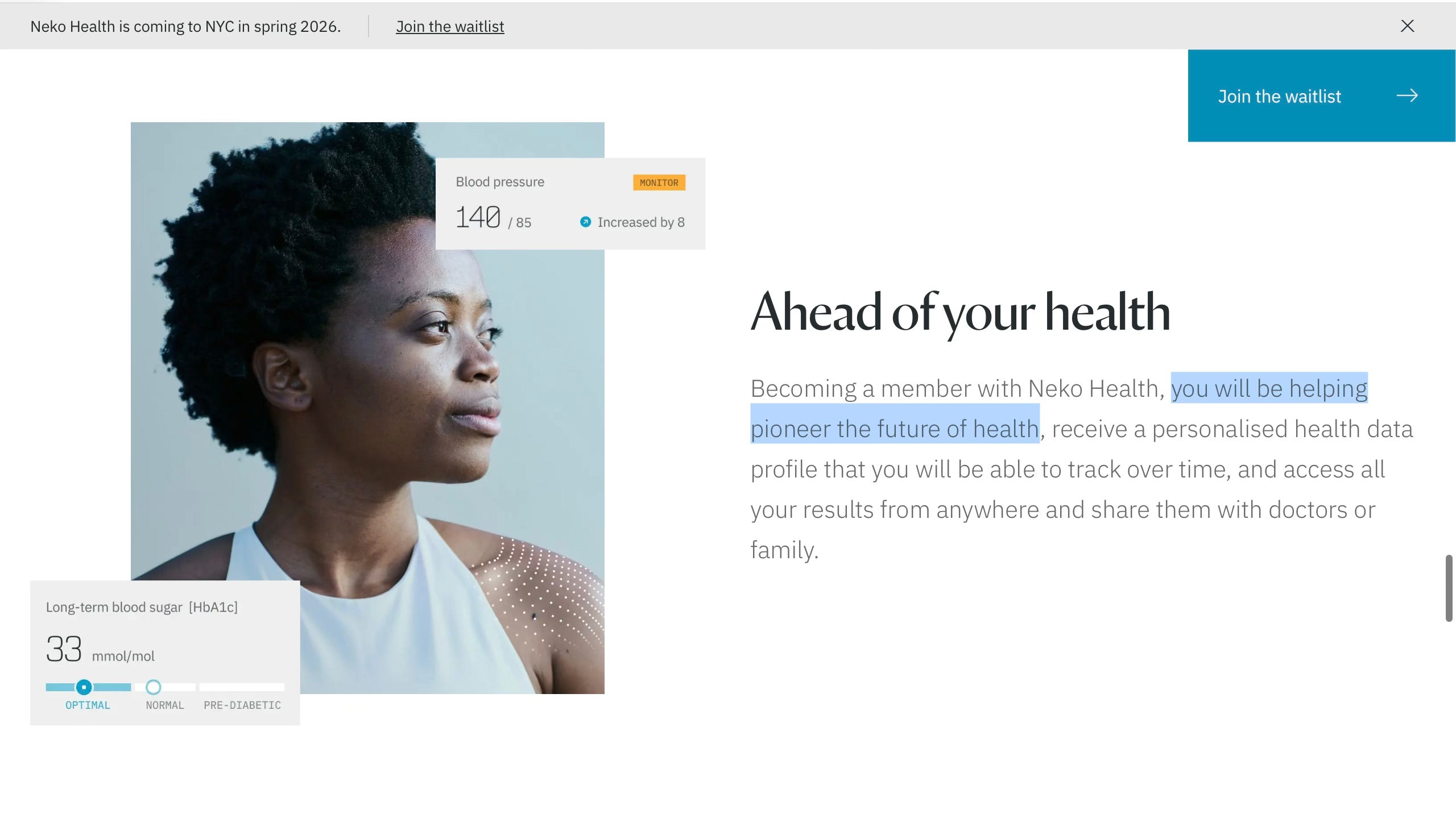
Then there’s the invitation to “share your results with family.” My immediate reaction: why would I want to share my results with my family? If I want to share it with my spouse, I’ll just show it to them on my phone. Aging parents sharing with their adult children is the only use case I can think of, and it’s so niche it doesn’t deserve a headline. In a country where people are acutely aware that health data in the wrong hands can affect insurance coverage, even a harmless feature framed that way triggers a reflex. Who has access?
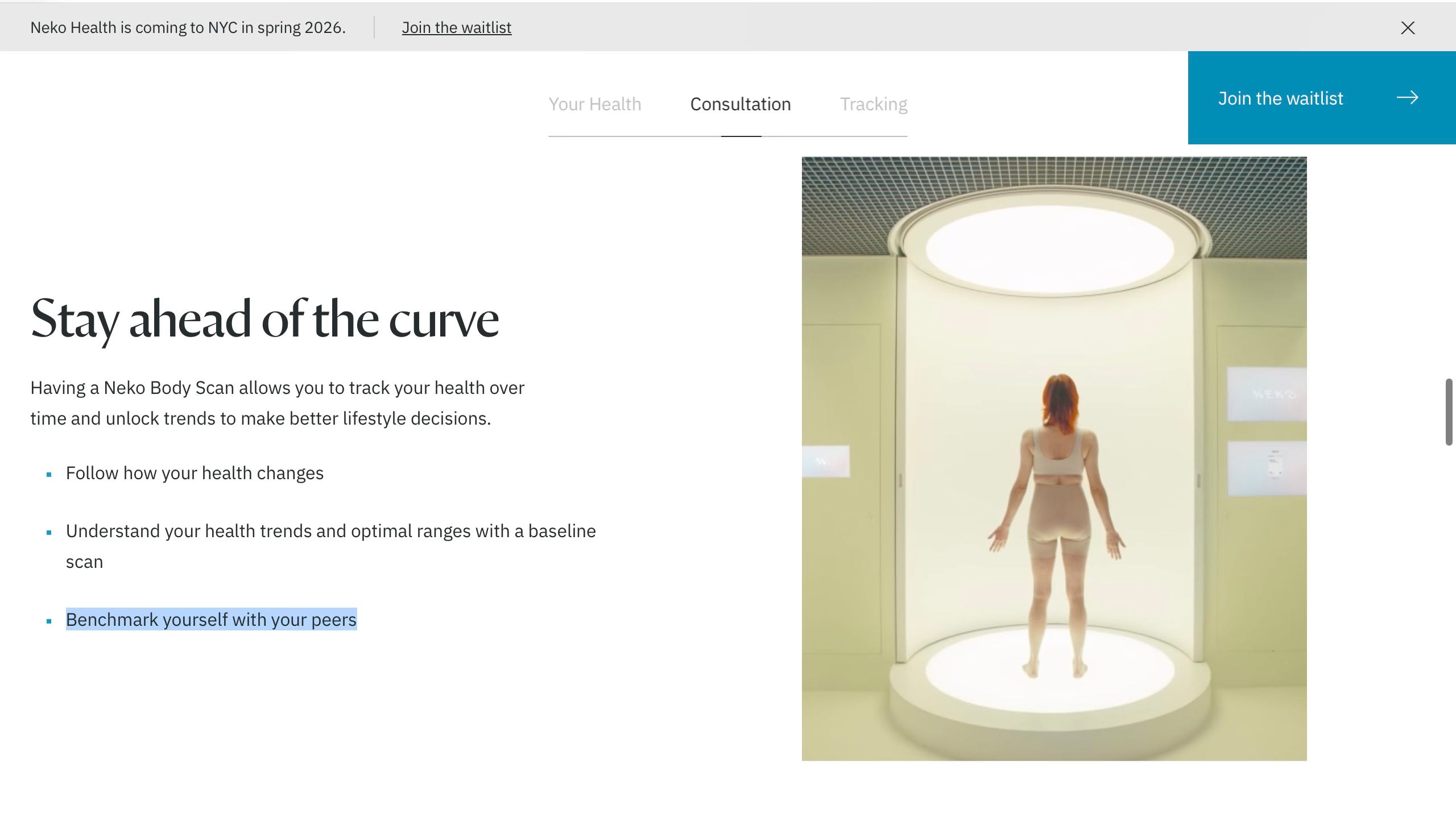
The depiction of the scan experience throughout the website is calm, clinical, Scandinavian in its restraint. Then you hit the tracking section and it tells you to “benchmark yourself with your peers”. (Exhibit 6) Health as a leaderboard feels borrowed from Strava, but in the medical context, it’s a charged framing. Medicine benchmarks you against clinical reference ranges that are age- and sex-adjusted and research-backed, as imperfect as they may be. “Benchmark yourself with your peers” stacks you up against other health-obsessed, cash-paying Neko members. What happens when your peer is younger, genetically luckier, or has simply been doing this three years longer than you? Was this a feature requested by or tested with Neko members, or did this messaging survive because no one in the room questioned it? The scan experience and the tracking product have completely different positioning personalities. One is European-calm-clinical. The other is Silicon Valley-optimize-compete.
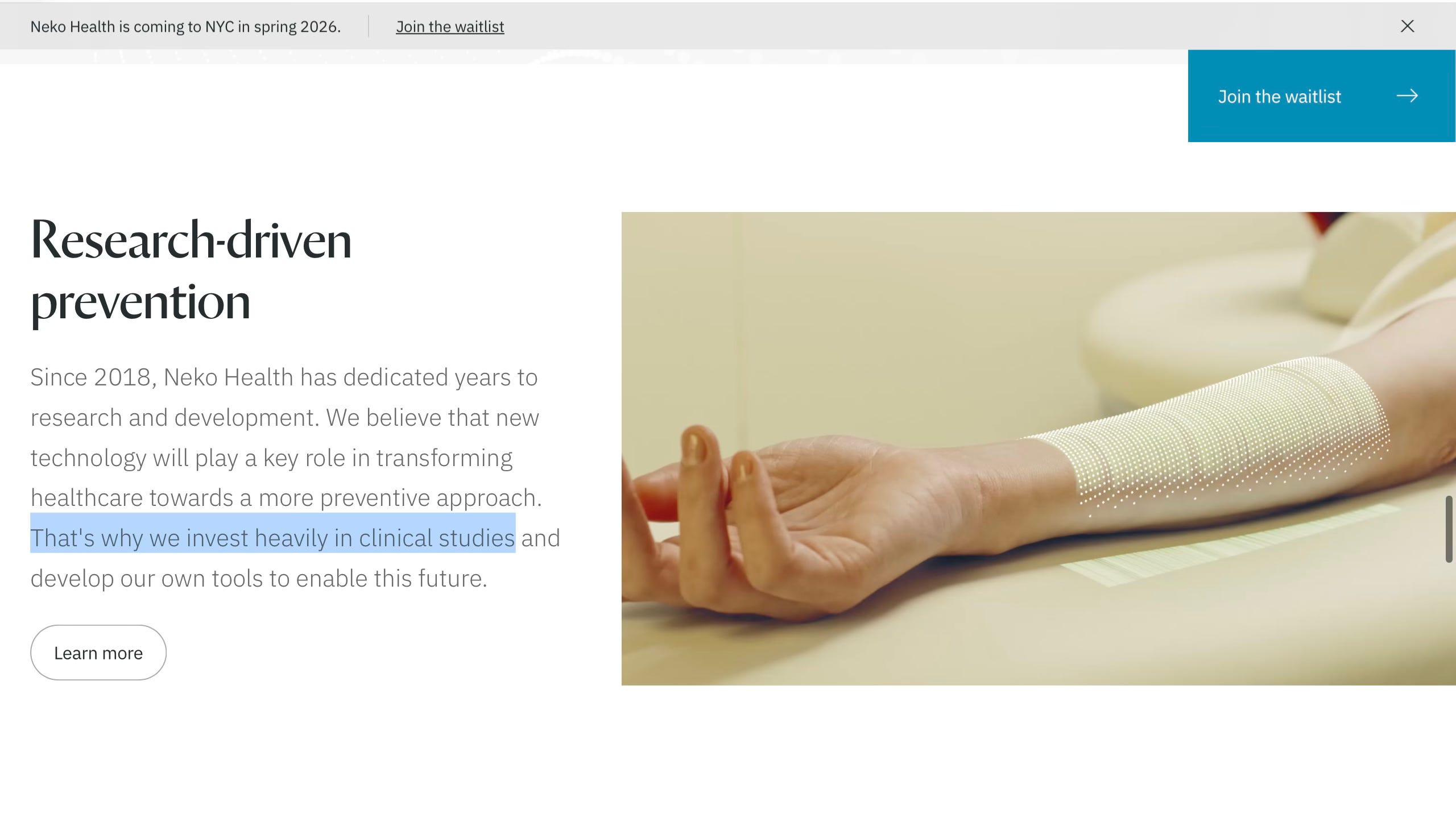
On the podcast, Hjalmar made a point that immediately set Neko apart from the noise: only biomarkers with clinical actionability make the cut. No wellness theater, especially not from someone raised in a family where medical research is highly regarded. Their annual Data Story backs it up — 2,707 people scanned in year one, 1% life-saving findings, 23 severe cardiovascular cases caught in an otherwise healthy population. But you won’t find those numbers within a couple of clicks on the website. Instead you get “research-driven prevention” with no research partners named, no outcome data cited, no publications linked (Exhibit 7). No joke, I navigated to the data story once and couldn’t find it again in the maze (no, it’s not the ‘learn more’ CTA button underneath — I had to Google “neko data story” for the citation above). The clinical credibility exists, just not where it counts.
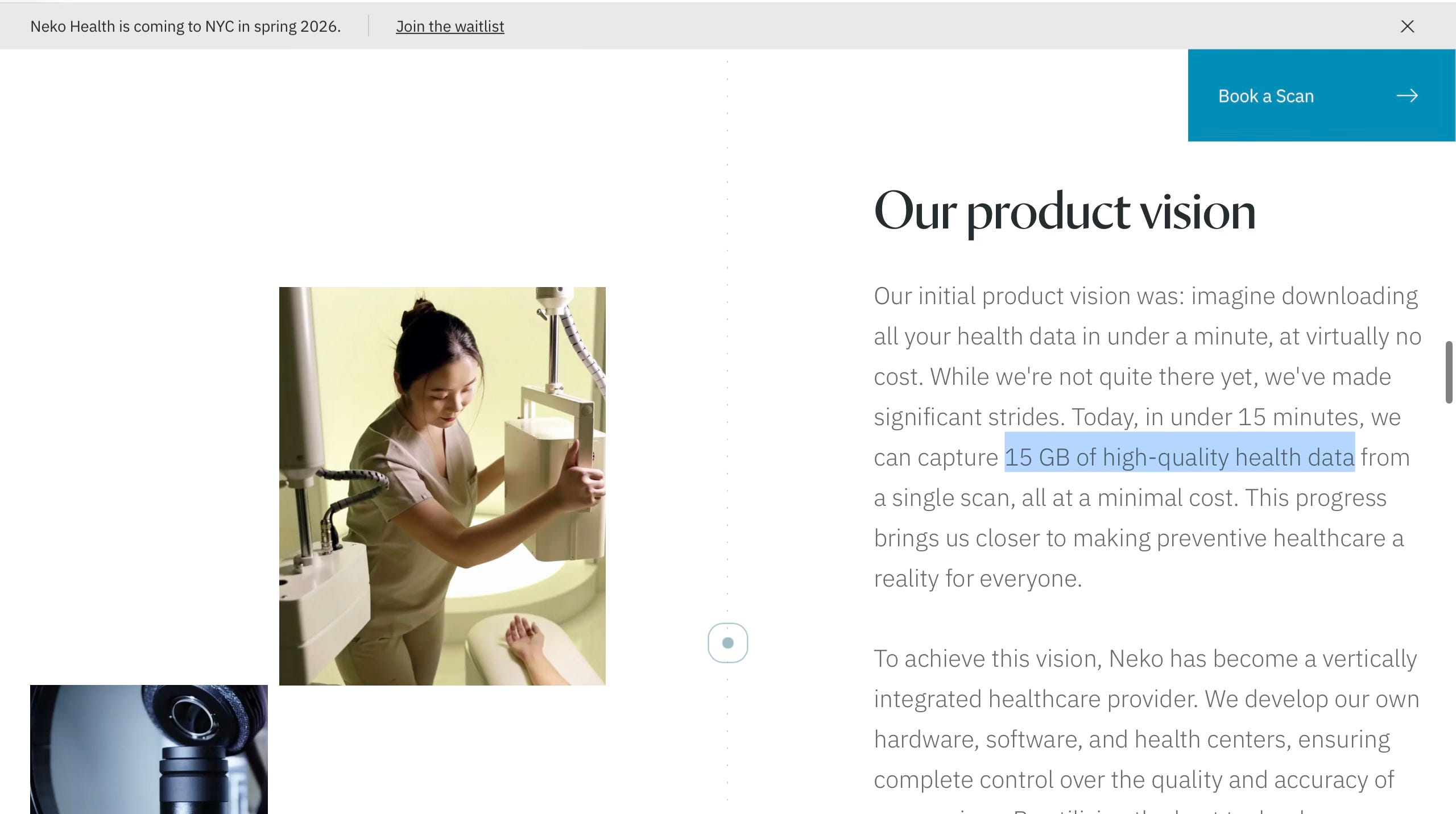
The bigger underlying problem embedded in the website copy is Neko’s worldview clash with healthcare. “15 GB of high-quality health data from a single scan,” they say (Exhibit 8). The inherited tech language raises a question about who they think they’re addressing. Is 15 GB a lot? You have no frame of reference because the website doesn’t tell you what data to expect. The health-savvy American wants to know what risks your scan caught that their PCP would have missed. The metric doesn’t land even for the tech-adjacent early adopter because this isn’t cloud storage. The website was built in the language of the people who envisioned the product. The US market will need it rebuilt in the language of the people who will pay for it.
There are two things the website is doing right, aligned with Hjalmar’s words on the podcast. First, in a market screaming AI from the rooftops, deliberate AI restraint is a differentiator. Second, “all medical decisions are made by the doctor” can be found in several spots in their website copy, which is a trust and philosophy signal.
Neko is coming to America with a product (or rather, an experience, in Daniel’s words) enjoying success across the Atlantic. The US is their biggest cash-pay market and capturing consumers in the crowded preventive health space rides on getting the positioning right at the top of the funnel. Here are the signals I’ll be watching for:
If the US rebooking rate matches Sweden’s 76% within year one, the product translated even if the marketing didn’t.
Waitlist-to-booking conversion in NYC. A high drop-off suggests the positioning didn’t match the pricing.
Timeline to launch in a second US city. Speed of expansion is a proxy for PMF confidence.
No posts
Comments
Nothing yet. Say the first thing.
Sign in to join the conversation.