
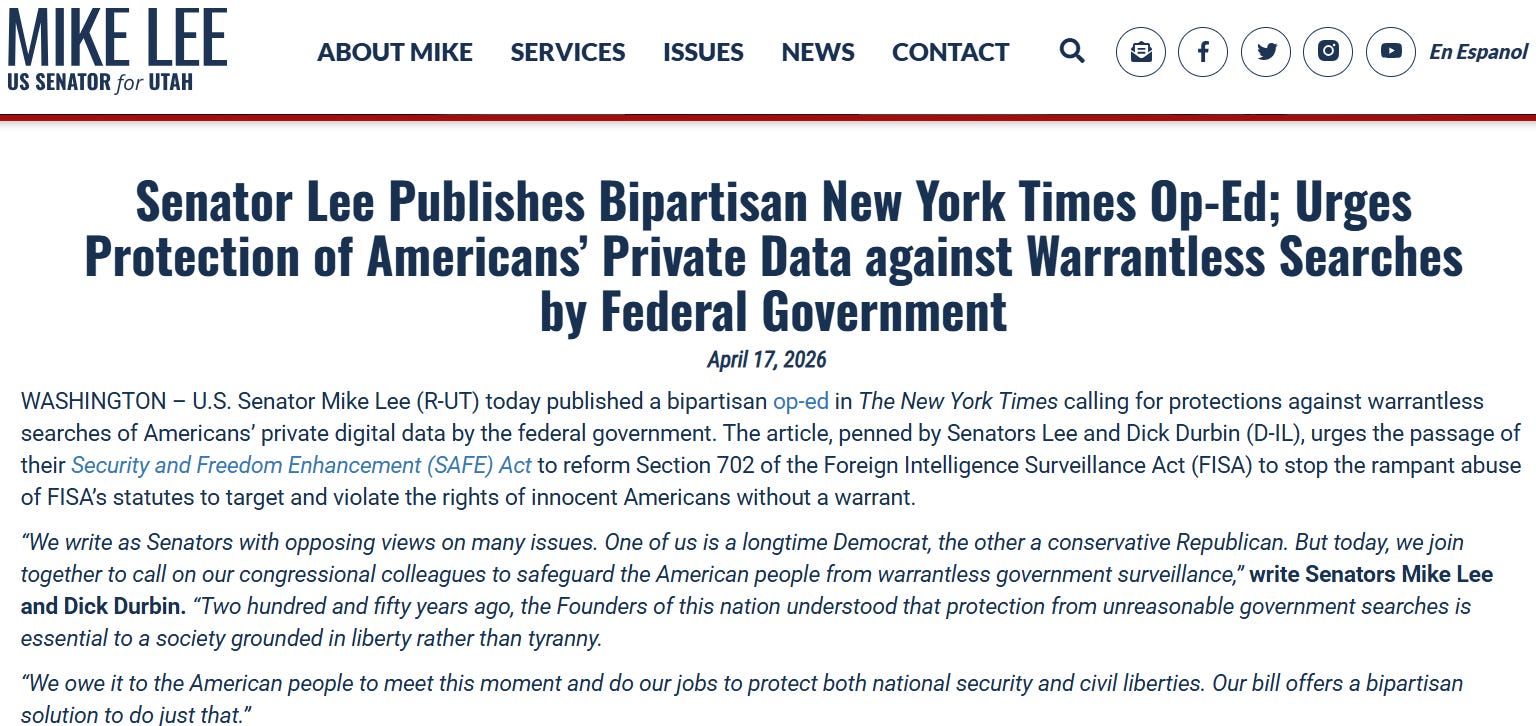
Occasionally principle unites political actors who are usually at odds. An example of such an occasion has been occurring this year among some members of Congress with respect to Section 702 of the Foreign Intelligence Surveillance Act (FISA). Last April, Senators Mike Lee (R-UT) and Dick Durbin (D-IL) explained this in an essay that the New York Times published titled “We Disagree on a Lot. But We Know This Law Must Change.” The phenomenon manifested again on June 5 when seven Republican senators – Josh Hawley, John Kennedy, Mike Lee, Rand Paul, Eric Schmitt, Rick Scott, and Tommy Tuberville – joined all but one Democratic senator (John Fetterman) in voting against reauthorization of Section 702. Similarly, on June 11 nineteen House Republicans joined all but seven of their Democratic colleagues in rejecting reauthorization of Section 702.
Sen. Lee explained his June 5 vote in a social media post as follows: “No warrant to protect Americans? No FISA.” Below, from the New York Times essay that he coauthored with Sen. Durbin, is a fuller explanation.
We disagree on many issues. One of us is a longtime Democrat, the other a conservative Republican. But both of us are deeply concerned about warrantless government surveillance of the American people.
On Friday, Congress passed a brief 10-day extension of Section 702 of the Foreign Intelligence Surveillance Act, which was originally enacted in 2008 to allow the government to gather vital intelligence about foreign governments, terrorists and spies.
The problem is that it has also allowed agencies like the F.B.I. and the National Security Agency to regularly gather and search through the private communications of American citizens without a warrant. That is a clear violation of rights protected by the Constitution.
In their essay, Sens. Lee and Durbin proceeded to summarize documented abuses of Section 702 before discussing reform legislation they jointly introduced, the SAFE Act (S.3893/S.4280):
That’s why the two of us have proposed the Security and Freedom Enhancement (SAFE) Act, a compromise that would reauthorize the valuable core of this tool while enacting reasonable safeguards to protect the Fourth Amendment rights of all Americans.
The government would still be able to check its databases to uncover connections between targeted foreigners and Americans. But it would have to get court approval in the small number of cases in which these searches have generated results and the government has a proper basis for gaining access to the contents of the communications. Importantly, our warrant requirement also contains robust exceptions for legitimate emergencies, so that we can balance civil liberties with legitimate security needs.
Our bill would also cut off another form of warrantless surveillance: the widespread practice of circumventing the Fourth Amendment by purchasing Americans’ sensitive information from data brokers.
As PBS in collaboration with the Associated Press reported, after his June 5 vote Sen. Ron Wyden also spoke of the bipartisan nature of his position:
Sen. Ron Wyden, D-Ore., a longtime critic of the surveillance system, said the bipartisan vote was proof that “reform efforts transcend red and blue.”
“It’s a message that Americans aren’t going to stand for law-abiding people being spied on,” Wyden told The Associated Press.
Wyden is a co-sponsor of the SAFE Act, and along with Lee and Republican Sen. Cynthia Lummis he also introduced the Government Surveillance Reform Act of 2026 (S.4082). Democratic Rep. Zoe Lofgren and Republican Rep. Warren Davidson introduced an identical companion bill in the House (H.R.7901). The text below is from Rep. Davidson’s March 12 press release about this legislation (emphasis in original):
Today, March 12, 2026, U.S. Representatives Warren Davidson (R-OH-08) and Zoe Lofgren (D-CA-18), along with U.S. Senators Ron Wyden (D-OR) and Mike Lee (R-UT), introduced the Government Surveillance Reform Act, a bipartisan and bicameral bill to reauthorize and reform Section 702 of the Foreign Intelligence Surveillance Act (FISA) and enact sweeping reforms to protect Americans’ constitutional right to privacy.
[...]
“FISA Section 702 has been stretched far beyond its original purpose and now enables unconstitutional warrantless searches of American citizens and their private communications,” said Congressman Warren Davidson. “The bipartisan Government Surveillance Reform Act counters these abuses by requiring a warrant to search Americans’ data and by closing the data broker loophole that allows the federal government to spy on citizens by purchasing private data that would otherwise require a warrant or subpoena.”
“Advances in technology, from AI to the explosion of Americans’ data available for purchase, have far outpaced the laws protecting Americans’ privacy and civil liberties,” Senator Wyden said. “I’m proud to introduce this bipartisan bill as a leader of the Ben Franklin caucus, which stands for the proposition that liberty and security aren’t mutually exclusive.”
“It is imperative that Congress enact real reforms to protect our civil liberties, including warrant requirements and statutory penalties for privacy violations, in exchange for reauthorizing Section 702,” said Senator Mike Lee. “Our bipartisan Government Surveillance Reform Act stops illegal government spying and restores the Constitutional rights of all Americans.”
“Now more than ever, unchecked government access to Americans’ personal information threatens their privacy, their civil liberties, and our democracy,” said Rep. Zoe Lofgren. “Congress should not reauthorize broad domestic surveillance authorities without putting meaningful safeguards in place. The bipartisan, bicameral Government Surveillance Reform Act offers a comprehensive and balanced solution that would prevent abuse of Americans’ personal information while preserving essential national security tools that keep our country safe.”
I have presented all of this evidence of bipartisan agreement about the need to reform Section 702 as background to partisan attacks upon Democrats for their role in blocking reauthorization of Section 702, which after a brief extension enacted earlier this year was set to (and did) expire on June 12. Here is Senate Majority Leader John Thune on June 9:
“Mr. President, without Democrat cooperation, in four days the Section 702 program will go dark.
“America’s enemies, however, will not – will not – go dark.
“They will continue working against the United States, whether that’s conducting cyberattacks, planning terrorist activity, or trafficking fentanyl and other deadly drugs into our country.
“The only difference is that our intelligence agencies will have a greatly reduced capacity to discover these activities.
“Mr. President, I hope my Democrat colleagues will rethink their decision to hold the 702 program hostage before we all have cause to regret the consequences.”
In a June 18 Fox News interview, Sen. Katie Britt (R-AL) was less cordial than Thune:
“So first off, let’s go back to the fact that the reason that FISA has expired is because of Democrats. Democrats played politics with people’s lives. Here we have the World Cup, Dana, across our nation, where we’re hosting all of these events and people. And yet Democrats decided that they were going to play politics and shut down the eyes of our intelligence community. That is 100% on them …
In fact, as NPR reported, the formal expiration of Section 702 does not mean that the program has gone dark:
Intelligence collection under FISA’s Section 702 is authorized annually by a federal court — and the law allows for that collection to continue for the duration of the court’s authorization, even if the law lapses before the court’s next approval. That means companies — electronic communications service providers, in this context — will still be legally required to turn over material to intelligence agencies.
[...]
Elizabeth Goitein, a privacy rights advocate and senior director of the Brennan Center’s Liberty and National Security Program, says the FISA law is clear that companies must continue to comply with the government’s collection requests even after lapse — and that existing case law means any challenges will be sorted quickly. Companies risk a fine of $250,000 per day by not complying.
On April 30, the libertarian Cato Institute devoted an entire post to “The FISA Section 702 Lapse ‘Going Dark’ Myth.”
As NPR also reported, the president bolstered opposition to Section 702 reauthorization when he appointed Bill Pulte to serve as acting Director of National Intelligence (DNI), a move that even Sen. Thune opposes (emphasis added).
In the weeks leading up to the June 12 expiration, it appeared there was movement toward a three-year extension with moderate reforms, though stopping short of a warrant requirement. While any deal was far from certain, there were signs of progress.
Then, things fell apart when, last week, President Trump nominated Bill Pulte to serve as acting director of national intelligence. As director of the Federal Housing Finance Agency, Pulte is known for leveraging his post and large social media audience to attack the president’s perceived foes.
[...]
Democrats — even those most closely aligned with the intelligence community — immediately decried the appointment and said they would not reauthorize Section 702 while Pulte was Trump’s pick, over concerns that Pulte would weaponize FISA information as well as the rest of the U.S. intelligence apparatus.
[...]
Even Republican leaders expressed worries. “We don’t need a weaponized DNI,” Senate Majority Leader John Thune, R-S.D., told reporters last week. “We need professionals there.”
The page on the Office of the Director of National Intelligence (ODNI) website dedicated to Section 702 makes clear the potential danger (emphasis added):
Section 702 of the Foreign Intelligence Surveillance Act is a critical intelligence collection authority that enables the U.S. Intelligence Community to collect, analyze, and appropriately share foreign intelligence information, as identified by the Attorney General and the Director of National Intelligence, such as information concerning international terrorism or the acquisition of weapons of mass destruction. For more information, see resources below:
One of the indicated resources is a document titled “Overseeing Section 702: Multi-layered Oversight to Protect Privacy and Civil Liberties.” The document speaks of the responsibility of the Attorney General and the DNI to oversee Section 702 – which is not at all reassuring given the past conduct of acting Attorney General Todd Blanche, much less that of Pulte in his (continuing) role as Director of the Federal Housing Finance Agency. The document does not mention another layer, one that the president eviscerated during his first month in office: the Privacy and Civil Liberties Oversight Board (PCLOB). In a January 31, 2025 letter to Congressional leaders of both parties (see here for the letter and here for a post about it), the Brennan Center and other members of a technology and civil liberties coalition objected to the president having illegally and without cause removed the Democratic members of the PCLOB and left in place only a Republican member, Beth Williams.
As Nextgov/FCW noted in an April 2 post titled “Single-member surveillance watchdog backs 702 powers, raising independence questions,” without a quorum to authorize a board opinion, the staff of the PCLOB went ahead and issued a report that urged reauthorization of Section 702 without any reforms. Nextgov/FCW quoted objections from civil liberties advocates:
“The board was designed to be multi-member and an independent institution,” said Kia Hamadanchy, senior policy counsel at the American Civil Liberties Union. “This is neither, given the PCLOB was gutted by the Trump administration. The report is a product of a single member hostile to civil liberties concerns who above all else prioritizes supporting the administration and intelligence community. It should not be taken seriously.”
“This is not a real PCLOB report, it’s a BethCLOB report,” said Jake Laperruque, deputy director of the Center for Democracy and Technology’s Security and Surveillance Project, referring to Williams as the sole member of the panel. “The basic concept of the board was a multi-member and an independent institution; this is neither.
Toward the conclusion of the Nextgov/FCW post are quotes from Sen. Wyden with which his Republican original co-sponsors of Section 702 reform legislation ought in principle to agree:
“Donald Trump illegally fired members of the Privacy and Civil Liberties Oversight Board — now the only board member left is a former Trump appointee,” said Sen. Ron Wyden, D-Ore., a longtime privacy advocate who sits on the Senate Intelligence Committee. Williams served in the Justice Department as Assistant Attorney General for the Office of Legal Policy in Trump’s first term.
“She just put out a report that says Trump needs to do more warrantless spying on Americans,” Wyden added. “No one should fall for it.”
A PCLOB spokesperson said the board “continues to produce professional staff reports under agency sub-quorum rules adopted by the quorate board in October 2024.”
We can all do a better job of resisting politicized messaging that misrepresents important issues.
No posts
Comments
Nothing yet. Say the first thing.
Sign in to join the conversation.